
Ask questions, doubts, problems and we will help you..
Ask questions which are clear, concise and easy to understand.
Ask Question
CBSE, JEE, NEET, CUET
Question Bank, Mock Tests, Exam Papers
NCERT Solutions, Sample Papers, Notes, Videos
Posted by Tidke Pranav 5 years, 2 months ago (9833468)
- 1 answers
Posted by Anshu Tb 5 years, 2 months ago (9403739)
- 1 answers
A S 5 years, 2 months ago (7735353)
Posted by Niharika Kumari 5 years, 2 months ago (5478465)
- 0 answers
Posted by Iniya Gnanasekaran 5 years, 2 months ago (9768171)
- 1 answers
Posted by Yash Hardeep 5 years, 2 months ago (9936661)
- 2 answers
Yash Hardeep 3 years, 11 months ago (9936661)
Gaurav Seth 5 years, 2 months ago (2898529)
he earth is called a unique planet because:
- It is the only planet which has favorable conditions that support life. It is neither too hot nor too cold.
- It has water and air, which are very essential for our survival.
- The air has life-supporting gases like oxygen.
Posted by Manav Sharma 5 years, 2 months ago (9207923)
- 0 answers

Posted by Manav Sharma 5 years, 2 months ago (9207923)
- 0 answers
Posted by Kavin Kavin 5 years, 2 months ago (9102311)
- 1 answers
Gaurav Seth 5 years, 2 months ago (2898529)
We know that the line drawn from the centre of the circle to the tangent is perpendicular to the tangent.
∴OP ⊥ PQ
By applying Pythagoras theorem in ΔOPQ,
∴OP2 + PQ2 = OQ2
52 + PQ2 =122
PQ2 =144 − 25
PQ = underroot 119
Hence, the correct answer is underroot 119 cm test.
Posted by Manav Sharma 5 years, 2 months ago (9207923)
- 1 answers
Yogita Ingle 5 years, 2 months ago (2577571)
Agriculture was the main occupation of the people of the Chinese civilisation. Crops grown included rice, wheat, millet, barley and soya bean. Tea was also grown for the first time by the Chinese. In the beginning, tea was cultivated for exclusively medicinal purposes. It was only later that it was grown for beverage use. An elaborate irrigation system was put in place in order to ensure surplus food production. This reinforced the growth of the Chinese civilisation.
Posted by Manav Sharma 5 years, 2 months ago (9207923)
- 1 answers
Meghna Thapar 5 years, 2 months ago (6237)
As of 2019, GDP of India is around of 10 times greater than Pakistan. In nominal terms gap is wider (above 10 times) than ppp terms (below 10 times). India is 5th largest country of the world in nominal method and 3rd largest economy in ppp method. Nominal ranking of Pakistan is 43 and PPP ranking is 25. India's economically largest states Maharashtra has GDP ($334 billion) greater than Pakistan. Margin between these two countries was lowest in 1993 when Nominal GDP of India was 5.43x of Pakistan and highest was in 1973 (13.53x).
Both countries together share 9.78% and 18.15% of total Asia's GDP.
Both countries has been neck-to-neck in gdp per capita terms. Margin is being wider in favour of India since 2009. In 2019, per capita income of India would be 1.62 times all time higher than Pakistan on exchange rate basis. 2006 is the previous year when Pakistan was more richer than India. Both nations are at very lower position in World GDP per capita ranking. rank of India is 145 (nominal) and 126 (PPP). World rank of Pakistan is 156 (nominal) and 140 (PPP). Out of 33 Indian states/UTs, 28 states/UTs are more richer than Pakistan.
India attains maximum gdp growth rate of 9.63% in year 1988 and minimum -5.24% in 1979. Pakistan reached an all time high of 10.35% in 1970 and a record low of 0.47% in 1971. During period 1961 to 2017, Pakistan grew by more than 10% in 3 years while India never. GDP growth rate was negative in four years for India, but Pakistan has never showed negative growth rate.
According to CIA Fackbook sector wise GDP composition of India in 2017 are as follows : Agriculture (15.4%), Industry (23%) and Services (61.5%). Sector wise GDP composition of Pakistan in 2017 are : Agriculture (24.7%), Industry (19.1%) and Services (56.3%).
Posted by Tushar Himmatramka 5 years, 2 months ago (8630020)
- 2 answers
Justin Bieber 5 years, 2 months ago (9937765)
Gaurav Seth 5 years, 2 months ago (2898529)
- Prehistory: Time period in the past when there was no paper or the written word and hence no books or written accounts of events. Information about such an age is obtained from excavations which reveal paintings, pottery, habitat, etc.
- Drawings and paintings were the oldest form of artistic expression practised by humans. Reasons for such drawings: Either to decorate their homes or/and to keep a journal of events in their lives.
- Lower and Middle Palaeolithic Periods have not shown any evidence of artworks so far. The Upper Palaeolithic Age shows a lot of artistic activities.
- Earliest paintings in India are from the Upper Palaeolithic Age.
- The first discovery of rock paintings in the world was made in India by archaeologist Archibald Carlleyle in 1867 – 68 (in Sohagighat, Mirzapur District, Uttar Pradesh).
- Rock paintings have been found in the walls of caves at Madhya Pradesh, Andhra Pradesh, Uttar Pradesh, Bihar and Karnataka, some in the Kumaon Hills of Uttarakhand.
- Paintings at the rock shelters at Lakhudiyar on the banks of the Suyal River (Uttarakhand) –
- 3 categories of paintings: man, animal and geometric patterns in black, white and red ochre.
- Humans in stick-like forms, a long-snouted animal, a fox, a multiple-legged lizard, wavy lines, groups of dots and rectangle-filled geometric designs, hand-linked dancing humans.
- Paintings in Kupgallu (Telangana), Piklihal and Tekkalkota (both in Karnataka)
- Mostly in white and red ochre.
- Subjects are bulls, sambhars, elephants, sheep, gazelles, goats, horses, stylised humans and tridents.
- Paintings in the Vindhya ranges at Madhya Pradesh extending into Uttar Pradesh –
- About 500 rock shelters at Bhimbetka in the Vindhya Hills at Madhya Pradesh.
- Images of hunting, dancing, music, elephant and horse riders, honey collection, animal fighting, decoration of bodies, household scenes, etc.
- Bhimbetka drawings can be categorised into 7 Periods.
- Period I: Upper Palaeolithic
- Period II: Mesolithic
- Period III: Chalcolithic
- Two major sites of prehistoric rock/cave paintings in India: Bhimbetka Caves and Jogimara Caves (Amarnath, Madhya Pradesh).
Posted by Manav Sharma 5 years, 2 months ago (9207923)
- 1 answers
Gaurav Seth 5 years, 2 months ago (2898529)
Starting 1978, several reforms were introduced in phases in China. First, agriculture, foreign trade and investment sectors were taken up. Commune lands were divided into small plots. These were allotted to individual households for cultivation.
The reforms were expanded to industrial sector. Private firms were allowed to set up manufacturing units. Also, local collectives or cooperatives could produce goods. This meant competition between the newly sanctioned private sector and the old state-owned enterprises.
This kind of reform in China brought in the necessity of dual pricing. This meant the farmers and industrial units were to buy and sell fixed quantities of raw material and products on the basis of prices fixed by the government. As production increased, the material transacted through the open market also rose in quantity. Special Economic Zones (SEZs) were set up in China to attract foreign investors.
Posted by Manav Sharma 5 years, 2 months ago (9207923)
- 1 answers
Gaurav Seth 5 years, 2 months ago (2898529)
Like the development path of India, Pakistan also followed the import substitution strategy. This was achieved through tariff and other trade barriers that restricted foreign competition. The motive was to make foreign products expensive relative to domestic ones, thereby giving a thrust to domestic industries.
Pakistan follows a mixed economy system, where the public and private sectors co-exist. The green revolution was aimed to increase domestic food grain production in Pakistan. Until the 1970s, domestic industries were given priority. In the 1980s, importance was given to the private sector. New investment was invited and the economy opened up to the rest of the world.
Both India and Pakistan have benefited from a mixed economic system, in that they have been able to maintain high economic growth rates despite high rates of growth of population. The countries have been able to develop a service sector and have used technology increasingly in their production processes. Poverty remains to plague their economies, however. Unemployment is a major concern in India and Pakistan, as the working population is on the rise and commensurate jobs are less in number.
Posted by Anjila Grg 5 years, 2 months ago (9936654)
- 5 answers
Posted by Khushi Bhullar 5 years, 2 months ago (5535721)
- 1 answers
Gaurav Seth 5 years, 2 months ago (2898529)
India faced the following three challenges at the time of independence in 1947 :
(i) The first challenge was to shape a nation that was united, yet accommodative of the diversity in our society. India was a land of continental size and diversity. Its people spoke different languages and followed different culture and religions. At that time it aws widely believed that a country full of such kinds of diversity could not remain together for long.
(ii) The second challenge was to establish democracy. The Constitution had granted fundamental rights and extended right to vote to every citizen. India adopted Representative democracy based on the parliamentary form of goverment.The challenge was to develop democratic practices in accordance with the Constitution.
(iii) The third challenge was to ensure the development and well-being of the entire society and not only of some sections. The Constitution had adopted the principle of equality and provided special protection to socially disadvantaged groups and religious and cultural communities. The real challenge was to evolve effective policies for economic development and eradication of poverty.
Posted by Kamalnayan Shukla 5 years, 2 months ago (9052073)
- 1 answers
Meghna Thapar 5 years, 2 months ago (6237)
A chemical substance is a form of matter having constant chemical composition and characteristic properties. Some references add that chemical substance cannot be separated into its constituent elements by physical separation methods, i.e., without breaking chemical bonds. A chemical by definition is any substance consisting of matter; this includes solids, liquids, and gas. Chemicals can either be of a pure substance or a mixture of substances. A chemical substance such as water (H2O) is a pure chemical because it has the same molecules and combination throughout its structure.
Posted by Rashi Gaur 5 years, 2 months ago (3952688)
- 4 answers
Sona Lika 5 years, 2 months ago (9882140)
Posted by Aditya Singh 5 years, 2 months ago (9936579)
- 5 answers
Muskan Samanta 5 years, 2 months ago (9933653)
Radhika Mantri 5 years, 2 months ago (9939761)
Meeta Saxena 5 years, 2 months ago (8467039)
Gaurav Seth 5 years, 2 months ago (2898529)
Four classes in the Rig Vedic period are following.
- Brahmanas— They were educated priests and scholars who performed religious rites and imparted education.
- Kshatriyas— They were the soldiers and protect the tribe from outside attacks.
- Vaishyas— They were the farmers, traders and craftsmen.They had to shoulder the entire responsibility of the society.
- Shudras— They formed the lowest order of society and served the other three groups and did menial jobs.
Posted by Ashupal Singh 5 years, 2 months ago (9326936)
- 1 answers
A S 5 years, 2 months ago (7735353)
Posted by A K 5 years, 2 months ago (9572448)
- 2 answers
Shiva N.?? Yadav?? 5 years, 2 months ago (9322396)
Posted by Ankita Sharma 5 years, 2 months ago (3949621)
- 0 answers
Posted by Dipak Yadav 5 years, 2 months ago (9936534)
- 0 answers
Posted by Tanzeela Badagi 5 years, 2 months ago (9936514)
- 1 answers
Yogita Ingle 5 years, 2 months ago (2577571)
Sustainable development is that process of development which meets the needs of present generation without reducing the ability of future generation to meet their own needs.
Main features of sustainable development is as under:
(i) Sustained rise in Real per Capita Income and Economic welfare.
(ii) Rational use of natural resources.
(iii) No reduction in the ability of the future generation to meet their own needs.
(iv) Check on pollution.
Posted by Mohit Prajapati 5 years, 2 months ago (8670682)
- 1 answers
Yogita Ingle 5 years, 2 months ago (2577571)
India‘s policy of non-alignment:
(i) Not to join either of the two camps- the US and the USSR.
(ii) Taking independent stand on various international issues.
Posted by Anshika Pareek 5 years, 2 months ago (9891126)
- 0 answers
Posted by Bhupender Singh 5 years, 2 months ago (8776323)
- 0 answers
myCBSEguide
Trusted by 1 Crore+ Students

Test Generator
Create papers online. It's FREE.

CUET Mock Tests
75,000+ questions to practice only on myCBSEguide app

Gaurav Seth 5 years, 2 months ago (2898529)
Given: ABCD is a parallelogram. AC is a diagonal of parallelogram ABCD which divides it into two triangles, namely, ∆ABC and ∆CDA.
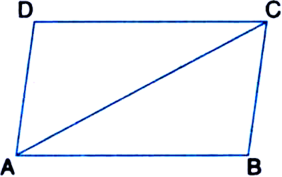
To Prove: ∆ABC ≅ ∆CDA
Proof: BC || DA
| Opposite sides of a parallelogram are parallel
and AC is a transversal
∴ ∠BCA = ∠DAC ...(1)
| Pair of alternate interior angles
Also, AB || DC
Opposite sides of a parallelogram are parallel
and AC is a transversal
∴ ∠BAC = ∠DCA ...(2)
| Pair of alternate interior angles
AC = CA ...(3) | Common
In view of (1), (2) and (3),
∆ABC ≅ ∆CDA
| ASA congruence criterion
1 Thank You