Exploring Forces – NCERT Solutions Class 8 Science (Curiosity) includes all the questions with solutions given in the NCERT Class 8 Science (Curiosity) textbook.
NCERT Solutions Class 8
English Poorvi Hindi Malhar Maths Ganita Prakash Science Curiosity Social Exploring SocietyExploring Forces – NCERT Solutions
Q.1: Why does it feel harder to pedal a bicycle when going uphill than on flat ground?
Solution: When cycling uphill, a bicycle has to move against gravity, which pulls both the cycle and the rider downward. More muscular force has to be applied to push the bicycle up the slope as compared to flat ground, where gravity does not resist the forward motion as much. That is why pedaling feels much harder going uphill.
Q.2: Why is it easier to slip on a wet surface?
Solution: Wet surfaces have less friction compared to dry surfaces. Friction is the force that helps in gripping the ground when walking or moving. When a surface is wet, the thin layer of water reduces the irregularities between the surfaces of shoes and the floor, causing the friction to decrease. With less friction, it is easy to slip and fall.
Q.3: Why do we feel ‘light’ or like we are ‘floating’ just after our swing reaches its highest point and begins to come down?
Solution: At the highest point of a swing’s motion, the swing (and the person on it) stops for a moment before starting to move back down. For that brief moment, the pull of gravity is almost balanced by the upward force of the swing, making a sensation similar to floating or feeling “light.” This happens because, at that instant, the only force acting is gravity and the person is in a state called “free fall.”
Q.4: Share your questions
Solution:
- Why does sliding work better on ice than on sand?
- What would happen if friction did not exist at all?
- Why do heavier objects sink more in water than lighter ones of the same size?
- Does air also provide friction to moving objects?
- Why can some birds fly easily for long periods without getting tired?
Q.5: Match items in Column A with the items in Column B.
| Column A (Type of force) | Column B (Example) | ||
|---|---|---|---|
| (i) | Muscular force | (a) | A cricket ball stopping on its own just before touching the boundary line |
| (ii) | Magnetic force | (b) | A child lifting a school bag |
| (iii) | Frictional force | (c) | A fruit falling from a tree |
| (iv) | Gravitational force | (d) | Balloon rubbed on woollen cloth attracting hair strands |
| (v) | Electrostatic force | (e) | A compass needle pointing North |
Solution:
| Column A (Type of force) | Column B (Example) |
| (i) Muscular force | (b) A child lifting a school bag |
| (ii) Magnetic force | (e) A compass needle pointing North |
| (iii) Frictional force | (a) A cricket ball stopping on its own just before touching the boundary line |
| (iv) Gravitational force | (c) A fruit falling from a tree |
| (v) Electrostatic force | (d) Balloon rubbed on woollen cloth attracting hair strands |
Q.6: A force is always required to change the speed of motion of an object.
Options:
(1) True ✅
(2) False
Explanation: Force changes speed, direction, or shape.
Q.7: Due to friction, the speed of the ball rolling on a flat ground increases.
Options:
(1) True
(2) False ✅
Explanation: Friction slows down or stops moving objects.
Q.8: There is no force between two charged objects placed at a small distance apart.
Options:
(1) True
(2) False ✅
Explanation: Electrostatic force acts between charged objects without contact.
Q.9: Two balloons rubbed with a woollen cloth are brought near each other. What would happen and why?
Solution:
- The two balloons will repel each other.
- This happens because rubbing with woollen cloth gives both balloons the same type of static charge, and like charges push each other away due to electrostatic force.
Q.10: When you drop a coin in a glass of water, it sinks, but when you place a bigger wooden block in water, it floats. Explain.
Solution:
- The coin sinks because its density is higher than water, so the gravitational force pulling it down is stronger than the buoyant force from water pushing it up.
- The wooden block floats because its density is lower than water, making the buoyant force equal to or greater than gravity, keeping it on the surface.
Q.11: If a ball is thrown upwards, it slows down, stops momentarily, and then falls back to the ground. Name the forces acting on the ball and specify their directions.
- During its upward motion
- During its downward motion
- At its topmost position
Solution:
- During its upward motion: Gravitational force pulls the ball downward, slowing it down, while the initial throwing force acts upward but weakens.
- During its downward motion: Only gravitational force pulls the ball downward, making it speed up.
- At its topmost position: Gravitational force pulls downward; the ball stops momentarily before falling, with zero speed at that instant.
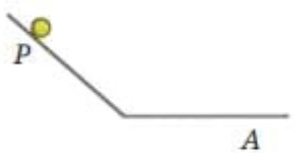
Q.12: A ball is released from the point P and moves along an inclined plane and then along a horizontal surface as shown in the figure. It comes to stop at the point A on the horizontal surface. Think of a way so that when the ball is released from the same point P, it stops
- before the point A
- after crossing the point A.
Solution:
- To stop before point A, make the surface rougher to increase frictional force, which slows the ball down faster.
- To stop after crossing point A, make the surface smoother to reduce frictional force, allowing the ball to roll farther.
Q.13: Why do we sometimes slip on smooth surfaces like ice or polished floors? Explain.
Solution: We slip on smooth surfaces because there is very little friction between our feet and the surface. Without enough friction to grip and oppose sliding, it’s easy to lose balance and fall.
Q.14: Is any force being applied to an object in a non-uniform motion?
Solution: Yes, a force is applied to an object in non-uniform motion (when speed or direction changes). Force causes these changes, like speeding up, slowing down, or turning.
Q.15: The weight of an object on the Moon becomes one-sixth of its weight on the Earth. What causes this change? Does the mass of the object also become one-sixth of its mass on the Earth?
Solution: The change happens because the Moon’s gravitational force is weaker than Earth’s (about one-sixth). Weight depends on gravity, so it’s less on the Moon. The mass stays the same everywhere, as it’s the amount of matter in the object.
Q.16: Three objects 1, 2, and 3 of the same size and shape but made of different materials are placed in water. They dip to different depths as shown in figure. If the weights of the three objects 1, 2, and 3 are w1, w2, and w3, respectively, then choose the correct relation.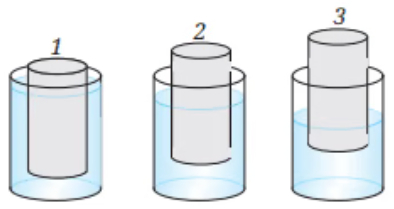
Options:
(1) w1=w2=w3w1=w2=w3
(2) w1>w2>w3w1>w2>w3 ✅
(3) w2>w3>w1w2>w3>w1
(4) w3>w1>w2w3>w1>w2
Explanation: Heavier objects sink deeper because their weight overcomes buoyant force more, while lighter ones float higher.
NCERT Solutions Class 8 Science Curiosity
- Exploring the Investigative World of Science
- The Invisible Living World: Beyond Our Naked Eye
- Health: The Ultimate Treasure
- Electricity: Magnetic and Heating Effects
- Exploring Forces
- Pressure, Winds, Storms, and Cyclones
- Particulate Nature of Matter
- Nature of Matter: Elements, Compounds, and Mixtures
- The Amazing World of Solutes, Solvents, and Solutions
- Light: Mirrors and Lenses
- Keeping Time with the Skies
- How Nature Works in Harmony
- Our Home: Earth, a Unique Life-Sustaining Planet

Test Generator
Create question paper PDF and online tests with your own name & logo in minutes.
Create Now
Learn8 App
Practice unlimited questions for Entrance tests & government job exams at ₹99 only
Install Now