Finding the Unknown – NCERT Solutions Class 7 Maths (Ganita Prakash) includes all the questions with solutions given in the NCERT Class 7 Maths (Ganita Prakash).
NCERT Solutions Class 7
English Poorvi Hindi Malhar Maths Ganita Prakash Science Curiosity Social Exploring SocietyFinding the Unknown – NCERT Solutions
Q.1: Solve the equation and check the solution: {tex}3 x-10=35{/tex}
Solution:
Step 1: Add 10 to both sides:
{tex} 3 x-10+10=35+10 \Longrightarrow 3 x=45 {/tex}
Step 2: Divide both sides by 3:
{tex} x=\frac{45}{3}=15 {/tex}
Check: {tex}3 \times 15-10=45-10=35{/tex}
Q.2: Solve the equation and check the solution: {tex}5 s=3 s{/tex}
Solution:
Step 1: Subtract {tex}3 s{/tex} from both sides:
{tex} 5 s-3 s=3 s-3 s \Longrightarrow 2 s=0 {/tex}
Step 2: Divide both sides by 2:
{tex} s=0 {/tex}
Check: {tex}5 \times 0=3 \times 0{/tex}, both sides are 0.
Q.3: Solve the equation and check the solution: {tex}3 u-7=2 u+3{/tex}
Solution:
Step 1: Subtract {tex}2 u{/tex} from both sides:
{tex} 3 u-2 u-7=2 u-2 u+3 \Longrightarrow u-7=3 {/tex}
Step 2: Add 7 to both sides:
{tex} u-7+7=3+7 \Longrightarrow u=10 {/tex}
Check: {tex}3 \times 10-7=30-7=23,{/tex} {tex}2 \times 10+3=20+3=23{/tex}
Q.4: Solve the equation and check the solution: {tex}4(m+6)-8=2 m-4{/tex}
Solution:
Expand left:
{tex} 4 m+24-8=2 m-4 \Longrightarrow 4 m+16=2 m-4 {/tex}
Step 1: Subtract {tex}2 m{/tex} from both sides:
{tex} 4 m-2 m+16=2 m-2 m-4{/tex} {tex} \Longrightarrow 2 m+16=-4 {/tex}
Step 2: Subtract 16 from both sides:
{tex} 2 m+16-16=-4-16 \Longrightarrow 2 m=-20 {/tex}
Step 3: Divide by 2:
{tex} m=-10 {/tex}
Check: {tex}4(-10+6)-8=4(-4)-8=-16-8{/tex} {tex}=-24,2 \times-10-4=-20-4=-24{/tex}
Q.5: Solve the equation and check the solution: {tex}\frac{u}{15}=6{/tex}
Solution:
Multiply both sides by 15:
{tex} u=6 \times 15=90 {/tex}
Check: {tex}\frac{90}{15}=6{/tex}
Q.6: Write 5 equations whose solution is x = -2.
Solution:
- {tex}x+2=0{/tex}
{tex}x=-2{/tex} - {tex}3 x+6=0{/tex}
{tex}3 x=-6 \Longrightarrow x=\frac{-6}{3}=-2{/tex} - {tex}2 x=-4{/tex}
{tex}x=\frac{-4}{2}=-2{/tex} - {tex}5 x+10=0{/tex}
{tex}5 x=-10 \Longrightarrow x=\frac{-10}{5}=-2{/tex} - {tex}\frac{x}{2}=-1{/tex}
{tex}x=-1 \times 2=-2{/tex}
In each equation, substituting {tex}x=-2{/tex} satisfies the equality.
Q.7: Find the value: {tex}2 y=60{/tex}
Solution:
Divide both sides by 2:
{tex} y=\frac{60}{2}=30 {/tex}
{tex}2 \times 30=60{/tex}
Q.8: Find the value: {tex}-8=5 x-3{/tex}
Solution:
Add 3 to both sides:
{tex} -8+3=5 x \Longrightarrow-5=5 x {/tex}
Divide by 5 :
{tex} x=\frac{-5}{5}=-1 {/tex}
{tex}5 \times-1-3=-5-3=-8{/tex}
Q.9: Find the value: {tex}-53 w=-15{/tex}
Solution:
Divide both sides by -53:
{tex} w=\frac{-15}{-53}=\frac{15}{53} {/tex}
{tex}-53 \times \frac{15}{53}=-15{/tex}
Q.10: Find the value: {tex} 13-z=8 {/tex}
Solution:
Subtract 13 from both sides:
{tex} -z=8-13=-5 {/tex}
Multiply both sides by -1:
{tex} z=5 {/tex}
{tex}13-5=8{/tex}
Q.11: Find the value: {tex}k+8=12-k{/tex}
Solution:
Add {tex}k{/tex} to both sides:
{tex} k+k+8=12 \Longrightarrow 2 k+8=12 {/tex}
Subtract 8 from both sides:
{tex} 2 k=4 {/tex}
Divide by 2:
{tex} k=2 {/tex}
{tex}2+8=10 ; 12-2=10 {/tex}
Q.12: Find the value: {tex}7 m=m-3{/tex}
Solution:
Subtract {tex}m{/tex} from both sides:
{tex} 7 m-m=-3 \Longrightarrow 6 m=-3 {/tex}
Divide by 6:
{tex} m=-\frac{3}{6}=-\frac{1}{2} {/tex}
{tex}7 \times-\frac{1}{2}=-\frac{7}{2} ;-\frac{1}{2}-3{/tex} {tex}=-\frac{1}{2}-\frac{6}{2}=-\frac{7}{2}{/tex}
Q.13: Find the value: {tex}3 n=10+n{/tex}
Solution:
Subtract {tex}n{/tex} from both sides:
{tex} 3 n-n=10 \Longrightarrow 2 n=10 {/tex}
Divide by 2:
{tex} n=5 {/tex}
{tex}3 \times 5=15 ; 10+5=15 \checkmark{/tex}
Q.14: I am a 3-digit number. My hundred’s digit is 3 less than my ten’s digit. My ten’s digit is 3 less than my unit’s digit. The sum of all the three digits is 15. Who am I?
Solution:
The required 3-digit number is 258.
- Hundreds digit: 2
- Tens digit: 5
- Units digit: 8
This satisfies all conditions:
- Hundreds digit (2) is 3 less than tens digit (5).
- Tens digit (5) is 3 less than units digit (8).
- Sum: {tex}2+5+8=15{/tex}.
Q.15: The weight of a brick is 1 kg more than half its weight. What is the weight of the brick?
Solution:
The weight of the brick is 2 kg.
Let the brick’s weight be {tex}W{/tex}. According to the problem:
{tex} W=1+\frac{W}{2} {/tex}
Solving gives {tex}W=2 \mathrm{~kg}{/tex}. This satisfies all conditions.
Q.16: One quarter of a number increased by 9 gives the same number. What is the number?
Solution:
The number is 12.
When you take one quarter of {tex}12(12 / 4=3){/tex} and increase it by {tex}9(3+9=12){/tex}, you get the original number. So, the solution is 12.
Q.17: Given {tex}4 k+1=13{/tex}, find the values of:
- {tex}8 k+2{/tex}
- {tex}4 k{/tex}
Solution:
- {tex} 8 k+2=8 \times 3+2=24+2=26 {/tex}
- {tex} 4 k=4 \times 3=12 {/tex}
Q.18: {tex} \text { Given } 4 k+1=13 \text {, find the values of: } {/tex}
- {tex}k{/tex}
- {tex}4 k-1{/tex}
- {tex}-\mathrm{k}-2{/tex}
Solution:
- {tex} k=3 {/tex}
- {tex} 4 k-1=12-1=11 {/tex}
- {tex} -k-2=-3-2=-5 {/tex}
Q.19: Fill in the blank with integers:
{tex} 5 \times{/tex} ________ {tex}-8=37{/tex}
Solution:
Let the blank be {tex}x{/tex}.
{tex} 5 x-8=37 {/tex}
Add 8 to both sides:
{tex} 5 x=45 {/tex}
Divide both sides by 5:
{tex} x=9 {/tex}
Q.20: Fill in the blank with integers:
{tex} 37-(33-{/tex} ________{tex})\ = \ 35 {/tex}
Solution:
Let the blank be {tex}y{/tex}.
{tex} 37-(33-y)=35 {/tex}
Rewrite:
{tex} 37-33+y=35 \Longrightarrow 4+y=35 {/tex}
Subtract 4 from both sides:
{tex} y=31 {/tex}
Q.21: Fill in the blank with integers:
{tex}-3 \times(-11+{/tex} ________{tex})=45{/tex}
Solution:
Let the blank be {tex}z{/tex}.
{tex} -3 \times(-11+z)=45 {/tex}
Divide both sides by -3:
{tex} -11+z=-15 {/tex}
Add 11 to both sides:
{tex} z=-4 {/tex}
Q.22: Ranju is a daily wage labourer. She earns ₹ 750 a day. Her employer pays her in 50 and 100 rupee notes. If Ranju gets an equal number of 50 and 100 rupee notes, how many notes of each does she have?
Solution:
Ranju has 5 notes of ₹ 50 and 5 notes of ₹ 100.
Explanation: Let the number of ₹ 50 notes be {tex}x{/tex}. Since the number of ₹ 100 notes is equal, it is also {tex}x{/tex}.
The total amount is {tex}50 x+100 x=150 x{/tex}.
Given total amount is ₹ 750, so {tex}150 x=750{/tex}, solving gives {tex}x=5{/tex}.
Hence, 5 notes of ₹ 50 and 5 notes of ₹ 100 make ₹ 750.
Q.23: In the given picture, each black blob hides an equal number of blue dots. If there are 25 dots in total, how many dots are covered by one blob? Write an equation to describe this problem.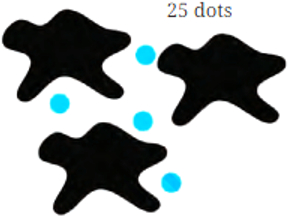
Solution:
Let {tex}x{/tex} be the number of blue dots hidden by each black blob. There are 4 blobs and 3 visible blue dots, and a total of 25 dots. The equation is:
{tex} 4 x+3=25 {/tex}
Solving this, we get:
{tex} 4 x=22 \Longrightarrow x=5.5 {/tex}
So, each blob covers 5.5 dots according to the math, but since the answer should be a whole number, check the image context carefully. (If there is a miscount or if only whole numbers are possible, the image or question may expect another interpretation, but the equation is correctly set as above.)
Q.24: Here are machines that take an input, perform an operation on it and send out the result as an output.

Find the inputs in the following cases: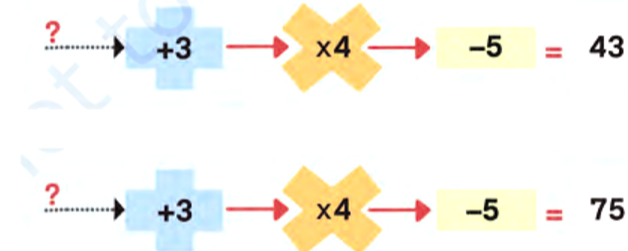
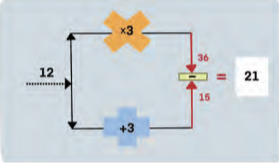
Find the inputs in the following cases: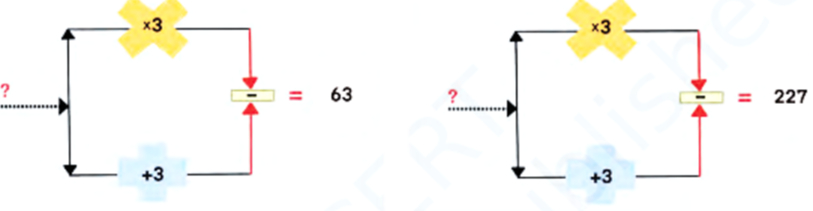
Solution:
- For the given machines:
- For output 43, the input should be 9.
- For output 75, the input should be 17. These are found by solving the equation {tex}(({/tex}input +3{tex}) \times 4)-5={/tex} output for each case in the image
- For these machines:
- For output 63, the input should be 26.
- For output 227, the input should be {tex}\frac{242}{3}{/tex} (which is approximately 80.67). So the required inputs are:
- First input: 26
- Second input: 80.67 (if integer values are needed, review the operation or output for rounding or possible adjustment).
Q.25: What are the inputs to these machines?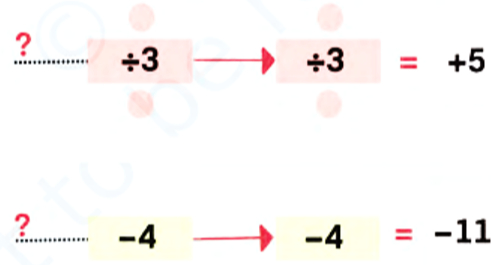
Solution:
For the machines shown:
- The input for the first machine (divide by 3, then by 3, result is 5) is 45.
- The input for the second machine (subtract 4, then subtract 4, result is -11) is -3.
So the answers are 45 and -3, respectively.
Q.26: A taxi driver charges a fixed fee of ₹ 800 per day plus ₹ 20 for each kilometre travelled. If the total cost for a taxi ride is ₹ 2200, determine the number of kilometres travelled.
Solution:
The number of kilometres travelled is 70 km.
This is found by solving the equation:
{tex} 800+20 \times \text { kilometres }=2200 {/tex}
So, the distance is 70 km.
Q.27: The sum of two numbers is 76. One number is three times the other number. What are the numbers?
Solution:
The two numbers are 19 and 57.
- The smaller number is 19.
- The larger number (three times the smaller) is 57.
Their sum is {tex}19+57=76{/tex}, as required.
Q.28: The figure shows the diagram for a window with a grill. What is the gap between two rods in the grill?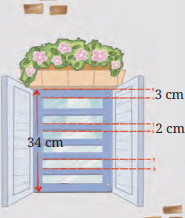
Solution:
The gap between two rods in the grill is 11.33 cm (rounded to two decimal places).
This is because the total length between the outermost rods is 34 cm, and there are three gaps between four rods, so each gap is {tex}\frac{34}{3}=11.33 \mathrm{~cm}{/tex}.
Q.29: Given {tex}28 p-36=98{/tex}, find the value of {tex}14 p-19{/tex} and {tex}28 p-38{/tex}.
Solution:
Given {tex}28 p-36=98{/tex}, solving gives {tex}p=\frac{67}{14}{/tex}.
- {tex}14 p-19=48{/tex}
- {tex}28 p-38=96{/tex}
These are the required values using the found value of {tex}p{/tex} in each expression.
Q.30: The steps to solve three equations are shown below. Identify and correct any mistakes.
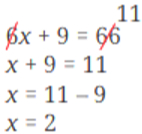
- {tex} 14 y+24=36 {/tex}
{tex} 7 y+12=18 {/tex}
{tex} 7 y=6 {/tex}
{tex} y=\frac{6}{7} {/tex} - {tex} 4 x-5=9 x+8 {/tex}
{tex} 4 x=9 x+8-5 {/tex}
{tex} 4 x=9 x+3 {/tex}
{tex} 4 x-9 x=3 {/tex}
{tex} -5 x=3 {/tex}
{tex}x=\frac{-5}{3} {/tex}
Solution:
- The first step shows: {tex}x+9=11{/tex} (incorrect).
Correct process:
{tex}6 x+9=66{/tex}
{tex}6 x=66-9=57{/tex}
{tex}x=\frac{57}{6}{/tex}
Correction:
{tex} 6 x+9=66 {/tex}
{tex} 6 x=57 {/tex}
{tex} x=9.5 {/tex} - The first step divides everything by 2: {tex}7 y+12=18{/tex} (which is correct).
– Next: {tex}7 y=6{/tex}, so {tex}y=\frac{6}{7}{/tex} - The solution follows the correct process:
{tex}4 x-5=9 x+8{/tex}
{tex}4 x-9 x=8+5 \Longrightarrow-5 x=13{/tex}
But in the image it adds 5 to 3 for {tex}-5 x=3{/tex}, which is wrong.
Correct is:
{tex}4 x-9 x=8+5{/tex}
{tex}-5 x=13{/tex}
{tex}x=-\frac{13}{5}{/tex}
Correction:
{tex} 4 x-5=9 x+8 {/tex}
{tex} 4 x-9 x=8+5 {/tex}
{tex} -5 x=13 {/tex}
{tex} x=-\frac{13}{5} {/tex}
Q.31: Find the measures of the angles of these triangles.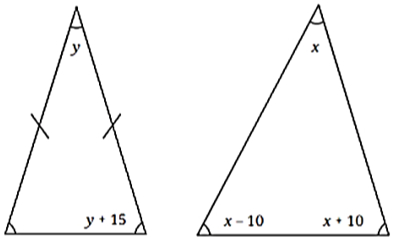
Solution:
Here are the measures of the angles in each triangle:
Left Triangle:
- Top angle: {tex}y=50^{\circ}{/tex}
- Base angles: {tex}y+15=65^{\circ}{/tex} each
Right Triangle:
- Angles: {tex}x=60^{\circ}, x+10=70^{\circ}, x-10=50^{\circ}{/tex}
All angle measures add up to {tex}180^{\circ}{/tex} for each triangle.
Q.32: Write 4 equations whose solution is u = 6.
Solution:
Here are 4 different equations whose solution is {tex}u=6{/tex}:
- {tex}u+2=8{/tex}
- {tex}2 u=12{/tex}
- {tex}u-9=-3{/tex}
- {tex}\frac{u}{3}=2{/tex}
In each case, substituting {tex}u=6{/tex} turns the equation into a true statement.
Q.33: The Bakhshali Manuscript (300 CE) mentions the following problem. The amount given to the first person is not known. The second person is given twice as much as the first. The third person is given thrice as much as the second; and the fourth person four times as much as the third. The total amount distributed is 132. What is the amount given to the first person?
Solution:
The amount given to the first person is {tex}\mathbf{4}{/tex}.
Here’s how it is determined:
- Let the amount given to the first person be {tex}x{/tex}.
- Second person: {tex}2 x{/tex}
- Third person: {tex}3 \times 2 x=6 x{/tex}
- Fourth person: {tex}4 \times 6 x=24 x{/tex}
- Total: {tex}x+2 x+6 x+24 x=33 x=132{/tex}
- Solving gives {tex}x=4{/tex}.
So, the first person receives 4 units.
Q.34: The height of a giraffe is two and a half metres more than half its height. How tall is the giraffe?
Solution:
The height of the giraffe is 5 metre.
This is because the equation is:
{tex} h=2.5+\frac{h}{2} {/tex}
Solving it gives {tex}h=5{/tex}.
Q.35: Two separate figures are given below. Each figure shows the first few positions in a sequence of arrangements made with sticks. Identify the pattern and answer the following questions for each figure:
- How many squares are in position number 11 of the sequence?
- How many sticks are needed to make the arrangement in position number 11 of the sequence?
- Can an arrangement in this sequence be made using exactly 85 sticks? If yes, which position number will it correspond to?
- Can an arrangement in this sequence be made using exactly 150 sticks? If yes, which position number will it correspond to?
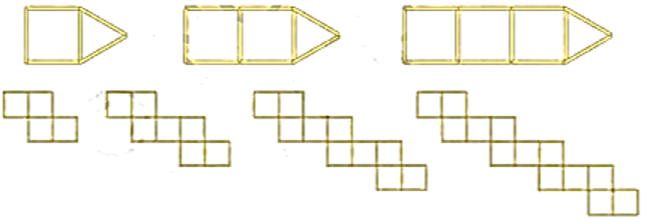
Solution:
First Figure (kite-train / top row)
- Squares in position 11:
- Pattern: Position {tex}n{/tex} has {tex}n{/tex} squares.
- Answer: 11 squares.
- Sticks for position 11:
- 1 square {tex}=4{/tex} sticks, each new square adds 3 more (shares one s
- Formula: {tex}4+3(n-1)=3 n+1{/tex}
- For {tex}n=11: 3 \times 11+1=34{/tex}
- Answer: 34 sticks.
- Can arrangement have 85 sticks? Position?
- Equation: {tex}3 n+1=85 \Rightarrow 3 n=84 \Rightarrow n=28{/tex}
- Yes, position 28.
- Answer: Yes, position 28.
- Can arrangement have 150 sticks? Position?
- Equation: {tex}3 n+1=150 \Rightarrow 3 n=149 \Rightarrow n=49.666 \ldots{/tex}
- No exact whole position, so No.
Second Figure (stepped squares / bottom row)
- Squares in position 11:
- Pattern: Position {tex}n{/tex} has {tex}n+1{/tex} squares.
- Answer: 12 squares.
- Sticks for position 11:
- Pattern: 1st position {tex}=7{/tex} sticks, each new position adds 3 more.
- Formula: {tex}7+3(n-1)=3 n+4{/tex}
- For – For {tex}n=11: 3 \times 11+4=37{/tex}
- Answer: 37 sticks.
- Can arrangement have 85 sticks? Position?
- Equation: {tex}3 n+4=85 \Rightarrow 3 n=81 \Rightarrow n=27{/tex}
- Yes, position 27.
- Answer: Yes, position 27.
- Can arrangement have 150 sticks? Position?
- Equation: {tex}3 n+4=150 \Rightarrow 3 n=146 \Rightarrow n=48.666 \ldots{/tex}
- No exact whole position, so No.
Q.36: A number increased by 36 is equal to ten times itself. What is the number?
Solution:
The number is 4.
This is because the equation is:
{tex} x+36=10 x {/tex}
Solving gives {tex}x=4{/tex}.
Q.37: Solve these equations:
- {tex} 5(r+2)=10 {/tex}
- {tex}-3(u+2)=2(u-1){/tex}
Solution:
- {tex} 5(r+2)=10 {/tex}
{tex} r=0 {/tex} - {tex} -3(u+2)=2(u-1) {/tex}
{tex} u=-\frac{4}{5} {/tex}
Q.38: Solve these equations:
- {tex} 2(7-2 n)=-6 {/tex}
- {tex}2(x-4)=-16 {/tex}
Solution:
- {tex} 2(7-2 n)=-6 {/tex}
{tex} n=5 {/tex} - {tex} 2(x-4)=-16 {/tex}
{tex} x=-4 {/tex}
Q.39: Solve these equations:
- {tex} 6(x-1)=2(x-1)-4 {/tex}
- {tex}3-7 s=7-3 s {/tex}
Solution:
- {tex} 6(x-1)=2(x-1)-4 {/tex}
{tex} x=0 {/tex} - {tex} 3-7 s=7-3 s {/tex}
{tex} s=-1 {/tex}
Q.40: Solve these equations:
- {tex} 2 x+1=6-(2 x-3) {/tex}
- {tex}10-5 x=3(x-4)-2(x-7) {/tex}
Solution:
- {tex} 2 x+1=6-2(x-3) {/tex}
{tex} x=\frac{11}{4} {/tex} - {tex} 10-5 x=3(x-4)-2(x-7) {/tex}
{tex} x=\frac{4}{3} {/tex}
Q.41: Solve the equations to find a path from Start to the End. Show your work in the given boxes provided and colour your path as you proceed.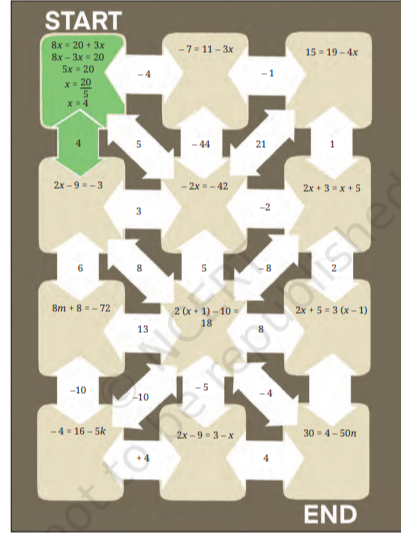
Solution:
Do it Yourself.
Q.42: There are some children and donkeys on a beach. Together they have 28 heads and 80 feet. How many donkeys are there? How many children are there?
Solution:
There are 16 children and 12 donkeys on the beach.
Each child has 1 head and 2 feet.
Each donkey has 1 head and 4 feet.
Solving the system {tex}c+d=28{/tex} and {tex}2 c+4 d=80{/tex} gives {tex}c=16{/tex} and {tex}d=12{/tex}.
NCERT Solutions Class 7 Maths (Ganita Prakash)
- Large Numbers Around Us
- Arithmetic Expressions
- A Peek Beyond the Point
- Expressions Using Letter-Numbers
- Parallel And Intersection Lines
- Number Play
- A Tale of Three Intersecting Lines
- Working With Fractions
- Geometric Twins
- Operations with Integers
- Finding Common Ground
- Another Peek Beyond the Point
- Connecting the Dots
- Constructions and Tilings
- Finding the Unknown

Test Generator
Create question paper PDF and online tests with your own name & logo in minutes.
Create Now
Learn8 App
Practice unlimited questions for Entrance tests & government job exams at ₹99 only
Install Now