Geometric Twins – NCERT Solutions Class 7 Maths (Ganita Prakash) includes all the questions with solutions given in the NCERT Class 7 Maths (Ganita Prakash).
NCERT Solutions Class 7
English Poorvi Hindi Malhar Maths Ganita Prakash Science Curiosity Social Exploring SocietyGeometric Twins – NCERT Solutions
Q.1: Check if the two figures are congruent.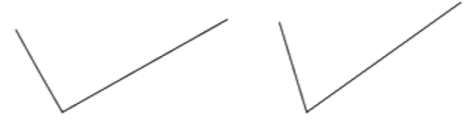
Solution:
Yes, the two figures are congruent, because their angles and sides (arms) are equal in measure.
They may appear as mirror images, but that does not affect congruence – reflection still preserves size and shape.
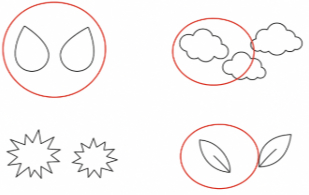
Q.2: Circle the pairs that appear congruent.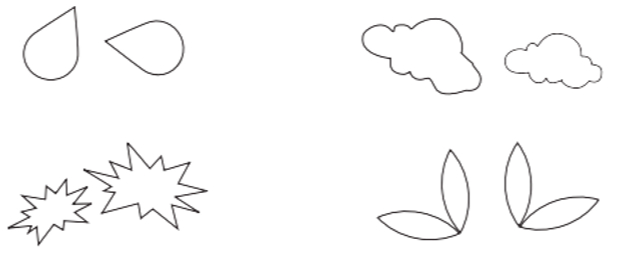
Solution:
Q.3: What measurements would you take to create a figure congruent to a given:
- Circle
- Rectangle
Using this, state how would you check if two —
- Circles are congruent?
- Rectangles are congruent?
Solution:
To create a congruent figure:
- Circle: Measure the radius. The new circle should have the same radius.
- Rectangle: Measure the length and breadth. The new rectangle should have the same length and breadth.
To check if two figures are congruent:
- Circles: Two circles are congruent if they have the same radius.
- Rectangles: Two rectangles are congruent if their lengths and breadths are equal.
Q.4: Suppose {tex}\triangle \mathrm{HEN}{/tex} is congruent to {tex}\triangle \mathrm{BIG}{/tex}. List all the other correct ways of expressing this congruence.
Solution:
If {tex}\triangle H E N \cong \triangle B I G{/tex}, the order of letters shows the correspondence between vertices:
{tex} H \leftrightarrow B, E \leftrightarrow I \text {, and } N \leftrightarrow G \text {. } {/tex}
So, all other correct ways of expressing this congruence are:
- {tex}\triangle E N H \cong \triangle I G B{/tex}
- {tex}\triangle N H E \cong \triangle G B I{/tex}
- {tex}\triangle H N E \cong \triangle B G I{/tex}
- {tex}\triangle N E H \cong \triangle G I B{/tex}
- {tex}\triangle E H N \cong \triangle I B G{/tex}
Each pair keeps the correct correspondence of vertices ({tex}H \rightarrow B, E \rightarrow I, N \rightarrow G{/tex}).
Q.5: Determine whether the triangles are congruent. If yes, express the congruence.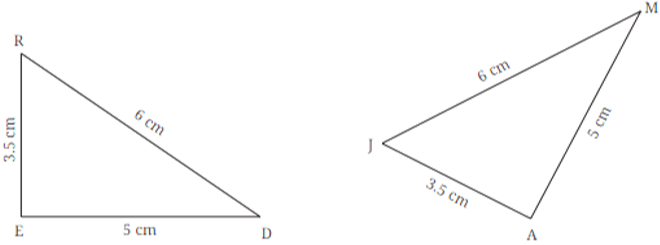
Solution:
Let’s compare the sides of the two triangles:
In {tex}\triangle \mathrm{RED}{/tex}:
- {tex}\mathrm{RE}=3.5 \mathrm{~cm}{/tex}
- {tex}\mathrm{ED}=5 \mathrm{~cm}{/tex}
- {tex}\mathrm{RD}=6 \mathrm{~cm}{/tex}
In {tex}\triangle \mathrm{JAM}{/tex}:
- {tex}\mathrm{JA}=3.5 \mathrm{~cm}{/tex}
- {tex}\mathrm{AM}=5 \mathrm{~cm}{/tex}
- {tex}J M=6 \mathrm{~cm}{/tex}
The three corresponding sides are equal:
{tex}R E=J A, E D=A M, R D=J M{/tex}
Therefore, the two triangles are congruent by SSS (Side-Side-Side) criterion.
Congruence statement:
{tex} \triangle R E D \cong \triangle J A M {/tex}
Q.6: In the figure below, are {tex}\triangle \mathrm{DFE} \text { and } \triangle \mathrm{GED}{/tex} congruent to each other? It is given that DF = DG and FE = GE.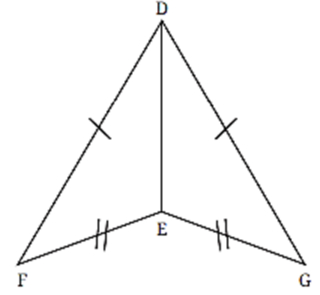
Solution:
Yes, triangles {tex}\triangle \mathrm{DFE}{/tex} and {tex}\triangle \mathrm{GED}{/tex} are congruent to each other. This can be proved using the Side-Side-Side (SSS) congruence criterion.
Reasoning
- It is given that {tex}D F=D G{/tex} and {tex}F E=G E{/tex}
- Both triangles share the side {tex}D E{/tex}, which is common to both triangles
- Thus, the three sides of triangle {tex}\triangle \mathrm{DFE}{/tex} are respectively equal to the three sides of triangle {tex}\triangle \mathrm{GED}{/tex}:
- {tex}D F=D G{/tex}
- {tex}D E=D E{/tex} (common side)
- {tex}F E=G E{/tex}
By the SSS congruence rule, if the three sides of one triangle are equal to the three sides of another triangle, then the triangles are congruent.
Conclusion
Triangles {tex}\triangle \mathrm{DFE}{/tex} and {tex}\triangle \mathrm{GED}{/tex} are congruent by SSS criterion.
Q.7: Identify whether the triangles below are congruent. What conditions did you use to establish their congruence? Express the congruence.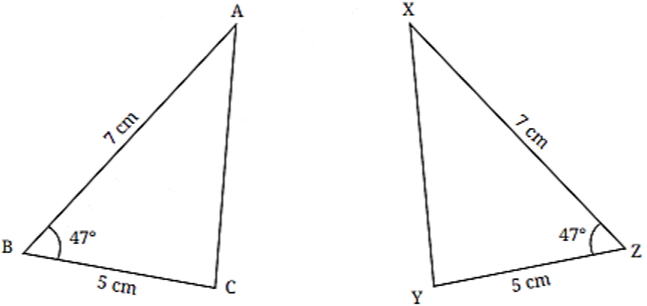
Solution:
Yes, the triangles shown in the image – triangle {tex}\triangle A B C{/tex} and triangle {tex}\triangle X Y Z-{/tex} are congruent to each other.
Conditions for Congruence
The given conditions are:
- {tex}A B=X Z=7 \mathrm{~cm}{/tex} {tex}\square{/tex}
- {tex}B C=Y Z=5 \mathrm{~cm}{/tex} {tex}\bigcirc{/tex}
- Angle {tex}B=\angle Y=47^{\circ}{/tex}
These satisfy the SAS (Side-Angle-Side) congruence criterion, which states that if two sides and the included angle of one triangle are equal to the corresponding two sides and included angle of another triangle, then the triangles are congruent.
Expressing the Congruence
Triangles are congruent as follows:
{tex} \triangle A B C \cong \triangle X Y Z {/tex}
by the SAS criterion.
Q.8: Given that CD and AB are parallel, and AB = CD, what are the other equal parts in this figure? (Hint: When the lines are parallel, the alternate angles are equal. Are the two resulting triangles congruent? If so, express the congruence.)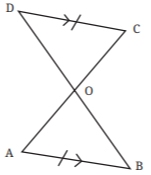
Solution:
- First, {tex}A B{/tex} and {tex}C D{/tex} are parallel lines, and their lengths are equal ({tex}A B=C D{/tex}).
- When two lines are parallel, the alternate interior angles between them and a transversal are also equal.
- The side that connects {tex}A B{/tex} to {tex}C D{/tex} (the transversal) is the same for both triangles, so it is a common side.
- Now, both triangles have two equal sides and the angle between them equal (by the SAS rule).
- Therefore, the triangles are congruent, meaning they are equal in size and shape.
- We write this as: {tex}\triangle A B C \cong \triangle D C B{/tex} (depending on the figure’s points).
This method uses the SAS (Side-Angle-Side) congruence rule.
Q.9: Identify the equal parts in the following figure, given that {tex}\angle \mathrm{ABD}= \angle \mathrm{DCA}{/tex} and {tex}\angle \mathrm{ACB}=\angle \mathrm{DBC}{/tex}.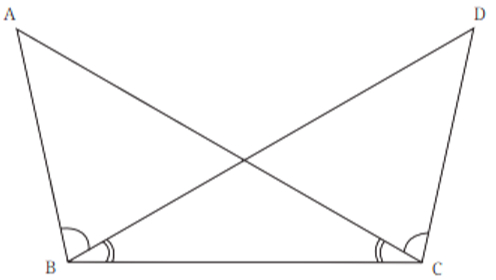
Solution:
In the figure, the given equal parts are:
- {tex}\angle A B D=\angle D C A{/tex} (given).
- {tex}\angle A C B=\angle D B C{/tex} (given).
These are pairs of equal angles in triangles {tex}A B D{/tex} and {tex}D C A{/tex}.
Equal Parts Identified - Angle {tex}A B D{/tex} in triangle {tex}A B D{/tex} is equal to angle {tex}D C A{/tex} in triangle {tex}D C A{/tex}.
- Angle {tex}A C B{/tex} in triangle {tex}A C B{/tex} is equal to angle {tex}D B C{/tex} in triangle {tex}D B C{/tex}.
If lines {tex}A B{/tex} and {tex}C D{/tex} intersect at interior points, the equal angles make the two triangles similar, but not necessarily congruent unless the sides are also equal.
Q.10: Each of the following cases contains certain measurements taken from two triangles. Identify the pairs in which the triangles are congruent to each other, with reason. Express the congruence whenever they are congruent.
- {tex} {AB}={DE} {/tex}
{tex} {BC}={EF} {/tex}
{tex} {CA}={DF} {/tex} - {tex} {AB}={EF} {/tex}
{tex} \angle {~A}=\angle {E} {/tex}
{tex} {AC}={ED} {/tex} - {tex} {AB}={DF} {/tex}
{tex} \angle {~B}=\angle {D}=90^{\circ} {/tex}
{tex} {AC}={FE} {/tex} - {tex} \angle {A} =\angle {D} {/tex}
{tex} \angle {~B} =\angle {E} {/tex}
{tex} {AC} ={DF} {/tex} - {tex} {AB}={DF} {/tex}
{tex} \angle {~B}=\angle {F} {/tex}
{tex} {AC}={DE} {/tex}
Solution:
- {tex}A B=D E, B C=E F, C A=D F{/tex}
– All three corresponding sides are equal.
– Congruence by SSS criterion.
– Express: {tex}\triangle A B C \cong \triangle D E F{/tex}. image.jpg - {tex}A B=E F, \angle A=\angle E, A C=E D{/tex}
– Two sides and the included angle are equal.
– Congruence by SAS criterion.
– Express: {tex}\triangle A B C \cong \triangle E F D{/tex}. image.jpg - {tex}A B=D F, \angle B=\angle D=90^{\circ}, A C=F E{/tex}
– Hypotenuse and one side of right triangle equal.
– Congruence by RHS criterion (Right angle-Hypotenuse-Side).
– Express: {tex}\triangle A B C \cong \triangle D F E{/tex}. image.jpg - {tex}\angle A=\angle D, \angle B=\angle E, A C=D F{/tex}
– Two angles and the side between them are equal.
– Congruence by ASA criterion.
– Express: {tex}\triangle A B C \cong \triangle D E F{/tex}. - {tex}A B=D F, \angle B=\angle F, A C=D E{/tex}
– Two sides and a non-included angle are given.
– Not necessarily congruent (no rule applies here directly).
– Not Congruent.
Q.11: It is given that OB = OC, and OA = OD. Show that AB is parallel to CD.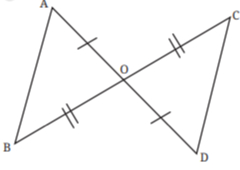
Solution:
- Given: {tex}O B=O C{/tex} and {tex}O A=O D{/tex}.
- Triangles {tex}O B A{/tex} and {tex}O C D{/tex} :
In triangle OBA : sides {tex}O B{/tex} and {tex}O A{/tex}.
In triangle {tex}O C D{/tex} : sides {tex}O C{/tex} and {tex}O D{/tex}.
These pairs are equal by given information. - {tex}A D{/tex} acts as a transversal to {tex}A B{/tex} and {tex}C D{/tex}.
- Alternate Angles:
- In both triangles, angle {tex}O B A{/tex} equals angle {tex}O C D{/tex} (since triangles OBA and OCD have two pairs of equal sides including one common angle at O).
- Therefore, alternate interior angles formed by {tex}A B{/tex} and {tex}C D{/tex} with transversal {tex}A D{/tex} are equal.
- Conclusion:
Because alternate angles are equal, by the property of parallel lines, {tex}A B{/tex} is parallel to {tex}C D{/tex}.
So, with {tex}\mathrm{OB}=\mathrm{OC}, \mathrm{OA}=\mathrm{OD}{/tex}, and equal alternate angles formed by the transversal AD, it is proved that {tex}A B \| C D{/tex}.
Q.12: ABCD is a square. Show that {tex}\triangle \mathrm{ABC} \cong \triangle \mathrm{ADC}{/tex}. Is {tex}\triangle \mathrm{ABC}{/tex} also congruent to {tex}\triangle C D A{/tex}?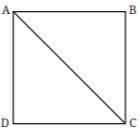
Give more examples of two triangles where one triangle is congruent to the other in two different ways, as in the case above. Can you give an example of two triangles where one is congruent to the other in six different ways?
Solution:
Examples of Two Triangles Congruent in Two Different Ways
- In a Rectangle:
Draw a diagonal in a rectangle PQRS.
Triangles {tex}\triangle P Q S{/tex} and {tex}\triangle Q R S{/tex} are congruent by SSS.
Also, they are congruent by SAS (since the diagonal and two sides are equal). - In an Equilateral Triangle:
Draw median AM in {tex}\triangle A B C{/tex} where all sides are equal.
Triangles {tex}\triangle A B M{/tex} and {tex}\triangle A C M{/tex} are congruent by SSS (side AM is common, sides {tex}\mathrm{AB}={/tex} AC, and {tex}\mathrm{BM}=\mathrm{CM}{/tex} as medians of an equilateral triangle).
Also, they are congruent by SAS (AM, angle at A, and AB = AC).
Showing {tex}\triangle A B C \cong \triangle A D C{/tex}
- ABCD is a square, so all sides are equal: {tex}A B=B C=C D=D A{/tex}.
- Diagonal AC is common for both triangles.
- Angles at B and D are right angles ({tex}90^{\circ}{/tex} each).
- So, triangles {tex}A B C{/tex} and {tex}A D C{/tex} have:
{tex}A B=A D{/tex} (square sides)
{tex}B C=D C{/tex} (square sides)
{tex}A C{/tex} (common side) - By SSS (Side-Side-Side) criterion, {tex}\triangle A B C \cong \triangle A D C{/tex}.
{tex}\triangle A B C{/tex} is also congruent to {tex}\triangle C D A{/tex}, because the parts correspond exactly as above due to the symmetric nature of a square.
So, {tex}\triangle A B C \cong \triangle C D A{/tex} by SSS.
{tex}\triangle A B C \cong \triangle A D C{/tex} (SSS criterion).
Yes, {tex}\triangle A B C{/tex} is also congruent to {tex}\triangle C D A{/tex}.
Q.13: Find {tex}\angle \mathrm{B}{/tex} and {tex}\angle \mathrm{C}{/tex}, if A is the centre of the circle.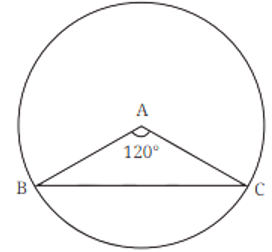
Solution:
Given: {tex}A{/tex} is the center of the circle and {tex}\angle B A C=120^{\circ}{/tex}.
To Find: {tex}\angle B{/tex} and {tex}\angle C{/tex}
Since {tex}A{/tex} is the center, {tex}A B{/tex} and {tex}A C{/tex} are radii, so the triangle {tex}B A C{/tex} is isosceles with {tex}A B=A C{/tex}.
Let us use the properties:
- The sum of angles in any triangle is {tex}180^{\circ}{/tex}.
- Let {tex}x{/tex} be the value of {tex}\angle B{/tex} and {tex}\angle C{/tex} (since triangle is isosceles).
So,
{tex} \angle B A C+\angle B+\angle C=180^{\circ} {/tex}
{tex} 120^{\circ}+x+x=180^{\circ} {/tex}
{tex} 2 x=60^{\circ} {/tex}
{tex} x=30^{\circ} {/tex}
- {tex}\angle B=30^{\circ}{/tex}
- {tex}\angle C=30^{\circ}{/tex}
Q.14: Find the missing angles. As per the convention that we have been following, all line segments marked with a single ‘|’ are equal to each other and those marked with a double ‘|’ are equal to each other, etc.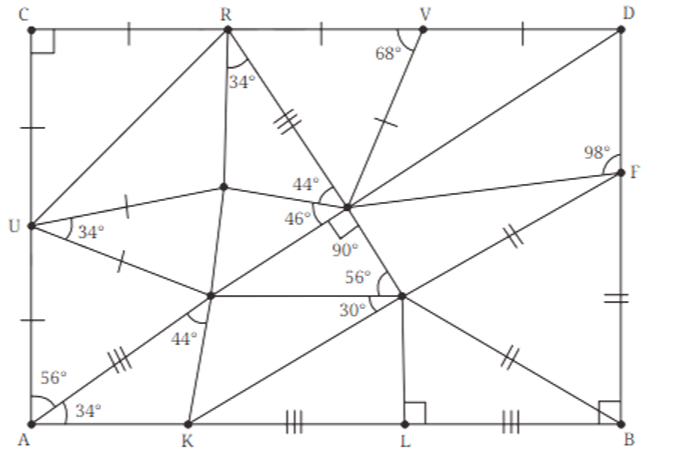
Solution:
- Identify isosceles triangles by equal line markings.
Base angles of isosceles triangles are equal. - Use the sum of angles in a triangle:
{tex}\angle 1+\angle 2+\angle 3=180^{\circ}{/tex} - Work systematically:
For each triangle, use given angles plus your equal side marker clues to solve for unknown angles.
Examples:
Triangle URK:
{tex}R U=U K, \angle U K R=34^{\circ}{/tex} (given).
The base angles at {tex}U{/tex} and {tex}R{/tex} are equal, let them be {tex}x{/tex}.
{tex}x+x+34^{\circ}=180^{\circ}{/tex}
{tex}2 x=146^{\circ} \Longrightarrow x=73^{\circ}{/tex}
So, {tex}\angle K U R=\angle K R U=73^{\circ}{/tex}.
Triangle KUL:
If you have a right angle at K or L, and another angle is given, use {tex}180^{\circ}{/tex} total for the triangle.
For example:
{tex}\angle K U L=56^{\circ}, \angle U K L=90^{\circ}{/tex}, then
{tex}\angle L K U=180^{\circ}-56^{\circ}-90^{\circ}=34^{\circ}{/tex}.
Repeat for all triangles in the figure using these steps.

Test Generator
Create question paper PDF and online tests with your own name & logo in minutes.
Create Now
Learn8 App
Practice unlimited questions for Entrance tests & government job exams at ₹99 only
Install Now