The Amazing World of Solutes, Solvents and Solutions- NCERT Solutions Class 8 Science (Curiosity) includes all the questions with solutions given in the NCERT Class 8 Science (Curiosity).
NCERT Solutions Class 8
English Poorvi Hindi Malhar Maths Ganita Prakash Science Curiosity Social Exploring SocietyThe Amazing World of Solutes, Solvents and Solutions – NCERT Solutions
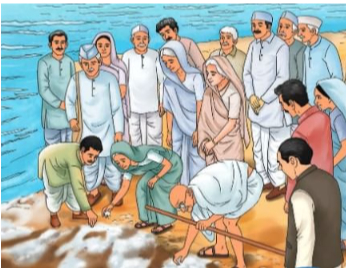
Q.1: What do you think is happening in the picture below?
Solution:
- The picture shows Mahatma Gandhi obtaining salt from the sea during the Salt March, accompanied by followers.
- This illustrates the historical process of extracting salt from seawater through evaporation, where seawater acts as a natural solution with salt as the solute and water as the solvent, highlighting concepts of solubility and traditional salt production.
Q.2: What happens when you add too much sugar to your tea and it stops dissolving? How can you solve this problem?
Solution:
- When too much sugar is added, the tea becomes a saturated solution, and excess sugar settles at the bottom as it can no longer dissolve at that temperature.
- To solve this, heat the tea to increase the solubility of sugar, allowing more to dissolve, as solubility generally increases with temperature for solids in liquids.
Q.3: Why do sugar and salt dissolve in water but not in oil? Why is water considered a good solvent?
Solution:
- Sugar and salt dissolve in water because water is a polar solvent that can break apart ionic bonds in salt or form hydrogen bonds with sugar molecules.
- Oil is non-polar, so it does not interact with these polar or ionic solutes.
- Water is considered a good solvent due to its polarity, allowing it to dissolve a wide range of substances, earning it the title “universal solvent”.
Q.4: Why are water bottles usually tall and cylindrical in shape instead of spherical?
Solution:
- Tall, cylindrical shapes are more efficient for storage, stacking, and manufacturing.
- They provide better grip, stability, and use less material for the same volume compared to spheres, which would roll and be harder to handle.
Q.5: Oxygen gas is more soluble in hot water rather than in cold water.
Options:
(1) True
(2) False ✅
Explanation: Oxygen gas is more soluble in cold water rather than in hot water, as the solubility of gases decreases with increasing temperature.
Q.6: A mixture of sand and water is a solution.
Options:
(1) True
(2) False ✅
Explanation: A mixture of sand and water is a non-uniform mixture, not a solution.
Q.7: The amount of space occupied by any object is called its mass.
Options:
(1) True
(2) False ✅
Explanation: The amount of space occupied by any object is called its volume, not mass.
Q.8: An unsaturated solution has more solute dissolved than a saturated solution.
Options:
(1) True
(2) False ✅
Explanation: An unsaturated solution has less solute dissolved than a saturated solution; a saturated solution cannot dissolve more solute at that temperature.
Q.9: The mixture of different gases in the atmosphere is also a solution.
Options:
(1) True ✅
(2) False
Explanation: The mixture of different gases in the atmosphere is a solution, with nitrogen as the solvent.
Q.10: The volume of a solid can be measured by the method of displacement, where the solid is __________ in water and the ____________ in water level is measured.
Solution: immersed, rise
Q.11: The maximum amount of _______________ dissolved in _______________ at a particular temperature is called solubility at that temperature.
Solution: solute, solvent
Q.12: Generally, the density ____________ with increase in temperature.
Solution: decreases
Q.13: The solution in which glucose has completely dissolved in water, and no more glucose can dissolve at a given temperature, is called a __________ solution of glucose.
Solution: saturated
Q.14: You pour oil into a glass containing some water. The oil floats on top. What does this tell you?
Options:
(1) Oil is denser than water
(2) Water is denser than oil ✅
(3) Oil and water have the same density
(4) Oil dissolves in water
Explanation: Oil floats because its density is lower than water’s, causing less dense substances to float on denser ones.
Q.15: A stone sculpture weighs 225 g and has a volume of 90 cm3. Calculate its density and predict whether it will float or sink in water.
Solution: Density = Mass / Volume = 225 g / 90 cm3 = 2.5 g/cm3.
Since this is greater than water’s density (1 g/cm3), the sculpture will sink in water.
Q.16: Which one of the following is the most appropriate statement, and why are the other statements not appropriate?
Options:
(1) A saturated solution can still dissolve more solute at a given temperature.
(2) An unsaturated solution has dissolved the maximum amount of solute possible at a given temperature.
(3) No more solute can be dissolved into the saturated solution at that temperature. ✅
(4) A saturated solution forms only at high temperatures.
Explanation:
- is incorrect because a saturated solution cannot dissolve more.
- describes a saturated, not unsaturated, solution.
- is wrong as saturation can occur at any temperature.
Q.17: You have a bottle with a volume of 2 litres. You pour 500 mL of water into it. How much more water can the bottle hold?
Solution: The bottle can hold an additional 1,500 mL (or 1.5 litres) of water, as 2 litres – 0.5 litres = 1.5 litres.
Q.18: An object has a mass of 400 g and a volume of 40 cm3. What is its density?
Solution: Density = 400 g / 40 cm3 = 10 g/cm3.
Q.19: Analyse Fig.(a) and (b). Why does the unpeeled orange float, while the peeled one sinks? Explain.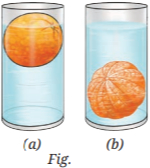
Solution: The unpeeled orange floats due to air pockets in the peel, reducing its overall density below that of water. The peeled orange sinks because, without the peel, its density is higher than water’s.
Q.20: Object A has a mass of 200 g and a volume of 40 cm3. Object B has a mass of 240 g and a volume of 60 cm3. Which object is denser?
Solution: Density of A: 200 g / 40 cm³ = 5 g/cm3. Density of B: 240 g / 60 cm3 = 4 g/cm3. Object A is denser.
Q.21: Reema has a piece of modeling clay that weighs 120 g. She first moulds it into a compact cube that has a volume of 60 cm3. Later, she flattens it into a thin sheet. Predict what will happen to its density.
Solution: The density remains the same (120 g / 60 cm3 = 2 g/cm3 initially) because mass is constant, and changing shape does not affect density, only volume and arrangement.
Q.22: A block of iron has a mass of 600 g and a density of 7.9 g/cm3. What is its volume?
Solution: Volume = Mass / Density = 600 g / 7.9 g/cm3 = 75.95 cm3.
Q.23: You are provided with an experimental setup as shown in Fig. (a) and (b). On keeping the test tube (Fig b) in a beaker containing hot water (70 °C), the water level in the glass tube rises. How does it affect the density?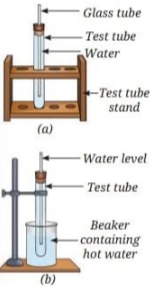
Solution: Heating causes the air in the tube to expand, increasing volume and decreasing density, which makes the water level rise as less dense air pushes up.
Q.24: Research project on Dead Sea: Why is there no aquatic life in the Dead Sea? Try to find out if there are any other similar water bodies.
Solution: The Dead Sea is super salty-about 34% salt! That’s way too much for most fish, plants, or animals to live there because the salt pulls water out of their bodies, stressing them out. Only tough bacteria can survive. This happens because the water evaporates a lot, leaving salt behind, and there’s no river to wash it away. Other places like this are the Great Salt Lake in Utah, USA (too salty for most life), and Lake Assal in Djibouti (one of the saltiest spots on Earth with very few living things)
Q.25: Investigate how well common salt dissolves in different solvents, such as water, vinegar, and oil. Compare the solubility of salt in each solvent and record your observations.
Solution: Try this experiment! In water (a polar liquid that attracts salt), the salt mixes in completely and makes a clear liquid. In vinegar (also polar but a bit weaker), some salt dissolves, but not as much as in water- it might look a little cloudy. In oil (non-polar, like grease), the salt doesn’t dissolve at all and just sits at the bottom. What I observed: Water is best because its molecules pull salt apart easily. Oil doesn’t work because it doesn’t mix with salt’s particles. This shows why some things dissolve and others don’t!
Q.26: Debate in class- Is water truly the most versatile solvent?
Solution: Let’s debate!
Yes side: Water is awesome because it’s polar, so it can dissolve salts, sugars, gases, and more. It helps in our blood, oceans, and even rain-keeping life going!
No side: Water isn’t perfect-it can’t dissolve oily stuff like fats or petrol. Other solvents like alcohol (ethanol) can handle both watery and oily things better in some cases, like in medicines or cleaning.
Conclusion: Water is super useful for many things, but it’s not the only star-it depends on what you’re trying to dissolve. Have fun arguing with your classmates!
NCERT Solutions Class 8 Science Curiosity
- Exploring the Investigative World of Science
- The Invisible Living World: Beyond Our Naked Eye
- Health: The Ultimate Treasure
- Electricity: Magnetic and Heating Effects
- Exploring Forces
- Pressure, Winds, Storms, and Cyclones
- Particulate Nature of Matter
- Nature of Matter: Elements, Compounds, and Mixtures
- The Amazing World of Solutes, Solvents, and Solutions
- Light: Mirrors and Lenses
- Keeping Time with the Skies
- How Nature Works in Harmony
- Our Home: Earth, a Unique Life-Sustaining Planet

Test Generator
Create question paper PDF and online tests with your own name & logo in minutes.
Create Now
Learn8 App
Practice unlimited questions for Entrance tests & government job exams at ₹99 only
Install Now