Tissues in Action – NCERT Solutions Class 9 Science Exploration includes all the questions with solutions given in NCERT Class 9 Science Exploration textbook.
NCERT Solutions Class 9
English Kaveri Hindi Ganga Sanskrit Sharada Maths Ganita Manjari Science Exploration Social Understanding SocietyTissues in Action – NCERT Solutions
Q.1: You may have noticed that fibres of coconut husk are hard and brittle, whereas the leaf stalks of coriander are soft and flexible. Find out the reason.
Solution: The difference is due to the type of plant tissue present:
- Coconut husk fibres are made of sclerenchyma tissue, which has thick, lignified cell walls. This makes them hard and brittle.
- Coriander leaf stalks contain collenchyma tissue, which has unevenly thickened cell walls. This provides flexibility and softness.
So, the difference arises from sclerenchyma (hard) vs collenchyma (flexible) tissues.
Q.2: Why do you think that a thick cuticle on the outer wall of epidermis is advantageous for a plant living in the desert but disadvantageous for a plant living underwater?
Solution:
- In desert plants: A thick cuticle (waxy layer) reduces water loss by transpiration, which is essential in dry conditions. So it is advantageous.
- In underwater plants: A thick cuticle would hinder absorption of water, gases, and minerals directly from surroundings. Since water is abundant, they don’t need protection from loss. So it is disadvantageous.
Q.3: Once water is absorbed by plant roots, it has to travel against gravity through xylem. How do the ‘dead’ cells of the xylem work together with the living cells of leaves at the top to keep the water moving?
Solution: Water moves up through xylem mainly due to the transpiration pull mechanism:
- In leaves (living cells): Water evaporates from leaf surfaces (transpiration). This creates a negative pressure (suction) at the top.
- In xylem (dead cells): Xylem vessels are hollow and continuous, allowing water to move upward easily. Water molecules stick together (cohesion) and to the walls (adhesion), forming a continuous column.
So, transpiration in living leaf cells pulls the water upward, and the dead xylem cells provide a continuous pathway to maintain this flow against gravity.
Q.4: What do you think will happen if there were no stomata in the epidermis of the stem or leaves?
Solution: If there were no stomata:
- No gas exchange → CO₂ cannot enter → photosynthesis stops
- No oxygen release
- No transpiration → no cooling and no upward pull of water
- Transport of water and minerals gets affected
Ultimately, the plant would not survive.
Q.5: Look at the picture given below. Carefully observe the various poses of classical and folk dances of India. Can you identify which joints are involved? Also, what type of movement each joint allows?
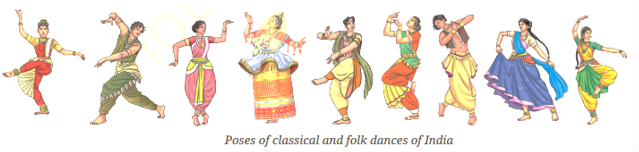
Solution: In the different dance poses, mainly the following joints and movements are involved:
- Shoulder joints (ball and socket joint)
→ Allow movement in all directions (circular movement of arms) - Hip joints (ball and socket joint)
→ Enable rotation and wide leg movements - Elbow joints (hinge joint)
→ Allow back-and-forth movement (bending and straightening of arms) - Knee joints (hinge joint)
→ Help in bending legs and jumping movements - Neck joint (pivot joint)
→ Allows rotation of the head - Wrist and ankle joints (gliding joints)
→ Provide small, flexible movements
Q.6: Meristematic tissues divide repeatedly. What property of their cells allows them to do this?
Options:
(1) They have thick walls for protection.
(2) They contain large vacuoles that store nutrients.
(3) They have thin walls, dense cytoplasm and large prominent nucleus. ✅
(4) They are functionally differentiated cells.
Explanation: Meristematic cells are actively dividing cells. For continuous division:
- Thin cell walls allow easy division
- Dense cytoplasm supports high metabolic activity
- Large nucleus controls rapid cell division
They lack large vacuoles and are not differentiated, which keeps them capable of dividing repeatedly.
Q.7: If a plant is unable to transport food from leaves to roots which tissue is malfunctioning?
Options:
(1) Xylem
(2) Phloem ✅
(3) Epidermis
(4) Sclerenchyma
Explanation:
- Phloem transports food (sugars) from leaves to other parts like roots.
- Xylem transports water and minerals (not food).
- Epidermis is protective tissue.
- Sclerenchyma provides support.
Q.8: Why are the epithelial tissues that line an animal’s internal organs usually only one or a few cells thick?
Options:
(1) To store food efficiently.
(2) To provide maximum strength.
(3) To allow quick exchange of materials across them. ✅
(4) To reduce friction.
Explanation: Epithelial tissues lining internal organs are thin so that diffusion of substances (like gases, nutrients, wastes) can occur rapidly and efficiently across them.
Q.9: You can perform these two jumps:
Straight-leg jump – keep knees and ankles stiff.
Normal jump – bend knees and ankles naturally.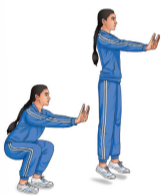
How did your ankle, knee and hip positions differ between the two jumps?
Solution: Straight-leg jump:
- Ankles, knees, hips remain mostly straight and stiff
- Very little bending → limited movement
Normal jump:
- Ankles, knees, hips bend (flex) before jumping
- Then extend (straighten) during take-off
So, the normal jump involves flexion and extension at all three joints, while the straight-leg jump keeps them rigid.
Q.10: Which type of joint is involved when you bend your knees and ankles?
- Ball and socket
- Hinge
- Pivot
Solution: (ii) Hinge
Explanation:
- Knee and ankle joints mainly allow back-and-forth movement (flexion and extension)
- This type of movement is characteristic of a hinge joint (like a door hinge)
Q.11: Assertion (A): Cardiac muscle can contract continuously without fatigue.
Reason (R): Cardiac muscle cells have a high number of mitochondria and an abundant blood supply.
Options:
(1) Both A and R are true and R is the correct explanation of A. ✅
(2) Both A and R are true but R is not the correct explanation of A.
(3) A is true but R is false.
(4) A is false but R is true.
Explanation:
- Assertion is true: Cardiac muscles can work continuously without fatigue.
- Reason is true: They have many mitochondria and a rich blood supply, providing constant energy.
- This directly explains their ability to contract continuously.
Q.12: Assertion (A): Tendons connect bone to bone and allow joint movement.
Reason (R): Tendons are made of tough connective tissue that transmits force from muscle to bone.
Options:
(1) Both A and R are true and R is the correct explanation of A.
(2) Both A and R are true but R is not the correct explanation of A.
(3) A is true but R is false.
(4) A is false but R is true. ✅
Explanation:
- Assertion is false: Tendons connect muscle to bone, not bone to bone.
- Reason is true: Tendons are strong connective tissues that transmit force from muscle to bone, enabling movement.
Q.13: Assertion (A): In a hinge joint, movement occurs primarily in one plane.
Reason (R): The bone ends are shaped to allow sliding in all directions.
Options:
(1) Both A and R are true and R is the correct explanation of A.
(2) Both A and R are true but R is not the correct explanation of A.
(3) A is true but R is false. ✅
(4) A is false but R is true.
Explanation:
- Assertion is true: Hinge joints (like knee, elbow) allow movement in one plane (back and forth).
- Reason is false: “Sliding in all directions” describes gliding joints, not hinge joints.
Q.14: Assertion (A): Epithelium is well-suited for gas exchange in the lungs.
Reason (R): It consists of multiple layers of tall cells that slow down diffusion.
Options:
(1) Both A and R are true and R is the correct explanation of A.
(2) Both A and R are true but R is not the correct explanation of A.
(3) A is true but R is false. ✅
(4) A is false but R is true.
Explanation:
- Assertion is true: Lung epithelium (simple squamous) is very thin, making it ideal for gas exchange.
- Reason is false: It is not multilayered or tall; such a structure would slow diffusion, not support it.
Q.15: Plot a graph between the age of a tree (in years) on the x-axis and the diameter of the tree (in cm) along with the number of annual rings formed over time on the y-axis, using the data given in the Table.
Table: Data related to the age of a teak tree, and corresponding increase in the diameter of stem and number of annual rings
| S. No. | Age of the teak tree (Years) | DBH (Diameter at Breast Height) of tree (cm) | Number of annual rings formed |
| 1. | 5 | 4 | 5 |
| 2. | 10 | 8 | 10 |
| 3. | 20 | 24 | 20 |
| 4. | 25 | 28 | 25 |
| 5. | 30 | 32 | 30 |
| 6. | 40 | 40 | 40 |
- Analyse the graph in terms of the diameter of the stem over time and share the interpretation.
- What is the relation between the diameter of the teak tree to the annual rings formed?
- Which specialised tissue is responsible for the girth of the stem and where is it located?
Solution:
- Analysis of graph:
- As the age of the tree increases, the diameter of the stem also increases.
- The growth is not perfectly uniform—it increases more rapidly at certain stages.
This shows continuous growth over time.
- Relation between diameter and annual rings:
- Number of annual rings = Age of the tree
- As annual rings increase, the diameter also increases
So, they are directly related.
- Tissue responsible for girth:
- Vascular cambium (lateral meristem)
- Located between xylem and phloem
It causes increase in girth (secondary growth) of the stem.
Q.16: In a forest, it was observed that one of the trees was severely debarked by an elephant to meet its food requirements, as the bark is a rich source of nutrients. Based on your learning, answer the following: Which function(s) of the tree is/are hampered by debarking?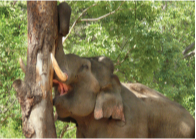
- Which plant tissue would be affected by further damage to the tree trunk even after debarking? (1)
- Which function of the tree would be hampered if the tissues beneath the bark were severely damaged? (1)
- What assumptions are you making to answer the questions above? (2)
OR
How would the answer change if your assumptions are also changed? (2)
Solution:
- Function(s) hampered by debarking:
- Transport of food (photosynthesis products) through phloem
- Food cannot move from leaves to roots
- Tissue affected later:
- Cambium
- Continuous damage can stop growth in girth
- If tissues beneath bark are damaged:
- Xylem gets affected
- Water transport from roots to leaves will be hampered
Assumptions & change:- Assumption: Bark includes phloem and protective tissues, and inner tissues are initially intact
- If deeper tissues (like xylem/cambium) are also damaged →
- Both food and water transport stop, leading to death of the tree
Q.17: Aamrapali observed that a young mango sapling’s stem bends flexibly during monsoon winds and does not break. Which tissue is responsible for this flexibility? Predict and provide your explanation of the impact if the existing tissue was replaced by sclerenchyma.
Solution: The flexibility of the young mango sapling stem is due to collenchyma tissue.
Explanation:
- Collenchyma cells have unevenly thickened walls, which provide support along with flexibility.
- This allows the stem to bend in wind without breaking.
If replaced by sclerenchyma:
- Sclerenchyma has thick, lignified (rigid) cell walls.
- The stem would become hard and brittle, losing flexibility.
Q.18: Sohan designed an experiment for the regeneration of sugarcane, where he used cuttings to grow sugarcane. He used two types of cuttings, type ‘A’ and type ‘B’. After a few weeks, type ‘B’ cuttings sprouted and developed into sugarcane plants, whereas the type ‘A’ cuttings did not sprout.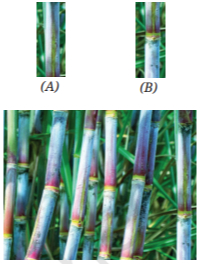
- Why were the type ‘B’ cuttings able to grow as sugarcane but type ‘A’ could not? (1)
- What difference was present in type ‘B’ compared to type ‘A’? (1)
- What observation or measurement was made to determine whether this change had an effect? (2)
OR
What parameters should be kept the same for both types of cuttings to ensure a fair comparison? (2)
Solution:
- Type B had buds (meristem) → could grow; Type A had none → no growth
- Type B: nodes with buds; Type A: no buds
- Sprouting/new shoot formation observed
OR
Keep same: soil, water, sunlight, temperature, size of cuttings
Q.19: During the discussion in class, Rohan gives a statement that, “A tissue is a group of similar cells performing similar functions”. But Rajiv counter argues that, “this is true in case of simple tissues but little different in case of complex tissues”. Provide your explanation in view of the discussion in class.
Solution:
- Rohan is correct for simple tissues → they are made of similar cells performing the same function (e.g., parenchyma, collenchyma).
- Rajiv is correct for complex tissues → they consist of different types of cells working together for a common function (e.g., xylem, phloem).
- So, the definition applies fully to simple tissues, but complex tissues have different cell types with a shared function.
Q.20: Coconut husk fibres are used for mats which are tough and fibrous. Which tissue has structural features suitable for providing this strength? Explain why living parenchyma couldn’t serve the same purpose.
Solution: Tissue responsible: Sclerenchyma
Explanation: Coconut husk fibres are tough because sclerenchyma cells have thick, lignified cell walls that provide great mechanical strength and rigidity.
Why not parenchyma?
Living parenchyma cells have thin cell walls and are soft, so they cannot provide the strength and toughness required for fibres like coconut husk.
Q.21: Vibha claims to her friend Neha that, “Meristematic cells are located only at the root and shoot apices”. What do you think about this statement? What question can Neha ask Vibha to help her understand further if the statement is incorrect?
Solution: Vibha’s statement is incorrect.
Meristematic tissues are not only present at root and shoot apices (apical meristem), but also:
- Intercalary meristem (at nodes/internodes)
- Lateral meristem (cambium, for increase in girth)
Question Neha can ask:
“If meristematic cells are only at apices, then how does a plant increase in thickness (girth)?”
Q.22: A plant cell and an animal cell are of the same size.
- Which cell will have a larger vacuole? Give reasons.
- What assumptions are you making to answer the question above?
Solution:
- The plant cell will have a larger vacuole
Because plant cells typically contain a large central vacuole that maintains turgor pressure, storage, and support.
Animal cells either have small vacuoles or none. - Assumptions:
- Both cells are typical, mature cells
- No special modifications (like storage cells, etc.)
- Normal conditions where plant cells maintain turgidity
Q.23: A textbook states, “Each plant tissue performs only one specific function”. What questions would you ask to critically examine the correctness of this statement? What examples of tissues would you take to find out the answers to these questions?
Solution:
- Do all tissues perform only one function, or can they have multiple roles?
- Are there tissues that provide both support and storage/transport?
- Do complex tissues perform more than one function?
Examples to check:
- Parenchyma → storage, photosynthesis, healing
- Collenchyma → support + flexibility
- Xylem → transport of water + support
- Phloem → transport of food
Class 9 Science Exploration NCERT Solutions
- Exploration: Entering the World of Secondary Science
- Cell: The Building Block of Life
- Tissues in Action
- Describing Motion Around Us
- Exploring Mixtures and Their Separation
- How Forces Affect Motion
- Work, Energy and Simple Machines
- Journey Inside the Atom
- Atomic Foundations of Matter
- Sound Waves: Characteristics and Applications
- Reproduction: How Life Continues
- Patterns in Life: Diversity and Classification
- Earth as a System: Energy, Matter and Life

Test Generator
Create question paper PDF and online tests with your own name & logo in minutes.
Create Now
Learn8 App
Practice unlimited questions for Entrance tests & government job exams at ₹99 only
Install Now