Exploring Algebraic Identities – NCERT Solutions Class 9 Maths Ganita Manjari includes all the questions with solutions given in NCERT Class 9 Ganita Manjari textbook.
NCERT Solutions Class 9
English Kaveri Hindi Ganga Sanskrit Sharada Maths Ganita Manjari Science Exploration Social Understanding SocietyExploring Algebraic Identities – NCERT Solutions
Q.1:
What can you say about a and b if (a + b)2 < a2 + b2?
Solution:
Given:
{tex} (a+b)^2<a^2+b^2 {/tex}
Expand LHS:
{tex} (a+b)^2=a^2+2 a b+b^2 {/tex}
So inequality becomes:
{tex} a^2+2 a b+b^2<a^2+b^2 {/tex}
Subtract {tex}a^2+b^2{/tex} from both sides:
{tex} 2 a b <0 {/tex}
{tex} a b <0 {/tex}
Conclusion:
{tex}a{/tex} and {tex}b{/tex} have opposite signs
(one is positive and the other is negative)
Q.2:
What can you say about a and b if (a + b)2 > a2 + b2?
Solution:
{tex} (a+b)^2=a^2+2 a b+b^2 {/tex}
a = 8
b = 4
{tex} (a+b)^2=a^2+2 a b+b^2 {/tex}
{tex} 12^2=64+32+32+16=144 {/tex}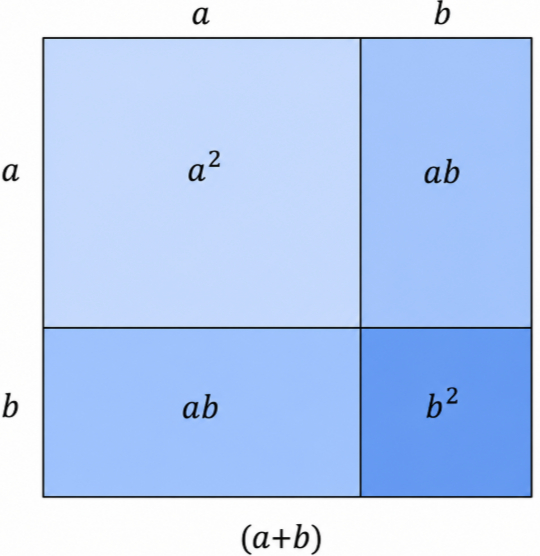
Comparing with {tex}a^2+b^2{/tex}:
{tex} (a+b)^2=a^2+b^2+2 a b {/tex}
So,
{tex} (a+b)^2>a^2+b^2 \Rightarrow 2 a b>0 \Rightarrow a b>0 {/tex}
This means:
{tex} a{/tex} and {tex}b{/tex} have the same sign (both positive or both negative)
Therefore, when {tex}a{/tex} and {tex}b{/tex} are of the same sign, {tex}(a+b)^2>a^2+b^2{/tex}.
Q.3:
When will (a + b)2 be equal to a2 + b2?
Solution:
For {tex}(a+b)^2{/tex} to be equal to {tex}a^2+b^2{/tex}:
{tex} a^2+2 a b+b^2=a^2+b^2 {/tex}
{tex} \Rightarrow 2 a b=0 \Rightarrow a b=0 {/tex}
This happens when:
{tex}a=0{/tex} or {tex}b=0{/tex}
Therefore, {tex}(a+b)^2=a^2+b^2{/tex} when one of the numbers is zero.
Q.4:
Did you observe that {tex}(a+b)^2{/tex} and {tex}a^2+b^2{/tex} are both positive? What term will decide which is larger? Use the expansion of {tex}(a+b)^2{/tex} to decide.
Solution:
Both {tex}(a+b)^2{/tex} and {tex}a^2+b^2{/tex} are always positive (since they are sums of squares).
Now compare them:
{tex} (a+b)^2=a^2+b^2+2 a b {/tex}
So, the term that decides which is larger is {tex}2 a b{/tex}.
- If {tex}2 a b>0{/tex}, then {tex}(a+b)^2>a^2+b^2{/tex}
- If {tex}2 a b<0{/tex}, then {tex}(a+b)^2<a^2+b^2{/tex}
- If {tex}2 a b=0{/tex}, then {tex}(a+b)^2=a^2+b^2{/tex}
Therefore, the deciding term is {tex}2 a b{/tex}.
Q.5:
What if we replace {tex}b{/tex} by {tex}-b{/tex} in {tex}(a+b)^2=a^2+2 a b+b^2{/tex}?
Solution:
Replace b by −b in the identity:
So,
{tex} (a+(-b))^2=a^2+2 a(-b)+(-b)^2 {/tex}
{tex} =a^2-2 a b+b^2 {/tex}
Therefore, when we replace {tex}b{/tex} by {tex}-b{/tex}, we get a new identity:
{tex} (a-b)^2=a^2-2 a b+b^2 {/tex}
This is the identity for the square of a difference.
Q.6:
Label the squares and rectangles in Fig. 4.4 so that it represents the identity {tex}(a+b+c)^2=a^2+b^2+c^2+2 a b+2 b c+2 c a{/tex}.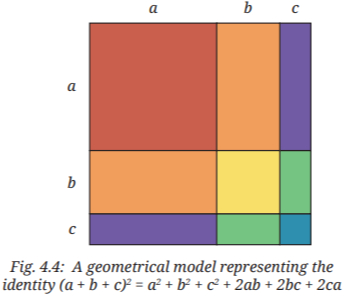
Solution:
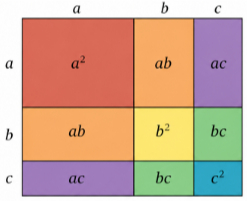
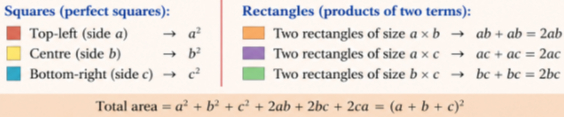
Q.7:
Try to evaluate the following using a suitable identity:
- 352
- 652
- 852
- 1052
Do you observe any interesting pattern?
Solution:
Use the identity:
{tex}(a+b)^2=a^2+2 a b+b^2{/tex}
- {tex}35^2=(30+5)^2=30^2+2 \cdot 30 \cdot 5+5^2{/tex} {tex}=900+300+25={/tex} 1225
- {tex}65^2=(60+5)^2=60^2+2 \cdot 60 \cdot 5+5^2{/tex} {tex}=3600+600+25={/tex} 4225
- {tex}85^2=(80+5)^2=80^2+2 \cdot 80 \cdot 5+5^2{/tex} {tex}=6400+800+25={/tex} 7225
- {tex}105^2=(100+5)^2=100^2+2 \cdot 100 \cdot 5+5^2{/tex} {tex}=10000+ 1000+25=11025{/tex}
Interesting pattern:
- All numbers end with 5
- Their squares always end with 25
- The remaining digits come from multiplying the number before 5 with its next number{tex} \text { (e.g., } 3 \times 4=12,6 \times 7=42 \text {, etc.) } {/tex}
So, numbers ending in 5 follow a special squaring pattern.
Q.8:
Observe the two rows of figures below. They represent an algebraic identity. Try to identify it.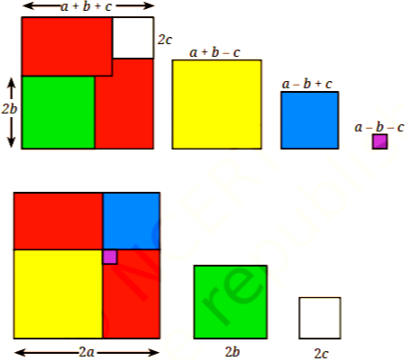
Solution:
From the figure, the same area is represented in two different ways.
First representation:
The shapes correspond to squares with sides:
- {tex}a+b+c{/tex}
- {tex}a+b-c{/tex}
- {tex}a-b+c{/tex}
- {tex}a-b-c{/tex}
So, total area:
{tex} (a+b+c)(a+b-c)(a-b+c)(a-b-c) {/tex}
Second representation:
The same area is rearranged into:
- a square of side {tex}2 a \rightarrow{/tex} area {tex}4 a^2{/tex}
- a square of side {tex}2 b \rightarrow{/tex} area {tex}4 b^2{/tex}
- a square of side {tex}2 c \rightarrow{/tex} area {tex}4 c^2{/tex}
So, total area:
{tex} 4 a^2-4 b^2-4 c^2+4 b c \text { (after simplification) } {/tex}
Final identity:
{tex} (a+b+c)(a+b-c)(a-b+c)(a-b-c){/tex} {tex}=\left(a^2-b^2-c^2\right)^2-(2 b c)^2 {/tex}
{tex} =a^4+b^4+c^4-2 a^2 b^2-2 b^2 c^2-2 c^2 a^2 {/tex}
Required identity:
{tex} (a+b+c)(a+b-c)(a-b+c)(a-b-c){/tex} {tex}=a^4+b^4+c^4-2 a^2 b^2-2 b^2 c^2-2 c^2 a^2 {/tex}
Q.9:
Suppose 7x is split as 2x + 5x; can a similar rectangular arrangement be formed? Consider other possibilities and check.
Solution:
No, a similar rectangular arrangement cannot be formed if {tex}7 x{/tex} is split as {tex}2 x+5 x{/tex}.
In algebra tiles (as shown in your chapter), to form a rectangle:
- The split must allow tiles to arrange into equal rows and columns
- The numbers should correspond to factors of the constant term
For {tex}x^2+7 x+12{/tex} :
Correct split: {tex}7 x=3 x+4 x{/tex} because {tex}3 \times 4=12{/tex}
→ forms rectangle {tex}(x+3)(x+4){/tex}
But if we try:
{tex}7 x=2 x+5 x{/tex}
{tex} \rightarrow 2 \times 5=10 \neq 12 {/tex}
So tiles cannot form a complete rectangle.
A rectangular arrangement is possible only when the split numbers multiply to the constant term (12).
Thus, {tex}3 x+4 x{/tex} works, but {tex}2 x+5 x{/tex} does not.
Q.10:
Algebra tiles can be used to represent products and find factors. Figure out the product of x + 2 and x + 3 using algebra tiles.
Solution:
Product of {tex}x+2{/tex} and {tex}x+3{/tex}
Using algebra tiles:
- {tex}x \times x=x^2{/tex}
- {tex}x \times 3=3 x{/tex}
- {tex}2 \times x=2 x{/tex}
- {tex}2 \times 3=6{/tex}
Adding:
{tex} x^2+3 x+2 x+6=x^2+5 x+6 {/tex}
So,
{tex} (x+2)(x+3)=x^2+5 x+6 {/tex}
Q.11:
Algebra tiles can be used to represent products and find factors. Lay out algebra tiles for x2 + 11x + 30 in such a way that you will see its factors.
Solution:
Factorisation of {tex}x^2+11 x+30{/tex} using tiles
To arrange algebra tiles into a rectangle:
Split {tex}11 x{/tex} into two parts such that their product is 30
{tex} 11 x=5 x+6 x \text { and } 5 \times 6=30 {/tex}
Now arrange:
- {tex}x^2{/tex} tile in one corner
- {tex}5 x{/tex}-tiles on one side
- {tex}6 x{/tex}-tiles on the other side
- 30 unit tiles forming a rectangle
This forms a rectangle with sides:
{tex} (x+5) \text { and }(x+6) {/tex}
Q.12:
James and Reshma were talking about algebraic identities they learnt in school.
James: {tex}(a-b)^2(a+b)=\left(a^2-2 a b+b^2\right)(a+b){/tex}
Reshma: I have a different idea. {tex}(a-b)^2(a+b)=(a-b)[(a-b)(a+b)]{/tex} {tex} =(a-b)\left(a^2-b^2\right) {/tex}
I will find this product to get the answer.
According to you, who is correct and why?
Try to combine more such identities and find new results.
Solution:
James’s method:
He expands step by step:
{tex} (a-b)^2(a+b)=\left(a^2-2 a b+b^2\right)(a+b) {/tex}
Then multiplies further to get the result.
Reshma’s method:
She uses identities smartly:
{tex} (a-b)^2(a+b)=(a-b)[(a-b)(a+b)] {/tex}
Now using:
{tex} (a-b)(a+b)=a^2-b^2 {/tex}
So,
{tex} =(a-b)\left(a^2-b^2\right) {/tex}
This method is shorter and more efficient.
Conclusion:
- Both methods give the same final result
- Reshma’s method is better because it uses identities cleverly and reduces steps
New identity formed:
Using Reshma’s idea:
{tex} (a-b)^2(a+b)=(a-b)\left(a^2-b^2\right) {/tex}
You can further expand:
{tex} =a^3-a^2 b-a b^2+b^3 {/tex}
Insight:
Combining identities like:
- {tex}(a-b)^2{/tex}
- {tex}(a-b)(a+b){/tex}
helps create new identities and faster methods for solving problems.
Q.13:
Try to simplify the following rational expression:
{tex} \frac{36 s^2-12 s t+t^2}{t^2+2 t s-48 s^2}=\frac{(6 s-t)^2}{(\_\_\_\_\_\_\_\_+\_\_\_\_\_\_\_\_)(\_\_\_\_\_\_\_\_+\_\_\_\_\_\_\_\_)} {/tex}
Solution:
First factor both numerator and denominator.
Numerator:
{tex} 36 s^2-12 s t+t^2=(6 s-t)^2 {/tex}
Denominator:
Factor {tex}t^2+2 t s-48 s^2{/tex}.
We need two numbers whose:
- sum {tex}=2{/tex}
- product {tex}=-48{/tex}
These are 8 and -6 .
So,
{tex} t^2+2 t s-48 s^2=(t+8 s)(t-6 s) {/tex}
Now simplify:
{tex} \frac{36 s^2-12 s t+t^2}{t^2+2 t s-48 s^2}=\frac{(6 s-t)^2}{(t+8 s)(t-6 s)} {/tex}
Note:
{tex} (6 s-t)=-(t-6 s) {/tex}
So,
{tex} (6 s-t)^2=(t-6 s)^2 {/tex}
Cancel one common factor:
{tex} =\frac{t-6 s}{t+8 s} {/tex}
Q.14:
Using the identity {tex}(a+b)^2=a^2+2 a b+b^2{/tex}, expand {tex}(7 x+4 y)^2{/tex}.
Solution:
Using the identity
{tex} (a+b)^2=a^2+2 a b+b^2 {/tex}
we expand {tex}(7 x+4 y)^2{/tex}
Here {tex}a=7 x, b=4 y{/tex}
{tex} =(7 x)^2+2(7 x)(4 y)+(4 y)^2=49 x^2+56 x y+16 y^2 {/tex}
Q.15:
Using the identity {tex}(a+b)^2=a^2+2 a b+b^2{/tex}, expand {tex}\left(\frac{7}{5} x+\frac{3}{2} y\right)^2{/tex}.
Solution:
Using the identity
{tex}(a+b)^2=a^2+2 a b+b^2{/tex}
we expand {tex}\left(\frac{7}{5} x+\frac{3}{2} y\right)^2{/tex}
{tex} =\left(\frac{7}{5} x\right)^2+2\left(\frac{7}{5} x\right)\left(\frac{3}{2} y\right)+\left(\frac{3}{2} y\right)^2 {/tex}
{tex} =\frac{49}{25} x^2+\frac{21}{5} x y+\frac{9}{4} y^2 {/tex}
Q.16:
Using the identity {tex}(a+b)^2=a^2+2 a b+b^2{/tex}, expand {tex}(2.5 p+1.5 q)^2{/tex}.
Solution:
Using the identity
{tex} (a+b)^2=a^2+2 a b+b^2 {/tex}
we expand {tex} (2.5 p+1.5 q)^2 {/tex}
{tex} = (2.5 p)^2+2(2.5 p)(1.5 q)+(1.5 q)^2 {/tex}
{tex} =6.25 p^2+7.5 p q+2.25 q^2 {/tex}
Q.17:
Using the identity {tex}(a+b)^2=a^2+2 a b+b^2{/tex}, expand {tex}\left(\frac{3}{4} s+8 t\right)^2{/tex}.
Solution:
Using the identity
{tex} (a+b)^2=a^2+2 a b+b^2 {/tex}
we expand {tex} \left(\frac{3}{4} s+8 t\right)^2 {/tex}
{tex} =\left(\frac{3}{4} s\right)^2+2\left(\frac{3}{4} s\right)(8 t)+(8 t)^2 {/tex}
{tex} =\frac{9}{16} s^2+12 s t+64 t^2 {/tex}
Q.18:
Using the identity {tex}(a+b)^2=a^2+2 a b+b^2{/tex}, expand {tex}\left(x+\frac{1}{2 y}\right)^2{/tex}.
Solution:
Using the identity
{tex} (a+b)^2=a^2+2 a b+b^2 {/tex}
we expand {tex} \left(x+\frac{1}{2 y}\right)^2 =x^2+2\left(x \cdot \frac{1}{2 y}\right)+\left(\frac{1}{2 y}\right)^2 {/tex}
{tex} =x^2+\frac{x}{y}+\frac{1}{4 y^2} {/tex}
Q.19:
Using the identity {tex}(a+b)^2=a^2+2 a b+b^2{/tex}, expand {tex}\left(\frac{1}{x}+\frac{1}{y}\right)^2{/tex}.
Solution:
Using the identity
{tex} (a+b)^2=a^2+2 a b+b^2 {/tex}
we expand {tex} \left(\frac{1}{x}+\frac{1}{y}\right)^2 {/tex}
{tex} =\left(\frac{1}{x}\right)^2+2\left(\frac{1}{x} \cdot \frac{1}{y}\right)+\left(\frac{1}{y}\right)^2 {/tex}
{tex} =\frac{1}{x^2}+\frac{2}{x y}+\frac{1}{y^2} {/tex}
Q.20:
Using the identity {tex}(a+b)^2=a^2+2 a b+b^2{/tex} , find the value of the {tex}(64)^2{/tex}.
Solution:
Using the identity
{tex} (a+b)^2=a^2+2 a b+b^2 {/tex}
Write {tex}64=60+4{/tex}
{tex} (60+4)^2=60^2+2(60)(4)+4^2{/tex} {tex}=3600+480+16=4096 {/tex}
Q.21:
Using the identity {tex}(a+b)^2=a^2+2 a b+b^2{/tex} , find the value of the {tex}(105)^2{/tex}.
Solution:
Using the identity
{tex} (a+b)^2=a^2+2 a b+b^2 {/tex}
Write {tex}105=100+5{/tex}
{tex} (100+5)^2=100^2+2(100)(5)+5^2{/tex} = 10000 + 1000 + 25 = 11025
Q.22:
Using the identity {tex}(a+b)^2=a^2+2 a b+b^2{/tex} , find the value of the {tex}(205)^2{/tex}.
Solution:
Using the identity
{tex} (a+b)^2=a^2+2 a b+b^2 {/tex}
Write {tex}205=200+5{/tex}
{tex} (200+5)^2=200^2+2(200)(5)+5^2{/tex} {tex}=40000+2000+25=42025 {/tex}
Q.23:
Factor {tex}9 x^2+24 x y+16 y^2{/tex} completely.
Solution:
We use the identity
{tex} a^2+2 a b+b^2=(a+b)^2 {/tex}
{tex} 9 x^2+24 x y+16 y^2 {/tex}
{tex} =(3 x)^2+2(3 x)(4 y)+(4 y)^2=(3 x+4 y)^2 {/tex}
Q.24:
Factor {tex}4 s^2+20 s t+25 t^2{/tex} completely.
Solution:
We use the identity
{tex} a^2+2 a b+b^2=(a+b)^2 {/tex}
{tex} 4 s^2+20 s t+25 t^2 {/tex}
{tex} =(2 s)^2+2(2 s)(5 t)+(5 t)^2=(2 s+5 t)^2 {/tex}
Q.25:
Factor {tex}49 x^2+28 x y+4 y^2{/tex} completely.
Solution:
We use the identity
{tex} a^2+2 a b+b^2=(a+b)^2 {/tex}
{tex} 49 x^2+28 x y+ 4 y^2 {/tex}
{tex} =(7 x)^2+2(7 x)(2 y)+(2 y)^2=(7 x+2 y)^2 {/tex}
Q.26:
Factor {tex}64 p^2+\frac{32}{3} p q+\frac{4}{9} q^2{/tex} completely.
Solution:
We use the identity
{tex} a^2+2 a b+b^2=(a+b)^2 {/tex}
{tex} 64 p^2+\frac{32}{3} p q +\frac{4}{9} q^2 {/tex}
{tex} = (8 p)^2+2(8 p)\left(\frac{2}{3} q\right)^{\downarrow}+\left(\frac{2}{3} q\right)^2=\left(8 p+\frac{2}{3} q\right)^2 {/tex}
Q.27:
Factor {tex} 3 a^2+4 a b+\frac{4}{3} b^2{/tex} completely.
Solution:
{tex}3 a^2+4 a b+\frac{4}{3} b^2{/tex}
Take 3 common:
{tex} =3\left(a^2+\frac{4}{3} a b+\frac{4}{9} b^2\right) {/tex}
{tex} =3\left(a+\frac{2}{3} b\right)^2 {/tex}
Q.28:
Factor {tex} \frac{9}{5} s^2+6 s v+5 v^2{/tex} completely.
Solution:
{tex}\frac{9}{5} s^2+6 s v+5 v^2{/tex}
Take {tex}\frac{1}{5}{/tex} common:
{tex} =\frac{1}{5}\left(9 s^2+30 s v+25 v^2\right) {/tex}
{tex} =\frac{1}{5}(3 s+5 v)^2 {/tex}
Q.29:
Find the value of (79)2 using the identity (a – b)2 = a2 – 2ab + b2.
Solution:
Using the identity
{tex} (a-b)^2=a^2-2 a b+b^2 {/tex}
Write {tex}79=80-1{/tex}
{tex} (80-1)^2=80^2-2(80)(1)+1^2{/tex} {tex}=6400-160+1=6241 {/tex}
Q.30:
Find the value of {tex}(193)^2{/tex} using the identity (a – b)2 = a2 – 2ab + b2.
Solution:
Using the identity
{tex} (a-b)^2=a^2-2 a b+b^2 {/tex}
Write {tex}193=200-7{/tex}
{tex} (200-7)^2=200^2-2(200)(7)+7^2{/tex} {tex}=40000-2800+49=37249 {/tex}
Q.31:
Find the value of {tex}(299)^2{/tex} using the identity (a – b)2 = a2 – 2ab + b2.
Solution:
Using the identity
{tex} (a-b)^2=a^2-2 a b+b^2 {/tex}
Write {tex}299=300-1{/tex}
{tex} (300-1)^2=300^2-2(300)(1)+1^2{/tex} {tex}=90000-600+1=89401 {/tex}
Q.32:
Find {tex}117^2{/tex} using any identity. Determine which identity will make this calculation easier.
Solution:
We use identity:
{tex} (a+b)^2=a^2+2 a b+b^2 {/tex}
{tex} 117^2= (100+17)^2 {/tex}
{tex} =100^2+2(100)(17)+17^2{/tex} {tex}=10000+3400+289=13689 {/tex}
Q.33:
Find {tex}78^2{/tex} using any identity. Determine which identity will make this calculation easier.
Solution:
We use identity:
{tex} (a-b)^2=a^2-2 a b+b^2 {/tex}
{tex} 78^2=(80-2)^2 {/tex}
{tex} =80^2-2(80)(2)+2^2=6400-320+4=6084 {/tex}
Q.34:
Find {tex}198^2{/tex} using any identity. Determine which identity will make this calculation easier.
Solution:
We use identity:
{tex} (a-b)^2=a^2-2 a b+b^2 {/tex}
{tex} 198^2= (200-2)^2 {/tex}
{tex} =200^2-2(200)(2)+2^2{/tex} {tex}=40000-800+4=39204 {/tex}
Q.35:
Find {tex}214^2{/tex} using any identity. Determine which identity will make this calculation easier.
Solution:
We use identity:
{tex} (a+b)^2=a^2+2 a b+b^2 {/tex}
{tex} 214^2= (200+14)^2 {/tex}
{tex} =200^2+2(200)(14)+14^2{/tex} {tex}=40000+5600+196=45796 {/tex}
Q.36:
Find {tex}1104^2{/tex} using any identity. Determine which identity will make this calculation easier.
Solution:
We use identity:
{tex} (a+b)^2=a^2+2 a b+b^2 {/tex}
{tex} 1104^2=(1100+4)^2 {/tex}
{tex} =1100^2+2(1100)(4)+4^2={/tex} {tex}1210000+8800+16=1218816 {/tex}
Q.37:
Find {tex}1120^2{/tex} using any identity. Determine which identity will make this calculation easier.
Solution:
We use identity:
{tex} (a+b)^2=a^2+2 a b+b^2 {/tex}
{tex} 1120^2=(1100+20)^2 {/tex}
{tex} =1100^2+2(1100)(20)+20^2=1210000+44000+400=1254400 {/tex}
Q.38:
Factor {tex}16 y^2-24 y+9{/tex} using suitable identities.
Solution:
We use identity:
{tex} (a-b)^2=a^2-2 a b+b^2 {/tex}
{tex}16 y^2-24 y+9{/tex}
{tex} =(4 y)^2-2(4 y)(3)+3^2=(4 y-3)^2 {/tex}
Q.39:
Factor {tex}\frac{9}{4} s^2+6 s t+4 t^2{/tex} using suitable identities.
Solution:
We use identity:
{tex} (a+b)^2=a^2+2 a b+b^2 {/tex}
{tex} \frac{9}{4} s^2+6 s t+ 4 t^2 {/tex}
{tex} =\left(\frac{3}{2} s\right)^2+2\left(\frac{3}{2} s\right)(2 t)+(2 t)^2=\left(\frac{3}{2} s+2 t\right)^2 {/tex}
Q.40:
Factor {tex}\frac{m^2}{9}+\frac{m k}{3}+\frac{k^2}{4}+3 n k+2 m n+9 n^2{/tex} using suitable identities.
Solution:
We use identity:
{tex} \text { }(a+b+c)^2=a^2+b^2+c^2+2 a b+2 b c+2 c a {/tex}
{tex}\frac{m^2}{9}+\frac{m k}{3}+\frac{k^2}{4}+3 n k+2 m n+9 n^2{/tex}
Group terms:
{tex} =\left(\frac{m}{3}\right)^2+\left(\frac{k}{2}\right)^2+(3 n)^2+2\left(\frac{m}{3} \cdot \frac{k}{2}\right){/tex} {tex}+2\left(\frac{k}{2} \cdot 3 n\right)+2\left(\frac{m}{3} \cdot 3 n\right) {/tex}
{tex} =\left(\frac{m}{3}+\frac{k}{2}+3 n\right)^2 {/tex}
Q.41:
Factor {tex}\frac{p^2}{16}-2+\frac{16}{p^2}{/tex} using suitable identities.
Solution:
We use identity:
{tex} (a-b)^2=a^2-2 a b+b^2 {/tex}
{tex}\frac{p^2}{16}-2+\frac{16}{p^2}{/tex}
{tex} =\left(\frac{p}{4}\right)^2-2\left(\frac{p}{4} \cdot \frac{4}{p}\right)+\left(\frac{4}{p}\right)^2=\left(\frac{p}{4}-\frac{4}{p}\right)^2 {/tex}
Q.42:
Factor {tex}9 a^2+4 b^2+c^2-12 a b+6 a c-4 b c{/tex} using suitable identities.
Solution:
We use identity:
{tex}(a+b+c)^2=a^2+b^2+c^2+2 a b+2 b c+2 c a {/tex}
{tex} 9 a^2+4 b^2+c^2-12 a b+6 a c -4 b c {/tex}
{tex} =(3 a)^2+(-2 b)^2+c^2 {/tex} {tex}+2(3 a)(-2 b)+2(3 a)(c)+2(-2 b)(c) {/tex}
{tex} = (3 a-2 b+c)^2 {/tex}
Q.43:
Expand {tex}(p+3 q+7 r)^2{/tex} using the identity {tex}(a+b+c)^2=a^2+b^2+c^2+2 a b+2 b c+2 c a{/tex}.
Solution:
Using the identity
{tex} (a+b+c)^2=a^2+b^2+c^2+2 a b+2 b c+2 c a {/tex}
{tex}(p+3 q+7 r)^2{/tex}
Here {tex}a=p, b=3 q, c=7 r{/tex}
{tex} =p^2+(3 q)^2+(7 r)^2+2(p)(3 q){/tex} {tex}+2(3 q)(7 r)+2(7 r)(p) {/tex}
{tex} =p^2+9 q^2+49 r^2+6 p q+42 q r+14 p r {/tex}
Q.44:
Expand {tex}(3 x-2 y+4 z)^2{/tex} using the identity {tex}(a+b+c)^2=a^2+b^2+c^2+2 a b+2 b c+2 c a{/tex}.
Solution:
Using the identity
{tex} (a+b+c)^2=a^2+b^2+c^2+2 a b+2 b c+2 c a {/tex}
{tex}(3 x-2 y+4 z)^2{/tex}
Here {tex}a=3 x, b=-2 y, c=4 z{/tex}
{tex} =(3 x)^2+(-2 y)^2+(4 z)^2+2(3 x)(-2 y){/tex} {tex}+2(-2 y)(4 z)+2(4 z)(3 x) {/tex}
{tex} =9 x^2+4 y^2+16 z^2-12 x y-16 y z+24 x z {/tex}
Q.45:
Is this an identity?
{tex} (a+b-c)^2+(a-b+c)^2+(a-b-c)^2{/tex} {tex}=2 a^2+2 b^2+2 c^2 {/tex}.
Solution:
Let us verify by expanding the LHS.
{tex} (a+b-c)^2=a^2+b^2+c^2+2 a b-2 a c-2 b c {/tex}
{tex} (a-b+c)^2=a^2+b^2+c^2-2 a b+2 a c-2 b c {/tex}
{tex} (a-b-c)^2=a^2+b^2+c^2-2 a b-2 a c+2 b c {/tex}
Adding all three:
{tex} {LHS}=3 a^2+3 b^2+3 c^2+(2 a b-2 a b-2 a b){/tex} {tex}+(-2 a c+2 a c-2 a c)+(-2 b c-2 b c+2 b c) {/tex}
{tex} =3 a^2+3 b^2+3 c^2-2 a b-2 a c-2 b c {/tex}
But RHS is:
{tex} 2 a^2+2 b^2+2 c^2 {/tex}
Since
LHS {tex}\neq{/tex} RHS
the given expression is not an identity.
Q.46:
{tex}s^2-11 s+24{/tex} = (________) (________)
Solution:
We factor expression using the method {tex}x^2+(a+b) x+a b=(x+a)(x+b){/tex}.
{tex}s^2-11 s+24{/tex}
We need two numbers whose sum {tex}=-11{/tex} and product {tex}=24:-3,-8{/tex}
{tex} =(s-3)(s-8) {/tex}
Q.47:
(________) {tex}(x+1)=\left(3 x^2-4 x-7\right){/tex}
Solution:
We factor expression using the method {tex}x^2+(a+b) x+a b=(x+a)(x+b){/tex}.
(________) {tex}(x+1)=\left(3 x^2-4 x-7\right){/tex}
Factor RHS:
{tex} 3 x^2-4 x-7=3 x^2-7 x+3 x-7=(3 x-7)(x+1) {/tex}
So blank {tex}=3 x-7{/tex}
Q.48:
10x2 – 11x – 6 = (2x – ________) (________ + 2)
Solution:
We factor expression using the method {tex}x^2+(a+b) x+a b=(x+a)(x+b){/tex}.
10x2 – 11x – 6 = (2x – ________) (________ + 2)
Try factors of {tex}10 x^2{/tex} and -6 :
{tex} =(2 x-3)(5 x+2) {/tex}
So blanks {tex}=3{/tex} and {tex}5 x{/tex}
Q.49:
{tex}6 x^2+7 x+2={/tex} (________) (________)
Solution:
We factor expression using the method {tex}x^2+(a+b) x+a b=(x+a)(x+b){/tex}.
{tex}6 x^2+7 x+2{/tex}
Find numbers with sum 7, product 12: 3,4
{tex} =6 x^2+3 x+4 x+2=3 x(2 x+1){/tex} {tex}+2(2 x+1)=(3 x+2)(2 x+1) {/tex}
Q.50:
Select and use the identity that will help you to find {tex}(41)^2{/tex} without multiplying directly.
Solution:
We use identity (a + b)2
{tex} 41^2=(40+1)^2 {/tex}
{tex} =1600+80+1=1681 {/tex}
Q.51:
Select and use the identity that will help you to find {tex}(27)^2{/tex} without multiplying directly.
Solution:
We use identity (a – b)2
{tex} 27^2=(30-3)^2 {/tex}
{tex} =900-180+9=729 {/tex}
Q.52:
Select and use the identity that will help you to find {tex} 23 \times 17{/tex} without multiplying directly.
Solution:
We use identity (a + b)(a – b)
{tex} 23 \times 17=(20+3)(20 -3) {/tex}
{tex} =20^2-3^2=400-9=391 {/tex}
Q.53:
Select and use the identity that will help you to find {tex}(135)^2{/tex} without multiplying directly.
Solution:
We use identity (a + b)2
{tex} 135^2=(100+35)^2 {/tex}
{tex} =10000+7000+1225=18225 {/tex}
Q.54:
Select and use the identity that will help you to find {tex}(97)^2{/tex} without multiplying directly.
Solution:
We use identity (a – b)2
{tex} 97^2=(100-3)^2 {/tex}
{tex} =10000-600+9=9409 {/tex}
Q.55:
Select and use the identity that will help you to find {tex}18 \times 29{/tex} without multiplying directly.
Solution:
{tex}18 \times 29=(23-5)(23+6){/tex} not suitable
Better:
Using identity (a – b)2
{tex} 18 \times 29=((18+29) / 2)^2-((29-18) / 2)^2 {/tex}
But simpler:
{tex} =(20-2)(20+9) {/tex}
Best:
{tex} =522 \text { (direct) } {/tex}
Q.56:
Select and use the identity that will help you to find {tex}(34 \times 43){/tex} without multiplying directly.
Solution:
We use identity (a – b)2
{tex} 34 \times 43=((34+43) / 2)^2-((43-34) / 2)^2 {/tex}
{tex} =77 / 2,9 / 2 \Rightarrow=\left(\frac{77}{2}\right)^2-\left(\frac{9}{2}\right)^2{/tex} {tex}=\frac{5929-81}{4}=\frac{5848}{4}=1462 {/tex}
Q.57:
Select and use the identity that will help you to find {tex}(205)^2{/tex} without multiplying directly.
Solution:
We use identity (a + b)2
{tex} 205^2=(200+5)^2 {/tex}
{tex} =40000+2000+25=42025 {/tex}
Q.58:
Factor: {tex}9 a^2+b^2+4 c^2-6 a b+12 a c-4 b c{/tex}
Solution:
{tex} 9 a^2+b^2+4 c^2-6 a b+12 a c -4 b c {/tex}
{tex} =(3 a)^2+(-b)^2+(2 c)^2 +2(3 a)(-b){/tex} {tex}+2(3 a)(2 c)+2(-b)(2 c) {/tex}
{tex} = (3 a-b+2 c)^2 {/tex}
Q.59:
Factor: {tex} 16 s^2+25 t^2-40 s t {/tex}
Solution:
{tex} 16 s^2+25 t^2-40 s t {/tex}
{tex} =(4 s)^2+(5 t)^2-2(4 s)(5 t)=(4 s-5 t)^2 {/tex}
Q.60:
Factor: {tex}r^2-r-42{/tex}
Solution:
{tex}r^2-r-42{/tex}
Find numbers: product {tex}=-42{/tex}, sum {tex}=-1 \rightarrow-7,6{/tex}
{tex} =(r-7)(r+6) {/tex}
Q.61:
Factor: {tex} 49 g^2+14 g h+h^2 {/tex}
Solution:
{tex} 49 g^2+14 g h+h^2 {/tex}
{tex}=(7 g)^2+2(7 g)(h)+h^2=(7 g+h)^2 {/tex}
Q.62:
Factor: {tex} \text {} 64 u^2+121 v^2+4 w^2-176 u v-32 u w+44 v w {/tex}
Solution:
{tex} \text {} 64 u^2+121 v^2+4 w^2-176 u v-32 u w+44 v w {/tex}
{tex} =(8 u)^2+(-11 v)^2+(-2 w)^2 +2(8 u)(-11 v){/tex} {tex}+2(8 u)(-2 w)+2(-11 v)(-2 w) {/tex}
{tex} =(8 u-11 v-2 w)^2 {/tex}
Q.63:
Simplify the rational expression {tex}\frac{3 p^2-3 p q-18 q^2}{p^2+3 p q-10 q^2}{/tex} assuming that the expression in the denominator is not equal to zero.
Solution:
{tex}\frac{3 p^2-3 p q-18 q^2}{p^2+3 p q-10 q^2}{/tex}
Factor:
{tex} =\frac{3\left(p^2-p q-6 q^2\right)}{\left(p^2+3 p q-10 q^2\right)}=\frac{3(p-3 q)(p+2 q)}{(p+5 q)(p-2 q)} {/tex}
Q.64:
Simplify the rational expression {tex}\frac{n^3-3 n^2 m+3 n m^2-m^3}{5 m^2-10 m n+5 n^2}{/tex} assuming that the expression in the denominator is not equal to zero.
Solution:
{tex} \frac{n^3-3 n^2 m+3 n m^2-m^3}{5 m^2-10 m n+5 n^2} {/tex}
{tex} =\frac{(n-m)^3}{5(m-n)^2}=\frac{(n-m)^3}{5(n-m)^2}=\frac{n-m}{5} {/tex}
Q.65:
Simplify the rational expression {tex}\frac{w^3-v^3+x^3+3 w v x}{w^2+v^2+x^2-2 w v-2 v x+2 w x}{/tex} assuming that the expression in the denominator is not equal to zero.
Solution:
{tex}\frac{w^3-v^3+x^3+3 w v x}{w^2+v^2+x^2-2 w v-2 v x+2 w x}{/tex}
Use identity:
{tex} w^3+x^3-v^3+3 w v x={/tex} {tex}(w+x-v)\left(w^2+v^2+x^2-2 w v-2 v x+2 w x\right) {/tex}
So,
{tex} =w+x-v {/tex}
Q.66:
Simplify the rational expression {tex} \frac{4 y^2-20 y z+25 z^2}{25 z^2-4 y^2} {/tex} assuming that the expression in the denominator is not equal to zero.
Solution:
{tex} \frac{4 y^2-20 y z+25 z^2}{25 z^2-4 y^2} {/tex}
{tex} =\frac{(2 y-5 z)^2}{(5 z-2 y)(5 z+2 y)} {/tex}
{tex} =\frac{(2 y-5 z)^2}{-(2 y-5 z)(5 z+2 y)}=\frac{5 z-2 y}{5 z+2 y} {/tex}
Q.67:
Simplify the rational expression {tex}\frac{\left(x^2+x-6\right)\left(x^2-7 x+12\right)}{\left(x^2-6 x+8\right)\left(x^2-9\right)}{/tex} assuming that the expression in the denominator is not equal to zero.
Solution:
{tex}\frac{\left(x^2+x-6\right)\left(x^2-7 x+12\right)}{\left(x^2-6 x+8\right)\left(x^2-9\right)}{/tex}
Factor:
{tex} =\frac{(x+3)(x-2)(x-3)(x-4)}{(x-2)(x-4)(x-3)(x+3)} {/tex}
Everything cancels:
{tex} =1 {/tex}
Q.68:
Simplify the rational expression {tex} \frac{p^4-16}{p^2-4 p+4} {/tex} assuming that the expression in the denominator is not equal to zero.
Solution:
{tex} \frac{p^4-16}{p^2-4 p+4} {/tex}
{tex} =\frac{\left(p^2-4\right)\left(p^2+4\right)}{(p-2)^2}=\frac{(p-2)(p+2)\left(p^2+4\right)}{(p-2)^2} {/tex}
Cancel one ({tex}p-2{/tex}):
{tex} =\frac{(p+2)\left(p^2+4\right)}{p-2} {/tex}
Q.69:
Use suitable identity to find the product {tex}(-3 x+4)^2{/tex}.
Solution:
{tex}(-3 x+4)^2{/tex}
Using {tex}(a-b)^2=a^2-2 a b+b^2{/tex}
{tex} =(-3 x)^2+2(-3 x)(4)+4^2=9 x^2-24 x+16 {/tex}
Q.70:
Use suitable identity to find the product {tex}(2 s+7)(2 s-7){/tex}.
Solution:
{tex}(2 s+7)(2 s-7){/tex}
Using {tex}a^2-b^2=(a+b)(a-b){/tex}
{tex} =(2 s)^2-7^2=4 s^2-49 {/tex}
Q.71:
Use suitable identity to find the product {tex} \left(p^2+\frac{1}{2}\right)\left(p^2-\frac{1}{2}\right) {/tex}.
Solution:
{tex} \left(p^2+\frac{1}{2}\right)\left(p^2-\frac{1}{2}\right) {/tex}
{tex} =\left(p^2\right)^2-\left(\frac{1}{2}\right)^2=p^4-\frac{1}{4} {/tex}
Q.72:
Use suitable identity to find the product {tex}(2 n+7)(2 n-7){/tex}.
Solution:
Here, {tex}a=2 n{/tex} and {tex}b=7{/tex}
{tex}(2 n+7)(2 n-7)=(2 n)^2-7^2{/tex}
{tex}=4 n^2-49{/tex}
Q.73:
Use suitable identity to find the product {tex} (s-2 t)\left(s^2+2 s t+4 t^2\right) {/tex}.
Solution:
{tex} (s-2 t)\left(s^2+2 s t+4 t^2\right) {/tex}
{tex} \text { Using } a^3-b^3=(a-b)\left(a^2+a b+b^2\right) {/tex}
{tex} =s^3-(2 t)^3=s^3-8 t^3 {/tex}
Q.74:
Use suitable identity to find the product {tex} \left(\frac{1}{2 r}-4 r\right)^2 {/tex}.
Solution:
{tex} \left(\frac{1}{2 r}-4 r\right)^2 {/tex}
{tex} =\left(\frac{1}{2 r}\right)^2-2\left(\frac{1}{2 r} \cdot 4 r\right)+(4 r)^2 {/tex}
{tex} =\frac{1}{4 r^2}-4+16 r^2 {/tex}
Q.75:
Use suitable identity to find the product {tex}(-3 m+4 k-l)^2{/tex}.
Solution:
{tex}(-3 m+4 k-l)^2{/tex}
Using {tex}(a+b+c)^2{/tex}
{tex} =9 m^2+16 k^2+l^2-24 m k+6 m l-8 k l {/tex}
Q.76:
Use suitable identity to find the product {tex} \left(x-\frac{1}{3} y\right)^3 {/tex}.
Solution:
{tex} \left(x-\frac{1}{3} y\right)^3 {/tex}
{tex} \text { Using }(a-b)^3=a^3-3 a^2 b +3 a b^2-b^3 {/tex}
{tex} =x^3-x^2 y+\frac{1}{3} x y^2-\frac{1}{27} y^3 {/tex}
Q.77:
Use suitable identity to find the product {tex} \left(\frac{7}{2} k-\frac{2}{3} m\right)^3 {/tex}.
Solution:
{tex} \left(\frac{7}{2} k-\frac{2}{3} m\right)^3 {/tex}
{tex} =\left(\frac{7}{2} k\right)^3-3\left(\frac{7}{2} k\right)^2\left(\frac{2}{3} m\right)+3\left(\frac{7}{2} k\right)\left(\frac{2}{3} m\right)^2-\left(\frac{2}{3} m\right)^3 {/tex}
{tex} =\frac{343}{8} k^3-\frac{49}{2} k^2 m+\frac{14}{3} k m^2-\frac{8}{27} m^3 {/tex}
Q.78:
Find the value of {tex}17 \times 21{/tex} using suitable identity.
Solution:
{tex}17 \times 21{/tex}
Use {tex}(a-b)(a+b)=a^2-b^2{/tex}
{tex} =(19-2)(19+2)=19^2-2^2=361-4=357 {/tex}
Q.79:
Find the value of {tex} 104 \times 96 {/tex} using suitable identity.
Solution:
{tex} 104 \times 96 {/tex}
{tex}=(100+4)(100-4)=100^2-4^2=10000-16=9984 {/tex}
Q.80:
Find the value of {tex} 24 \times 16 {/tex} using suitable identity.
Solution:
{tex} 24 \times 16 {/tex}
{tex} =(20+4)(20-4)=20^2-4^2=400-16=384 {/tex}
Q.81:
Find the value of {tex}147^3{/tex} using suitable identity.
Solution:
Use
{tex} (a-b)^3= a^3-3 a^2 b+3 a b^2-b^3 {/tex}
{tex} = (150-3)^3={/tex} {tex}150^3-3\left(150^2\right)(3)+3(150)(9)-27 {/tex}
{tex} =3375000-202500+4050-27=3176523 {/tex}
Q.82:
Find the value of {tex} 199^3 {/tex} using suitable identity.
Solution:
{tex} 199^3 {/tex}
{tex} =(200-1)^3=200^3-3\left(200^2\right)(1)+3(200)(1)-1 {/tex}
{tex} =8000000-120000+600-1=7880599 {/tex}
Q.83:
Find the value of {tex} 127^3 {/tex} using suitable identity.
Solution:
{tex} 127^3 {/tex}
{tex} =(100+27)^3=100^3+3\left(100^2\right)(27)+3(100)\left(27^2\right)+27^3 {/tex}
{tex} =1000000+810000+218700+19683=2048383 {/tex}
Q.84:
Find the value of {tex}(-107)^3{/tex} using suitable identity.
Solution:
{tex}(-107)^3{/tex} {tex} =-\left(107^3\right) {/tex}
{tex} 107^3=(100+7)^3=1000000+210000+14700+343=1225043 {/tex}
{tex} \Rightarrow(-107)^3=-1225043 {/tex}
Q.85:
Find the value of {tex} (-299)^3{/tex} using suitable identity.
Solution:
{tex} (-299)^3=-\left(299^3\right) {/tex}
Now use identity:
{tex} (a-b)^3=a^3-3 a^2 b+3 a b^2-b^3 {/tex}
Take {tex}299=300-1{/tex}
{tex} 299^3=(300-1)^3 {/tex}
{tex} =300^3-3\left(300^2\right)(1)+3(300)\left(1^2\right)-1^3 {/tex}
{tex} =27000000-270000+900-1 {/tex}
{tex} =26730900-1=26730899 {/tex}
So,
{tex} (-299)^3=-26730899 {/tex}
Q.86:
Factor the algebraic expression {tex}4 y^2+1+\frac{1}{16 y^2}{/tex}.
Solution:
{tex} 4 y^2+1+\frac{1}{16 y^2} {/tex}
{tex} =(2 y)^2+2(2 y)\left(\frac{1}{4 y}\right)+\left(\frac{1}{4 y}\right)^2=\left(2 y+\frac{1}{4 y}\right)^2 {/tex}
Q.87:
Factor the algebraic expression {tex} 9 m^2-\frac{1}{25 n^2} {/tex}.
Solution:
{tex} 9 m^2-\frac{1}{25 m^2} {/tex}
{tex}=(3 m)^2-\left(\frac{1}{5 n}\right)^2=\left(3 m-\frac{1}{5 n}\right)\left(3 m+\frac{1}{5 n}\right) {/tex}
Q.88:
Factor the algebraic expression {tex} 27 b^3-\frac{1}{64 b^3} {/tex}.
Solution:
{tex} 27 b^3-\frac{1}{64 b^3} {/tex}
{tex}=(3 b)^3-\left(\frac{1}{4 b}\right)^3=\left(3 b-\frac{1}{4 b}\right)\left(9 b^2+\frac{3}{4}+\frac{1}{16 b^2}\right) {/tex}
Q.89:
Factor the algebraic expression {tex} x^2+\frac{5 x}{6}+\frac{1}{6} {/tex}.
Solution:
{tex} x^2+\frac{5 x}{6}+\frac{1}{6} {/tex}
{tex} =x^2+x+\left(-\frac{1}{6} x+\frac{1}{6}\right)=(x+1)\left(x+\frac{1}{6}\right) {/tex}
Q.90:
Factor the algebraic expression {tex} 27 u^3-\frac{1}{125}-\frac{27 u^2}{5}+\frac{9 u}{25} {/tex}.
Solution:
{tex} 27 u^3-\frac{1}{125}-\frac{27 u^2}{5}+\frac{9 u}{25} {/tex}
{tex} =(3 u)^3-\left(\frac{1}{5}\right)^3-3(3 u)^2\left(\frac{1}{5}\right)+3(3 u)\left(\frac{1}{5}\right)^2 {/tex}
{tex} =\left(3 u-\frac{1}{5}\right)^3 {/tex}
Q.91:
Factor the algebraic expression {tex} 64 y^3+\frac{1}{125} z^3 {/tex}.
Solution:
{tex} 64 y^3+\frac{1}{125} z^3 {/tex}
{tex} =(4 y)^3+\left(\frac{z}{5}\right)^3=\left(4 y+\frac{z}{5}\right)\left(16 y^2-\frac{4 y z}{5}+\frac{z^2}{25}\right) {/tex}
Q.92:
Factor the algebraic expression {tex}p^3+27 q^3+r^3-9 p q r{/tex}.
Solution:
{tex}p^3+27 q^3+r^3-9 p q r{/tex}
Using identity:
{tex} a^3+b^3+c^3-3 a b c=(a+b+c)\left(a^2+b^2+c^2-a b-b c-c a\right) {/tex}
{tex} =(p+3 q+r)\left(p^2+9 q^2+r^2-3 p q-3 q r-p r\right) {/tex}
Q.93:
Factor the algebraic expression {tex} 9 m^2-12 m+4 {/tex}.
Solution:
{tex} 9 m^2-12 m+4 {/tex}
{tex} =(3 m)^2-2(3 m)(2)+2^2=(3 m-2)^2 {/tex}
Q.94:
Factor the algebraic expression {tex}9 x^3-\frac{8}{3} y^3+\frac{z^3}{3}+6 x y z{/tex}.
Solution:
{tex}9 x^3-\frac{8}{3} y^3+\frac{z^3}{3}+6 x y z{/tex}
Take {tex}\frac{1}{3}{/tex} common:
{tex} =\frac{1}{3}\left(27 x^3-8 y^3+z^3+18 x y z\right) {/tex}
{tex} =\frac{1}{3}(3 x-2 y+z)^3 {/tex}
Q.95:
Factor the algebraic expression {tex} 4 x^2+9 y^2+36 z^2+12 x z+36 y z+24 x y {/tex}.
Solution:
{tex} 4 x^2+9 y^2+36 z^2+12 x z+36 y z+24 x y {/tex}
{tex} =(2 x)^2+(3 y)^2+(6 z)^2+2(2 x)(3 y){/tex} {tex}+2(3 y)(6 z)+2(2 x)(6 z) {/tex}
{tex} =(2 x+3 y+6 z)^2 {/tex}
Q.96:
Factor the algebraic expression {tex} 27 u^3-\frac{1}{216}-\frac{9 u^2}{2}+\frac{u}{4} {/tex}.
Solution:
{tex} 27 u^3-\frac{1}{216}-\frac{9 u^2}{2}+\frac{u}{4} {/tex}
{tex} =(3 u)^3-\left(\frac{1}{6}\right)^3-3(3 u)^2\left(\frac{1}{6}\right)+3(3 u)\left(\frac{1}{6}\right)^2 {/tex}
{tex} =\left(3 u-\frac{1}{6}\right)^3 {/tex}
Q.97:
Simplify: {tex}\frac{4 x^2+4 x+1}{4 x^2-1}{/tex}
Solution:
{tex} \frac{4 x^2+4 x+1}{4 x^2-1} {/tex}
{tex} 4 x^2+4 x+1 =(2 x+1)^2, 4 x^2-1{/tex} {tex}=(2 x-1)(2 x+1) {/tex}
{tex} =\frac{(2 x+1)^2}{(2 x-1)(2 x+1)}=\frac{2 x+1}{2 x-1} {/tex}
Q.98:
Simplify: {tex} \frac{9\left(3 a^3-24 b^3\right)}{9 a^2-36 b^2} {/tex}
Solution:
{tex} \frac{9\left(3 a^3-24 b^3\right)}{9 a^2-36 b^2} {/tex}
{tex} =\frac{9 \cdot 3\left(a^3-8 b^3\right)}{9\left(a^2-4 b^2\right)}=\frac{27(a-2 b)\left(a^2+2 a b+4 b^2\right)}{9(a-2 b)(a+2 b)} {/tex}
{tex} =\frac{3\left(a^2+2 a b+4 b^2\right)}{a+2 b} {/tex}
Q.99:
Simplify: {tex}\frac{s^3+125 t^3}{s^2-2 s t-35 t^2}{/tex}
Solution:
{tex}\frac{s^3+125 t^3}{s^2-2 s t-35 t^2}{/tex}
{tex} s^3+125 t^3=(s+5 t)\left(s^2-5 s t+25 t^2\right) {/tex}
{tex} s^2-2 s t-35 t^2=(s-7 t)(s+5 t) {/tex}
Cancel {tex}(s+5 t){/tex}:
{tex} =\frac{s^2-5 s t+25 t^2}{s-7 t} {/tex}
Q.100:
Find possible expression for the length and breadth of the rectangle whose area is given by the following expression in square units.
{tex}25 a^2-30 a b+9 b^2{/tex}
Solution:
{tex}25 a^2-30 a b+9 b^2{/tex}
Recognise identity: {tex}(a-b)^2=a^2-2 a b+b^2{/tex}
{tex} =(5 a)^2-2(5 a)(3 b)+(3 b)^2=(5 a-3 b)^2 {/tex}
So,
Length {tex}=5 a-3 b{/tex}
Breadth {tex}=5 a-3 b{/tex}
Q.101:
Find possible expression for the length and breadth of the rectangle whose area is given by the following expression in square units.
{tex}36 s^2-49 t^2{/tex}
Solution:
{tex}36 s^2-49 t^2{/tex}
Recognise identity: {tex}a^2-b^2=(a-b)(a+b){/tex}
{tex} =(6 s)^2-(7 t)^2=(6 s-7 t)(6 s+7 t) {/tex}
So,
Length {tex}=6 s-7 t{/tex}
Breadth {tex}=6 s+7 t{/tex}
Q.102:
Find possible expressions for the length, breadth, and height of the following cuboid whose volume is given by the following expressions in cubic units.
{tex}6 a^2-24 b^2{/tex}
Solution:
{tex}6 a^2-24 b^2{/tex}
Take common factor:
{tex} =6\left(a^2-4 b^2\right) {/tex}
Use identity {tex}a^2-b^2=(a-b)(a+b){/tex}:
{tex} =6(a-2 b)(a+2 b) {/tex}
So possible dimensions are:
{tex} \text { Length }=6, \text { Breadth }=a-2 b, \text { Height }=a+2 b {/tex}
Q.103:
Find possible expressions for the length, breadth, and height of the following cuboid whose volume is given by the following expressions in cubic units.
{tex}3 p s^2-15 p s+12 p{/tex}
Solution:
{tex}3 p s^2-15 p s+12 p{/tex}
Take common factor:
{tex} =3 p\left(s^2-5 s+4\right) {/tex}
Factor quadratic:
{tex} =3 p(s-1)(s-4) {/tex}
So possible dimensions are:
{tex} \text { Length }=3 p, \text { Breadth }=s-1, \text { Height }=s-4 {/tex}
Q.104:
The village playground is shaped as a square of side 40 metres. A path of width s metres is created around the playground for people to walk. Find an expression for the area of the path in terms of s.
Solution:
Side of square playground {tex}=40 {~m}{/tex}
Path of width {tex}s{/tex} is all around, so new outer square side:
{tex} =40+2 s {/tex}
Area of outer square:
{tex} (40+2 s)^2 {/tex}
Area of playground:
{tex} 40^2=1600 {/tex}
Area of path:
{tex} =(40+2 s)^2-1600 {/tex}
{tex} =\left(1600+160 s+4 s^2\right)-1600 {/tex}
{tex} =160 s+4 s^2 {/tex}
Q.105:
If a number plus its reciprocal equals {tex}\frac{10}{3}{/tex}, find the number.
Solution:
Let the number be {tex}x{/tex}.
Given:
{tex} x+\frac{1}{x}=\frac{10}{3} {/tex}
Multiply both sides by {tex}3 x{/tex}:
{tex} 3 x^2+3=10 x {/tex}
Rearrange:
{tex} 3 x^2-10 x+3=0 {/tex}
Factorise:
{tex} (3 x-1)(x-3)=0 {/tex}
So,
{tex} x=\frac{1}{3} \text { or } x=3 {/tex}
Q.106:
A rectangular pool has area 2x2 + 7x + 3 square hastas. If its width is 2x + 1 hastas, find its length. Hasta was a unit used to measure length.
Solution:
Area of rectangle {tex}=2 x^2+7 x+3{/tex}
Width {tex}=2 x+1{/tex}
We know:
{tex} \text { Area }=\text { Length × Width } {/tex}
So,
{tex} \text { Length }=\frac{2 x^2+7 x+3}{2 x+1} {/tex}
Now factorise numerator:
{tex} 2 x^2+7 x+3=(2 x+1)(x+3) {/tex}
Cancel common factor:
{tex} \text { Length }=\frac{(2 x+1)(x+3)}{2 x+1}=x+3 {/tex}
Q.107:
If both {tex}x-2{/tex} and {tex}x-\frac{1}{2}{/tex} are factors of {tex}p x^2+5 x+r{/tex}, show that {tex}p=r{/tex}.
Solution:
Given polynomial:
{tex} p x^2+5 x+r {/tex}
Since {tex}x-2{/tex} and {tex}x-\frac{1}{2}{/tex} are factors, by factor theorem:
Put {tex}x=2{/tex}:
{tex} p(2)^2+5(2)+r=0 \Rightarrow 4 p+10+r=0{/tex} …(1)
Put {tex}x=\frac{1}{2}{/tex}:
{tex} p\left(\frac{1}{2}\right)^2+5\left(\frac{1}{2}\right)+r=0 {/tex}
{tex} \Rightarrow \frac{p}{4}+\frac{5}{2}+r=0 {/tex}
Multiply by 4:
{tex}p+10+4 r=0{/tex} …(2)
Now solve (1) and (2):
From (1):
{tex} 4 p+r=-10 {/tex}
From (2):
{tex} p+4 r=-10 {/tex}
Multiply (2) by 4:
{tex} 4 p+16 r=-40 {/tex}
Subtract (1):
{tex} (4 p+16 r)-(4 p+r)=-40-(-10) {/tex}
{tex} 15 r=-30 \Rightarrow r=-2 {/tex}
Q.108:
If {tex}a+b+c=5{/tex} and {tex}a b+b c+c a=10{/tex}, then prove that {tex}a^3+b^3+c^3-3 a b c=-25{/tex}.
Solution:
Given:
{tex} a+b+c=5, a b+b c+c a=10 {/tex}
Use the identity:
{tex} a^3+b^3+c^3-3 a b c={/tex} {tex}(a+b+c)\left(a^2+b^2+c^2-a b-b c-c a\right) {/tex}
First find {tex}a^2+b^2+c^2{/tex}:
{tex} a^2+b^2+c^2= (a+b+c)^2-2(a b+b c+c a) {/tex}
{tex} =5^2-2(10) {/tex}
{tex} =25-20=5 {/tex}
Now substitute:
{tex} a^3+b^3+c^3-3 a b c={/tex} {tex}(a+b+c)\left(a^2+b^2+c^2-a b-b c-c a\right) {/tex}
{tex} =5(5-10) {/tex}
{tex} =5 \times(-5) {/tex}
{tex} =-25 {/tex}
Final Result:
{tex} a^3+b^3+c^3-3 a b c=-25 {/tex}
Q.109:
By factoring the expression, check that n3 – n is always divisible by 6 for all natural numbers n. Give reasons.
Solution:
We need to check whether {tex}n^3-n{/tex} is always divisible by 6.
Step 1: Factorise
{tex} n^3-n=n\left(n^2-1\right) {/tex}
{tex} =n(n-1)(n+1) {/tex}
Step 2: Observe the factors
{tex} n(n-1)(n+1) {/tex}
are three consecutive natural numbers.
Step 3: Use number properties
Among any three consecutive numbers:
- One number is always divisible by 2 (even number)
- One number is always divisible by 3
Step 4: Conclusion
So the product:
{tex} n(n-1)(n+1) {/tex}
is divisible by:
{tex} 2 \times 3=6 {/tex}
{tex}n^3-n{/tex} is always divisible by 6 for all natural numbers {tex}n{/tex}.
Q.110:
Find the value of x3 + y3 – 12xy + 64, when x + y = - 4
Solution:
Given {tex}x+y=-4{/tex}
Expression:
{tex} x^3+y^3-12 x y+64 {/tex}
Use identity:
{tex} x^3+y^3=(x+y)^3-3 x y(x+y) {/tex}
So,
{tex} x^3+y^3-12 x y+64={/tex} {tex}(x+y)^3-3 x y(x+y)-12 x y+64 {/tex}
Substitute {tex}x+y=-4{/tex} :
{tex} =(-4)^3-3 x y(-4)-12 x y+64 {/tex}
{tex} =-64+12 x y-12 x y+64 {/tex}
{tex} =0 {/tex}
Q.111:
Find the value of x3 – 8y3 – 36xy – 216, when x = 2y + 6.
Solution:
Given {tex}x=2 y+6{/tex}
Expression:
{tex} x^3-8 y^3-36 x y-216 {/tex}
Use identity:
{tex} x^3-(2 y)^3=(x-2 y)\left(x^2+2 x y+4 y^2\right) {/tex}
{tex} = (x-2 y)\left(x^2+2 x y+4 y^2\right)-36 x y-216 {/tex}
Now substitute {tex}x=2 y+6{/tex}, so:
{tex} x-2 y=6 {/tex}
{tex} =6\left(x^2+2 x y+4 y^2\right)-36 x y-216 {/tex}
{tex} =6 x^2+12 x y+24 y^2-36 x y-216 {/tex}
{tex} =6 x^2-24 x y+24 y^2-216 {/tex}
{tex} =6\left(x^2-4 x y+4 y^2\right)-216 {/tex}
{tex} =6(x-2 y)^2-216 {/tex}
Since {tex}x-2 y=6{/tex} :
{tex} =6\left(6^2\right)-216=216-216=0 {/tex}
NCERT Solutions Class 9 Ganita Manjari
- The Use of Coordinates
- Introduction to Linear Polynomials
- The World of Numbers
- Exploring Algebraic Identities
- I’m Up and Down, and Round and Round
- Measuring Space: Perimeter and Area
- The Mathematics of Maybe: Introduction to Probability
- Exploring Sequences and Progressions

Test Generator
Create question paper PDF and online tests with your own name & logo in minutes.
Create Now
Learn8 App
Practice unlimited questions for Entrance tests & government job exams at ₹99 only
Install Now