
Ask questions which are clear, concise and easy to understand.
Ask QuestionPosted by Aman Singh 5 years, 7 months ago
- 1 answers
Posted by Anupama ?? 5 years, 7 months ago
- 1 answers
Gaurav Seth 5 years, 7 months ago
The twinkling of a star is due to atmospheric refraction of starlight. The starlight, on entering the earth’s atmosphere, undergoes refraction continuously before it reaches the earth. The atmospheric refraction occurs in a medium of gradually changing refractive index. Since the atmosphere bends starlight towards the normal, the apparent position of the star is slightly different from its actual position. The star appears slightly higher (above) than its actual position when viewed near the horizon.
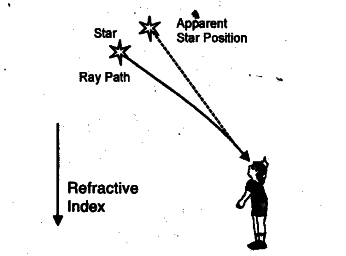
Further, this apparent position of the star is not stationary, but keeps on changing slightly, since the physical conditions of the earth’s atmosphere are not stationary. Since the stars are very distant, they are approximate point-sized sources of light. As the path of rays of light coming from the star goes on varying slightly, the apparent position of the star fluctuates and the amount of starlight entering the eye flickers i.e., the star sometimes appears brighter, and at some other time, fainter, which is the twinkling effect.
The planets are much closer to the earth, and are thus seen as extended sources. If we consider a planet as a collection of a large number of point-sized sources of light, the total variation in the amount of light entering our eye from all the individual point-sized sources will average out to zero, thereby nullifying the twinkling effect.
Posted by Aastha Gupta 5 years, 7 months ago
- 3 answers
Sanika Walimbe 5 years, 7 months ago
Gaurav Seth 5 years, 7 months ago
Saliva is a fluid which is secreted by the salivary glands. It helps in digestion of food by following Ways.
- Saliva contains a digestive enzyme called salivary amylase, which converts carbohydrates in to maltose sugars.
- It cleans the mouth cavity and tends to destroy germs that cause teeth decay. It contains lysozomes which help in destroying the bacteria.
- It moistens and lubricates food which again helps in swallowing.
- It acts as solvent, dissolving some food particles to stimulate taste buds of the tongue.
Anupama ?? 5 years, 7 months ago
Posted by Anupama ?? 5 years, 7 months ago
- 2 answers
Posted by Aastha Mistry 5 years, 7 months ago
- 1 answers
Yogita Ingle 5 years, 7 months ago
(i) Indian farmers are facing challenge from international competition.
(ii) Government is reducing investment in agricultural sector, especially irrigation sector.
(iii) Subsidy in fertilizers has decreased, leading to a rise in cost of production.
(iv) Reduction in import duties on agricultural products.
(v) Farmers are withdrawing their investment from agriculture causing a downfall in the employment in agriculture.
Posted by Aastha Mistry 5 years, 7 months ago
- 1 answers
Prajnasree Behera 5 years, 7 months ago
Posted by Anupama ?? 5 years, 7 months ago
- 2 answers
Yogita Ingle 5 years, 7 months ago
When white light comes out of the prism, light is spread in a fan shaped beam. This fan shaped beam is termed as a spectrum. Light is said to be dispersed into a spectrum consisting of violet, indigo, blue, green, yellow, orange and red.
Posted by Anupama ?? 5 years, 7 months ago
- 2 answers
Anupama ?? 5 years, 7 months ago
Yogita Ingle 5 years, 7 months ago
Convex lens:
A lens having two spherical surface bulging outwards is called Convex Lens. It is also known as biconvex lens because of two spherical surface bulging outwards.

Concave lens:
A lens having two spherical surface bulging inwards is called Concave Lens. It is also known as biconcave lens because of two spherical surface bulging inwards.
Posted by Anupama ?? 5 years, 7 months ago
- 1 answers
Prajnasree Behera 5 years, 7 months ago
Posted by Akshjot Sandhu 5 years, 7 months ago
- 1 answers
Yogita Ingle 5 years, 7 months ago
To God,
leaving in our hearts
date
dear god
I'm one of your loving child who have faith on you, and bleave you whole heartedly . I have heard that you always take care of your child and fulfill their dreams and wishes. If it is true I also want to wish you something.
(write your wishes below)
1.
2.
3.
your loving child
your name
Posted by Vinay Kumar Mangali 5 years, 7 months ago
- 2 answers
Kap Sharma 5 years, 7 months ago
Gaurav Seth 5 years, 7 months ago
Grafting:
Grafting is a horticultural technique used to join parts from two or more plants so that they appear to grow as a single plant. In grafting, the upper part (scion) of one plant grows on the root system (rootstock) of another plant.
In grafting, one plant is selected for its roots, and this is called the stock or rootstock. The other plant is selected for its stems, leaves, flowers, or fruits and is called the scion. The scion contains the desired genes to be duplicated in future production by the stock/scion plant. For successful grafting to take place, the vascular cambium tissues of the stock and scion plants must be placed in contact with each other. Both tissues must be kept alive until the graft has taken, usually a period of a few weeks. Successful grafting requires that a vascular connection takes place between the two tissues.
Grafting is most commonly used for the propagation of trees and shrubs grown commercially. Grafting is limited to dicots and gymnosperms.
Posted by Himanshi . 5 years, 7 months ago
- 1 answers
Yogita Ingle 5 years, 7 months ago
Comparing with standard quadratic equation ax2 + bx + c = 0
a = 2, b = 0, c = -11
Discriminant D = b2 – 4ac
= (0)2 – 4.2.(-11)
= 0 + 88
= 88
Posted by Chahat Modi 5 years, 7 months ago
- 2 answers
Gaurav Seth 5 years, 7 months ago
1. High quantities of fertilisers, high yield variety seeds, insecticides and pesticides are used to enhance the productivity of land.
2. The degree and extent of commercialised agriculture varies from region to region. For example, wheat in Punjab is a commercial crop, while in Orissa, it is a subsistence crop.
3. Plantation is also a kind of commercial farming where a single crop is grown over a large area.
4. In commercial farming, crops are grown for earning profits. Some of the cash crops are tea, coffee, rubber etc.
Posted by Nisha Saifi 5 years, 7 months ago
- 2 answers
Yogita Ingle 5 years, 7 months ago
Internet is called 'Network of Networks' because it is global network of computers that are linked together by cables and telephone lines making communication possible among them. It can be defined as a global network over a million of smaller heterogeneous computer networks.
Gaurav Seth 5 years, 7 months ago
The Internet is a global collection of computer networks that are linked together by devices called routers and use a common set of protocols for data transmission known as TCP/IP (transmission control protocol / Internet protocol). The primary purpose of the Internet is to facilitate the sharing of information.
Posted by Rudra Patel 5 years, 7 months ago
- 0 answers
Posted by Saket Tiwari 5 years, 7 months ago
- 1 answers
Gaurav Seth 5 years, 7 months ago
The young seagull was afraid to fly as he thought that his wings would not support him. His two brothers and his sister had already flown away the day before and so, he was left alone and hungry on the ledge. His father and mother threatened to starve him on the ledge and cajoled him to fly because learning the art of flight was very necessary for a bird. But the young seagull was too timid to fly.
Posted by Susmita Das 5 years, 7 months ago
- 5 answers
Gaurav Seth 5 years, 7 months ago
tertiary sector
The tertiary sector different from the primary and secondary sectors this sector does not produce goods by itself but the other two sectors produce goods. This sector help in the development of the primary and secondary sectors. The activities under the tertiary sector are an aid or support for the production process. For example, transport, communication, storage, banking, insurance, trade activities etc. Similarly, doctors, teachers, lawyers, tailor, etc., come under the tertiary sector as they provide services rather than material goods. This is why this sector is also termed as the service sector.
Posted by Manisha Parmar 5 years, 7 months ago
- 2 answers
Gaurav Seth 5 years, 7 months ago
The classmates of Anne Frank were shaking with fear and nervousness because the teachers were in the process of deciding about the fate of the students. The teachers were deciding as to which students would be promoted to the next class which would stay back in the same class. Anne was very confident about herself and her friends that they would be promoted to the next class.
Posted by Laxmi Ramadurga 5 years, 7 months ago
- 2 answers
?Suhani Arora? 5 years, 7 months ago
Posted by Uttam Pandey 5 years, 7 months ago
- 3 answers
Anupama ?? 5 years, 7 months ago
Kap Sharma 5 years, 7 months ago
Yogita Ingle 5 years, 7 months ago
(i) The Rowlatt Act was passed in March , 1919 .
(ii) It was passed by the Government to "curb the growing upsurge" in the country .
(iii) It was passed as a result of the Bills introduced in the Central Legislature , in February , 1919
(iv) The Rowlatt act implied arrest of a person without warrant.
(v) It allowed camera trial and restricted movements of individuals.
(vi) It suspended the Right to Habeas Corpus.
(vii) As a result , Gandhiji started Satyagraha to challenge the Government.
(viii) This was one of the causes that led to the Non-cooperation Movement.
Posted by Satendra Singh 5 years, 7 months ago
- 1 answers
Yogita Ingle 5 years, 7 months ago
Powers of the Chief Minister are:
- He is the real executive head of the state and the leader of the majority party in the State Legislative Assembly.
- He and his Council of Ministers carry out the state's administration.
- He is the head of the Council of Ministers. He is therefore also known as the ‘head of the Cabinet Arch’.
- The Governor on his advice appoints the rest of the ministers.
- He assigns various portfolios to the Cabinet ministers and other ministers and also coordinates the functioning of the various departments.
- He presides over the meetings of the Cabinet and the Council of Ministers and; all the decisions taken are then communicated to the Governor. Thus, he acts as a link between the Cabinet and the Governor.
- He is the defender of the government in the State Legislature.
- In case of conflict between the Chief Minister and a minister, it is the minister who has to step down.
- The Chief Minister’s position is of primary importance in the state's administrative system. His responsibilities are similar to those of the Prime Minister and therefore he is responsible for the success or failure of the government.
Powers of the Prime Minister
The Constitution does not say very much about the powers of the Prime Minister or the ministers or their relationship with each other. But as head of the government, the Prime Minister has wide ranging powers.
1. He chairs Cabinet meetings.
2. He coordinates the work of different Departments.
3. His decisions are final in case disagreements arise between Departments.
4. He exercises general supervision of different ministries and all the ministers work under his leadership.
5. The Prime Minister distributes and redistributes work to the ministers.
6. He also has the power to dismiss ministers.
7. When the Prime Minister quits, the entire ministry quits.
Posted by Suraj Bag 5 years, 7 months ago
- 1 answers
Gaurav Seth 5 years, 7 months ago
The Provisions of Treaty of Vienna of 1815 include:
(i) The Bourbon dynasty was restored to power.
(ii) France lost the territories it had annexed under Napoleon.
(iii) A series of states were set up on the boundaries of France to prevent French expansion in future.
(iv) Belgium was set up in the north and Genoa was added to Piedmont in the south.
(v) Prussia was given important new territories on its western frontiers, while Austria was given control of northern Italy.
(vi) In the east, Russia was given part of Poland while Prussia was given a portion of Saxony.
(vii) Thus, monarchies that had been overthrown by Napoleon were restored and a new conservative order was created in Europe.
Posted by Subiksha Vijaya 5 years, 7 months ago
- 1 answers
Gaurav Seth 5 years, 7 months ago
7. To find out the concentration of SO2 in the air (in parts per million, i.e., ppm), the data was collected for 30 localities in a certain city and is presented below:
| Concentration of SO2 ( in ppm) | Frequency |
| 0.00 – 0.04 | 4 |
| 0.04 – 0.08 | 9 |
| 0.08 – 0.12 | 9 |
| 0.12 – 0.16 | 2 |
| 0.16 – 0.20 | 4 |
| 0.20 – 0.24 | 2 |
Find the mean concentration of SO2 in the air.
Solution:
To find out the mean, first find the midpoint of the given frequencies as follows:
| Concentration of SO2 (in ppm) | Frequency (fi) | Mid-point (xi) | fixi |
| 0.00-0.04 | 4 | 0.02 | 0.08 |
| 0.04-0.08 | 9 | 0.06 | 0.54 |
| 0.08-0.12 | 9 | 0.10 | 0.90 |
| 0.12-0.16 | 2 | 0.14 | 0.28 |
| 0.16-0.20 | 4 | 0.18 | 0.72 |
| 0.20-0.24 | 2 | 0.20 | 0.40 |
| Total | Sum fi = 30 | Sum (fixi) = 2.96 |
The formula to find out the mean is
Mean = x̄ = ∑fixi /∑fi
= 2.96/30
= 0.099 ppm
Therefore, the mean concentration of SO2 in air is 0.099 ppm.
Posted by Rounak Anand 5 years, 7 months ago
- 3 answers
Anupama ?? 5 years, 7 months ago
Anmol Genius 5 years, 7 months ago
Posted by Disha Agarwal 5 years, 7 months ago
- 1 answers
Gaurav Seth 5 years, 7 months ago
Considering the loss of classroom teaching time due to the Covid-19 pandemic and lockdown, CBSE reduced the syllabus of classes 9 to 12 with the help of suggestions from NCERT.
The CBSE syllabus has been rationalized keeping intact the learning outcomes so that the core concepts of students can be retained.
Deleted syllabus of CBSE Class 10 Science

Posted by Om Chaubey Chaubey 5 years, 7 months ago
- 3 answers
Kap Sharma 5 years, 7 months ago
Gaurav Seth 5 years, 7 months ago
जलियांवाला बाग नरसंहार 13 अप्रैल 1919 को हुआ था। इस दिन ब्रिटिश लेफ्टिनेंट जनरल रेगिनाल्ड डायर ने अमृतसर के जलियांवाला बाग में बैसाखी के मौके पर इकट्ठे हजारों निहत्थे मासूम भारतीयों पर अंधाधुंध गोलियां चलवा दी थीं। इस गोलीबारी में 1000-2000 भारतीय मारे गए थे। वहीं इससे कहीं ज्यादा गंभीर रूप से घायल हुए थे।
बैसाखी के दिन 13 अप्रैल 1919 को अमृतसर के जलियांवाला बाग में एक सभा रखी गई, जिसमें कुछ नेता भाषण देने वाले थे। शहर में कर्फ्यू लगा हुआ था, फिर भी इसमें सैंकड़ों लोग ऐसे भी थे, जो बैसाखी के मौके पर परिवार के साथ मेला देखने और शहर घूमने आए थे और सभा की खबर सुन कर वहां जा पहुंचे थे। जब नेता बाग में पड़ी रोड़ियों के ढेर पर खड़े हो कर भाषण दे रहे थे तभी डायर ने बाग से निकलने के सारे रास्ते बंद करवा दिए। बाग में जाने का जो एक रास्ता खुला था जनरल डायर ने उस रास्ते पर हथियारबंद गाड़ियां खड़ी करवा दी थीं।
डायर करीब 100 सिपाहियों के सीथ बाग के गेट तक पहुंचा। उसके करीब 50 सिपाहियों के पास बंदूकें थीं। वहां पहुंचकर बिना किसी चेतावनी के उसने गोलियां चलवानी शुरु कर दी। गोलीबारी से डरे मासूम बाग में स्थित एक कुएं में कूदने लगे। गोलीबारी के बाद कुएं से 200 से ज्यादा शव बरामद हुए थे।
इस घटना के प्रतिघात स्वरूप सरदार उधमसिंह ने 13 मार्च 1940 को लंदन के कैक्सटन हॉल में इस घटना के समय ब्रिटिश लेफ़्टिनेण्ट गवर्नर मायकल ओ ड्वायर को गोली चला के मार डाला। उन्हें 31 जुलाई 1940 को फांसी पर चढ़ा दिया गया था।
Posted by Student Inquisitive 5 years, 7 months ago
- 1 answers
Gaurav Seth 5 years, 7 months ago
The "division of power" between the Central & State Govts is done in a 3 fold distribution of "legislative powers" between the Union & the State Govts.
Explanation:
There are 3 lists - "Union List", "State List" & "Concurrent List".
(i) Union List: It comprises areas of "national significance" such as defense of the nation, foreign affairs, communication, currency, & banking. The Central Govt alone can take all decisions on matters included in this list. The objective of "including" these matters in the "Union List" is to make sure there is "uniformity" in the "policy" of these areas across the nation.
(ii) State List: It comprises subjects of "state & local" significance such as trade, police, agriculture, irrigation, & commerce. The State Govts alone can take all decisions pertaining to these areas.
(iii) Concurrent List: It comprises those areas that are of "common interest" to both the Central & State Govts. It comprises matters such as forests, education, trade unions, & marriage. Both the Central & State govts can take all decisions pertaining to these matters.
Posted by Vishakha Girl 5 years, 7 months ago
- 2 answers
Gaurav Seth 5 years, 7 months ago
(xii) √2, √8, √18, √32 …
Here,
a2 – a1 = √8-√2 = 2√2-√2 = √2
a3 – a2 = √18-√8 = 3√2-2√2 = √2
a4 – a3 = 4√2-3√2 = √2
Since, an+1 – an or the common difference is same every time.
Therefore, d = √2 and the given series forms a A.P.
Hence, next three terms are;
a5 = √32+√2 = 4√2+√2 = 5√2 = √50
a6 = 5√2+√2 = 6√2 = √72
a7 = 6√2+√2 = 7√2 = √98
Posted by #?Abhishek...? . 5 years, 7 months ago
- 1 answers
Gaurav Seth 5 years, 7 months ago
Class 10 Maths Exercise 6.3
10. CD and GH are respectively the bisectors of  ACB and EGF such that D and H lie on sides AB and FE at
  ABC and EFG respectively. If ABC
  FEG, show that:
(i) 
(ii) DCB HE
(iii) DCA HGF
Ans. We have, ABC  FEG
FEG
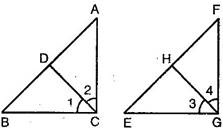
 A = F………(1)
And C = G
 C = G
C = G
1 = 3 and 2 = 4 ……….(2)
[ CD and GH are bisectors of C and G
respectively]
 In s DCA and HGF, we have
A = F[From eq.(1)]
2 = 4[From eq.(2)]
By AA-criterion of similarity, we have
DCA HGF
Which proves the (iii) part
We have,DCA HGF

Which proves the (i) part
In s DCA and HGF, we have
1 = 3[From eq.(2)]
B = E[ DCB HE]
Which proves the (ii) part

myCBSEguide
Trusted by 1 Crore+ Students

Test Generator
Create papers online. It's FREE.

CUET Mock Tests
75,000+ questions to practice only on myCBSEguide app

Yogita Ingle 5 years, 7 months ago
1Thank You