
Ask questions which are clear, concise and easy to understand.
Ask QuestionPosted by V@Rind@ Dhim@N 5 years, 3 months ago
- 1 answers
Posted by Dharmin Sanghvi 5 years, 3 months ago
- 4 answers
Kiran Kumari 5 years, 3 months ago
Manvi Singh 5 years, 3 months ago
Yogita Ingle 5 years, 3 months ago
Metallic oxides: A chemical compound formed by metal and oxygen.
Examples:
- Magnesium reacts with oxygen to form magnesium oxide
2Mg + 2O2→ 2MgO
- Other examples of metallic oxides – Na2O, Al2O3, FeO, CuO, V2O5
Posted by Subash Gouda 5 years, 3 months ago
- 1 answers
Gaurav Seth 5 years, 3 months ago
In the given figure,
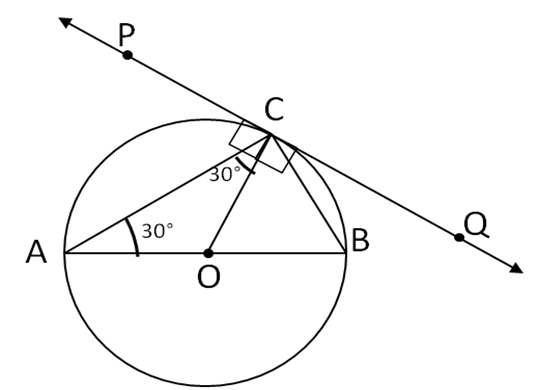
In Δ ACO,
OA=OC (Radii of the same circle)
Therefore,
ΔACO is an isosceles triangle.
∠CAB = 30° (Given)
∠CAO = ∠ACO = 30° (angles opposite to equal sides of an isosceles triangle are equal)
∠PCO = 90° …(radius is drawn at the point of
contact is perpendicular to the tangent)
Now ∠PCA = ∠PCO – ∠CAO
Therefore,
∠PCA = 90° – 30° = 60°
Posted by Nikhil Sidar 5 years, 3 months ago
- 1 answers
Gaurav Seth 5 years, 3 months ago
Suresh is having a garden near Delhi. In the garden, there are different types of trees and flower plants. One day due to heavy rain and storm one of the trees got broken as shown in the figure.The height of the unbroken part is 15 m and the broken part of the tree has fallen at 20 m away from the base of the tree.
Using the Pythagoras answer the following questions:
1) What is the length of the broken part?
A) 15 m
B) 20 m
C) 25 m
D) 30 m
2) What was the height of the full tree?
A) 40 m
B) 50 m
C) 35 m
D) 30 m
3) In the formed right-angle triangle what is the length of the hypotenuse?
A) 15 m
B) 20 m
C) 25 m
D) 30m
4) What is the area of the formed right angle triangle?
A) 100 m2
B) 200 m2
C) 60 m2
D) 150 m2
5 )What is the perimeter of the formed triangle?
A) 60 m
B) 50 m
C) 45 m
D) 100 m
Answer:
1)C
2)A
3)C
4)D
5)A
Posted by Mukund Jha 5 years, 3 months ago
- 1 answers
Gaurav Seth 5 years, 3 months ago
बेल्जियम ने अपनी विविध जनसंख्या को एक ऐसी व्यवस्था के रूप में समायोजित किया जो विभिन्न समुदायों की आवश्यकताओं के अनुकूल थी। यह निम्नलिखित तरीकों से किया गया था:
- हालांकि डच देश में बहुमत में थे, केंद्र सरकार में फ्रेंच और डच बोलने वाली आबादी को समान प्रतिनिधित्व दिया गया था।
- बेल्जियम को एक संघीय राज्य के रूप में घोषित किया गया था, और इस प्रकार राज्य सरकारों को महत्वपूर्ण अधिकार दिए गए थे। राज्य सरकारों ने केंद्र सरकार के अधीनस्थ कार्य नहीं किया।
- राजधानी ब्रुसेल्स की एक अलग सरकार थी। हालाँकि, शहर में फ्रांसीसी बोलने वाली आबादी बहुमत में थी, लेकिन उन्होंने ब्रुसेल्स में समान प्रतिनिधित्व को स्वीकार किया। ऐसा इसलिए था क्योंकि डच भाषी लोगों ने बहुमत में होने के बावजूद केंद्र सरकार में समान प्रतिनिधित्व को स्वीकार किया था।
- सामुदायिक सरकार भी बेल्जियम में मौजूद थी जिसे प्रमुख भाषाई समूहों अर्थात् डच, फ्रेंच और जर्मन भाषी लोगों द्वारा चुना गया था। इस सरकार ने शैक्षिक, भाषा और शैक्षिक मुद्दों की देखभाल की
Posted by Hruday Reddy 5 years, 3 months ago
- 1 answers
Gaurav Seth 5 years, 3 months ago
| S.No | Nation state | Modern state |
| 1. | In a nation state, citizens came to develop a common identity based on shared history | In a modern state, centralized power exercised sovereign control over a clearly defined territory |
| 2. | It overthrew monarchy and dynasty rule in Europe | It was a long process which started in Europe in the 19th century |
Posted by Alisha. Afreen 5 years, 3 months ago
- 4 answers
Posted by Prachi Saini 5 years, 3 months ago
- 1 answers
Yashika B. 5 years, 3 months ago
Posted by Nihal Kumar 5 years, 3 months ago
- 1 answers
Gaurav Seth 5 years, 3 months ago
Q. 1 Answer any four of the following questions briefly:
- How had C.V. Raman’s childhood been difficult?
- Why has life been termed as a gamble?
- How does C.V. Raman’s speech inspire us?
- What instances, quoted by C.V. Raman in his speech, show that he was a nature lover?
- According to C.V. Raman, where can we seek real happiness and where can it not be found?
Answer
- During his childhood, C.V. Raman had no clothes, no books, no conveyance. He had to walk along miles even without an umbrella.
- Life has been termed as a gamble as it is not sure that the intelligent or the strong would certainly succeed in life.
- In his speech, C.V. Raman told us the easiest way to enjoy life, we should enjoy the common things of life, love and appreciate nature, appreciate its wonderful gifts, marvellous ingenuity, resourcefulness, and infinite variety.
- There is the butterfly jumping about in flourishing colors on all sides, look at this wonderful thing that God has given for our enjoyment.
- We can seek happiness in all the God-given things which cost nothing. Happiness can never be found in artificial things like going to pictures and seeing thrilling films.
Q. 2 Choose the best option from the words given below which mean the same as:
- despair
- disappointment
- hopelessness
- misery
- distress
- endless
- unlimited
- continuous
- infinite
- unreachable
- prosperous
- rich
- flourishing
- wealthy
- fortunate
- exciting
- joyful
- funny
- exhilarating
- thrilling
- nonetheless
- but
- and
- still
- although
Answer
- disappointment
- infinite
- flourishing
- thrilling
- still
Posted by Prawash Priyam 5 years, 3 months ago
- 4 answers
Gaurav Seth 5 years, 3 months ago
Considering the loss of classroom teaching time due to the Covid-19 pandemic and lockdown, CBSE reduced the syllabus of classes 9 to 12 with the help of suggestions from NCERT.
The CBSE syllabus has been rationalized keeping intact the learning outcomes so that the core concepts of students can be retained.
Deleted syllabus of CBSE Class 10 Science

Posted by Gaurav Singh 5 years, 3 months ago
- 2 answers
Ankit Kumar 5 years, 2 months ago
Posted by Hanan Ap 5 years, 3 months ago
- 2 answers
Yashita Bisht 5 years, 3 months ago
Posted by Sakshi Patil 5 years, 3 months ago
- 0 answers
Posted by Aditya Singh 5 years, 3 months ago
- 0 answers
Posted by Shiwani Kumari 5 years, 3 months ago
- 1 answers
Gaurav Seth 5 years, 3 months ago
Magnification of Convex Lens:
It is a ratio between the image height and object height. A magnification of 2 indicates the image is twice the size of the object and a magnification of 1 indicates an image size being the same as the object size. If the magnification is positive, then the image is upright compared to the object (virtual image). If magnification is negative then the image is inverted as compared to the object (real image).
Posted by Poonam Verma 5 years, 3 months ago
- 1 answers
Yogita Ingle 5 years, 3 months ago
अंतर्राष्ट्रीय व्यापार, अंतर्राष्ट्रीय सीमाओं या क्षेत्रों के आर-पार पूंजी, माल और सेवाओं का आदान-प्रदान है।[1]. अधिकांश देशों में, यह सकल घरेलू उत्पाद (GDP) के महत्त्वपूर्ण अंश का प्रतिनिधित्व करता है। जबकि अंतर्राष्ट्रीय व्यापार, इतिहास के अधिकांश भाग में मौजूद रहा है (देखें सिल्क रोड, एम्बर रोड) इसका आर्थिक, सामाजिक और राजनीतिक महत्व हाल की सदियों में बढ़ने लगा है।
Posted by Poonam Verma 5 years, 3 months ago
- 1 answers
Yogita Ingle 5 years, 3 months ago
इस सवाल के लिए धन्यवाद। मेंरा जवाब मेंरी निजी सोच, मान्यता व अनुभव के आधार पर है। अन्य मत का स्वागत है।
१). हम क्वोरा में लोकतंत्र, लोकतंत्र ही तो खेल रहे हैं। अगर लोकतंत्र नहीं होता तो क्वोरा भी नहीं होता (हां, शायद होता, पर यह ‘कोरा’ होता)। अतः मुझे सवाल में ‘दोष’ शब्द का स्तेमाल अतिरेक पू्र्ण लगा। कोई भी प्रद्धति पूर्ण रूप से खामी मुक्त नहीं होती है, अतः लोकतांत्रिक शासन पद्धति भी पूर्ण रूप से खामी रहित नहीं है। फिर भी पहले तो यही कहुंगा कि यह शासन व्यवस्था, अन्य उपलब्ध शासन व्यवस्थाओं में सर्वाधिक स्वाभाविक व मानव स्वभाव के करीब है, व सबसे श्रेष्ठ है। खामियां भी प्रद्धति में नहीं, हमारी अपनी कमजोरियों की वजह से है (अगर हम बारीश में रैनकोट अथवा छाता ना लें और भिगने का दोष बारीश पर लगाएं तो यह सही नहीं होगा)। फिर इन खामियों को दूर करने की क्षमता भी इसी व्यवस्था में ही है।
२). भारत के संदर्भ में : हमें ऐसा जरूर प्रतित होता है कि लोकतंत्र में कार्य संपादन की गति धीमी होती है, वोट की राजनीति की मजबुरी की वजह से राजनेताओं में बदलाव के प्रति अरुचि रहती है व यथास्थितिवाद/ तदर्थवाद हावी रहता है। (इनकी वजह है बार बार के चुनाव, सामाजिक आर्थिक विषमता, मतदाता में स्वतंत्र चिंतन का अभाव जिस वजह से वोट बैंक की राजनीति का फलना फुलना, आदि। उम्मीद है सुधार होगा)।
३). कुछ लोग अभिव्यक्ति की स्वतंत्रता का दुरूपयोग करते हैं। पर इनसे निपटने की सामर्थ्य भी लोक-तंत्र में ही है।
४). लोकतंत्र में व्यवस्था संचालन एक सिस्टम के तहत होता है। व खासियत यह है कि सिस्टम पर नजर/ नियंत्रण करने की उत्तम व्यवस्था भी है, संस्थाओं के रूप में। और सबसे ऊपर है ‘जन(ता)’ जिसे इन सब को नियंत्रित करने का अधिकार प्राप्त है (मानव स्वभाव है कि वह शासन करना चाहता है, शासित नहीं होना चाहता यह सुविधा लोकतंत्र में ही संभव है)।
५). दोष : चुंकि लोकतंत्र आमजन की सामुहिक चेतना से संचालित होता है, अतः इसमें वे सभी दोष हैं जो मानव में है। अतः जो में वे सभी कमियां है उसके लिए तंत्र जिम्मेदार नहीं है। तो मेंरे हिसाब से स्थति तनावपूर्ण जरूर है, पर नियंत्रण में है। लोकतंत्र में सरकार चलाना एक बहुत बड़े संयुक्त परिवार के संचालन जैसा है। हम अपने-अपने घरों में देख सकते हैं। सभी के मुंह से यही निकलेगा “हम बदलेंगें, युग बदलेगा”।
Posted by Poonam Verma 5 years, 3 months ago
- 1 answers
Yogita Ingle 5 years, 3 months ago
किसी संस्था के उद्देश्यों की पूर्ति के लिए उसकी विभिन्न क्रियाओं में सांमजस्य व तालमेल स्थापित करना ‘समन्वय’ कहलाता है। यह प्रबन्ध का वह कार्य है जो किसी संस्था के विभिन्न विभागों, कर्मचारियों तथा उसके समूहों में इस प्रकार एकीकरण स्थापित करता है कि न्यूनतम लागत पर वाछिंत उद्देश्यों की पूर्ति में सहायता मिलती है।
‘समन्वय प्रबन्ध का सार है।’ सार किसी वस्तु की आन्तरिक प्रकृति अथवा उसके महत्वपूर्ण गुण का नाम है। समन्वय वह महत्वपूर्ण तत्व है जिससे प्रबन्ध प्रक्रिया का निर्माण होता है। यह नियोजन की अवस्था में ही प्रारम्भ हो जाता है तथा संगठन, निर्देशन, नियन्त्रण आदि सभी कार्यों के साथ चलता है। समन्वय से ही प्रबन्ध निम्न वांछित परिणाम उपलब्ध कर पाता हैl
Posted by Ritesh Yadav 5 years, 3 months ago
- 1 answers
Yogita Ingle 5 years, 3 months ago
All organic compounds are derivatives of hydrocarbons.
The derivatives are obtained by replacing one or more hydrogen atoms with some other atom or a group
of atoms.
The new set of compounds formed after replacement has functions different from the parent hydrocarbon.
Functional group:
An atom or a group of atoms present in the molecules, which determines the characteristics property of the organic compounds, is called the functional group.

Posted by Asmitha Perumal 5 years, 3 months ago
- 1 answers
Gaurav Seth 5 years, 3 months ago
This chapter is an extract from the autobiography of Nelson Mandela (born- 18 July, 1918), the first Black President of South Africa. It begins with the description of their inaugural ceremony which took place on the 10th of May 1994 where the entire nation along with many international leaders embraced the victory of a newly and fairly elected government. It involved speeches by the President and the two Deputy Presidents followed by an impressive air show of fighter jets and helicopters. Long ago, in the first decade of the twentieth century, white supremacy introduced the system of apartheid and made life a living hell for the dark-skinned population. It gave rise to one of the most inhumane societies of the world. Many people have struggled and sacrificed for basic human rights. The author expressed his desire to thank all those freedom fighters who couldn’t live to see this autumn day. He referred to the citizens as the greatest asset of the country. It is these people he gathered his courage from. Mandela believes that courageous is not the man who is fearless, but the man who has overcome fear. He also mentioned the two responsibilities every human has and how in order to fulfil his obligation towards the society, his obligation towards his family was neglected. He became a man of people when he realised that the idea of freedom was an illusion for him and people like him. It was then he joined the African National Congress and fought for his rights till he became the first black President of the nation. According to him, the oppressor is as much a prisoner as the oppressed. As soon as the former robs the oppressed of their freedom he, himself gets robbed of his humanity. Thus, the oppressor too, is not free.
Posted by Rohit Kukreja 5 years, 3 months ago
- 1 answers
Gaurav Seth 5 years, 3 months ago
Apparatus: A battery (12 V), a variable resistance for a rheostat), an ammeter (0-5 A), a plug key, and a long straight thick copper wire. Procedure: Fix the cardboard and insert the wire through the centre of cardboard such that it is normal to its plane. Connect the wire with rheostat, ammeter, battery and plug key in series Sprinkle the iron filings uniformly on the cardboard. Keep the variable of the rheostat at a fixed position and note the current through the ammeter. Close the key and gently tap the cardboard. Observe the pattern of the iron filings over the cardboard.
The magnetic field lines are formed in concentric circles around the current carrying conductor and whose centre lies on the wire. These lines do not intersect each other and are equidistant from each other. 1. Right hand thumb rule II. Since alpha particles are positively charged so a magnetic field will be produced. But neutrons are neutral charge so no magnetic field is produced.
Posted by Sunny Kumar Rajak 5 years, 3 months ago
- 0 answers
Posted by Sunny Kumar Rajak 5 years, 3 months ago
- 1 answers
Posted by Harsha Shreya 5 years, 3 months ago
- 1 answers
Yogita Ingle 5 years, 3 months ago
The business class in India initially supported the Civil Disobedience Movement. This was because the industrialists and merchants in India had become rich during the First World War. They were keen on expanding their businesses and wanted protection against foreign industries. Many eminent industrialists such as Purshottamdas Thakurdas and G. D. Birla criticised the colonial government for its control over the Indian economy which prevented their growth. They provided financial assistance during the movement, and refused to buy and sell imported goods. Many industrialists began to see swaraj as a time when colonial restrictions on business will end. However, towards the end, they became apprehensive of the growing influence of socialism among the younger members of the Congress.
Posted by Rudranshu Singh 5 years, 3 months ago
- 1 answers
Gaurav Seth 5 years, 3 months ago
The following steps have been taken to control price rise.
(i) Monetary Measures: The Reserve Bank of India takes the following monetary measures to control price rise:
It increases the Bank rate; i.e, the rate at which it lends money to the commercial banks. As a corollary, the commercial banks increase the rate of interest while lending money to their customers. The increase in the interest rate curbs the tendency to borrow money and invest the same in speculative ventures.
The increase in the rate of interest on the deposits encourages the consumers to invest their surplus funds. Thereby surplus funds go out of circulation. The tendency to make unnecessary purchases is curbed. This reduces the demand for the goods. The Reserve Bank withdraws surplus funds from the market by selling the government securities. It increases the Cash Reserve Ration and reduces the availability of funds with the commercial banks.
(ii) Fiscal Measures are taken by the government to control price rise. These are: The government reduces the public expenditure, postpones plans involving heavy expenditure and curbs wasteful expenditure. It increases the level of existing taxes and imposes new taxes and thereby reduces spending capacity of the people. It borrows money from the market, private individuals and institutions. Thereby, it curtails excess purchasing power and demand for goods and services.
(iii) Control on investment is a direct step to curb price rise. It encourages productive investments in agricultural and consumer goods industries. Thereby the supply of food grains and consumer goods in increased. At the same time, it discourages speculative investments.
(iv) Price Regulation and Rationing was introduced in India for the first time during the Second World War and continued till 1972, when India became self-sufficient in production of food grains. The price control continues even today. Essential commodities are mad available to the weaker sections through the public distribution system of the society. For this purpose a chain of Fair Price Shops has been set up. The government gives subsidy of food grains, petroleum products and gas to keep prices under control.
(v) Administered Price Mechanism the government has made it obligatory for all the manufacturers to state the MRP (Maximum Retail Price) on their products, which are inclusive of all taxes. Essential Commodities Act, 1955 lays down the level of stocks to be maintained and their display. The traders are required to maintain stock registers. Any disparity between actual stock and that mentioned in stock register attracts punishment.
Posted by Laxmi S.P? 5 years, 3 months ago
- 1 answers
Gaurav Seth 5 years, 3 months ago
Chapter 1 Power Sharing
- With this chapter, we resume the tour of democracy that we started last year.
- An intelligent sharing of power among a legislature, executive and judiciary is very important to the design of a democracy.
- We start with two stories from Belgium and Sri Lanka.
- Both these stories are about how democracies handle demands for power sharing.
Belgium and Sri Lanka:
- Belgium is a small country in Europe.
- It has borders with Netherlands, France and Germany.
- 59% in the Flemish region speaks Dutch.
- Another 40% people live in Wallonia region and speaks French.
- Remaining 1% of the Belgians speak Germany.
- n the capital city Brussels, 80% people speak French while 20% are Dutch – speaking.
- The minority French – speaking community was relatively rich and powerful.
- This was resented by the Dutch-speaking community who got the benefit of the economic development and education much later.
- The tension between two communities was acuter in Brussels.
- Like other nations in the south Asia region, Sri Lanka has a diverse population.
- The Sinhala speaks are 74% and Tamil speakers are 18%
- Among Tamils, there are two sub groups, Tamil natives of the country are called “Sri Lankan Tamils”; the rest whose forefathers came from India as a population workers during the colonial period, is called ‘Indian Tamils’.
Majoritarianism in Sri Lanka:
- Sri Lankan emerged as an independent country in 1948.
- The leaders of the Sinhala community sought to secure dominance over the government by virtue of their majority.
- In 1956, an Act was passed to recognize Sinhala as the only official language, thus disregarding Tamil.
- A new constitution stipulated that the state shall protect and foster Buddhism.
- All these coming measures, coming one after the other, gradually increased the feeling of alienation among the Sri Lankan Tamils.
- As a result, the relations between the Sinhala and Tamil communities strained over time.
- The Sri Lankan Tamils launched parties and struggles.
- But their demand for more autonomy to provinces populated by the Tamils was repeatedly denied.
- The distrust between the two communities turned into widespread conflict. It soon turned into CIVIL WAR.
- The civil war caused a terrible setback to the social, cultural and economic life of the country.
Accommodation in Belgium:
- Belgium recognized the existence of regional differences and cultural diversities.
- Between 1970 and 1993, they amended their constitution four times so as to work out an arrangement that would enable everyone to live together within the same country.
- Here are some of the elements of the Belgian model:
a. Constitution prescribes that the number of Dutch and French-speaking ministers shall be equal in the central government.
b. Many powers of the central government have been given to states government of the two of the regions of the country.
c. Brussels has separated government in which both the communities have equal representation.
d. Apart from the central and state government, there is a third kind of government. This is community government. - In Belgium, the leaders have realized that the unity of the country is possible only by respecting the feelings and interests of different communities and regions.
- Sri Lanka shows us a contrasting example. It shows us that if a majority community wants to force its dominance over others and refuses to share power, it can undermine the unity of the country.
Why is power sharing desirable?
- Thus, two different sets of reasons can be given in favor of power sharing.
- Firstly, power sharing is good because it helps to reduce the possibility of conflict between social groups.
- There is a second, deeper reason why power sharing is good for democracy. Power sharing is very spirit of democracy. A democratic rule involves sharing power with those affected by its exercise, and who have to live with it effects.
- Let us call the first set of reasons PRUDENTIAL and the second moral.
- While prudential reasons stress that power sharing will bring out better outcomes, moral reasons emphasizes the very act of the power sharing as valuable.
Forms of power sharing:
- The idea of power sharing has emerged in opposition to the notions of undivided political power.
- For a long time, it was believed that all power of a government must reside in one person or group of a person located at one place.
- One basic principle of power sharing is that people are the source of all political power.
- In a good democratic government, due respect is given to diverse groups and views that exist in a society.
- Everyone has a voice in the shaping of public politics.
- Therefore, it follows that in a democracy political power should be distributed among as many citizens as possible.
Let us look at some of the most common arrangements that we have or will come across.
- Power is shared among different organs of the government, such as the legislature, executive, and judiciary. Let us call this horizontal distribution of power because it allows different organs of the government placed at the same level to exercise different powers.
- Power can be shared among governments at different levels – a general government for the entire country and governments at the provincial or regional level. The division of higher and lower levels of government is called the vertical division of power.
- Power may also be shared among different social groups, such as the religious and linguistic groups. ‘Community government’ is a good example of this arrangement.
- Power sharing arrangement can also be seen in the way political parties, pressure groups and movements control or influence those in power.
Posted by Rahul Sethy 5 years, 3 months ago
- 1 answers
Gaurav Seth 5 years, 3 months ago
- For an introduction, you can start with the following phrases-
- The chart given above describes
- The table suggests
- The line graph shows
- The data given provides information about
- The pie chart illustrates, etc.
- For describing trends, use phrases and words like- a pattern of growth, rapidly doubled, skyrocketed, striking increase, peaked, soaring rates, declined, plummeted, leveled off, stagnated, fluctuate, starting to rise, starting to fall, drop down, slightly, etc.
- For describing quantities, use various styles like- 48% of, one-third of, nearly one-fourth of, almost 80%, majority, on average, twice as much, almost equal, the highest, the lowest, very close to 2%, roughly, approximately 5% of, just under three percent, etc.
- For establishing a relationship or contrast, use phrases and words like- relationship between, similarly, in contrast with, in comparison to, but in the opposite case, however, whereas, when it comes to, as opposed to, while, striking difference, noticeable difference, etc.
- For the conclusion and other connecting phrases use- overall, subsequently, in all, in a nutshell, for the chart given, in short, striking changes, including, therefore, etc.

myCBSEguide
Trusted by 1 Crore+ Students

Test Generator
Create papers online. It's FREE.

CUET Mock Tests
75,000+ questions to practice only on myCBSEguide app

Good Day 5 years, 2 months ago
0Thank You