No products in the cart.

Ask questions which are clear, concise and easy to understand.

Ask Question
  • 2 answers

Bhoomika Verma 5 years, 2 months ago

Sum of the zeroes= -1. Polynomial is 6x3+x2-4x-1 Product of the zeroes = 1/2 Sum of product of the zeroes = 1/3 Sum of the zeroes = -b/a Alpha+bita+gamma = -b/a -1+1/2+1/3 = -1/6 -6+3+2/6 = -1/6 -6+5/6 =-1/6 -1/6 = -1/6 Product of the zeroes = d/a Alpha×bita×gamma = d/a -1×1/2×1/3 = -1/6 -1/6 = -1/6 Sum of product of the zeroes = c/a Alpha×bita+bita×gamma+gamma×alpha = c/a (-1)×1/2 + 1/2×1/3 + 1/3×(-1) = -4/6 -1/2+1/6+(-1/3) = -4/6 -1/2+1/6-1/3 = -4/6 -3+1-2/6 = -4/6 -5+1/6 = -4/6 -4/6 = -4/6

Arshdeep Kaur 5 years, 3 months ago

Verfdgh
  • 2 answers

Kiran Kumari 5 years, 3 months ago

Distance of (2,3)from the origin =root under 2square+3square Root under 13 Ans.

Saurabh Kumar 5 years, 3 months ago

Under root 13
  • 1 answers

Aashutosh Kumar 5 years, 3 months ago

Biography Early years  Robert Frost, circa 1910 Robert Frost was born in San Francisco, California, to journalist William Prescott Frost, Jr., and Isabelle Moodie.[2] His mother was a Scottish immigrant, and his father descended from Nicholas Frost of Tiverton, Devon, England, who had sailed to New Hampshire in 1634 on the Wolfrana. Frost was a descendant of Samuel Appleton, one of the early settlers of Ipswich, Massachusetts, and Rev. George Phillips, one of the early settlers of Watertown, Massachusetts.[4] Frost's father was a teacher and later an editor of the San Francisco Evening Bulletin (which later merged with The San Francisco Examiner), and an unsuccessful candidate for city tax collector. After his death on May 5, 1885, the family moved across the country to Lawrence, Massachusetts, under the patronage of Robert's grandfather William Frost, Sr., who was an overseer at a New England mill. Frost graduated from Lawrence High School in 1892.[5] Frost's mother joined the Swedenborgian church and had him baptized in it, but he left it as an adult. Although known for his later association with rural life, Frost grew up in the city, and he published his first poem in his high school's magazine. He attended Dartmouth College for two months, long enough to be accepted into the Theta Delta Chi fraternity. Frost returned home to teach and to work at various jobs, including helping his mother teach her class of unruly boys, delivering newspapers, and working in a factory maintaining carbon arc lamps. He did not enjoy these jobs, feeling his true calling was poetry. Adult years  Robert Frost's 85th birthday in 1959 In 1894, he sold his first poem, "My Butterfly. An Elegy" (published in the November 8, 1894, edition of the New York Independent) for $15 ($443 today). Proud of his accomplishment, he proposed marriage to Elinor Miriam White, but she demurred, wanting to finish college (at St. Lawrence University) before they married. Frost then went on an excursion to the Great Dismal Swamp in Virginia and asked Elinor again upon his return. Having graduated, she agreed, and they were married at Lawrence, Massachusetts on December 19, 1895. Frost attended Harvard University from 1897 to 1899, but he left voluntarily due to illness.[6][7][8] Shortly before his death, Frost's grandfather purchased a farm for Robert and Elinor in Derry, New Hampshire; Frost worked the farm for nine years while writing early in the mornings and producing many of the poems that would later become famous. Ultimately his farming proved unsuccessful and he returned to the field of education as an English teacher at New Hampshire's Pinkerton Academy from 1906 to 1911, then at the New Hampshire Normal School (now Plymouth State University) in Plymouth, New Hampshire. In 1912, Frost sailed with his family to Great Britain, settling first in Beaconsfield, a small town outside London. His first book of poetry, A Boy's Will, was published the next year. In England he made some important acquaintances, including Edward Thomas (a member of the group known as the Dymock poets and Frost's inspiration for "The Road Not Taken"), T. E. Hulme, and Ezra Pound. Although Pound would become the first American to write a favorable review of Frost's work, Frost later resented Pound's attempts to manipulate his American prosody.Frost met or befriended many contemporary poets in England, especially after his first two poetry volumes were published in London in 1913 (A Boy's Will) and 1914 (North of Boston). The Robert Frost Farm in Derry, New Hampshire, where he wrote many of his poems, including "Tree at My Window" and "Mending Wall." In 1915, during World War I, Frost returned to America, where Holt's American edition of A Boy's Will had recently been published, and bought a farm in Franconia, New Hampshire, where he launched a career of writing, teaching, and lecturing. This family homestead served as the Frosts' summer home until 1938. It is maintained today as The Frost Place, a museum and poetry conference site. He was made an honorary member of Phi Beta Kappa at Harvard in 1916. During the years 1917–20, 1923–25, and, on a more informal basis, 1926–1938, Frost taught English at Amherst College in Massachusetts, notably encouraging his students to account for the myriad sounds and intonations of the spoken English language in their writing. He called his colloquial approach to language "the sound of sense." In 1924, he won the first of four Pulitzer Prizes for the book New Hampshire: A Poem with Notes and Grace Notes. He would win additional Pulitzers for Collected Poems in 1931,A Further Range in 1937,and A Witness Tree in 1943. For forty-two years – from 1921 to 1962 – Frost spent almost every summer and fall teaching at the Bread Loaf School of English of Middlebury College, at its mountain campus at Ripton, Vermont. He is credited as a major influence upon the development of the school and its writing programs. The college now owns and maintains his former Ripton farmstead, a National Historic Landmark, near the Bread Loaf campus. In 1921, Frost accepted a fellowship teaching post at the University of Michigan, Ann Arbor, where he resided until 1927 when he returned to teach at Amherst. While teaching at the University of Michigan, he was awarded a lifetime appointment at the University as a Fellow in Letters. The Robert Frost Ann Arbor home was purchased by The Henry Ford Museum in Dearborn, Michigan and relocated to the museum's Greenfield Village site for public tours. Throughout the 1920s, Frost also lived in his colonial era home in Shaftsbury, Vermont. The home opened as the Robert Frost Stone House Museum in 2002 and was given to Bennington College in 2017. In 1934, Frost began to spend winter months in Florida. In March 1935, he gave a talk at the University of Miami. In 1940, he bought a 5-acre (2.0 ha) plot in South Miami, Florida, naming it Pencil Pines; he spent his winters there for the rest of his life. In her memoir about Frost's time in Florida, Helen Muir writes, "Frost had called his five acres Pencil Pines because he said he had never made a penny from anything that did not involve the use of a pencil."[20] His properties also included a house on Brewster Street in Cambridge, Massachusetts. Harvard's 1965 alumni directory indicates Frost received an honorary degree there. Although he never graduated from college, Frost received over 40 honorary degrees, including ones from Princeton, Oxford and Cambridge universities, and was the only person to receive two honorary degrees from Dartmouth College. During his lifetime, the Robert Frost Middle School in Fairfax, Virginia, the Robert L. Frost School in Lawrence, Massachusetts, and the main library of Amherst College were named after him. "I had a lover's quarrel with the world." The epitaph engraved on his tomb is an excerpt from his poem "The Lesson for Today." In 1960, Frost was awarded a United States Congressional Gold Medal, "In recognition of his poetry, which has enriched the culture of the United States and the philosophy of the world,"which was finally bestowed by President Kennedy in March 1962. Also in 1962, he was awarded the Edward MacDowell Medal for outstanding contribution to the arts by the MacDowell Colony. Frost was 86 when he read at the inauguration of John F. Kennedy on January 20, 1961. Frost originally attempted to read his poem "Dedication", which was written for the occasion, but was unable to read it due to the brightness of the sunlight, so he recited his poem "The Gift Outright" from memory instead. In the summer of 1962, Frost accompanied Interior Secretary Stewart Udall on a visit to the Soviet Union in hopes of meeting Nikita Khrushchev to lobby for peaceful relations between the two Cold War powers. Frost died in Boston on January 29, 1963 of complications from prostate surgery. He was buried at the Old Bennington Cemetery in Bennington, Vermont. His epitaph quotes the last line from his poem, "The Lesson for Today" (1942): "I had a lover's quarrel with the world." One of the original collections of Frost materials, to which he himself contributed, is found in the Special Collections department of the Jones Library in Amherst, Massachusetts. The collection consists of approximately twelve thousand items, including original manuscript poems and letters, correspondence and photographs, as well as audio and visual recordings. The Archives and Special Collections at Amherst College holds a small collection of his papers. The University of Michigan Library holds the Robert Frost Family Collection of manuscripts, photographs, printed items, and artwork. The most significant collection of Frost's working manuscripts is held by Dartmouth. Personal life The Frost family grave in Bennington Old Cemetery Robert Frost's personal life was plagued by grief and loss. In 1885 when he was 11, his father died of tuberculosis, leaving the family with just eight dollars. Frost's mother died of cancer in 1900. In 1920, he had to commit his younger sister Jeanie to a mental hospital, where she died nine years later. Mental illness apparently ran in Frost's family, as both he and his mother suffered from depression, and his daughter Irma was committed to a mental hospital in 1947. Frost's wife, Elinor, also experienced bouts of depression. Elinor and Robert Frost had six children: son Elliot (1896–1900, died of cholera); daughter Lesley Frost Ballantine (1899–1983); son Carol (1902–1940, committed suicide); daughter Irma (1903–1967); daughter Marjorie (1905–1934, died as a result of puerperal fever after childbirth); and daughter Elinor Bettina (died just one day after her birth in 1907). Only Lesley and Irma outlived their father. Frost's wife, who had heart problems throughout her life, developed breast cancer in 1937, and died of heart failure in 1938.
  • 2 answers

Ujjawal Mittal 5 years, 3 months ago

S.No Nation state Modern state 1. In a nation state, citizens came to develop a common identity based on shared history In a modern state, centralized power exercised sovereign control over a clearly defined territory 2. It overthrew monarchy and dynasty rule in Europe It was a long process which started in Europe in the 19th century

Gaurav Seth 5 years, 3 months ago

S.No Nation state Modern state
1. In a nation state, citizens came to develop a common identity based on shared history In a modern state, centralized power exercised sovereign control over a clearly defined territory
2. It overthrew monarchy and dynasty rule in Europe It was a long process which started in Europe in the 19th century


Or


Nation states emerged after overthrowing monarchy and dynasty rule in Europe. While modern states have been developing since then. Modern states are ruled by a centralised power and authority.

In a nation state, citizens came to develop a common identity based on shared language, traditions and cutoms. In modern states, people speaking different languages, following various traditions and cultures live together. Nations states have now developed as modern states.

  • 1 answers

Gaurav Seth 5 years, 3 months ago

Nelson Mandela described the scene of inauguration jubilantly. It took place on the bright and clear day, the 10th of May in Sandstone amphitheater. Many world leaders and great personalities were present there. He had gone there with his daughter Zenani. At first Mr. De Klerk was sworn in as second deputy president on the podium, then the Thabo Mbeki as first deputy president and after that Mandela was sworn in. This ceremony was held to declare Nelson Mandela as the first black president of South Africa: Finally the jets left off smoke of different colors of the new South African flag. The day was symbolized by the playing of two national anthems. Nelson Mandela was over-whelmed.

  • 2 answers

Sejal Thakur 5 years, 3 months ago

This theory was given by Atkins (1916) and Preistley (1923). According to this theory, the root cells behave as an ideal osmotic pressure system through which water moves up from the soil solution to the root xylem along an increasing gradient of D.P.D. (suction pressure, which is the real force for water absorption). If the solute concentration is high and water potential is low in the root cells, water can enter from soil to root cells through endosmosis. Mineral nutrients are absorbed actively by the root cells due to utilisation of adenosine triphosphate (ATP). As a result, the concentration of ions (osmotica) in the xylem vessels is more in comparison to the soil water. A concentration gradient is established between the root and the soil water. Hence, the solute potential of xylem water is more in comparison to that of soil and correspondingly water potential is low than the soil water. If stated, water potential is comparatively positive in the soil water. This gradient of water potential causes endosmosis. The endosmosis of water continues until the water potential both in the root and soil becomes equal. It is the absorption of minerals that utilise metabolic energy, but not water absorption. Hence, the absorption of water is indirectly an active process in a plant's life. Active transport is in an opposite direction to that of diffusion. *hope it is help for you *

Aashutosh Kumar 5 years, 3 months ago

Active absorption refers to the absorption of water by roots with the help of adenosine triphosphate, generated by the root respiration: as the root cells actively take part in the process, it is called active absorption. According to Jenner, active absorption takes place in low transpiring and well-watered plants, and 4% of total water absorption is carried out in this process. The active absorption is carried out by two theories; active osmotic water absorption and Active non-osmotic water absorption. In this process, energy is not required. Active absorption is important for the plants.
  • 2 answers

Adarsh Singh 5 years, 2 months ago

So hello it is also available on Google so you can go there and search you syllabus was available ok

Sejal Thakur 5 years, 3 months ago

It on google check on google
  • 1 answers

Tanu Choudhary # 5 years, 3 months ago

To create form and report in a database one need to design a table and enter data values in it
  • 2 answers

Kiran Kumari 5 years, 3 months ago

For example, Do you complete your homework? Ans: yes I have completed my homework

Kiran Kumari 5 years, 3 months ago

Present perfect tense.
  • 5 answers

Kiran Kumari 5 years, 2 months ago

Oswaal is one of the best sample paper for class 10.

Arjoo Yadav 5 years, 3 months ago

Arihant publication which is All in one

Malaika Sharma 5 years, 3 months ago

Firstly read your necert book thoroughly then go for "together with cbse sample papers" As per the 30%reduced syllabus by CBSE

Divyanshi Dhakad 5 years, 3 months ago

Ncert book

Ayush Raj Gupta 5 years, 3 months ago

Science book
  • 4 answers

Sejal Thakur 5 years, 3 months ago

Guard cells have chloroplasts while other epidermal cells lack in it. Shape of guard cells is different in monocots (dumb-bell) and dicots (bean), while epidermal cells are irregular in shape in both.

Aashutosh Kumar 5 years, 3 months ago

Monocot and dicot plants contain stomata in their leaves as well as in their stem. The major role of stomata is to facilitate the gas exchange. They also facilitate transpiration, which helps the absorption of water from the soil and the transport of water through the xylem. The size of the stomata is controlled by a pair of guard cells. The main difference between stomata of monocot and dicot plants is that the guard cells of the monocots are dumbbell-shaped whereas the guard cells of dicot plants are bean-shaped.

Aachal Satwan 5 years, 3 months ago

Thanks

Yogita Ingle 5 years, 3 months ago

Guard cells have chloroplasts while other epidermal cells lack in it. Shape of guard cells is different in monocots (dumb-bell) and dicots (bean), while epidermal cells are irregular in shape in both.

  • 1 answers

Aachal Satwan 5 years, 3 months ago

LIST OF MAP ITEMS CLASS X (2020-21) A. HISTORY (Outline Political Map of India) Chapter - 3 Nationalism in India – (1918 – 1930) for Locating and Labelling / Identification 1. Indian National Congress Sessions: a. Calcutta (Sep. 1920) b. Nagpur (Dec. 1920) c. Madras (1927) 2. Important Centres of Indian National Movement a. Champaran (Bihar) - Movement of Indigo Planters b. Kheda (Gujarat) - Peasant Satyagrah c. Ahmedabad (Gujarat) - Cotton Mill Workers Satyagraha d. Amritsar (Punjab) - Jallianwala Bagh Incident e. Chauri Chaura (U.P.) - Calling off the Non-Cooperation Movement f. Dandi (Gujarat) - Civil Disobedience Movement B. GEOGRAPHY (Outline Political Map of India) Chapter 1: Resources and Development (Identification only) a. Major soil Types Chapter 3: Water Resources (Locating and Labelling) Dams: a. Salal b. Bhakra Nangal c. Tehri d. Rana Pratap Sagar e. Sardar Sarovar f. Hirakud g. Nagarjuna Sagar h. Tungabhadra Note: The theoretical aspect of chapter ‘Water Resources’ to be assessed in the Periodic Tests only and will not be evaluated in Board Examination. However, the map items of this chapter as listed above will be evaluated in Board Examination. Chapter 4: Agriculture (Identification only) a. Major areas of Rice and Wheat b. Largest / Major producer states of Sugarcane, Tea, Coffee, Rubber, Cotton and Jute Chapter 5: Minerals and Energy Resources Minerals (Identification only) a. Iron Ore mines  Mayurbhanj  Durg  Bailadila  Bellary  Kudremukh b. Coal Mines  Raniganj  Bokaro  Talcher  Neyveli c. Oil Fields  Digboi  Naharkatia  Mumbai High  Bassien  Kalol  Ankaleshwar Power Plants (Locating and Labelling only) a. Thermal  Namrup  Singrauli  Ramagundam b. Nuclear  Narora  Kakrapara  Tarapur  Kalpakkam Chapter 6: Manufacturing Industries (Locating and Labelling Only) Cotton Textile Industries: a. Mumbai b. Indore c. Surat d. Kanpur e. Coimbatore Iron and Steel Plants: a. Durgapur b. Bokaro c. Jamshedpur d. Bhilai e. Vijaynagar f. Salem Software Technology Parks: a. Noida b. Gandhinagar c. Mumbai d. Pune e. Hyderabad f. Bengaluru g. Chennai h. Thiruvananthapuram Chapter 7: Lifelines of National Economy Major Ports: (Locating and Labelling) a. Kandla b. Mumbai c. Marmagao d. New Mangalore e. Kochi f. Tuticorin g. Chennai h. Vishakhapatnam i. Paradip j. Haldia International Airports: a. Amritsar (Raja Sansi) b. Delhi (Indira Gandhi International) c. Mumbai (Chhatrapati Shivaji) d. Chennai (Meenam Bakkam) e. Kolkata (Netaji Subhash Chandra Bose) f. Hyderabad (Rajiv Gandhi) Note: Items of Locating and Labelling may also be given for Identification.
  • 1 answers

Shizu 5121 5 years, 3 months ago

एक 5 सेंटीमीटर त्रिज्या वाले वृत्त पर बिंदु P पर एक स्पर्श रेखा PQखींची गई है यदिOQ=13cmहै तोPQकी लम्बाई ज्ञात करो 15 13 12 16
  • 1 answers

Yogita Ingle 5 years, 3 months ago

Globalisation has resulted in the trade of foreign commodities in domestic countries. Globalisation is the interconnection between counties through the expansion of foreign trade and foreign investment. It is the process of integrating the home country with foreign countries through the movement of goods, services, investment, technology and people.  With the growing globalisation, Chinese manufacturers are exporting Chinese toys to the Indian economy. In India, toys are sold at a high price. Because of this high price for toys, the Chinese manufacturers have started to export plastic toys to India. It will give a lot of opportunities and openings for domestic consumers to reach out beyond the domestic market. The consumers can choose between Indian and Chinese toys. Chinese toys have become more popular in the Indian markets due to its low price and attractive designs. Thus a large proportion of Indian toys have been substituted with much cheaper Chinese toys. This has also reduced the price of toys in the Indian market.  But the producers are at a loss because of the import of Chinese toys. Producers in India has to compete with the Chinese producers. Even though this greater competition has resulted in the improved standards of the products produced at a lower price, Indian producers are having a tough time competing in the market. The Chinese toys are far better in terms of cost of production and designs.  Thus the excessive import of toys has enabled the Indian buyers to have a wider choice at lower prices. The Chinese toy makers also acquire an opportunity to expand their production and profits. But the Indian producers face losses and many are shutting down their production. 

  • 2 answers

Ujjawal Mittal 5 years, 3 months ago

Evergreen self study

Ayush Raj Gupta 5 years, 3 months ago

All in one - arihant
  • 1 answers

Yogita Ingle 5 years, 3 months ago

Physical Properties of Metals

● Hard and have a high tensile strength
● Solid at room temperature
● Sonorous
● Good conductors of heat and electricity
● Malleable, i.e., can be beaten into thin sheets
● Ductile, i.e., can be drawn into thin wires
● High melting and boiling points (except Caesium (Cs) and Gallium (Ga))
● Dense, (except alkali metals). Osmium – highest density and lithium – least density
● Lustrous
● Silver-grey in colour, (except gold and copper)

Physical Properties of Nonmetals

  • Occur as solids, liquids and gases at room temperature
  • Brittle
  • Non-malleable
  • Non-ductile
  • Non-sonorous
  • Bad conductors of heat and electricity
  • Chemical Properties of Metals

    ● Alkali metals (Li, Na, K, etc) react vigorously with water and oxygen or air.
    ● Mg reacts with hot water.
    ● Al, Fe and Zn react with steam.
    ● Cu, Ag, Pt, Au do not react with water or dilute acids.

  • 1 answers

Yogita Ingle 5 years, 3 months ago

हालदार सोच रहे थे कि कुछ लोग अपनी जवानी जिंदगी घर-गृहस्थी को त्यागकर देश सेवा में जुट जाते हैं। परंतु जो जाति शहीदों, देशभक्तों का मजाक उड़ाती है; ऐसी जाति का क्या होगा? अर्थात वह नष्ट हो जाएगी

मूर्ति की आँखों पर सरकंडे से बना छोटा सा चश्मा रखा हुआ था, जैसा बच्चे बना लेते हैं।

भाव:-

बच्चों ने सरकंडे का चश्मा बनाकर सुभाष चंद्र बोस की मूर्ति पर लगा दिया क्योंकि उन्हें भी चश्मे के बिना सुभाष चंद्र बोस की मूर्ति अच्छी नहीं लग रही थी। इससे यह पता चलता है कि बच्चों में भी देशभक्ति की भावना है।

  • 1 answers

Yogita Ingle 5 years, 3 months ago

Advantages of dams are numerous, that is the reason so much money and work goes into building and maintaining them. Some of the advantages are:

  • Electricity is produced at the constant rate with the help of hydroelectricity or hydroelectric power.
  • If there is no need for electricity, then the sluice gates can also be closed or stopping the generation of electricity. Water can also be saved for the use of another time as and when the demand for electricity is high hence the usage of water remains judicious.
  • Dams are so designed by well-qualified engineers to span many of the decades and also can contribute to the generation of electricity for about many years or even decades to come.
  • The lake or reservoir which forms behind the dam can also be used for irrigation purpose, water sports or even as other forms of pleasurable activities.Few large dams such as the Bhakra Nangal dam present in India is the tourist attractions.
  • The buildup of water inside lake means that the energy can also be stored when needed and also when water is released for producing the electricity.
  • When used, the produced electricity by the dams does not even produce the greenhouse gases and also hence they do not pollute the atmosphere.
  • 2 answers

Manisha Kohli 5 years, 2 months ago

Yes right

Gaurav Seth 5 years, 3 months ago

तुएँ अधातुएँ
धातुओं के परमाणुओं के बाह्यतम कोश में इलेक्ट्रॉन की संख्या 1, 2 या 3 होती है। इनके परमाणुओं के बाह्यतम कोश में इलेक्ट्रॉनों की संख्या चार या इससे अधिक होती है।
पारे को छोड़कर सभी धातुएं ठोस अवस्था में पाई जाती है। यह सभी तीनों अवस्थाओं (ठोस, द्रव व गैस) में पाई जाती है।
धातुओं में एक विशेष चमक पाई जाती है। इनमें इस प्रकार की चमक नहीं पाई जाती है। (ग्रेफाइट को छोड़ कर)
अधिकतर धातुएं विद्युत व ऊष्मा के सुचालक होती है। ऊष्मा और विद्युत की कुचालक होती है (ग्रेफाइट को छोड़ कर)
धातुएँ आघातवर्ध्य तथा तन्य होती है। अधातुएं भंगुर होती है।
यह समानता कठोर होती है। (सोडियम तथा पोटेशियम को छोड़ कर) यह अपेक्षाकृत गर्म होती है। (हीरे (C) को छोड़कर)
धातुओं क्वथनांक में गलनांक होते हैं। अपेक्षाकृत इनके क्वथनांक व गलनांक का न्यून होते हैं ।
  • 4 answers

Aashutosh Kumar 5 years, 3 months ago

Anatomy, Abdomen and Pelvis, Bowman Capsule Falkson SR, Bordoni B. Publication Details Introduction Bowman’s capsule is a part of the nephron that forms a cup-like sack surrounding the glomerulus. Bowman’s capsule encloses a space called “Bowman’s space,” which represents the beginning of the urinary space and is contiguous with the proximal convoluted tubule of the nephron. Bowman’s capsule, Bowman’s space, and the glomerular capillary network and its supporting architecture can collectively be thought of as composing the glomerulus. There are an estimated 900000 glomeruli within the cortex of a mature human kidney.[1][2] Structure and Function In the kidney, the glomerulus represents the initial location of the renal filtration of blood. Blood enters the glomerulus through the afferent arteriole at the vascular pole, undergoes filtration in the glomerular capillaries, and exits the glomerulus through the efferent arteriole at the vascular pole. Bowman’s capsule surrounds the glomerular capillary loops and participates in the filtration of blood from the glomerular capillaries. Bowman’s capsule also has a structural function and creates a urinary space through which filtrate can enter the nephron and pass to the proximal convoluted tubule. Liquid and solutes of the blood must pass through multiple layers to move from the glomerular capillaries into Bowman’s space to ultimately become filtrate within the nephron’s lumen. The first step of filtration occurs through the endothelial layer of the capillaries, which is composed of fenestrated endothelial cells.[3] These fenestrations, or slits between endothelial cells, are approximately 60 to 80 nm wide and restrict the movement of matter above this size.[4][5][6][7] In addition to filtering based on size, the fenestrated endothelium carries negative charges that preferentially restrict the movement of negatively charged substances into Bowman’s space.[8][9][10] Filtrate next moves through the glomerular basement membrane (GBM). From the direction of the capillaries and moving towards Bowman’s capsule, three layers compose the GBM – the lamina rara interna, the lamina densa, and the lamina rara externa. Mesangial cells within the glomerulus play a role in creating and maintaining the GBM, as well as holding capillary loops together.[11] Following the GBM, filtrate must pass through the epithelial layer of Bowman’s capsule, which is composed of podocytes. The podocytes feature finger-like projections of cytoplasm referred to as “foot processes” or “pedicels.” These foot processes interdigitate with one another and create a further barrier through which filtrate must pass. Structures called “slit diaphragms” bridge nearby foot processes and provide structural support. The podocytes are the primary cells of the epithelium adjacent to the capillaries (the visceral epithelium) and play a role in filtration. The parietal epithelium of Bowman’s capsule is the outer layer and is composed of simple squamous epithelial cells called “parietal cells.” The parietal layer is not directly involved with filtration from the capillaries. Parietal cells play a structural role in maintaining Bowman’s capsule and are also speculated to have the ability to differentiate into podocytes to replace damaged or old podocytes.[12][13][14][13] Bowman’s space is the area between the visceral and parietal epithelium of Bowman’s capsule. In summary, filtrate entering Bowman’s space traverses through glomerular capillaries, the GBM, and the interdigitated foot processes of the podocytes and is filtered based on size and electric charge. The filtrate entering Bowman’s space has a very similar composition to that of the blood in the glomerular capillaries except for the protein, and cell content as these are the components largely prevented from entering Bowman’s space when glomerular filtration is functioning properly. Embryology Two embryological precursor structures – the metanephric mesenchyme and the ureteric bud – interact to form the human kidney.[15][16] The metanephric mesenchyme contains, among other progenitor cell types, nephron progenitor cells. The nephron progenitor cells give rise to various cell types of the nephron, including the podocytes and glomerular parietal epithelial cells that compose Bowman’s capsule.[16][17] The metanephric mesenchyme is also known as metanephric mesoderm, metanephrogenic blastema, and metanephric blastema. The RET (REarranged during Transfection) gene is crucial for the correct formation between the metanephric mesenchyme and renal development. The gene encodes a protein/receptor. The RET receptor tyrosine kinase is activated by a growth factor (glial cell growth factor - GDNF), initiating the development of the cell. The metanephric mesenchyme appears in the fifth week of gestation from the mesoderm. Blood Supply and Lymphatics The blood supply to the glomerulus ultimately comes from the renal arteries (one renal artery supplies each kidney), which comes off of the abdominal aorta. At the renal hilum, the renal artery branches many times as it travels through the kidney. First, it branches into the segmental artery, which branches into various interlobular arteries, which travel to the renal cortex and become arcuate arteries. The afferent arterioles ultimately branch off of these arcuate arteries to supply blood to the glomerular capillaries within the glomerulus.[18] Once blood passes through the glomerular capillaries, it exits the glomerulus through the efferent arteriole. From the efferent arteriole, blood enters a second capillary network, the peritubular capillaries, before exiting the kidney through the renal vein and ultimately entering the inferior vena cava. The renal lymphatic system, in general, is much more abundant in the renal cortex than in the medulla.[19] Many lymphatic vessels in the renal cortex appear to begin blindly close to Bowman’s capsule, with some lymphatic vessels either partially or fully surrounding Bowman’s capsule.[20][21] Lymphatic vessels within the kidney generally track the same course as the renal vasculature before leaving the kidney.[19] Lymphatics from the left kidney drain into the paraaortic, preaortic, and the retroaortic lymph nodes.[22] Those from the right kidney drain into the paracaval, precaval, interaortacaval, and retrocaval lymph nodes.[22] Lymph from both kidneys can also drain into lymphatic systems posterior to the aorta.[23] Ultimately, all lymph from the renal system funnels into the thoracic duct.[23] Nerves The kidney receives innervation by sympathetic, parasympathetic, and sensory nerves.[24] The effects of renal sympathetic and sensory innervation on renal hemodynamics and filtrate entering Bowman’s space are well described. By contrast, the precise effects of parasympathetic renal innervation, supplied by the Vagus nerve, are less well characterized in the literature. The sympathetic fibers innervating the kidney arise from the prevertebral and paravertebral ganglia and give rise to postganglionic neurons that largely track with the renal artery towards the kidney and intrarenal vasculature within the kidney.[24][25] Relative to the glomerulus, sympathetic fibers more heavily innervate the afferent arteriole than the efferent arteriole.[24][26] Sympathetic stimulation within the kidney leads to vasoconstriction.[24][27][28] Therefore, increased sympathetic stimulation to the kidney should constrict the afferent arteriole more than the efferent arteriole, yielding a net decrease in glomerular filtration rate and thus a decrease in filtrate entering Bowman’s space.[28] Sensory nerves within the kidney concentrate in the renal pelvic area.[28][29][30][31][32] These nerves activate upon distention of the renal pelvic wall and have an overall inhibitory effect on renal sympathetic stimulation.[28] As a result, increased renal sensory activation will lead to a reversal of the effects of sympathetic stimulation at the glomerulus leading to relatively more afferent arteriolar dilation than efferent arteriolar dilation, yielding an increase in glomerular filtration pressure, and thus more filtrate entering Bowman’s space. Muscles Smooth muscle in the afferent and efferent arterioles play a role mediating the glomerular filtration rate and pressure, forcing filtrate into Bowman’s space. Several important mechanisms regulate smooth muscle in the afferent and efferent arterioles. One such mechanism, the myogenic response, occurs when the afferent arteriole feels stretch from increased blood flow. In response, the smooth muscles of the afferent arteriole will contract, decreasing blood flow to the glomerulus and ultimately decreasing filtrate into Bowman’s space.[33] A second mechanism occurs when the afferent arteriole senses less stretch from passing blood flow. In response, the juxtaglomerular cells of the afferent arteriole, a type of specialized smooth muscle cell, secrete renin, which activates the renin-angiotensin-aldosterone system (RAAS), which has many effects; prominent among these is to increase blood pressure. Angiotensin II production occurs through RAAS, which, among other functions, preferentially constricts the efferent arteriole. This constriction increases pressure in the glomerular capillaries and thus filtrate entering Bowman’s space.[33] A third mechanism is tubuloglomerular feedback. In this process, macula densa cells of the thick ascending limb of the nephron secrete the paracrine mediators ATP, adenosine, and thromboxane in response to increased delivery of electrolytes through the nephron (a proxy for sensing increased glomerular filtration rate). These mediators dilate the efferent arteriole, yielding less glomerular filtration pressure, and thus less filtrate entering Bowman’s space.[33] As discussed previously, sympathetic stimulation offers a fourth mechanism of regulation, as such stimulation preferentially constricts the afferent arteriole, yielding less filtrate entering Bowman’s space.[28] In general, constriction of the afferent arteriole or dilation of the efferent arteriole will decrease pressure in the glomerular capillaries, creating less pressure driving filtrate into Bowman’s space. By contrast, dilation of the afferent arteriole or constriction of the efferent arteriole will increase pressure in the glomerular capillaries, creating more pressure driving filtrate into Bowman’s space. Surgical Considerations Healthy glomeruli, including Bowman’s capsule and Bowman’s space, are necessary for the proper functioning of the kidney. All glomeruli exist within the cortex of the kidney. Thus those performing renal operations should strive to maintain as much renal cortex as possible to preserve glomeruli and renal function.[34] Clinical Significance The glomerulus is clinically significant because it is the location where filtration in the kidney begins. All actions of the nephron downstream of the glomeruli rely on the passage of filtrate from the glomerular capillaries into Bowman’s space. Several diseases can affect the glomerulus. These diseases broadly divided into those presenting as nephrotic syndrome and those presenting as nephritic syndrome. The nephrotic syndrome is characterized by proteinuria of greater than 3.5 grams of protein per day, hypoalbuminemia, edema, and hyperlipidemia.[34][35] The nephritic syndrome is characterized by oliguria, hematuria, red blood cell casts in the urine, proteinuria under 3.5 grams of protein per day, and hypertension.[35] Some of the major causes of the nephrotic syndrome are minimal change disease, focal segmental glomerulosclerosis, diabetic nephropathy membranous nephropathy, membranoproliferative glomerulonephritis, and amyloidosis.phrotic syndromes are generally the result of damage to the foot processes of the podocytes or the GBM. Some of the major causes of the nephritic syndrome include post-infectious glomerulonephritis, infective endocarditis, IgA nephropathy, Lupus nephritis, Goodpasture disease, and vasculitis.[35] Nephritic syndromes generally result from damage to the glomerular capillary endothelium or the GBM. Other Issues Dysfunction of podocytes (cells in close contact with Bowman's capsules) causes a deterioration of glomerular function. Bowman's capsules and Bowman's space are essential to protect the function of the glomerulus because they prevent the infiltration of leukocytes (macrophages and CD4 + and CD8 + T cells). Preventing the accumulation of leukocytes protects the function of the podocytes.[36] In Bowman's capsules, there are cells with self-renewal properties, which can transform into podocytes. This event is more frequent when the structure needs repair, for example, in the presence of diabetes, such as a safety valve. The mechanism becomes stimulated by the decrease in Gas1 (Growth Arrest-Specific 1).[37] One of the causes of the presence of focal segmental glomerulosclerosis and crescentic glomerulonephritis is the accumulation of cuboidal cells or cuboidal parietal epithelial cells (PECs) in Bowman's capsule. These cuboidal PECS can create a metabolic environment that leads to the formation of sclerotic lesions, leading to kidney damage.

Baisa Hkm ?? 5 years, 3 months ago

Thank u

Sunny Ghorriwal 5 years, 3 months ago

Bowman capsule surrounds the glomerular capillary loops and participates in the filtration of blood from the glomerular capillaries.

Gaurav Seth 5 years, 3 months ago

Bowman's capsule is a cup-like sac at the beginning of the tubular component of a nephron in the mammalian kidney that performs the first step in the filtration of blood to form urine. A glomerulus is enclosed in the sac

  • 3 answers

Kiran Kumari 5 years, 3 months ago

Then x=y^2 X=(1)^2 X=1

Kiran Kumari 5 years, 3 months ago

X_1=8y_8 (1) ,x=y^2 Put the value of x^2 in eq (1) Y^2_1=8y_8 Y^2_8y+7=0 Y^2_7y_y+7=0 Y (y_7) _1 (y_7)=0 (Y_7) (y_1)=0 Y=7 ,y=1

Aachal Satwan 5 years, 3 months ago

x - 1 = 8(y - 1) y^2 - 1 = 8y - 8 (∵x=y^2) y^2 - 8y -1 +8 = 0 y^2 - 8y +7 = 0 y^2 - y -7y + 7 = 0 y (y-1) -7(y-1) = 0 (y -7) (y-1) = 0 ∴ either (y-7) =0 OR (y-1) = 0 ∴ y = 7 OR y= 1 i) If y= 7 , then x = y^2 = (7)^2 = 49 ii) If y = 1, then x = y^2 = (1)^2 = 1
  • 2 answers

Secret ??? 5 years, 3 months ago

So much commas with address! ?? To is also removed from the format of official letters there should be no punctuation mark after writing subject (.,!?) Write thank you instead of thanking you

Gaurav Seth 5 years, 3 months ago

Satya Nagar Colony ,

Bhubaneswar

Orissa

6th November 2020

To ,

The SHO

Police station ,

Bhubaneswar ,

Orissa

Subject : Residents flouting quarantine rules and request for actions .

Dear Sir/Mam,

I hereby , a respected member of Satya Nagar Colony am writing this letter to bring under your notice that people in our colony are repeatedly disdaining and flouting quarantine rules and regulations .

Such situations may cause a lot of harm to the community as most of the residents are elderly and other diseased patients .

People are misreckoning the severity of this pandemic and are taking it lightly thus not wearing masks and even going out during this lockdown period .

It's a humble and kind request for you and your team to take strict actions and guid the people to help them understand the severity.

Thanking you

Yours sincerely

Tarun

  • 0 answers
  • 2 answers

King Adithya H M... 5 years, 3 months ago

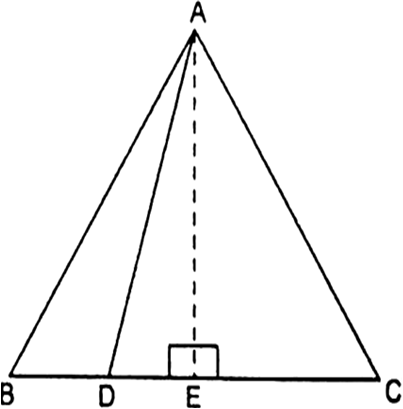
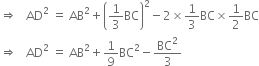
In an equilateral ABC, D is a point on side BC such that BD equals 1 third BC. Prove that 9AD2 = 7AB2. Given : An equilateral triangle ABC such that To Prove : 9AD2 = 7AB Given : An equilateral triangle ABC such that BD equals 1 third BC.To Prove : 9AD2 = 7AB2 Const: Draw AE ⊥ BC. Proof: In right triangles ABE and ACE, we have AE = AE [common] ∠AEB = ∠AEC [90°] and AB = AC [∆ABC is an equilateral] Therefore, by using RHS congruent condition space space increment ABE approximately equal to increment ACE rightwards double arrow BE = CE [by CPCT] rightwards double arrow BE equals CE equals 1 half BC In right triangle ADE, we have space AD squared space equals space AE squared plus DE squared rightwards double arrow AD squared space equals space AE squared plus left parenthesis BE minus BD right parenthesis squared rightwards double arrow space space space AD squared equals AE squared plus BE squared plus BD squared minus 2 BD. BE rightwards double arrow AD squared space equals space left parenthesis AE squared plus BE squared right parenthesis plus BD squared minus 2 BD. BE open square brackets because space space BD equals 1 third BC space and space BE space equals space CE space equals space 1 half BC close square brackets rightwards double arrow space space space AD squared space equals space AB squared plus open parentheses 1 third BC close parentheses squared minus 2 cross times 1 third BC cross times 1 half BC rightwards double arrow space space space AD squared space equals space AB squared plus 1 over 9 BC squared minus BC squared over 3 rightwards double arrow AD squared equals fraction numerator 9 AB squared plus BC squared minus 3 BC squared over denominator 9 end fraction rightwards double arrow 9 AD squared space equals space 9 AB squared minus 2 BC squared But AB = BC = CA rightwards double arrow <pre>uncaught exception: mkdir(): Permission denied (errno: 2) in /home/config_admin/public/felixventures.in/public/application/css/plugins/tiny_mce_wiris/integration/lib/com/wiris/util/sys/Store.class.php at line #56mkdir(): Permission denied

in file: /home/config_admin/public/felixventures.in/public/application/css/plugins/tiny_mce_wiris/integration/lib/com/wiris/util/sys/Store.class.php line 56
#0 [internal function]: _hx_error_handler(2, 'mkdir(): Permis...', '/home/config_ad...', 56, Array) #1 /home/config_admin/public/felixventures.in/public/application/css/plugins/tiny_mce_wiris/integration/lib/com/wiris/util/sys/Store.class.php(56): mkdir('/home/config_ad...', 493) #2 /home/config_admin/public/felixventures.in/public/application/css/plugins/tiny_mce_wiris/integration/lib/com/wiris/plugin/impl/FolderTreeStorageAndCache.class.php(110): com_wiris_util_sys_Store->mkdirs() #3 /home/config_admin/public/felixventures.in/public/application/css/plugins/tiny_mce_wiris/integration/lib/com/wiris/plugin/impl/RenderImpl.class.php(231): com_wiris_plugin_impl_FolderTreeStorageAndCache->codeDigest('mml=computeDigest(NULL, Array) #5 /home/config_admin/public/felixventures.in/public/application/css/plugins/tiny_mce_wiris/integration/service.php(19): com_wiris_plugin_impl_TextServiceImpl->service('mathml2accessib...', Array) #6 {main}</pre> rightwards double arrow <pre>uncaught exception: mkdir(): Permission denied (errno: 2) in /home/config_admin/public/felixventures.in/public/application/css/plugins/tiny_mce_wiris/integration/lib/com/wiris/util/sys/Store.class.php at line #56mkdir(): Permission denied

in file: /home/config_admin/public/felixventures.in/public/application/css/plugins/tiny_mce_wiris/integration/lib/com/wiris/util/sys/Store.class.php line 56
#0 [internal function]: _hx_error_handler(2, 'mkdir(): Permis...', '/home/config_ad...', 56, Array) #1 /home/config_admin/public/felixventures.in/public/application/css/plugins/tiny_mce_wiris/integration/lib/com/wiris/util/sys/Store.class.php(56): mkdir('/home/config_ad...', 493) #2 /home/config_admin/public/felixventures.in/public/application/css/plugins/tiny_mce_wiris/integration/lib/com/wiris/plugin/impl/FolderTreeStorageAndCache.class.php(110): com_wiris_util_sys_Store->mkdirs() #3 /home/config_admin/public/felixventures.in/public/application/css/plugins/tiny_mce_wiris/integration/lib/com/wiris/plugin/impl/RenderImpl.class.php(231): com_wiris_plugin_impl_FolderTreeStorageAndCache->codeDigest('mml=computeDigest(NULL, Array) #5 /home/config_admin/public/felixventures.in/public/application/css/plugins/tiny_mce_wiris/integration/service.php(19): com_wiris_plugin_impl_TextServiceImpl->service('mathml2accessib...', Array) #6 {main}</pre>

Gaurav Seth 5 years, 3 months ago

In an equilateral ABC, D is a point on side BC such that  Prove that 9AD2 = 7AB2

<hr />


Given : An equilateral triangle ABC such that To Prove : 9AD2 = 7AB2

Const: Draw AE ⊥ BC.
Proof: In right triangles ABE and ACE, we have
AE = AE    [common]
∠AEB = ∠AEC    [90°]
and    AB = AC
[∆ABC is an equilateral]
Therefore, by using RHS congruent condition
                                       
                                          BE = CE         [by CPCT]
                                          
In right triangle ADE, we have



But             AB = BC = CA


  • 1 answers

Gaurav Seth 5 years, 3 months ago

ANSWER

The DNA copies are produced during the process of cellular division. The new DNA copies which are synthesised during replication may not be identical to the original one, This may be due to the introduction of the mutations during the replication process. Mutations are random genetic changes. There are repair mechanisms which correct the mutations incorporated in the DNA. However, there many be some errors which remain in the new DNA. So, it is not necessary that the copies may be identical at times. 

  • 1 answers

Gaurav Seth 5 years, 3 months ago

ANSWER:

The resources should be equitably distributed for the benefit of every individual who is a part of the society. The equal distribution will allow the flow of the resources in every generation and will make sure that everyone makes sustainable use of the resources. The resources should not be exploited by anyone. The forces acting against such type of distribution are 1. Huge amount of resources in the hands of certain people and 2. limited amount of resources available in the nature.

myCBSEguide App

myCBSEguide

Trusted by 1 Crore+ Students

Test Generator

Test Generator

Create papers online. It's FREE.

CUET Mock Tests

CUET Mock Tests

75,000+ questions to practice only on myCBSEguide app

Download myCBSEguide App