
Ask questions which are clear, concise and easy to understand.
Ask QuestionPosted by Pallavi Akkalkot 5 years, 6 months ago
- 1 answers
Posted by Pallavi Akkalkot 5 years, 6 months ago
- 1 answers
Yogita Ingle 5 years, 6 months ago
The following are the Gandhiji's idea of Satyagraha:
1. According to him, Satyagraha has been formulated as armament of the strongest and does not sup-port violence in any form.
2. The motive behind Satyagraha was not to damage or harass the enemy but to change him or win him by sympathy, self- suffering and tolerance.
3. According to him the idea of Satyagraha was based on the power of truth.
4. This idea of Satyagraha emphasized on the belief of non-violence, truth, patience and peaceful demonstrations.
5. He considered that this dharma of non-violence and truth can unite the people of India
Posted by Sneha Singh 5 years, 6 months ago
- 1 answers
Yogita Ingle 5 years, 6 months ago
The word ‘fire’ stands for desire. In the poem, it indicates all types of greed and lust. In today’s world, mankind’s greed is endangering the very existence of the planet Earth. The word ‘ice’ in the poem indicates hatred and indifference which is as cold as ‘ice’.
Posted by Sneha Singh 5 years, 6 months ago
- 1 answers
Posted by Pallavi Akkalkot 5 years, 6 months ago
- 1 answers
Yogita Ingle 5 years, 6 months ago
The Non-Cooperation Movement spread to the countryside. The following points state its spread
(i) In Awadh, peasants under the leadership of Baba Ram Chandra revolted against the talukdars and the landlords who demanded very high rent and different taxes from them. The peasant demanded reduction of revenue, abolition of begar and social boycott of oppressive landlords. In many places, local leaders told peasants that Gandhiji had declared that no taxes were to be paid and land was to be redistributed among the poor.
(ii) In the Gudem hills of Andhra Pradesh, a Militant Guerrilla Movement spread. The colonial government had closed large forest areas which affected the livelihood of the forest people. When the government forced them to contribute begar or free labour, they revolted. Alluri Sitaram Raju inspired by Gandhiji’s ideals came to lead them and the Gudem rebels attacked police stations and carried on guerrilla warfare for achieving Swaraj.
Posted by Pallavi Akkalkot 5 years, 6 months ago
- 1 answers
Yogita Ingle 5 years, 6 months ago
Alluri Sitaram Raju was the tribal peasant’s leader in the Gudem Hills of Andhra Pradesh. He claimed that he had a variety of special powers. He could make correct astrological predictions and heal people and he could survive even bullet shorts.
Role:
- Raju talked of the greatness of Mahatma Gandhi.
- Raju was inspired by the Non-Cooperation Movement.
- He persuaded people to wear khadi and gave up drinking.
- But at the same time, he asserted that India could be liberated only by the use of force, not by non-violence.
- The Gudem rebels attacked police station, attempted to kill British officials and carried
on guerrilla warfare for achieving Swaraj.
Posted by Pallavi Akkalkot 5 years, 6 months ago
- 1 answers
Yogita Ingle 5 years, 6 months ago
Under the Inland Emigration Act of 1859, plantation workers were not permitted to leave the tea gardens without permission. In reality, they were rarely given such permission.
Posted by Pallavi Akkalkot 5 years, 6 months ago
- 1 answers
Yogita Ingle 5 years, 6 months ago
The War created a new economic and political situation :
(i) It led to a huge increase in defence expenditure which was financed by war loans and increasing taxes, customs duties were raised, and income tax introduced.
(ii) Through the war years, prices increased – doubling between 1913 and 1918 – leading to extreme hardships for the common people.
(iii) Villagers were called upon to supply soldiers, and the forced recruitment in rural areas caused widespread anger
Posted by Muskan .072 5 years, 6 months ago
- 2 answers
Vaishu ? 5 years, 6 months ago
Bishwajeet Kumar 5 years, 6 months ago
Posted by Pallavi Akkalkot 5 years, 6 months ago
- 1 answers
Yogita Ingle 5 years, 6 months ago
Following are the economic effects of the non-cooperation movement:
• The economic effects of the non-cooperation movement were very significant. Foreign goods were boycotted, liquor shops were picketed and bonfires were lit of foreign cloth.
• The domestic textile mills and handlooms industry got a shot in the arm since people had begun to prefer Indian clothes over imported ones.
• Merchants and traders abstained from trading in foreign goods or finance foreign trade.
• Between 1921 and 1922, the import of foreign cloth dropped by half and its value also diminished.
Posted by Nethi Saidivya 5 years, 6 months ago
- 1 answers
Gaurav Seth 5 years, 6 months ago
Answer
Europe in the mid-18th Century
- No nation states because Europeans never saw themselves as sharing a common identity or culture. E.g., The Habsburg Empire of Austria–Hungary comprised French, Italian and German-speaking people.
- Europe was broadly divided into two classes during this period namely: Aristocracy
- The land owning class.
- Numerically small, but dominated Europe, both socially and politically.
- Spoke French which was considered the language of the high society.
- Families were connected through marriage.
Posted by Gyanvi Gupta 5 years, 6 months ago
- 1 answers
Gaurav Seth 5 years, 6 months ago
The different power-sharing forms in modern democracies are as follows :
- Power is shared among different organs of a government such as the executive, the legislature and the judiciary.
- Power is shared among governments at different levels. Example: a government for the entire country and governments for different regions in the country.
- Power is shared among social groups such as linguistic groups, religious groups, etc.
- Power is shared among political parties, movements, and pressure groups. They try to control and influence the one in power.
Posted by Account Deleted 5 years, 6 months ago
- 1 answers
Posted by Bhakti Gupta 5 years, 6 months ago
- 1 answers
Gaurav Seth 5 years, 6 months ago
To draw y = x, we will plot the points (1,1) and (0,0).
To draw y = 2x, we will plot the points (1,2) and (0,0).
To draw x + y = 6, we will plot the points (0,6) and (6,0).
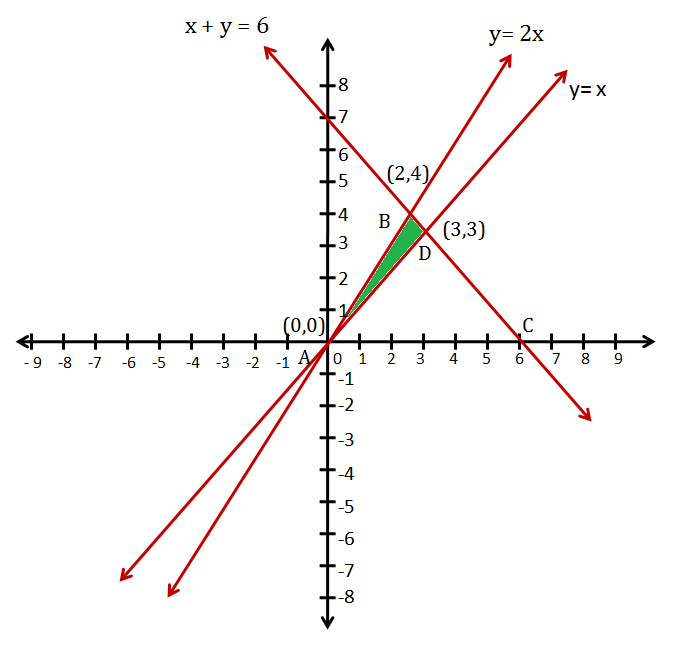

Coordinates of A (0,0), B (2,4), D (3,3).
Posted by Archana Nair 5 years, 6 months ago
- 1 answers
Bishwajeet Kumar 5 years, 6 months ago
Posted by Anshika Mishra 5 years, 6 months ago
- 1 answers
Riya Chauhan 5 years, 5 months ago
Posted by Anshika Mishra 5 years, 6 months ago
- 1 answers
Siddhant Chikate 5 years, 3 months ago
Posted by Piyush 5974 5 years, 6 months ago
- 2 answers
Vaishu ? 5 years, 6 months ago
Gaurav Seth 5 years, 6 months ago
Like all living organism, plants also require an excretory system to discharge excess water from their body. This process of elimination of excess water from the plant body is known as transpiration. It is generally the evaporation of water from the surface of the leaves.
During the process of transpiration, water molecules in the plant tissues are removed from the aerial parts of the plants. Only a small amount of water absorbed by the plants is utilised in growth and development. The rest is eliminated in the form of transpiration.
Posted by Anshika Mishra 5 years, 6 months ago
- 1 answers
Posted by Leema Reddy 5 years, 6 months ago
- 4 answers
Posted by Varad Bagul 5 years, 6 months ago
- 1 answers
Yogita Ingle 5 years, 6 months ago
Some countries in the world are trying to become a democratic country. These countries face the foundational challenge of making the transition to democracy and then, instituting democratic government.
- This involves bringing down the existing non-democratic regime.
- It is also necessary to keep military away from controlling government.
- Such countries have to make great efforts to establish a sovereign and functional state.
Posted by Varad Bagul 5 years, 6 months ago
- 3 answers
Yogita Ingle 5 years, 6 months ago
The most basic outcome of democracy is government accountability to the citizens and its responsiveness to the needs and expectations of the citizens.
Posted by Debadatta Ray 5 years, 6 months ago
- 0 answers
Posted by Aryan Sahu 5 years, 6 months ago
- 1 answers
Stu Dent 5 years, 6 months ago
Posted by Ritu Soni 5 years, 6 months ago
- 1 answers
Meghna Thapar 5 years, 4 months ago
(a) Reccurence of similar properties of elements after certain fixed interval of atomic number is called periodicity in properties of elements.
(b) They have similar properties because:
(i) They all have same number of valence electrons.
(ii) They all have same valency.
(c) The tendency to gain electrons increases due to increase in the nuclear charge. Due to this, atomic size decreases and a large number of valence electrons are held towards the nucleus and tendency to gain electrons increases.
Posted by Aarzoo Chaudhary 5 years, 6 months ago
- 1 answers
Gaurav Seth 5 years, 4 months ago
O be the center of circles.
AB be the chord to the larger circle and tangent to smaller circle at P.
OP be radius of smaller circle i.e., OP = 15 cm
OA & OB be radius of larger circle i.e., OA = OB = 17 cm
now,
OP ⊥ AB ( radius and tangent of a circle are ⊥ to each other)
∴ In ΔOAP by PGT,
=
+
=
+
289 = 225 +
289 - 225 =
64 =
= AP
AP = 8 cm.
Now,
In ΔOAP & ΔOPB
OA = OB = 17 cm (Radii of same circle)
OP = OP (Common Side)
∠OPA = ∠OPB = 90° ( OP⊥AB)
∴ ΔOAP ≡ ΔOPB (By R.H.S axiom)
∴ AP = PB by C.P.C.T
Now,
AB = AP + PB
AB = 2 x AP
AB = 2 x 8 cm
AB = 16 cm
∴ Length of Chord is 16 cm.
Posted by Varad Bagul 5 years, 6 months ago
- 1 answers
Divija Bansal 5 years, 6 months ago

myCBSEguide
Trusted by 1 Crore+ Students

Test Generator
Create papers online. It's FREE.

CUET Mock Tests
75,000+ questions to practice only on myCBSEguide app

Yogita Ingle 5 years, 6 months ago
Dandi March was a significant remark towards the freedom struggle of our country. Mahatma Gandhi undertook the Dandi March to protest against the salt tax on the public by the British regime in the country on the twelve day of March in the year 1930. Through this protest movement Mahatma Gandhi along with other 74 congress followers and other common public walked to Dandi in the state of Gujarat and prepared salt to mark the end of salt tax in the country implemented by the Britishers.The Dandi March was also called popularly as the salt satyagraha. The Dandi March also marked the beginning of the civil disobedience movement by the congress to eliminate British rule from the country.
1Thank You