
Ask questions which are clear, concise and easy to understand.
Ask QuestionPosted by Bensan Abraham 5 years, 3 months ago
- 1 answers
Posted by Kajal Gautam 5 years, 3 months ago
- 3 answers
Lavanya Sharma 5 years, 3 months ago
Rao. Snehin Rao 5 years, 3 months ago
Posted by Avichal Jain 5 years, 3 months ago
- 1 answers
Yogita Ingle 5 years, 3 months ago
A few examples of public sector activities are provision of water, electricity and some modes of transport. The government has taken these up because water and power are needed by everyone. If the work of providing electricity and water is left to private enterprises, the latter might exploit this opportunity and sell these at rates which the masses cannot afford. Hence, to ensure that basic amenities like water and power are available for all, the government supplies these at low and affordable rates.
Posted by Lipi Nag 5 years, 3 months ago
- 4 answers
Mayank Rauthan 5 years, 3 months ago
Yogita Ingle 5 years, 3 months ago
Alluvial soils are by far the largest and the most important soil group of India. The widest occurrence of the alluvial soils is in the Indo-Gangetic Plain starting from Punjab, Haryana, Uttar Pradesh, Bihar, West Bengal and Assam in the east, northern parts of Gujrat also have some covers alluvial soils.
Md Affan 5 years, 3 months ago
Posted by Kaviya Velavan 5 years, 3 months ago
- 2 answers
Posted by Kumari Shalini 5 years, 3 months ago
- 2 answers
Yogita Ingle 5 years, 3 months ago
The mechanism of urine formation involves the following steps:
Glomerular Filteration
Glomerular filtration occurs in the glomerulus where blood is filtered. This process occurs across the three layers- epithelium of Bowman’s capsule, endothelium of glomerular blood vessels, and a membrane between these two layers.
Blood is filtered in such a way that all the constituents of the plasma reach the Bowman’s capsule, except proteins. Therefore, this process is known as ultrafiltration.
Reabsorption
Around 99 percent of the filtrate obtained is reabsorbed by the renal tubules. This is known as reabsorption. This is achieved by active and passive transport.
Secretion
The next step in urine formation is the tubular secretion. Here, tubular cells secrete substances like hydrogen ion, potassium ion, etc into the filtrate. By this process, the ionic, acid-base and the balance of other body fluids are maintained. The secreted ions combine with the filtrate and form urine. The urine passes out of the nephron tubule into a collecting duct.
Urine
The urine produced is 95% water and 5% nitrogenous wastes. Wastes such as urea, ammonia, creatinine are excreted in the urine. Apart from these, the potassium, sodium and calcium ions are also excreted.
Posted by Nishant Mathur 5 years, 3 months ago
- 2 answers
Yogita Ingle 5 years, 3 months ago
Given that HCF = 9 and the numbers are 306 and 657 .
LCM = ?
We know that LCM × HCF = product of two numbers
⇒LCM × 9 = 306 × 657
⇒LCM = 201042/9 = 22338
Ranbeer Boparai 5 years, 3 months ago
Posted by Ayushi Maurya 5 years, 3 months ago
- 2 answers
Yogita Ingle 5 years, 3 months ago
Let roots 4k and 5k
4k+5k =-b/a
9k =-b/a
K=-b/9a..... (1)
4k*5k=c/a
20k2=c/a
Sub ... (1)
20 (-b/9a)2=c/a
20 (b2/81a2)=c/a
20 b2 = 81 ac
Ranbeer Boparai 5 years, 3 months ago
Posted by Samunder Singhal 5 years, 3 months ago
- 2 answers
Mayank Rauthan 5 years, 3 months ago
Posted by Atul Verma 5 years, 3 months ago
- 2 answers
Yogita Ingle 5 years, 3 months ago
Chlorophyll is remarkably similar in structure to haemoglobin which is defined as the oxygen carrying pigment found in the red blood cells of mammals and other vertebrates. Therefore, the metallic element present in chlorophyll is magnesium (Mg).
Nicolas Tesla 5 years, 3 months ago
Posted by Sakshi Tiwari 5 years, 3 months ago
- 1 answers
Yogita Ingle 5 years, 3 months ago
Given, sum of first m terms of an A.P. is n.

Also, sum of first n terms is m.

Subtracting (2) from (1),

Hence, the sum of its first (m + n) terms is -(m + n).
Posted by Pragati Kumar 5 years, 3 months ago
- 5 answers
Mayank Rauthan 5 years, 3 months ago
Posted by Uma Yadav 5 years, 3 months ago
- 5 answers
Ishan Goyal 5 years, 3 months ago
Posted by Uzair Khan 5 years, 3 months ago
- 0 answers
Posted by Uma Yadav 5 years, 3 months ago
- 1 answers
Radha Mistry?☺ 5 years, 3 months ago
Posted by Shreya Kumari 5 years, 3 months ago
- 1 answers
Yogita Ingle 5 years, 3 months ago
Brine is a solution of salt (usually sodium chloride) in water or one can say Brine is salt solutions ranging from about 3.5% up to about 26%. It is obtained by mixing of salts with water. Brine is a common fluid used in large refrigeration installations for the transport of heat from place to place.
- The process is termed as the chlor-alkali process. The term chlor for chlorine and alkali for sodium hydroxide.
- Chlorine gas is given off at the anode,
- Hydrogen gas is given off at the cathode.
- Sodium hydroxide solution is formed near the cathode.
- The reaction that takes place is as follows:

Posted by Shreya Kumari 5 years, 3 months ago
- 2 answers
Kumari Shalini 5 years, 3 months ago
Yogita Ingle 5 years, 3 months ago
Bee stings are acidic in nature, which is why a household remedy for a bee sting is baking soda or sodium bicarbonate, which is a basic substance. Sodium hydrogen carbonate (baking soda) is used as an antacid because it neutralises excess acid present in the stomach. It reacts with dilute hydrochloric acid to produce carbon dioxide gas, which is used in fire extinguishers.
Posted by Shreya Kumari 5 years, 3 months ago
- 1 answers
Shreya P Shreya P 5 years, 3 months ago
Posted by Shreya Kumari 5 years, 3 months ago
- 2 answers
Yogita Ingle 5 years, 3 months ago
Tooth decay causes enamel and dentine to gradually weaken. It begins when acids are formed by bacteria acting on sugars that soften or demineralize the enamel. Bacteria in the mouth create acids after eating through the oxidation of sugar and food particles in the mouth. Tooth decay starts when the mouth’s pH is below 5.5.
Posted by Harsh Varman 5 years, 3 months ago
- 3 answers
Avichal Jain 5 years, 3 months ago
Vani Vashisht 5 years, 3 months ago
Pravin Yedage 5 years, 3 months ago
Posted by Nandita Nishanth 5 years, 3 months ago
- 1 answers
Yogita Ingle 5 years, 3 months ago
In the given figure, quad. ABCD is circumscribed touching the circle at P, Q, R and S. If AP = 5 cm, BC= 7 c m and CS = 3 cm. Then, the length of AB = ?
Ans
Tangents drawn from an external point to a circle are equal.
Posted by Bhumit Saroha 5 years, 3 months ago
- 0 answers
Posted by Suman Nehra 5 years, 3 months ago
- 2 answers
Mayank Rauthan 5 years, 3 months ago
Posted by Kush Mathur 5 years, 3 months ago
- 1 answers
Posted by Avni Jain 5 years, 3 months ago
- 1 answers
Sakshi Tiwari 5 years, 3 months ago
Posted by Richa Shukla 5 years, 3 months ago
- 1 answers
Richa Shukla 5 years, 3 months ago
Posted by Anushka Mittal 5 years, 3 months ago
- 1 answers
Gaurav Seth 5 years, 3 months ago
The Trigonometry Ratios of the angle θ in the triangle APM are defined as follows.
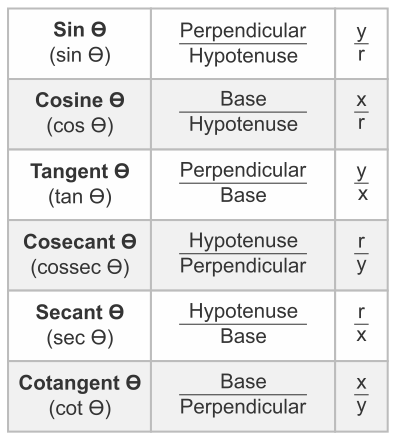
Opposite over Hypotenuse – Sin, Adjacent Over Hypotenuse – Cos, Opposite over Adjacent – Tan, Hypotenuse over Opposite – Cosec, Hypotenuse Over Adjacent – Sec and Adjacent over Opposite – Cotangent,
The ratios defined above are abbreviated as sin θ, cos θ, tan θ, cosec θ, sec θ and cot θ respectively. Note that the ratios cosec θ, sec θ and cot θ are respectively, the reciprocals of the ratios sin θ, cos θ and tan θ. So, the trigonometric ratios of an acute angle in a right triangle express the relationship between the angle and the length of its sides.
Opposite of Sin: Cosecant
Opposite of Cos: Secant
Opposite of Tan: Cotangent
Opposite of Cosecant: Sin
Opposite of Cotangent: Tan
Opposite of Secant: Cosecant
Trig Mnemonics – Some People Have, Curly Black Hair Through Proper Brushing.
Here, Some People Have is for
- Sin θ= Perpendicular/ Hypotenuse.
Curly Black Hair is for
- Cos θ= Base/ Hypotenuse.
Through Proper Brushing is for
- Tan θ= Perpendicular/Base
Trigonometric Ratios of Some Specific Angles
We already know about isosceles right angle triangle and right angle triangle with angles 30º, 60º and 90º.
Can we find sin 30º or tan 60º or cos 45º etc. with the help of these triangles?
Does sin 0º or cos 0º exist?
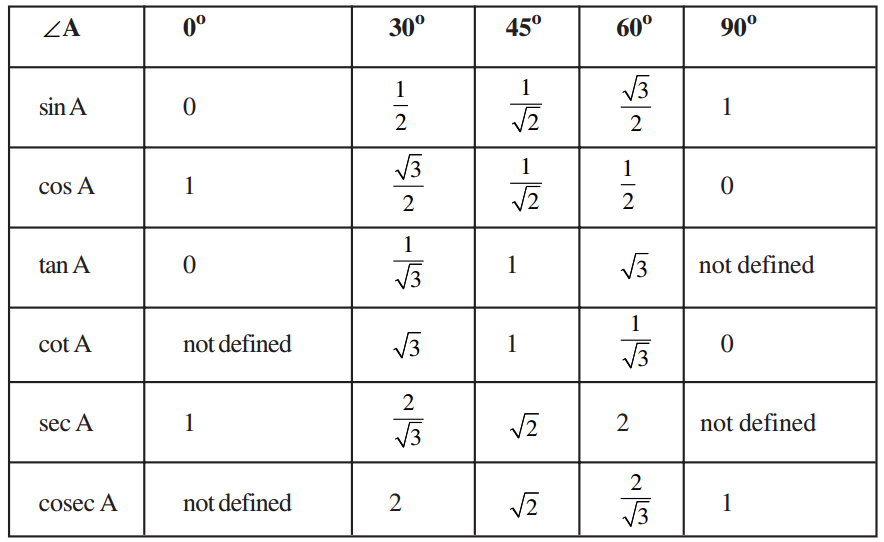 <figcaption id="caption-attachment-76384">Trig Table</figcaption>
</figure>
<figcaption id="caption-attachment-76384">Trig Table</figcaption>
</figure>
T
Posted by Avni Jain 5 years, 3 months ago
- 1 answers
Suman Nehra 5 years, 3 months ago

myCBSEguide
Trusted by 1 Crore+ Students

Test Generator
Create papers online. It's FREE.

CUET Mock Tests
75,000+ questions to practice only on myCBSEguide app

Yogita Ingle 5 years, 3 months ago
The product of LCM and HCF of two numbers is equal to the product of two numbers.
<div> LCM = product of the numbers / HCF</div>LCM = 26×91 /13
LCM = 2366 / 13
LCM = 182
0Thank You