
Ask questions, doubts, problems and we will help you..
Ask questions which are clear, concise and easy to understand.
Ask Question
CBSE, JEE, NEET, CUET
Question Bank, Mock Tests, Exam Papers
NCERT Solutions, Sample Papers, Notes, Videos
Posted by Komal Rathee 5 years, 4 months ago (9435977)
- 1 answers
Posted by Sweta Soreng 5 years, 4 months ago (4939990)
- 1 answers
Yogita Ingle 5 years, 4 months ago (2577571)
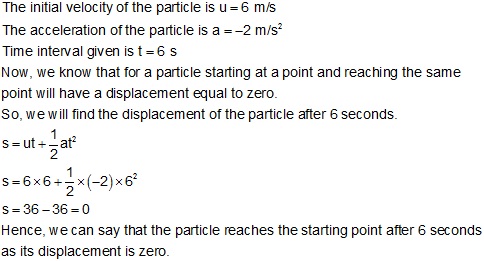
Initial velocity u = 5 km/hr
Time t = 10 min
Deceleration
And so, from the speed formula, we have
Distance
From equation of motion, we have,
Therefore, total distance = d1 + d2
Total distance
Posted by Sweta Soreng 5 years, 4 months ago (4939990)
- 1 answers
Yogita Ingle 5 years, 4 months ago (2577571)
Given,
Acceleration, a=36km/h2
Initial velocity, u=12km/h
Final velocity, v=18km/h
Using the equation of motion as:
v2−u2=2as
Where, s is distance traversed by ship.
(18)2−(12)2=2(36)s
324−144=36s
s=5km
Distance traversed by ship is 5 Km.
Posted by Pranit Agalave 5 years, 4 months ago (7509500)
- 0 answers

Posted by Sweta Soreng 5 years, 4 months ago (4939990)
- 1 answers
Yogita Ingle 5 years, 4 months ago (2577571)
initial velocity (u)= 0m/s
final velocity (v)=400
time(t)= 2 minutes
then,
Acceleration ( a)= v-u/t
= 400/2
= 200m/meter square
Posted by Komal Rao 5 years, 4 months ago (9666570)
- 3 answers
Deep Singh 5 years, 4 months ago (5849429)
Mishti ???? 5 years, 4 months ago (8889581)
Nayan Dip 5 years, 4 months ago (9673256)
Posted by Abhishek Singh 5 years, 4 months ago (5933699)
- 0 answers
Posted by Sweta Soreng 5 years, 4 months ago (4939990)
- 1 answers
Yogita Ingle 5 years, 4 months ago (2577571)
u= 20 m/s
v= 0
s = 5 cm = 0.05 m
from 3rd equation,
v² -u² = 2as
⇒0 - (20)² = 2×0.05×a
⇒0.1 a = - 400
⇒a = - 4000 m/s²
deceleration will be - 4000 m/s²
Posted by Vivek Chavan 5 years, 4 months ago (9585673)
- 0 answers
Posted by Deku Official 5 years, 4 months ago (8288135)
- 0 answers
Posted by Saravanan P 5 years, 4 months ago (8115555)
- 1 answers
Ayush Kashyap 5 years, 4 months ago (9331396)
Posted by Vishal Chhabra 5 years, 4 months ago (9661868)
- 4 answers
Sanjana Dua?????❣️ 5 years, 4 months ago (8790599)
Usha Yadav 5 years, 4 months ago (9596770)
Posted by Sania .S.S 5 years, 4 months ago (9674656)
- 1 answers
Posted by Lalpekhlui Chhangte 5 years, 4 months ago (9674418)
- 0 answers
Posted by Mansi Sahu 5 years, 4 months ago (9092552)
- 1 answers
Yogita Ingle 5 years, 4 months ago (2577571)
Colloidal particles are smaller in size. They remain in state of zig-zag motion
(Brownian motion) always, so the force of gravity is encountered and they do not settle down.
But the particles in suspension are larger in size, so they settle down under the influence of gravity.
Posted by Priya ✧*。٩(๑˙╰╯˙๑)و✧*。 5 years, 4 months ago (4803610)
- 3 answers
Priya ✧*。٩(๑˙╰╯˙๑)و✧*。 5 years, 4 months ago (4803610)
Shivaji Gaykwad 5 years, 4 months ago (9648219)
Yogita Ingle 5 years, 4 months ago (2577571)
Periscope is used to observe objects around an obstacle. The light from the objects enters the periscope from one end and emerges from the other end and enters into our eyes. We use mirrors inside a periscope to make the light bend in the direction we want to see it.
Periscope is an instrument used for observation around or through an obstacle that prevents direct line-in-sight observation from the observer position.
Posted by Ed Tabu 5 years, 4 months ago (9390036)
- 2 answers
Tanya ?? 5 years, 4 months ago (9516882)
Yogita Ingle 5 years, 4 months ago (2577571)
One morning the writer saw Saheb standing by the gate of the neighbourhood club. Two young men were playing tennis. Saheb was in tennis shoes. On enquiry, Saheb told that some rich boy discarded them because there was a hole in one of them. So he felt no harm in wearing them. It was rather good on his part that the dream of wearing shoes had come true.
Posted by Mansi Sahu 5 years, 4 months ago (9092552)
- 2 answers
Yogita Ingle 5 years, 4 months ago (2577571)
Tyndall effect is in fact the definite test to show the difference between a true and a colloidal solution. it works on the principle that light beams scatter due to the presence of large colloidal particles in the solution which separate the light however in a true solution the particles are not as large enough to scatter the light particles, thats why Tyndall effect is not seen in true solution.
Posted by Raghav Bajaj 5 years, 4 months ago (5700000)
- 1 answers
Sia ? 4 years, 9 months ago (6945213)
Posted by Gurmel Singh 5 years, 4 months ago (9552406)
- 2 answers
Yogita Ingle 5 years, 4 months ago (2577571)
(i) Imputed salaries of family members will be included in national income.
(ii) Interest will not be included in national income because borrowings by general government is treated for consumption purposes.
Posted by Priyansha Thakur 5 years, 4 months ago (9674553)
- 2 answers
Chirag Yadav 5 years, 4 months ago (9203785)
Yogita Ingle 5 years, 4 months ago (2577571)
| Janapadas |
Mahajanapadas |
| 1500 BC to the 6th century BC | 600 BC – 345 BC |
| The Sanskrit term “<i>Janapada</i>” compound term, made up of two words:<i> janas and pada</i>. <i>Jana</i> means “people” or “subject” The word <i>pada</i> means “foot” | Mahajapadas is a compound term consisting of <i>maha</i> meaning “great”, and <i>janapada</i> meaning”foothold of a people |
| The Janapada was the highest political unit in Ancient India during this period. They were usually monarchical in nature though some followed a republican form of government | The Mahajanapads still retained their monarchial nature while some of the republics came under the control of powerful oligarchs |
Posted by Pawan Kumari 5 years, 4 months ago (9252141)
- 1 answers
Yogita Ingle 5 years, 4 months ago (2577571)
Voltmeter is an electrical measuring device, which is used to measure potential difference between two points in a circuit. Voltmeter is always connected in parallel to a circuit.
Since Galvanometer is a very sensitive instrument, therefore it can not measure high potential difference. In order to convert a Galvanometer into voltmeter, a very high resistance known as "series resistance" is connected in series with the galvanometer.
Posted by Pratham Patel 5 years, 4 months ago (9424849)
- 1 answers
Ruchi Rao 5 years, 4 months ago (9534968)
Posted by Sachi Jain 5 years, 4 months ago (9608906)
- 1 answers
Posted by ☆°••(Prateek)••° ☆ 5 years, 4 months ago (9590819)
- 2 answers
Priya ✧*。٩(๑˙╰╯˙๑)و✧*。 5 years, 4 months ago (4803610)
Posted by Lakshmi A 5 years, 4 months ago (9674496)
- 2 answers
👌Aditya 👌 👌Kumar👌 5 years, 4 months ago (8928481)
Yogita Ingle 5 years, 4 months ago (2577571)
Water scarcity in most cases is caused by over- exploitation, excessive use and unequal access to water among different social groups.
<div> Water scarcity may be an outcome of large and growing population and consequent greater demands for water, and unequal access to it. A large population means more water not only for domestic use but also to produce more food. Hence, to facilitate higher food-grain production, water resources are being over-exploited to expand irrigated areas and dry-season agriculture. </div>
myCBSEguide
Trusted by 1 Crore+ Students

Test Generator
Create papers online. It's FREE.

CUET Mock Tests
75,000+ questions to practice only on myCBSEguide app

Komal Rathee 5 years, 4 months ago (9435977)
3 Thank You