
Ask questions which are clear, concise and easy to understand.
Ask QuestionPosted by Kyōka ( Demon Snow ) 5 years, 8 months ago
- 5 answers
Vikshit Kumar 5 years, 8 months ago
Kyōka ( Demon Snow ) 5 years, 8 months ago
Posted by Vanshika Baliyan 5 years, 8 months ago
- 3 answers
Posted by Krish Chandna 5 years, 8 months ago
- 1 answers
Yogita Ingle 5 years, 8 months ago
A 1.5 m tall boy is standing at some distance from a 30 m tall building. The angle of elevation from his eyes to the top of the building increases from  to
to  as he walks towards the building. Find the distance he walked towards the building.
Ans. AB = 30 m and PR = 1.5 m
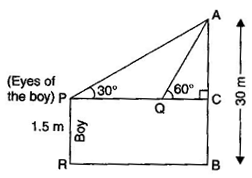
AC = AB – BC
= AB – PR
= 30 – 1.5
= 28.5 m
In right triangle ACQ,


 QC =
QC =  m
m
In right triangle ACP,


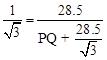
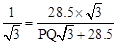


PQ = 
PQ =  =
=  m
m
Hence, the walked towards the building is m.
Posted by Nitin Nigam 5 years, 8 months ago
- 2 answers
Posted by W T F ? 5 years, 8 months ago
- 3 answers
W T F ? 5 years, 8 months ago
Study ? 5 years, 8 months ago
Study ? 5 years, 8 months ago
Posted by Vanshika Baliyan 5 years, 8 months ago
- 4 answers
Vikshit Kumar 5 years, 8 months ago
Posted by Neha Kakkar ?? 5 years, 8 months ago
- 3 answers
Posted by Ananya Tiwari 5 years, 8 months ago
- 2 answers
Gaurav Seth 5 years, 8 months ago
(i) Centre-State relations: As and when the ruling party at the State level was different, the parties that ruled at the Centre tried to undermine the power of the states. The Central Government has been misusing the Constitution to dismiss the State governments that were controlled by rival parties. This undermined the spirit of federalism. All this changed significantly after 1990. This period saw the rise of regional political parties in many states of the country.
(ii) Coalition Governments and autonomy of states: The era of coalition has changed the relationship between the centre and state governments since no single party got a clear majority in the LokSabha, the major national parties had to enter into an alliance with many parties including several regional parties to form a government at the Centre. This led to a new culture of power sharing and respect for the autonomy of State Governments.
(iii) Judgement of the Supreme Court: The Supreme Court of India has established strict guidelines for imposing President’s rule. With new guidelines it is very difficult for the Central Government to dismiss state governments in an arbitrary manner. Thus, federal power sharing is more effective today than it was in the early years after the Constitution came into force.
Sumesh ☺️☺️☺️ 5 years, 8 months ago
Posted by Vanshika Baliyan 5 years, 8 months ago
- 2 answers
Sumesh ☺️☺️☺️ 5 years, 8 months ago
Sumesh ☺️☺️☺️ 5 years, 8 months ago
Posted by Niyati Gautam 5 years, 8 months ago
- 2 answers
Posted by W T F ? 5 years, 8 months ago
- 5 answers
Shreya The Great ??????? 5 years, 7 months ago
Posted by Lucifer ? Morningstar? 5 years, 8 months ago
- 3 answers
Yogita Ingle 5 years, 8 months ago
Bauxite does not have a specific composition. It is a mixture of hydrous aluminum oxides, aluminum hydroxides, clay minerals, and insoluble materials such as quartz, hematite, magnetite, siderite, and goethite.
.. .... 5 years, 8 months ago
Posted by Yuvraj Singh 5 years, 8 months ago
- 3 answers
Vikshit Kumar 5 years, 8 months ago
Lucifer ? Morningstar? 5 years, 8 months ago
Posted by Vikshit Kumar 5 years, 8 months ago
- 3 answers
Vikshit Kumar 5 years, 8 months ago
Posted by Raj Chandesar 5 years, 8 months ago
- 2 answers
Posted by Dinesh Pro Gaming 5 years, 8 months ago
- 1 answers
Vikshit Kumar 5 years, 8 months ago
Posted by Ashish Sahu 5 years, 8 months ago
- 4 answers
Vikshit Kumar 5 years, 8 months ago
Posted by Yash Jaiswal????? 5 years, 8 months ago
- 5 answers
Posted by Sonu Singh 5 years, 8 months ago
- 1 answers
Yogita Ingle 5 years, 8 months ago
Electrolysis of water is the decomposition of water (H2O) into oxygen (O2) and hydrogen gas (H2) due to an electric current being passed through the water.
An electrical power source is connected to two electrodes, or two plates (typically made from some inert metal such as platinum, stainless steel or iridium) which are placed in the water. Hydrogen will appear at the cathode (the negatively charged electrode, where electrons enter the water), and oxygen will appear at the anode (the positively charged electrode). Assuming ideal faradaic efficiency, the amount of hydrogen generated is twice the amount of oxygen, and both are proportional to the total electrical charge conducted by the solution.
Above is the simple setup for electrolysis of water.
Posted by Tannu Raj 5 years, 8 months ago
- 2 answers
Vikshit Kumar 5 years, 8 months ago
Posted by .. .... 5 years, 8 months ago
- 4 answers
Yogita Ingle 5 years, 8 months ago
The conversion of vegetable oil to vegetable ghee is called hydrogenation reaction.
Posted by Bushral Thara 5 years, 8 months ago
- 3 answers
Posted by ??? ‐----- 5 years, 8 months ago
- 5 answers
??? ‐----- 5 years, 8 months ago
Posted by Bushral Thara 5 years, 8 months ago
- 5 answers
Posted by ? Pranali.A.P ? 5 years, 8 months ago
- 5 answers
? Pranali.A.P ? 5 years, 8 months ago
Prisha ?? 5 years, 8 months ago
Posted by Saurabh Shinde 5 years, 8 months ago
- 4 answers
Gaurav Seth 5 years, 8 months ago
It succeeded when, on February 4, 1948, Ceylon was granted independence as the Dominion of Ceylon. Dominion status within the British Commonwealth was retained for the next 24 years until May 22, 1972 when it became a republic and was renamed the Republic of Sri Lanka.
Posted by ??? ‐----- 5 years, 8 months ago
- 5 answers
Posted by Bushral Thara 5 years, 8 months ago
- 5 answers

myCBSEguide
Trusted by 1 Crore+ Students

Test Generator
Create papers online. It's FREE.

CUET Mock Tests
75,000+ questions to practice only on myCBSEguide app

Meghna Thapar 5 years, 8 months ago
Alveoli are an important part of the respiratory system whose function it is to exchange oxygen and carbon dioxide molecules to and from the bloodstream. These tiny, balloon-shaped air sacs sit at the very end of the respiratory tree and are arranged in clusters throughout the lungs.
The diaphragm is a thin skeletal muscle that sits at the base of the chest and separates the abdomen from the chest. It contracts and flattens when you inhale. This creates a vacuum effect that pulls air into the lungs. When you exhale, the diaphragm relaxes and the air is pushed out of lungs.
A pacemaker is a small device that's placed in the chest or abdomen to help control abnormal heart rhythms. This device uses electrical pulses to prompt the heart to beat at a normal rate. Pacemakers are used to treat arrhythmias (ah-RITH-me-ahs). Arrhythmias are problems with the rate or rhythm of the heartbeat.
0Thank You