
Ask questions which are clear, concise and easy to understand.
Ask QuestionPosted by Pranjal Tiwari 5 years, 7 months ago
- 4 answers
Gaurav Seth 5 years, 7 months ago
A n s w e r : USA ,japan and Belgium
In a unitary form of government, all the power is exercised by only one government. For example
USA ,japan and Belgium
Posted by Rushikesh Salagar 5 years, 7 months ago
- 0 answers
Posted by Kajal Sikarwar 5 years, 7 months ago
- 4 answers
Charvi Sangwan 5 years, 7 months ago
Aastha Barbate 5 years, 7 months ago
Gaurav Seth 5 years, 7 months ago
The Curved surface area of cuboid is the sum of the areas of its six faces. The surface area is the total area of all the faces of a 3D shape.
The curved surface area of a cuboid is the sum of 4 planes of a rectangle, leaving the top (upper) and the base (lower) a. Mathematically, the Curved Surface Area of a cuboid (CSA) is given as:
Curved Surface Area of a cuboid (LSA) = 2 (lh + wh) = 2 h (l + w) square units
Posted by Pabitra Deka 5 years, 7 months ago
- 2 answers
Gaurav Seth 5 years, 7 months ago
As advocated by the author, a first-rate mind, curiosity, and the will to win for the right reasons are the perfect ingredients tomake a scientist, an economist or historian. Reading is only an aspect of learning. It pleases the curiosity partially. A lot of reading may provide information but to reach a conclusion a person must possess good observation skills to have a pragmatic analysis of the same. So, we can say that to become a scientist, an economist or a historian a person should be a good observer and thinker. He should definitely perform experiments to test the hypotheses.
Yogita Ingle 5 years, 7 months ago
The most important thing is intrest. if we dont have it it's waste of studying books. if you know what you are intrested in then you will not have anything to fear , even for careers such as scients etc.. they are so overwhelming sometimes but intrest can push u to learn and explore them. love towards subject is most important. if we have it we can become anything even during the difficult times.
Posted by Tanishk Radadiya 5 years, 7 months ago
- 3 answers
Kajal Pal 5 years, 7 months ago
Avatar ? 5 years, 7 months ago
Gaurav Seth 5 years, 7 months ago
Respiration is a process where the body uses the oxygen to break down glucose and release energy, so that the cells in the body can use it. Carbon dioxide and water are produced during respiration.
Posted by Anura . 5 years, 7 months ago
- 1 answers
Yogita Ingle 5 years, 7 months ago
Borders: All borders, such as the text area border, the cell borders on a table, or OLE object borders, show in grey to help the author during editing. Those borders are not printed nor exported to PDF. It is possible to change the color of those borders (or eliminate them completely). To change border displays, choose OpenOffice → Preferences → Appearance and adjust settings under "Text boundaries", "Object boundaries" and "Table boundaries".
Objects inserted automatically: Objects such as the table of contents and the fields show a grey background. This background is not printed nor exported to PDF; it is there during editing only. You can modify that background in the same Appearance menu. There are separate options for "Field shadings" and "Index and table shadings".
Posted by Shaswat Dehury 5 years, 7 months ago
- 2 answers
Posted by Ria Prakash 5 years, 7 months ago
- 0 answers
Posted by Teena R 5 years, 7 months ago
- 1 answers
Charvi Sangwan 5 years, 7 months ago
Posted by Jissmol Jacob Varghese 5 years, 7 months ago
- 3 answers
Yogita Ingle 5 years, 7 months ago
Given diameter of solid cylinder = 2 cm
Radius of solid cylinder, r = 1 cm
Volume of solid cylinder = πr2h
= π × 12 × h = πh → (1)
Length of hollow cylinder, H = 16 cm
External diameter = 20 cm
External radius = 10 cm
Thickness = 2.5 mm = 0.25 cm
Internal radius = 10 – 0.25 = 9.75 cm
Volume of hollow cylinder = π[102 – (9.75)2] × 16
= 16π × 19.75 × 0.25 → (2)
From (1) and (2), we get
Πh = 16π × 19.75 × 0.25
∴ h = 16 × 19.75 × 0.25 = 79 cm
Gaurav Seth 5 years, 7 months ago
Given :
Let 'H’ be length of a solid cylinder.
Diameter of the solid cylinder, D = 2 cm
Length of the hollow cylinder, h = 16 cm
External diameter of the hollow cylinder, d1 = 20 cm
Thickness of the hollow cylinder = 2.5 mm = 0.25 cm
Radius of the Solid cylinder , R = 2/2 = 1 cm
External radius of the hollow cylinder, r1 = 20/2 = 10 cm
Internal radius of the hollow cylinder , r2 = External radius of the hollow cylinder - Thickness
Internal radius of the hollow cylinder, r2 = 10 - 0.25 = 9.75 cm
Volume of the hollow cylinder = πh(r1² −r2²)
Since the solid cylinder is recast into a hollow cylinder, so
Volume of solid cylinder = Volume of hollow cylinder
πR²H = πh(r1² −r2²)
R²H = 16(10² - 9.75²)
1²H = 16(100 - 95.0625)
H = 16 × 4.9375
H = 79 cm .
Hence, the length of a solid cylinder is 79 cm .
Posted by Singisetty Lipika 5 years, 7 months ago
- 3 answers
Yogita Ingle 5 years, 7 months ago
Steps to test the presence of starch in leaves :
Step 1: A fresh leaf is taken.
Step 2: The leaf is boiled in water for few minutes to soften the cells in the leaf.
Step 3: Now, dip this leaf in iodine solution.
Step 4: The color of the leaf will changes into blue black color when iodine is added to it which shows the presence of starch in it.
Itz Raman Here ☺ 5 years, 7 months ago
Itz Raman Here ☺ 5 years, 7 months ago
Posted by Anupama ?? 5 years, 7 months ago
- 3 answers
Gaurav Seth 5 years, 7 months ago
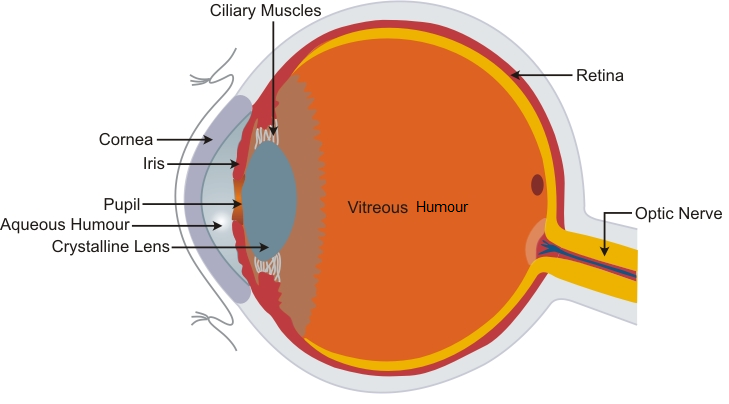
|
Main parts |
Functions |
|
Cornea |
Light enters the eyes through cornea. |
|
Iris |
It controls the amount of light entering the eyes. |
|
Pupil |
It dilates and contracts and thus enables us to in bright and dark light. |
|
Eye-lens |
It is a convex lens and focuses the light entering the eyes. |
|
Ciliary muscles |
Holds the eye lens and helps it to change its focal length. |
|
Retina |
Part of the eyes where image is formed |
|
Optic nerve |
It helps to carry the signals from the retina to the brain. |
Yogita Ingle 5 years, 7 months ago
|
Main parts |
Functions |
|
Cornea |
Light enters the eyes through cornea. |
|
Iris |
It controls the amount of light entering the eyes. |
|
Pupil |
It dilates and contracts and thus enables us to in bright and dark light. |
|
Eye-lens |
It is a convex lens and focuses the light entering the eyes. |
|
Ciliary muscles |
Holds the eye lens and helps it to change its focal length. |
|
Retina |
Part of the eyes where image is formed |
|
Optic nerve |
It helps to carry the signals from the retina to the brain. |
Posted by Itz Raman Here ☺ 5 years, 7 months ago
- 2 answers
Anupama ?? 5 years, 7 months ago
Posted by Abhay Singh 5 years, 7 months ago
- 1 answers
Gaurav Seth 5 years, 7 months ago
Here, a = k – 12, b = 2 (k – 12), c = 2
∴ D = b2 – 4ac = [2(k– 12)]2
– 4(k – 12) x 2
= 4 (k – 12)2 – 8 (k– 12)
Roots are equal, if D = 0
⇒ 4 (k – 12) 2 – 8 (k – 12) = 0
⇒ 4(k – 12)(k – 12 – 2) = 0
⇒ (k – 12) (k – 14) = 0
⇒ k = 12 or 14
But k = 12 does not satisfy the eqn.
k = 14 Ans.
2.
A quadratic equation ....[1] has equal roots when discriminant is 0.
Discriminant is given by:
As per the equation:
Given the quadratic equation:
On comparing with [1] we have;
a = 1 , b = -4k and c = k
Since, the given quadratic equation has equal root
⇒D =0
Squaring both sides we have;
⇒
Substitute the given values we have;
Simplify:
Divide both sides by 4k we have;
or
therefore, the value of k is, 1/4
Posted by Abhay Singh 5 years, 7 months ago
- 4 answers
Posted by Abhay Singh 5 years, 7 months ago
- 1 answers
Gaurav Seth 5 years, 7 months ago
Here, a = k – 12, b = 2 (k – 12), c = 2
∴ D = b2 – 4ac = [2(k– 12)]2
– 4(k – 12) x 2
= 4 (k – 12)2 – 8 (k– 12)
Roots are equal, if D = 0
⇒ 4 (k – 12) 2 – 8 (k – 12) = 0
⇒ 4(k – 12)(k – 12 – 2) = 0
⇒ (k – 12) (k – 14) = 0
⇒ k = 12 or 14
But k = 12 does not satisfy the eqn.
k = 14 Ans.
Posted by Itz Raman Here ☺ 5 years, 7 months ago
- 2 answers
Posted by Kazi Shahimoon Hossain 5 years, 7 months ago
- 1 answers
Gaurav Seth 5 years, 7 months ago
<font size="2"><font style="user-select: initial !important;">As we pass from one trophic level to the next, only 10% of energy is transferred from the first trophic level to the next. This is because a lot of energy is lost to the surroundings and rest is utilised by the organism.</font></font>
<font size="2"><font style="user-select: initial !important;">We can understand this better using an example.</font></font>
<font size="2"><font style="user-select: initial !important;">When green plants are eaten by primary consumers, lot of energy is lost as heat to the environment. Some energy is used by the consumer into doing work and digestion whereas rest is used for growth and reproduction. About 10% of the eaten food is turned into its body and made available to the next level of consumers. So the actual energy passing to the next trophic level is only 10%.</font></font>
Grass -> Grasshopper -> Frog -> snake -> hawk
Here, a part of the solar energy is captured by grass which uses it to produce food. About 10% of this captured energy is passed on to grasshoppers. Here, large amount of energy is lost as heat, some goes into digestion and doing work and rest towards growth. Again 10% of the food eaten by the grasshopper is made available to the next trophic level, comprising of frogs. In this way energy flows further from frog to snake and from snakes to the final trophic level, made up of hawks..
Another example would be
Dead organic matter -> Microrganisms like bacteria, fungi etc. -> Detritivores like earthworms, nematodes etc. -> Predators like snakes, frogs e
Posted by Vinay Adari 5 years, 7 months ago
- 2 answers
Posted by Himanshi Chouhan 5 years, 7 months ago
- 4 answers
Muskan Kumari 5 years, 7 months ago
Gaurav Seth 5 years, 7 months ago
The World Development Report, 2012, brought out by the World Bank has given the following criteria in classifying countries :
(I) Rich or High income countries : Countries with the per capita income of US $12276 per annum and above in 2010, are called rich countries.
(ii) Poor or Low income countries: The countries with the per capita income of US $ 1005 or less, are called low income countries.
India comes in the category of low middle income countries because its per capita income in 2010 was just US $ 1340.4 per annum. The rich countries, excluding countries of Middle East and certain other small countries, are generally called the developed countries.
Posted by Charvi Sangwan 5 years, 7 months ago
- 2 answers
Posted by Charvi Sangwan 5 years, 7 months ago
- 3 answers
Posted by Dhanasree .R 5 years, 7 months ago
- 1 answers
Gaurav Seth 5 years, 7 months ago
- An MNC is a company that owns or controls production in more than one nation.
- These companies set up offices and factories for production in regions where they can get cheap labour and other resources.
- This is done to ensure that the cost of production remains low and MNCs can earn greater profits.
Posted by Dhanasree .R 5 years, 7 months ago
- 1 answers
Gaurav Seth 5 years, 7 months ago
The conditions which determine MNC’s setting up production process in other countries are:
(i) Availability of skilled and unskilled labour at low costs.
(ii) Closeness to the markets.
(iii) Government policies which look after their interests.
Posted by Jithu 11 5 years, 7 months ago
- 1 answers
Aastha Barbate 5 years, 7 months ago
Posted by Charvi Sangwan 5 years, 7 months ago
- 1 answers
Gaurav Seth 5 years, 7 months ago
- Variation can be defined as the difference between the cells, organisms or group of organisms belonging to a particular species by environmental factors (phenotypic variation) or genetic differences (genotypic variations).
- It is caused by gene mutations due to certain environmental factors and various combinations of genetic material.
- Variation is important because it causes evolution and is the basis of heredity.
- It is advantageous to a population as it enables few individuals to adapt to the environment changes thus, enabling the survival of the population.
Posted by Abhay Singh 5 years, 7 months ago
- 1 answers
Aastha Barbate 5 years, 7 months ago
Posted by Angel Bakshi 5 years, 7 months ago
- 1 answers
Ayushi Singh 5 years, 7 months ago

myCBSEguide
Trusted by 1 Crore+ Students

Test Generator
Create papers online. It's FREE.

CUET Mock Tests
75,000+ questions to practice only on myCBSEguide app

Yogita Ingle 5 years, 7 months ago
FEDERALISM is practiced in India by, The creation of Linguistic States was the first and a major test for democratic politics in our country. In 1947, the boundaries of several old States were changed in order to create new States. This was done to ensure that people who spoke the same language lived in the same State.
0Thank You