
Ask questions which are clear, concise and easy to understand.
Ask QuestionPosted by Shubham Jha 5 years, 7 months ago
- 1 answers
Posted by Anupama ?? 5 years, 7 months ago
- 4 answers
Santosh Sharma 5 years, 7 months ago
Posted by Baithang Debbarma 5 years, 7 months ago
- 2 answers
Baithang Debbarma 5 years, 7 months ago
Posted by Anupama ?? 5 years, 7 months ago
- 3 answers
Sour Ram 5 years, 7 months ago
Gautam Kumar 5 years, 7 months ago
Posted by Minisha Sharma 5 years, 7 months ago
- 3 answers
Shubham Jha 5 years, 7 months ago
Posted by Khushi Ramchandani 5 years, 7 months ago
- 0 answers
Posted by Sushmita Singh 5 years, 7 months ago
- 1 answers
Sahil Kumar 5 years, 7 months ago
Posted by Sushmita Singh 5 years, 7 months ago
- 2 answers
Simranpreet Kaur 5 years, 7 months ago
Gaurav Seth 5 years, 7 months ago
The availability of ions is very important to conduct electricity. Distilled water is a pure type of water which does not contain any ions in it. Whereas rainwater contains dissolved gasses such as SO2, CO2. These gases dissolve in water to form some kind of acids like carbonic acids which dissociates to give ions. Thus rainwater is conducting electricity while distilled water is not conducting electricity.
Posted by Anura . 5 years, 7 months ago
- 0 answers
Posted by Sunidhi Singh 5 years, 7 months ago
- 1 answers
Gaurav Seth 5 years, 7 months ago
Both the IV and VI graph shows the relation between potential V, and current I.
In VI graph, we take potential at y-axis and current at x-axis.
The slope of VI graph give us the resistance.
In IV graph, Current is at y-axis and potential is at x-axis.
The reciprocal of the slope of IV graph shows the resistance.

Posted by S Viswanath 5 years, 7 months ago
- 1 answers
Posted by Atharv Bharadiya 5 years, 7 months ago
- 1 answers
Yogita Ingle 5 years, 7 months ago
The cause of the ‘Silesian Weavers’ uprising was due to the cheating of the weavers by the contractors. In 1845, the weavers raised a revolt against the contractors as the contractors drastically reduced their payments.
The viewpoint of the journalist Wilhelm Wolff for this uprising was - a large crowd of weavers reached the house of the contractor and demanded higher wages. They were not treated well, so a group of the crowd entered the contractor’s house forcibly and destroyed the furniture, windowpanes and plundered it. The contractor fled with his family to a neighbouring village but did not get shelter.
After 24 hours, he returned back with army and eleven weavers were shot dead. This shows that the viewpoint of the journalist was based against the weavers and in favour of the contractor. He did not understand the misery of the weavers properly.
Posted by S Viswanath 5 years, 7 months ago
- 2 answers
Gaurav Seth 5 years, 7 months ago
Let the given points be A(0, 0) and B(36, 15) then,
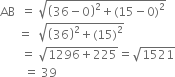
Yes, we can find the distance between the two towns A and B discussed in section 7.2 and this distance = 39 km.
Posted by S Viswanath 5 years, 7 months ago
- 4 answers
Mith Jain 5 years, 7 months ago
Rajnish Kalita 5 years, 7 months ago
Menka Kumari 5 years, 7 months ago
Posted by S Viswanath 5 years, 7 months ago
- 2 answers
Chandresh Tiwari 5 years, 7 months ago
Menka Kumari 5 years, 7 months ago
Posted by Debasish Gogoi 5 years, 7 months ago
- 4 answers
Posted by Debasish Gogoi 5 years, 7 months ago
- 4 answers
Anupama ?? 5 years, 7 months ago
Yogita Ingle 5 years, 7 months ago
The Kharif cropping season starts with the onset of the Indian subcontinent’s monsoon. Kharif crops are typically sown at the beginning of the first monsoon rains (depends on region to region). Harvesting season begins from the 3rd week of September to October (the exact harvesting dates differ from region to region).
Following are some of the examples of Kharif crops:
- Rice
- Maize
- Sorghum
- Bajra
- Soybean
- Cotton
Muskan Kumari 5 years, 7 months ago
Posted by Anura . 5 years, 7 months ago
- 0 answers
Posted by Aman Sen 5 years, 7 months ago
- 0 answers
Posted by Mukesh Patel 5 years, 7 months ago
- 3 answers
Posted by ?? ? 5 years, 7 months ago
- 2 answers
Gaurav Seth 5 years, 7 months ago
(क) चरन-कमल बंद हरि राई ।
(ख) करि-करि प्रतिपद प्रतिमनि बसुधा, कमल बैठकी साजति ।
(ग) जोइ-जोइ माँगत, सोइ-सोड़ देती, क्रम-क्रम करि के हाते ।
उत्तर
(क) रूपक अलंकारे।
(ख) अनुप्रास एवं पुनरुक्तिप्रकाश अलंकार।
(ग) अनुप्रास एवं पुनरुक्तिप्रकाश अलंकार।
लक्षण-उपर्युक्त अलंकारों में से रूपक एवं अनुप्रास के लक्षण ‘काव्य-सौन्दर्य के तत्त्वों के अन्तर्गत देखें।
पुनरुक्तिप्रकाश-जब एक ही शब्द की लगातार पुनरावृत्ति होती है, तब वहाँ पुनरुक्तिप्रकाश अलंकार होता है; जैसे उपर्युक्त पद ‘ख’ में करि-करि।
Posted by Diksha Rai 5 years, 7 months ago
- 1 answers
Khushi Ramchandani 5 years, 7 months ago
Posted by Nutan Kumari 5 years, 7 months ago
- 1 answers
Yogita Ingle 5 years, 7 months ago
The Salt March, which took place from March to April 1930 in India, was an act of civil disobedience led by Mohandas Gandhi to protest British rule in India. During the march, thousands of Indians followed Gandhi from his religious retreat near Ahmedabad to the Arabian Sea coast, a distance of some 240 miles. The march resulted in the arrest of nearly 60,000 people, including Gandhi himself. India finally was granted its independence in 1947. Britain’s Salt Act of 1882 prohibited Indians from collecting or selling salt, a staple in their diet. Indian citizens were forced to buy the vital mineral from their British rulers, who, in addition to exercising a monopoly over the manufacture and sale of salt, also charged a heavy salt tax. Although India’s poor suffered most under the tax, all Indians required salt. After living for two decades in South Africa, where Mohandas Gandhi fought for the civil rights of Indians residing there, Gandhi returned to his native country in 1915 and soon began working for India’s independence from Great Britain. Defying the Salt Act, Gandhi reasoned, would be an ingeniously simple way for many Indians to break a British law nonviolently. Gandhi declared resistance to British salt policies to be the unifying theme for his new campaign of “satyagraha,” or mass civil disobedience.
Posted by Diyaa Saha 5 years, 7 months ago
- 1 answers
Gaurav Seth 5 years, 7 months ago
On March 12, 1930 Mahatma Gandhi began the historic march from Sabarmati Ashram to Dandi, a village on the Gujarat sea coast. A number of people followed him. On the morning of 6th April, Gandhiji violated the Salt Laws at Dandi by picking up some salt left by the seawaves. Gandhiji's breaking of the Salt Laws marked the beginning of the Civil Disobedience Movement
Posted by Malvika Goyal 5 years, 7 months ago
- 2 answers
Posted by Disha Agarwal 5 years, 7 months ago
- 1 answers
Posted by Tamanna Kaliramana 5 years, 7 months ago
- 1 answers
Gaurav Seth 5 years, 7 months ago
A n s w e r :
कवि ने उत्साह कविता बादलों को इसलिए संबोधित की है क्योंकि ‘बादल’ निराला का प्रिय विषय है | जहाँ कविता में बादल एक ओर प्यास से पीड़ित लोगों की प्यास बुझाने वाला है वहीँ दूसरी ओर उसे नवीन कल्पना और नवांकुर के लिए विप्लव और क्रांति चेतना को संभव करने वाला भी माना है |

myCBSEguide
Trusted by 1 Crore+ Students

Test Generator
Create papers online. It's FREE.

CUET Mock Tests
75,000+ questions to practice only on myCBSEguide app

Priya C 5 years, 7 months ago
0Thank You