
Ask questions which are clear, concise and easy to understand.
Ask QuestionPosted by S. Gautham 5 years, 7 months ago
- 1 answers
Posted by S. Gautham 5 years, 7 months ago
- 3 answers
Riya Philip 5 years, 7 months ago
Tripura * 5 years, 7 months ago
Posted by S. Gautham 5 years, 7 months ago
- 1 answers
Yogita Ingle 5 years, 7 months ago
| Red soil | Laterite soil |
| 1. Red soil develops on crystalline igneous rocks in areas of low rainfall. | 1. Laterite soil develops in areas with high temperature and heavy rainfall. |
| 2. Red soil is found in parts of Odisha and Chhattisgarh, southern parts of the middle of Ganga plain and along the piedmont zone of the Western ghats. | 2. Laterite soil is mainly found in Karnataka, Kerala and the hilly areas of Odisha and Assam. |
| 3. Red soil develops a reddish colour due to diffusion of iron in crystalline and metamorphic rocks. | 3. In laterite soil, humus content is very low. |
Posted by S. Gautham 5 years, 7 months ago
- 3 answers
Riya Philip 5 years, 7 months ago
Sakshi Singh 5 years, 7 months ago
Yogita Ingle 5 years, 7 months ago
Khadir Soil:
- The type of soil which is found next to river is called Khadir soil.
- It is found in Doab region.
- This soil is more fertile and hence is highly suitable for agriculture purpose.
- It is made of fine silt and clay.
Bangar Soil:
- The type of soil which lies further from the river is called Bangar soil.
- It is also found in Doab region.
- This soil is less fertile and hence is not mostly used for agriculture purpose.
- It is composed of lime module.
Posted by S. Gautham 5 years, 7 months ago
- 1 answers
Samraat Sahil Verma 5 years, 7 months ago
Posted by S. Gautham 5 years, 7 months ago
- 1 answers
Yogita Ingle 5 years, 7 months ago
Circumference of circle = 22 cm
Let the radius of the given circle be 'r'
Circumference of a circle = 2πr
⇒ 22 = 2 × 22/7 × r
⇒ r = (22 × 7)/(22 × 2)
⇒ r = 154/44
⇒ r = 3.5 cm
Area of circle = πr²
⇒ 22/7 × 3.5 × 3.5
⇒ 269.5/7
= 38.5 cm²
So, the area of the given circle is 38.5 cm²
Posted by S. Gautham 5 years, 7 months ago
- 3 answers
Riya Philip 5 years, 7 months ago
Yogita Ingle 5 years, 7 months ago
The following are five important characteristics of Black soil:
- It is fine textured and clayey in nature.
- It has high amounts of lime, iron, magnesium and generally low quantities of phosphorus, nitrogen and organic matter.
- It is black in colour since it is formed from weathered lava rocks.
- It has up to 50% clay content and therefore is highly retentive of water. Because of the high clay content, these soils expand when wet and become difficult to plough through. During the dry season, these soils shrink and develop big cracks which help in the circulation of air.
- The soil is extremely fertile in most of the places where it is found.
Posted by S. Gautham 5 years, 7 months ago
- 1 answers
Yogita Ingle 5 years, 7 months ago
• Crop management: proper crop management is essential as it reduces the chances of soil infertility.
• Terrace farming: this is the a mechanical way of conserving soil in hilly or mountainous region.
• Avoid deforestation: deforestation is the major reason for the soil erosion thus washing off the upper fertile layer of the soil.
Posted by Rohit Singh 5 years, 7 months ago
- 1 answers
Meghna Thapar 5 years, 7 months ago
Cotton is a soft, fluffy staple fiber that grows in a boll, or protective case, around the seeds of the cotton plants of the genus Gossypium in the mallow family Malvaceae. The fiber is almost pure cellulose. Under natural conditions, the cotton bolls will increase the dispersal of the seeds.
After cotton has been harvested, producers who use conventional tillage practices cut down and chop the cotton stalks. The next step is to turn the remaining residue underneath the soil surface. Producers who practice a style of farming called conservation tillage often choose to leave their stalks standing and leave the plant residue on the surface of the soil.eeding is done with mechanical planters which cover as many as 10 to 24 rows at a time. The planter opens a small trench or furrow in each row, drops in the right amount of seed, covers them and packs the earth on top of them. The seed is planted at uniform intervals in either small clumps (“hill-dropped”) or singularly (“drilled”). Machines called cultivators are used to uproot weeds and grass, which compete with the  cotton plant for soil nutrients, sunlight and water.
About two months after planting, flower buds called squares appear on the cotton plants. In another three weeks, the blossoms open. Their petals change from creamy 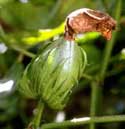 white to yellow, then pink and finally, dark red. After three days, they wither and fall, leaving green pods which are called cotton bolls.
Inside the boll, which is shaped like a tiny football, moist fibers grow and push out from the newly formed seeds. As the boll ripens, it turns brown. The fibers continue to expand under the warm 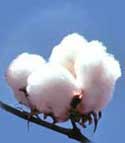 sun. Finally, they split the boll apart and the fluffy cotton bursts forth. It looks like white cotton candy.
Since hand labor is no longer used in the U.S. to harvest cotton, the crop is harvested by machines, either a picker or a stripper. Cotton picking machines have spindles that pick (twist) the seed cotton from the burrs that are attached to plants’ stems. Doffers then remove the seed cotton from the spindles and knock the seed cotton into the conveying system.
Posted by Rohit Singh 5 years, 7 months ago
- 1 answers
Posted by Rohit Singh 5 years, 7 months ago
- 3 answers
Riya Philip 5 years, 7 months ago
Yogita Ingle 5 years, 7 months ago
Horticulture is the practice of production of both fruit and vegetable crops. India is a producer of tropical as well as temperate fruits. Some of the major crops are:
- Mangoes: Many varieties of mangoes lie Safeda, Dussehri, Langda, Sindoori, etc. are grown in Maharashtra, U.P., Andhra Pradesh and West Bengal.
- Oranges: Nagpur and Cherrapunjee are famous for orange varieties of India.
- Bananas of various qualities are grown in Kerala, Mizoram, Maharashtra and Tamil Nadu.
- Lichi and Guava are famous in parts of Uttar Pradesh, Uttarakhand and Bihar.
Jagriti Singh 5 years, 7 months ago
Posted by Rohit Singh 5 years, 7 months ago
- 1 answers
Meghna Thapar 5 years, 7 months ago
Jute is the second most important vegetable fiber after cotton due to its versatility. Jute is used chiefly to make cloth for wrapping bales of raw cotton, and to make sacks and coarse cloth. The fibers are also woven into curtains, chair coverings, carpets, area rugs, hessian cloth, and backing for linoleum. It is a bast fibre, like hemp, and flax. Coarse fabrics made of jute are called hessian, or burlap in America. Like all natural fibres, Jute is biodegradable. "Jute" is the name of the plant or fiber that is used to make burlap, Hessian or gunny cloth.
Posted by Rohit Singh 5 years, 7 months ago
- 2 answers
Malaika Sharma 5 years, 6 months ago
Meghna Thapar 5 years, 7 months ago
Natural rubber is a stretchy, flexible and waterproof hydrocarbon polymer which is derived from latex and drawn by incising into the bark of the rubber tree. It is refined into the usable rubber. The commercial cultivation of natural rubber was introduced by the British planters. Rubber is a material which can stretch and shrink. It is a polymer. ... Sometimes the word means only natural rubber (latex rubber). Natural rubber is made from the white sap of some trees such as the Hevea brasiliensis (Euphorbiaceae). Other elastomers, called synthetic rubbers, are made by chemical processes.
Posted by Rohit Singh 5 years, 7 months ago
- 1 answers
Meghna Thapar 5 years, 7 months ago
The world Horticulture is derived from two Latin words viz. Hortus means garden and Culture means knowledge of growing these crops. Horticulture is an aesthetic science that deals with the important crops which are grown in the gardens e.g. vegetable crops in vegetable garden, fruit crops in fruit orchards. Horticulture is the science and art of the development, sustainable production, marketing, and use of high-value, intensively cultivated food and ornamental plants. Horticultural crops are diverse; they include annual and perennial species, delicious fruits and vegetables, and decorative indoor and landscape plants.
Posted by Rohit Singh 5 years, 7 months ago
- 2 answers
Riya Philip 5 years, 7 months ago
Meghna Thapar 5 years, 7 months ago
In the Indus River Valley in Pakistan, cotton was being grown, spun and woven into cloth 3,000 years BC. ... Arab merchants brought cotton cloth to Europe about 800 A.D. When Columbus discovered America in 1492, he found cotton growing in the Bahama Islands. By 1500, cotton was known generally throughout the world.
Uses of Cotton
- It is basically used for every type of clothing from jackets to normal shirts.
- In home, it finds its use in bedsheets and curtains.
- Its seed oil is used in food and cosmetics.
- It is also used in coffee filters.
- Its seeds are fed to cattle and crushed to make oil, rubber and plastics.
Posted by Rohit Singh 5 years, 7 months ago
- 2 answers
Riya Philip 5 years, 7 months ago
Meghna Thapar 5 years, 7 months ago
Coffee is one of the world's most popular beverages. Some claim it is the most widely consumed liquid in the world aside from water. The process that turns these seeds into beverage is a long and complex process, perhaps the most complex process associated with any major beverage. High-quality coffee should balance acidity, sweetness, and bitterness in one sip, with a smooth flavor, and no off-notes. That's a complex way to say that that good quality coffee should taste good. It shouldn't taste burnt, charred, or raw. It should have complex and nuanced flavors.
Posted by Rohit Singh 5 years, 7 months ago
- 2 answers
Malaika Sharma 5 years, 6 months ago
Meghna Thapar 5 years, 7 months ago
According to Chinese legend, the history of tea began in 2737 B.C.E. when the Emperor Shen Nong, a skilled ruler and scientist, accidentally discovered tea. While boiling water in the garden, a leaf from an overhanging wild tea tree drifted into his pot. Tea is a refreshing and aromatic drink made steeping the leaves of Camellia sinensis in hot water. Believed to have been discovered in 2737 BCE by Chinese sage/emperor Shennong, tea is the second most consumed beverage in the world after water.
Posted by Rohit Singh 5 years, 7 months ago
- 1 answers
Meghna Thapar 5 years, 7 months ago
The botanical name for groundnut, Arachis hypogaea Linn., is derived from two Greek words, Arachis meaning a legume and hypogaea meaning below ground, referring to the formation of pods in the soil. Groundnut is an upright or prostrate annual plant. Groundnut is one of the most important cash crops of our country. It is a low- priced commodity but a valuable source of all the nutrients. Groundnut is the sixth most important oilseed crop in the world. It contains 48-50% of oil and 26-28% of protein, and is a rich source of dietary fiber, minerals, and vitamins.
Posted by Rohit Singh 5 years, 7 months ago
- 2 answers
? Yang ? 5 years, 7 months ago
Meghna Thapar 5 years, 7 months ago
Among the nine oilseed crops grown in the country, seven are of edible oils (soybean, groundnut, rapeseed-mustard, sunflower, sesame, safflower and niger) and two are of non-edible oils (castor and linseed). India ranks first in the production of most of the minor oilseeds (castor, niger, safflower and sesame). Main oil-seeds produced in India are groundnut, mustard, coconut, sesamum (til), soyabean, castor seeds, cotton seeds, linseed and sunflower. Most of these are edible and used as cooking mediums. However, some of these are also used as raw material in the production of soap, cosmetics and ointments.
Posted by Taniya 5 years, 7 months ago
- 2 answers
? Yang ? 5 years, 7 months ago
Meghna Thapar 5 years, 7 months ago
In politics, a two-party system is a party system in which two major political parties dominate the political landscape. At any point in time, one of the two parties typically holds a majority in the legislature and is usually referred to as the majority or governing party while the other is the minority or opposition party. Around the world, the term has different senses. For example, in the United States, the Bahamas, Jamaica, Malta, and Zimbabwe, the sense of two-party system describes an arrangement in which all or nearly all elected officials belong to one of the only two major parties, and third parties rarely win any seats in the legislature. In such arrangements, two-party systems are thought to result from various factors like winner-takes-all election rules.
Posted by Priyanshu ?✌??? 5 years, 7 months ago
- 1 answers
Samraat Sahil Verma 5 years, 7 months ago
Posted by Aaditya Bansal 5 years, 7 months ago
- 0 answers
Posted by Priyanshu ?✌??? 5 years, 7 months ago
- 2 answers
Samraat Sahil Verma 5 years, 7 months ago
Posted by Priya Yadav 5 years, 7 months ago
- 1 answers
Posted by Anshuman Omm 5 years, 7 months ago
- 2 answers
Posted by Anshuman Omm 5 years, 7 months ago
- 5 answers
Priyanshu ?✌??? 5 years, 7 months ago
Anshuman Omm 5 years, 7 months ago
Narayan Yadav 5 years, 7 months ago
Narayan Yadav 5 years, 7 months ago
Posted by Itachi Uchiha ? 5 years, 7 months ago
- 2 answers
Riya Philip 5 years, 7 months ago
Posted by Davinder Kaur 5 years, 7 months ago
- 2 answers
Aditya Kumar 5 years, 7 months ago
Posted by Anoop Kaul 5 years, 7 months ago
- 4 answers
Yogita Ingle 5 years, 7 months ago
- Transportation can be defined as the movement of any substance from one place to another.
- Water and nutrients required for all metabolic activities should be transported in the body of plants and animals.
- The waste material or excretory products should also move to the region of excretion.
- Transportation in animal takes place through circulatory system which includes blood, blood vessels and heart.
- Blood is a fluid connective tissue consists of fluid medium called plasma.
- Functions of blood are to transport food, oxygen, carbon dioxide, nitrogenous wastes, salts.
- A pumping organ is necessary to push the blood around the body.
- Heart is the muscular pumping organ which pushes the blood around the body.
- Tube like structure through which carry blood to cells, tissues and organs are called as blood vessels.
- Two special blood vessels are arteries and veins.
- After reaching the organs, the arteries divide in to small branches called as capillaries.
- Heart in another component of circulatory system which is also known as pumping organ.
- Heart consists of four chambers separated by a partition to avoid mixing of oxygenated and deoxygenated blood.

myCBSEguide
Trusted by 1 Crore+ Students

Test Generator
Create papers online. It's FREE.

CUET Mock Tests
75,000+ questions to practice only on myCBSEguide app

Yogita Ingle 5 years, 7 months ago
It is important to have a planned strategy for the development of resources because, in a country like India, there is a vast population and uneven distribution of resources. To make good use to the available resources, there must be good planning, by keeping in mind the technology, skills and economy required to resolve the problems of lack and enhance all areas of development. In India, therefore, its first Five Year Plan essentially includes Resource Planning. Through resource planning, the wastage caused over-consumption of resources, followed by our socio-economic problems can be prevented by the conservation of resources. Leaders like Gandhiji believed that modern technology caused massive exploitation and extinction of resources.
0Thank You