
Ask questions which are clear, concise and easy to understand.
Ask QuestionPosted by Mohit Ranpariya 5 years, 6 months ago
- 1 answers
Posted by युवा समा्ट Vívék Rãjpût 5 years, 6 months ago
- 0 answers
Posted by Jitu Shukla 5 years, 6 months ago
- 0 answers
Posted by Khushi Bhadana 5 years, 6 months ago
- 1 answers
Tarun Mishra 5 years, 6 months ago
Posted by Muskan .072 5 years, 6 months ago
- 2 answers
Shivam Kumar 5 years, 6 months ago
Yogita Ingle 5 years, 6 months ago
After 1848, nationalism in Europe moved away from its association with democracy and revolution. The liberal wave that was swaying Europe was certainly a challenge to the traditional institutions of monarchy and church. c.
Posted by Sumit Thakur 5 years, 6 months ago
- 3 answers
Honey Jain 5 years, 6 months ago
Yogita Ingle 5 years, 6 months ago
The crow was sitting on the branch of hemlock tree which was covered with dusts of snow. The movement of the crow led to the movement of the branch and the dust of snow fall on the poet which changed the mood of the poet.
Saikat Chakraborty 5 years, 6 months ago
Posted by Ashutosh Mishra 5 years, 6 months ago
- 0 answers
Posted by Adarsh Shukla 5 years, 6 months ago
- 1 answers
Posted by Vaishnavi Jadhav 5 years, 6 months ago
- 0 answers
Posted by Muhammedbisher Bisher 5 years, 6 months ago
- 1 answers
A S 5 years, 6 months ago
Posted by ..... ...... 5 years, 6 months ago
- 0 answers
Posted by Yashwant Yadav 5 years, 6 months ago
- 2 answers
Posted by Ankita Lenka 5 years, 6 months ago
- 5 answers
Posted by Yash Gautam 5 years, 6 months ago
- 1 answers
Posted by Abhinav Choudhary 5 years, 6 months ago
- 1 answers
Yogita Ingle 5 years, 6 months ago
`Madam Rides the Bus’ is the story of an eight-year-old girl Valli. She was a wonderful girl. She was mature, clever, practical and self-respecting beyond her age. Standing in the front doorway and watching what was happening in the street was her favourite pastime. She was a great planner. She thriftily saved every penny that came her way for her first bus journey. During her first bus journey, Valli was full of enthusiasm and excitement. She enjoyed the landscape, the canal, palm trees, distant mountains and green fields stretching out as far as her eye could see. She reacted strongly when she was called ‘a child’ or ‘madam’. The self-respecting girl refused to accept a free cold drink offered by the bus conductor. She planned her bus journey during the nap hours of her mother. Interestingly, her mother could never know of the bus journey her daughter undertook during her nap in the afternoon.
Posted by Simran Deep Kaur 5 years, 6 months ago
- 2 answers
Honey Jain 5 years, 6 months ago
Yogita Ingle 5 years, 6 months ago
The postmaster was a fat and amiable fellow. He was a sensible and a compassionate human being who was amazed by the depth of faith in God that is shown by Lencho. Although at first he was amused by Lencho’s letter to God, he became serious and wanted to help Lencho because he didn’t want his faith to be shaken.
The postmaster himself gave a part of his salary and also requested his employees and a few friends to contribute for charity. He felt happy and satisfied when Lencho received the money. This shows that he was a kind and empathetic person as well. He loved to help others.
Posted by Vishal Shalu 5 years, 6 months ago
- 2 answers
Thejhasvi Dhanavel 5 years, 6 months ago
Yogita Ingle 5 years, 6 months ago
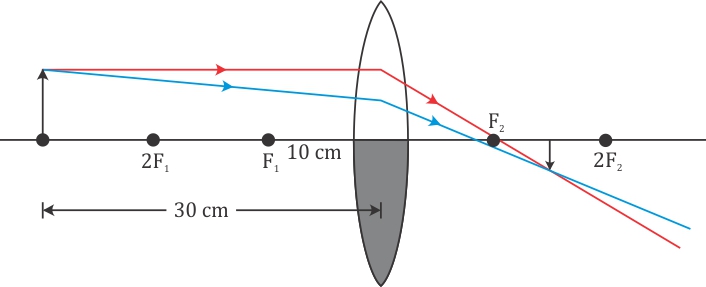
A convex lens can produce the complete image of the object even though half of the lens is covered. This is because light coming from the object can be refracted from the other half of the lens. However, the intensity of light will be reduced.
Posted by Sunil Madan 5 years, 6 months ago
- 0 answers
Posted by Good Student 5 years, 6 months ago
- 4 answers
Satyam Lodhi Rajput 5 years, 6 months ago
Priyanshi Jadeja 5 years, 6 months ago
Thejhasvi Dhanavel 5 years, 6 months ago
Yogita Ingle 5 years, 6 months ago
(i) Planaria - Regeneration
(ii) Hydra - Budding
(iii) Rhizopus-Spore Formation
Posted by Good Student 5 years, 6 months ago
- 1 answers
Yogita Ingle 5 years, 6 months ago
A group of organic compounds which can be represented by the same general formula with a same functional group and which show more or less similar trends in their properties is known as homologous series.
Example: The homologous series of straight chain alkanes can be represented by the general formula CnH2n+2
Posted by Good Student 5 years, 6 months ago
- 2 answers
Yogita Ingle 5 years, 6 months ago
There should be equitable distribution of resources among all people—rich and poor, so that all are benefitted from the development of these resources. Such an even distribution of resources restricts the exploitation, wastage and misuse of these resources. The poor will also get a chance to make benefit for himself and the society will improve. Unfortunately, it has been deserved that mainly the rich and the powerful take the full advantage of these resources and the poor are devoid of its pleasure. Thus, rich and powerful people for their personal benefit work against the equitable distribution.
Sawan Goja 5 years, 6 months ago
Posted by Good Student 5 years, 6 months ago
- 1 answers
Meghna Thapar 5 years, 5 months ago
Exclusive distribution means that your audiobook will only be available on Audible’s channels, which currently include Audible, Amazon and iTunes. You are not permitted to distribute or sell your audiobook in any other format on any site or store outside of Amazon, Audible, and iTunes. Audiobooks published distributed exclusively earn a 40% royalty.
If you choose non-exclusive distribution, you are able to also sell and distribute your completed audiobook through other distributors, such as on CD or other physical formats wherever you choose. Non-exclusive projects may not be published as a Royalty Share project, and must be completed as a Pay-for-Production or uploaded directly to ACX. Audiobooks distributed non-exclusively through ACX earn a 25% royalty.
Posted by Varad Bagul 5 years, 6 months ago
- 2 answers
Yogita Ingle 5 years, 6 months ago
The Basics conditions are:
1. Giving equal powers to all groups.
2. Avoiding Majoritarianism in holding powers.
3. Not allow social differences to overlap as they are dangerous.
4. Avoiding Communalism and making a practice of Secularism.
5. Improve economic growth of minority groups and supporting them.
Posted by Robins Kumar 5 years, 6 months ago
- 3 answers
Priyanshi Jadeja 5 years, 6 months ago
Kritika Pathak 5 years, 6 months ago
Prothom Bose 5 years, 6 months ago
Posted by Robins Kumar 5 years, 6 months ago
- 4 answers
Yogita Ingle 5 years, 6 months ago
Plane mirrors and convex mirrors only produce virtual images.
Prothom Bose 5 years, 6 months ago
Posted by Bhavishya Kaushik 5 years, 6 months ago
- 1 answers
Posted by Anurag Padhi 5 years, 6 months ago
- 0 answers
Posted by Xyz Mishra 5 years, 6 months ago
- 1 answers
Posted by A:) 5 years, 6 months ago
- 2 answers
Gaurav Seth 5 years, 6 months ago
Mr Keesing was an old maths teacher at Anne’s school.He was very strict by Nature. He would not tolerate anyone talking in his class. Naturally, he remained quiet annoyed with Anne who was no doubt the Chatterbox.He would punish her by giving her extra homework. Anne would stuff her assigned homework with such funny contents that not only the class but even Mr Keesing felt greatly delighted. But Mr Keesing still failed to stop Anne's habit of chattering in the class. With the intention of making a mockery of Anne he gave her an essay to write on the topic: ‘Quack, Quack, Quack,’ Mrs Chatterbox. Anne wrote her essay in the form of a story in verse. It told the story of a mother duck and a father swan. The father bites his three ducklings to death because they quacked too much. The father in the poem is clearly Mr Keesing and the ducklings are the children of his class. Luckily Mr Keesing took the joke the right way. He enjoyed this poem and read it to several classes. He stopped giving Anne any extra homework. He allowed her to talk in the class. He even started making jokes with the children. Thus we see how even Mr Keesing got infected by Anne's sense of humour.
Priya ✧*。٩(๑˙╰╯˙๑)و✧*。 5 years, 6 months ago
Posted by Lavi Awasthi 5 years, 6 months ago
- 2 answers
Priya ✧*。٩(๑˙╰╯˙๑)و✧*。 5 years, 6 months ago
Priya ✧*。٩(๑˙╰╯˙๑)و✧*。 5 years, 6 months ago

myCBSEguide
Trusted by 1 Crore+ Students

Test Generator
Create papers online. It's FREE.

CUET Mock Tests
75,000+ questions to practice only on myCBSEguide app

Meghna Thapar 5 years, 5 months ago
A rare-earth element (REE) or rare-earth metal (REM), as defined by the International Union of Pure and Applied Chemistry, is one of a set of seventeen chemical elements in the periodic table, specifically the fifteen lanthanides, as well as scandium and yttrium. Scandium and yttrium are considered rare-earth elements because they tend to occur in the same ore deposits as the lanthanides and exhibit similar chemical properties, but have different electronic and magnetic properties. Rarely, a broader definition that includes actinides may be used, since the actinides share some mineralogical, chemical, and physical (especially electron shell configuration) characteristics.
The 17 rare-earth elements are cerium (Ce), dysprosium (Dy), erbium (Er), europium (Eu), gadolinium (Gd), holmium (Ho), lanthanum (La), lutetium (Lu), neodymium (Nd), praseodymium (Pr), promethium (Pm), samarium (Sm), scandium (Sc), terbium (Tb), thulium (Tm), ytterbium (Yb), and yttrium (Y). They are often found in minerals with thorium (Th), and less commonly uranium (U).
Despite their name, rare-earth elements are – with the exception of the radioactive promethium – relatively plentiful in Earth's crust, with cerium being the 25th most abundant element at 68 parts per million, more abundant than copper. However, because of their geochemical properties, rare-earth elements are typically dispersed and not often found concentrated in rare-earth minerals; as a result economically exploitable ore deposits are less common.
0Thank You