No products in the cart.

Ask questions which are clear, concise and easy to understand.

Ask Question
  • 1 answers

Yogita Ingle 5 years, 2 months ago

Zaid Crop: These are crops which are sown between the rabi and kharif crops. Watermelon, muskmelon, cucumber and vegetables are some examples of the zaid crops.

  • 1 answers

Yogita Ingle 5 years, 2 months ago

Rabi crops are known as winter crops. They are grown in October or November. The crops are then harvested in spring. These crops require frequent irrigation because these are grown in dry areas. Wheat, gram, barley are some of the rabi crops grown in India.

Examples of Rabi Crops

Following are some of the examples of rabi crops:

  • Wheat
  • Barley
  • Oats
  • Pulses
  • Mustard
  • Linseed
  • 4 answers

Muskan Shekhawat 5 years, 2 months ago

Okay

Abhay Singh 5 years, 2 months ago

No

Muskan Shekhawat 5 years, 2 months ago

Please tell me

Muskan Shekhawat 5 years, 2 months ago

?
  • 3 answers
Answer batio

? ??? 5 years, 2 months ago

Hello

P B Student 5 years, 2 months ago

What
  • 3 answers

Taruna Sabharwal 5 years, 2 months ago

Describe your questions

Sonu Kumar 5 years, 2 months ago

What is potential Difference

P B Student 5 years, 2 months ago

Didn't understand the question
  • 5 answers

Paru ? 5 years, 2 months ago

Muje bi pta nahi
Pta nhi yar

Paru ? 5 years, 2 months ago

Table type questions matlab

Usha Rani Jena 5 years, 2 months ago

Yeah toh mereko ko bhi pta hai lekin... but maine kafi bacho ko table type questions bhi share kiya hai but woh kaise kiya unhone .. kya apko pta hai??

Paru ? 5 years, 2 months ago

When u will press the question u will get Type your answer option (below). press that option and type your answer. After typing send ur answer through send option (right side arrow option) . then your answer will be shared.
  • 1 answers

Yogita Ingle 5 years, 2 months ago

Hari Singh was 15 years old, but already he was an experienced and fairly successful thief.
He used to change his name frequently so as not to get caught by his former employees, whom he must have cheated. 
He even cheated Anil when he went to buy the daily supplies of groceries. However , he wished to get an education so that he could become a big and respected man, who would be able to achieve a lot.
He stole a large sum of money from Anil but regretted it when he realised that in doing so he had lost his only chance of getting an education. He is courageous enough to return the money , even though he knows that he may be caught in the process. 
However his desire to change himself is so great that it motivates him and gives him courage to return to Anil. 

  • 0 answers
  • 1 answers

Paru ? 5 years, 2 months ago

• a+b+c=-b/a • ab+bc+ca=c/a • abc=-d/a Here, a is alpha, b is beta & c is gamma
  • 1 answers

Yogita Ingle 5 years, 2 months ago

Symbol of following 


  • 1 answers

Gaurav Seth 5 years, 2 months ago

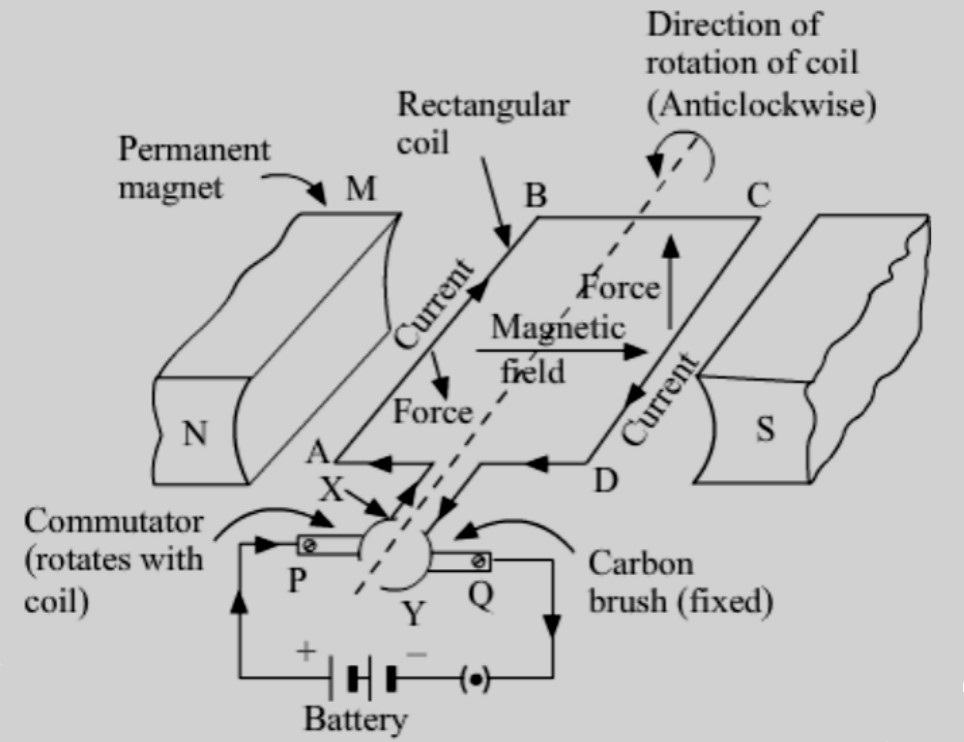
Electric Motor

Electric Motor is a device which converts electrical energy into mechanical energy.

Principle of Electric Motor

The principle of the electric motor is based on the fact that a current carrying conductor produces a magnetic field around it. A current carrying conductor placed perpendicular to magnetic field experiences a force.

Construction of Electric Motor

(1) Armature coil

It consist of a single loop of an insulated copper wire in the form of a rectangle.

(2) Strong field magnet

Armature coil is placed between 2 pole pieces of a strong magnet which provide strong magnetic field.

(3) Split ring type commutator

It consist of 2 halves of a metallic ring.The two ends of armature  coil are connected to these 2 halves of ring.Commutators reverses the direction of current in armature coil.

(4) Brushes

Two carbon brushes press against the commutator.These brushes act as contact between commutator and terminal battery.

(5) Battery

It is connected across the carbon brushes.It supplies current to the armature coil.

Working of Electric Motor

1)In the side AB of the rectangular cil ABCD, the direction of current is from A to B and in the side CD of the coil, the direction of current is from C to D.The direction of magnetic field is from N pole of the magnet to its S pole.

2) Applying Fleming’s Left hand rule to sides AB and CD of the coil, the force on side AB of the coil is in downward direction whereas the force on side CD of the coil is in upward direction. Due to this the side AB of the coil is pushed down and side CD is pushed up.This makes the coil ABCD rotate in the anticlockwise direction.

3) While rotating, when the coil reached vertical position, then the brushes will touch the gap between the two commutator rings and current of the coil is cut off. Though the current to the coil is cut off when it is in the exact vertical position, the coil does not stop rotating because it has already gained momentum due to which it goes beyond the vertical position.

4) After half rotation, when the coil goes beyond vertical position, the side CD of the coil comes on the left side whereas side AB of the coil comes to the right side, and the two commutator half rings automatically change contact from one brush to the other.

5) After half rotation of the coil , the commutator half ring R2 makes contact with brush B1 whereas the commutator half ring R1 makes contact with brush B2.This reverse the direction of current in the coil.

6) The reversal of direction of current reverses the direction of force acting on the sides AB and CD of the coil.The side CD of the coil is now on the left side with a downward force on it whereas the side AB is now on the right side with an upward force on it.Due to this the side CD of the coil is pushed down and the side AB of coil is pushed up.This makes the coil rotate anticlockwise by another half rotation.

7) The reversing of current in the coil is repeated after every half rotation due to which the coil continue to rotate as long as current from the battery is passed through it.

  • 2 answers

Yogita Ingle 5 years, 2 months ago

The chemical properties of metals.

  • The density of metals is usually high.
  • Metals are malleable and ductile.
  • Metals form an alloy with other metals or non – metals.
  • Some metals react with air and corrode. For e.g. Iron.
  • Metals are good conductors of heat and electricity. Lead is an exception.
  • Generally, metals are in a solid state at room temperature. Except for Mercury. Mercury is in a liquid state.

The chemical properties of nonmetals

  • Nonmetals are poor conductors of heat and electricity. Graphite and Gas carbon are exceptions.
  • Unlike metals, nonmetals aren’t malleable and ductile.
  • Nonmetals react more with metals than with nonmetals.
  • Usually, nonmetals react with other nonmetals in high temperature.
  • Most nonmetals do not react with air in room temperature.
  • White phosphorus is the only nonmetal that reacts with air to form its oxide by burning.

Karan Dhiman 5 years, 2 months ago

Metals soluble, malleable,ductile,hard,shiny, change in thin **** by hit And nonmetals are opposite of metals
  • 1 answers

Ayush Pandey 5 years, 2 months ago

It is the method by which the value of a variable in equation 1 is substituted in another equation and the value of the other variable in equation 2 is substituted in equation 1 or equation 3 made by equation 1. Let's understand it with an example: x+y=2............. eq 1 x-2y=1............. eq 2 In equation 1, x+y=2 x=y-2............. eq 3 substituting the value of x in equation 2 x-y=1 (y-2) -2y=1 y-2-2y=1 -y-2=1 -y=1+2 -y=3 [y= -3] Substituting the value of y in equation 3 x=y-2 x=-3-2 [x=-5] Hope you understood.
  • 2 answers

Prem Shankar Upadhyay 5 years, 2 months ago

Sale batana ho toh batao Motivation nhi chahiye bhag

Paru ? 5 years, 2 months ago

Agar tum dil lagake padoge to sub samajme ajayega?
  • 5 answers

Deshdeepak Yadav 5 years, 2 months ago

Dubara padh

Deshdeepak Yadav 5 years, 2 months ago

Dimaag kharaab hai tera

Saloni Priya 5 years, 2 months ago

Lead (pb).

Ganesh Sharma 5 years, 2 months ago

Na,K. are metals but does not conduct electricity

Paru ? 5 years, 2 months ago

Hey! Steel is the poorest conductor of heat
A
  • 4 answers

Riya Philip 5 years, 2 months ago

C

Saloni Priya 5 years, 2 months ago

B

Prem Shankar Upadhyay 5 years, 2 months ago

A

Mera Ba Vaghela 5 years, 2 months ago

Sorry
  • 4 answers

P B Student 5 years, 2 months ago

Age of father is 45years

King'S _Son 5 years, 2 months ago

let age of son be = x yr old then the age of father =3x given son's age = x=15 yr . therefore the age of father = 3x=3(15) = 45 . yr thank you ?

Paru ? 5 years, 2 months ago

Age of father is 45 years

Damak Chaudhary 5 years, 2 months ago

Age of son = 15 Age of father = 3 times age of son =3×15 = 45 years. (ans) = age of father.
  • 2 answers

P B Student 5 years, 2 months ago

Actually it is a general question.

Yogita Ingle 5 years, 2 months ago

Full-fledged territorial state means a country which is independent and is a sovereign state. In early modern period, a full fledged state meant a country which had clear boundaries, was independent and was not under the rule of any country. It may be however, under a monarchy. 
 

  • 1 answers

Som Patel 5 years, 2 months ago

What
  • 3 answers

Diksha Patel 5 years, 2 months ago

Drawbacks of Dobereiner's classification of elements was that it failed to arrange all the then known elements in the form of triads of elements having similar chemical properties. ... Dobereiner also failed to explain the relation between atomic masses of elements and their chemical properties.

Yogita Ingle 5 years, 2 months ago

Limitations of Dobereiner’s classification of elements was that it failed to arrange all the then known elements in the form of triads of elements having similar chemical properties. His classification was not applicable to all known elements but was limited only to a few elements. For example: nitrogen, Phosphorus and arsenic have similar chemical properties but they do not constituent a Dobereiner’s triad.  Dobereiner’s could identify only three triads from the elements known at that time. So his classification of elements was not much successful. Dobereiner also failed to explain the relation between atomic masses of elements and their chemical properties.
 

Som Patel 5 years, 2 months ago

Doberneir traid was got failed because his law was not applicable for all the elements...
  • 4 answers

Yangzee Sherpa 5 years, 2 months ago

If uh already knew the answer den y uh asked????? Anyway I liked the answer??? ???

Binaya Kumar Chhatria 5 years, 2 months ago

A stand for akad,B stand for bakkad, B stand for bambe, B stands for bo,so the answer is akkad bakkad bambe Bo assi nabbe poore sau

Binaya Kumar Chhatria 5 years, 2 months ago

Koi janta hai kya ise sabal ka answer

Yangzee Sherpa 5 years, 2 months ago

?IDK? ???
  • 2 answers

Ganesh Sharma 5 years, 2 months ago

Thanks Yogita

Yogita Ingle 5 years, 2 months ago

Mercury is obtained from its sulphide ore called cinnabar, HgS which is actually mercury(ii) sulphide.
The following steps are involved in its extraction:
1. mercury ore is roasted
2HgS(s) + 3 O2 (g) -----> 2HgO (s ) + 2 SO2 (g)
2. when this mercury oxide is heated at about 300 degrees Celsius , it decomposes to form mercury metal.
2HgO (s) ------> 2Hg (l) + O2(g)

  • 3 answers

Muskan Shekhawat 5 years, 2 months ago

Thanks som Patel and shivam Kumar

Som Patel 5 years, 2 months ago

He was a gujrati cotton trader, business man and industrialist,He was one of the signatory of Bombay Plan which was set of proposals for the post-independence economy of the India....

Shivam Kumar 5 years, 2 months ago

He was a gujrati cotton trader, business man and industrialist,He was one of the signatory of Bombay Plan which was set of proposals for the post-independence economy of the India
  • 1 answers

Mani Jha 5 years, 2 months ago

Speed is equal to distance over time The ,,distance is equal Speed into distance
  • 2 answers

Usha Rani Jena 5 years, 2 months ago

Apne itna bada answer kaise share kiya

Yangzee Sherpa 5 years, 2 months ago

*MONEY AND CREDIT* _MONEY AS A MEDIUM OF EXCHANGE_: Money acts as an intermediate in the exchange process, it is called a medium of exchange. A person holding money can easily exchange it for any commodity or service that he or she might want. _MODERN FORM OF MONEY_: In the early ages, Indians used grains and cattle as money. Thereafter came the use of metallic coins - gold coins, silver coins, copper coins - a phase which continued well into the last century. Now, the modern forms of money include currency – paper notes and coins. The modern forms of money – currency and deposits – are closely linked to the workings of the modern banking system. _CURRENCY_: In India, the Reserve Bank of India issues currency notes on behalf of the central government. No other individual or organisation is allowed to issue currency. The rupee is widely accepted as a medium of exchange in India. _DEPOSITS IN BANKS_: •The other form in which people hold money is as deposits with banks. People deposit their extra cash with the banks by opening a bank account in their name. Banks accept the deposits and also pay an amount as interest on the deposits. •The deposits in the bank accounts can be withdrawn on demand, these deposits are called demand deposits. The payments are made by cheques instead of cash. •A cheque is a paper instructing the bank to pay a specific amount from the persons account to the person in whose name the cheque has been issued. _LOAN ACTIVITIES OF BANKS_: Banks keep only a small proportion of their deposits as cash with themselves. These days banks in India hold about 15% of their deposits as cash. This is kept as a provision to pay the depositors who might come to withdraw money from the bank on any given day. Banks use the major portion of the deposits to extend loans. There is a huge demand for loans for various economic activities. Banks charge a higher interest rate on loans than what they offer on deposits. The difference between what is charged from borrowers and what is paid to depositors is their main source of income for banks. _TWO DIFFERENT CREDIT SITUATIONS_: •Credit (loan) refers to an agreement in which the lender supplies the borrower with money, goods or services in return for the promise of future payment. •Here are 2 examples which help you to understand how credit works. ~FESTIVE SEASON: In this case, Salim obtains credit to meet the working capital needs of production. The credit helps him to meet the ongoing expenses of production, complete production on time, and thereby increase his earnings. In this situation, credit helps to increase earnings and therefore the person is better off than before. ~SWAPNA'S PROBLEM: In Swapna’s case, the failure of the crop made loan repayment impossible. She had to sell part of the land to repay the loan. Credit, instead of helping Swapna improve her earnings, left her worse off. This is an example of debt-trap. Credit, in this case, pushes the borrower into a situation from which recovery is very painful. Whether credit would be useful or not, depends on the risks in the situation and whether there is some support, in case of loss. _TERMS OF CREDIT_: •Every loan agreement specifies an interest rate which the borrower must pay to the lender along with the repayment of the principal. In addition, lenders also demand collateral (security) against loans. •Collateral (Security) is an asset that the borrower owns (such as land, building, vehicle, livestocks, deposits with banks) and uses this as a guarantee to a lender until the loan is repaid. If the borrower fails to repay the loan, the lender has the right to sell the asset or collateral to obtain payment. •Interest rate, collateral and documentation requirement and the mode of repayment, together is called the terms of credit. It may vary depending on the nature of the lender and the borrower. _FORMAL SECTOR CREDIT IN INDIA_: •Cheap and affordable credit is crucial for the country’s development. The various types of loans can be grouped as: #Formal Sector Loans: These are the loans from banks and cooperatives. The Reserve Bank of India supervises the functioning of formal sources of loans. Banks have to submit information to the RBI on how much they are lending, to whom, at what interest rate, etc. #Informal Sector Loans: These are the loans from moneylenders, traders, employers, relatives and friends, etc. There is no organisation which supervises the credit activities of lenders in the informal sector. There is no one to stop them from using unfair means to get their money back. _FORMAL AND INFORMAL CREDIT_: The formal sector meets only about half of the total credit needs of rural people. The remaining credit needs are met from informal sources. It is important that the formal credit is distributed more equally so that the poor can benefit from the cheaper loans. 1)It is necessary that banks and cooperatives increase their lending, particularly in rural areas, so that the dependence on informal sources of credit reduces. 2)While the formal sector loans need to expand, it is also necessary that everyone receives these loans. _SELF HELP GROUPS FOR THE POOR_: Poor households are still dependent on informal sources of credit because of the following reasons: #Banks are not present everywhere in rural India. #Even if banks are present, getting a loan from a bank is much more difficult as it requires proper documents and collateral. *To overcome these problems, people created Self Help Groups (SHGs). SHGs are small groups of poor people which promote small savings among their members. A typical SHG has 15-20 members, usually belonging to one neighbourhood, who meet and save regularly. _ADVANTAGES OF SELF HELP GROUP (SHG)_: 1)It helps borrowers to overcome the problem of lack of collateral. 2)People can get timely loans for a variety of purposes and at a reasonable interest rate. 3)SHGs are the building blocks of organisation of the rural poor. 4)It helps women to become financially self-reliant. 5)The regular meetings of the group provide a platform to discuss and act on a variety of social issues such as health, nutrition, domestic violence, etc. HoPe It HeLpS yOu??

myCBSEguide App

myCBSEguide

Trusted by 1 Crore+ Students

Test Generator

Test Generator

Create papers online. It's FREE.

CUET Mock Tests

CUET Mock Tests

75,000+ questions to practice only on myCBSEguide app

Download myCBSEguide App