
Ask questions which are clear, concise and easy to understand.
Ask QuestionPosted by Anushka Biswas 7 years, 3 months ago
- 3 answers
Divya Keshav 7 years, 3 months ago
Posted by Srishti Chaurasia 7 years, 3 months ago
- 0 answers
Posted by Guru Charan 7 years, 3 months ago
- 0 answers
Posted by Shekhar Kashyap 7 years, 3 months ago
- 4 answers
Posted by Deepak Das 7 years, 3 months ago
- 5 answers
Posted by Nirbhay Tiwari 7 years, 3 months ago
- 2 answers
Posted by Anchal Goyal 6 years, 6 months ago
- 1 answers
Sia ? 6 years, 6 months ago
Let X and Y be two cars starting from points A and B respectively. Let the speed of car X be x km/hr and that of car Y be y km/hr.
CASE I :
When two cars move in the same directions:
Suppose two cars meet at point Q. Then,
Distance travelled by car {tex}X = AQ{/tex},
Distance travelled by car {tex}Y = BQ.{/tex}
{tex}\therefore{/tex} Distance travelled by car X in 9 hours = {tex}9x\ km.{/tex}
and {tex}BQ = 9y{/tex}
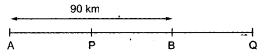
Clearly, {tex}AQ - BQ =AB{/tex}
{tex}\Rightarrow{/tex}{tex}9x - 9y =90{/tex}
{tex}\Rightarrow{/tex}{tex}x - y =10{/tex} [{tex}\because{/tex} {tex}AB = 90\ km{/tex}]
CASE II
When two cars move in opposite directions:
Suppose two cars meet at point P. Then,
Distance travelled by car {tex}X = AP{/tex},
Distance travelled by car {tex}Y = BP{/tex},
{tex}\therefore{/tex} Distance travelled by car X in {tex}\frac { 9 } { 7 }{/tex} hours {tex}= \frac { 9 } { 7 }{/tex} x km
and {tex}B P = \frac { 9 } { 7 } y{/tex}
{tex}AP + BP =AB{/tex}
{tex}\Rightarrow{/tex}{tex}\frac { 9 } { 7 } x + \frac { 9 } { 7 } y = 90{/tex}
{tex}\Rightarrow{/tex} {tex}\frac { 9 } { 7 } ( x + y ) = 90{/tex}
{tex}\Rightarrow{/tex} {tex}x + y=70{/tex} ....................................(ii)
Solving equations (i) and (ii), we get
{tex}x = 40\ and\ y =30{/tex}.
Hence, speed of car X is {tex}40\ km/hr{/tex} and speed of car y is {tex}30\ km/hr.{/tex}
Posted by Bhimireddy Udaysaikiranreddy 7 years, 3 months ago
- 1 answers
Posted by Ramakant??? 8306360538 7 years, 3 months ago
- 3 answers
Priyanka Chaurasiya 7 years, 3 months ago
Posted by Koki Barge 7 years, 3 months ago
- 2 answers
Posted by Priyal Khandelwal 7 years, 3 months ago
- 1 answers
Posted by Lalita Mangla 6 years, 6 months ago
- 1 answers
Sia ? 6 years, 6 months ago
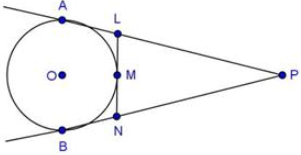
Since tangents drawn from an external point to a circle are equal.
{tex}\therefore{/tex} AL = LM
BN = MN
And, PA = PB
Now,
PA = PB
{tex}\Rightarrow{/tex} PL + LA = PN + NB
{tex}\Rightarrow{/tex} PL + LM = PN + MN
Hence, proved.
Posted by Aryan Yadav 7 years, 3 months ago
- 3 answers
Susmita Mandal 7 years, 3 months ago
Arghyadeep Kolay 7 years, 3 months ago
Posted by Kirtee Agarwal 7 years, 3 months ago
- 1 answers
Posted by Aryan Yadav 7 years, 3 months ago
- 0 answers
Posted by Vishal Prasad 7 years, 3 months ago
- 1 answers
Posted by Ziya Ferzin 7 years, 3 months ago
- 1 answers
Posted by Ziya Ferzin 7 years, 3 months ago
- 2 answers
Posted by Vaibhav Parmar 6 years, 6 months ago
- 1 answers
Sia ? 6 years, 6 months ago
Given,
{tex}\frac { 1 } { ( a + b + x ) } = \frac { 1 } { a } + \frac { 1 } { b } + \frac { 1 } { x }{/tex}
{tex}\Rightarrow \quad \frac { 1 } { ( a + b + x ) } - \frac { 1 } { x } = \frac { 1 } { a } + \frac { 1 } { b } \Rightarrow \frac { x - ( a + b + x ) } { x ( a + b + x ) } = \frac { b + a } { a b }{/tex}
{tex}\Rightarrow \quad \frac { - ( a + b ) } { x ( a + b + x ) } = \frac { ( a + b ) } { a b }{/tex}
On dividing both sides by (a+b)
{tex}\Rightarrow \quad \frac { - 1 } { x ( a + b + x ) } = \frac { 1 } { a b }{/tex}
Now cross multiply
{tex}\Rightarrow{/tex} x(a + b + x) = -ab
{tex}\Rightarrow{/tex} x2 + ax + bx + ab = 0
{tex}\Rightarrow{/tex} x(x +a) + b(x +a) = 0
{tex}\Rightarrow{/tex} (x + a) (x + b) = 0
{tex}\Rightarrow{/tex} x + a = 0 or x + b = 0
{tex}\Rightarrow{/tex} x = -a or x = -b.
Therefore, -a and -b are the roots of the equation.
Posted by Adeeshree Behera 7 years, 3 months ago
- 1 answers
Posted by Mond Mubbashir 7 years, 3 months ago
- 2 answers
Posted by Pandurang Mirashi 7 years, 3 months ago
- 2 answers
Posted by Dilpreet Singh 7 years, 3 months ago
- 2 answers
Yogita Ingle 7 years, 3 months ago
Let the point of x-axis be P(x, 0)
Given A(2, -5) and B(-2, 9) are equidistant from P
That is PA = PB
Hence PA2 = PB2 → (1)
Distance between two points is √[(x2 - x1)2 + (y2 - y1)2]
PA = √[(2 - x)2 + (-5 - 0)2]
PA2 = 4 - 4x +x2 + 25 = x2 - 4x + 29
Similarly, PB2 = x2 + 4x + 85
Equation (1) becomes
x2 - 4x + 29 = x2 + 4x + 85
- 8x = 56
x = -7
Hence the point on x-axis is (-7, 0)
Posted by Aman Raj 7 years, 3 months ago
- 1 answers
Yogita Ingle 7 years, 3 months ago
Here the first term; a = 5
Common difference; d = 11 - 8 = 8 - 5 = 3
So, nth term is given by;
tn = a + (n − 1)d = 5 + (n − 1) × 3
Now to prove whether 51 is term of this A.P, taking tn = 51
51 = 5 + (n − 1) × 3
⇒ 51 = 5 + 3n − 3
⇒ 3n = 51 + 3 − 5
⇒ 3n = 49
n = 49/33
Now we know that number of terms can't be in fraction.
So, 51 is not term of this A.P.
Posted by Diltej Singh Maan 7 years, 3 months ago
- 0 answers

myCBSEguide
Trusted by 1 Crore+ Students

Test Generator
Create papers online. It's FREE.

CUET Mock Tests
75,000+ questions to practice only on myCBSEguide app

Anushka Biswas 7 years, 2 months ago
0Thank You