
Ask questions which are clear, concise and easy to understand.
Ask QuestionPosted by Chinmay Goupale 7 years, 3 months ago
- 1 answers
Posted by Chinmay Goupale 7 years, 3 months ago
- 0 answers
Posted by Kumar Aditya Rajput 7 years, 3 months ago
- 0 answers
Posted by Sanchit Kalkal 6 years, 6 months ago
- 1 answers
Sia ? 6 years, 6 months ago
Given , point P(x,y) is equidistant from points L(5,1) = (x1, y1) and M(-1,5)= (x2, y2).
So, PL = PM
{tex}\Rightarrow PL^2=PM^2{/tex} [On squaring both sides]
{tex}\Rightarrow\left(\sqrt{{(x_\;\;-x_1)}^2+\;(y\;-y_1)^2}\right)^2\;=\;\left(\sqrt{{(x\;-x_2)}^2+\;(y\;\;-y_2)^2}\right)^2{/tex}
{tex}\Rightarrow (x-5)^2+(y-1)^2=(x+1)^2+(y-5)^2{/tex} [Using distance formula]
⇒ x2 - 10x + 25 + y2 - 2y + 1 = x2 + 2x + 1 + y2 - 10y + 25
⇒ - 10x - 2y + 26 = 2x - 10y + 26
⇒ -10x - 2x = - 10y + 2y
⇒ - 12 x = - 8y
{tex}\Rightarrow 3x=2y{/tex}
Posted by Hemant Verma 7 years, 3 months ago
- 2 answers
Pihu Khan 7 years, 3 months ago
Posted by Sumit Joshi 7 years, 3 months ago
- 1 answers
Posted by _T_A_N_U_78 ??? 7 years, 3 months ago
- 2 answers
Posted by _T_A_N_U_78 ??? 7 years, 3 months ago
- 0 answers
Posted by Ãđïťýã Ãñãñđ 5 years, 8 months ago
- 1 answers
Sia ? 6 years, 6 months ago
It is given that {tex} \alpha{/tex} and {tex} \beta{/tex} are the zeros of the quadratic polynomial {tex}f(x)=ax^2+bx+c{/tex}
{tex} \therefore \quad \alpha + \beta = - \frac { b } { a } \text { and } \alpha \beta = \frac { c } { a }{/tex}
Now,
{tex} \frac { \alpha ^ { 2 } } { \beta } + \frac { \beta ^ { 2 } } { \alpha } = \frac { \alpha ^ { 3 } + \beta ^ { 3 } } { \alpha \beta }{/tex}
{tex} = \frac { ( \alpha + \beta ) ^ { 3 } - 3 \alpha \beta ( \alpha + \beta ) } { \alpha \beta } = \frac { \left( - \frac { b } { a } \right) ^ { 3 } - 3 \left( \frac { c } { a } \right) \left( - \frac { b } { a } \right) } { \frac { c } { a } } = \frac { 3 a b c - b ^ { 3 } } { a ^ { 2 } c }{/tex}
Posted by Md Israil 7 years, 3 months ago
- 5 answers
Posted by Varsha Varsha 7 years, 3 months ago
- 2 answers
Posted by Ayush Singh 7 years, 3 months ago
- 2 answers
Posted by Noor E Zahra 7 years, 3 months ago
- 0 answers
Posted by Najreen Ansari 6 years, 6 months ago
- 1 answers
Sia ? 6 years, 6 months ago
Let number of tickets bought by Archana = x
Probability of winning first prize = {tex}\frac { x } { 12000 }{/tex}
{tex}\Rightarrow \quad \frac { x } { 12000 } = 0.04{/tex}
{tex}\Rightarrow \quad x = 0.04 \times 12000 = 480{/tex}
Posted by Somanshu Khatri 7 years, 3 months ago
- 2 answers
Posted by Jai Maata 7 years, 3 months ago
- 0 answers
Posted by Mohammedshafi8647 Mohammedshafi8647 7 years, 3 months ago
- 1 answers
Posted by Diwakar Kumar 7 years, 3 months ago
- 3 answers
Rakesh Kumar Tiwari 7 years, 3 months ago
Sonali Aggarwal 7 years, 3 months ago
Given :
diameter of the circular pond is 40m
therefore the radius =40/2=20m
the width of the grass path=5m
therefore the radius of the outer circle =25m
Area of the pond={tex}\frac{22}7\times20\times20{/tex}
=1256m2
Area of the outer circle={tex}\frac{22}7\times25\times25{/tex}
=1964.28m2
Area of the grass path =Area of the outer circle -Area of the pond
=1964.28-1256
=708.28m2
Rakesh Kumar Tiwari 7 years, 3 months ago
Posted by Kheem Mukesh 7 years, 3 months ago
- 1 answers
Posted by Jatin Mour 7 years, 3 months ago
- 2 answers
Aditya Sahu 7 years, 3 months ago
Posted by Abhijeet Kumar 6 years, 6 months ago
- 1 answers
Sia ? 6 years, 6 months ago
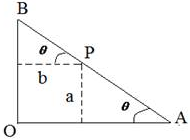
{tex}AP = a\cos ec\theta {/tex}
{tex}BP = b\sec \theta {/tex}
{tex}l = AP + BP{/tex}
{tex}l = a\cos ec\theta + b\sec \theta {/tex}
{tex}\frac{{dl}}{{d\theta }} = -a\cos ec\theta \cot \theta + b\sec \theta .\tan \theta {/tex}
{tex}\frac{{{d^2}l}}{{d{\theta ^2}}} = a\cos e{c^2}\theta + a\cos ec\theta {\cot ^2}\theta + {b^2} - {\sec ^3}\theta + b\sec \theta .{\tan ^2}\theta {/tex}
For maximum/minimum
{tex}\frac{{dl}}{{d\theta }} = 0{/tex}
{tex}\frac{{dl}}{{d\theta }} = -a\cos ec\theta \cot \theta + b\sec \theta .\tan \theta {/tex}
{tex}\frac{acos\theta}{sin^2\theta}=\frac{bsin\theta}{cos^2\theta}{/tex}
{tex}{\tan ^3}\theta = \frac{a}{b}{/tex}
{tex}\tan \theta = {\left( {\frac{a}{b}} \right)^{1/3}}{/tex}
{tex}\sin \theta = \frac{{{a^{1/3}}}}{{\sqrt {{a^{2/3}} + {b^{2/3}}} }},\cos \theta = \frac{{{b^{1/3}}}}{{\sqrt {{a^{2/3}} + {b^{2/3}}} }}{/tex}
{tex}\frac{{{d^2}l}}{{d{\theta ^2}}} < 0{/tex} for {tex}\tan \theta = {\left( {\frac{a}{b}} \right)^{1/3}}{/tex}
l is minimum and minimum value of l is given by,
{tex}l = a\cos ec\theta + b\sec \theta {/tex}
{tex}=a\sqrt{1+cot^2\theta}+b\sqrt{1+tan^2\theta}{/tex}
{tex}=a\sqrt{1+(\frac{b}{a})^{2/3}}+b\sqrt{1+(\frac{a}{b})^{2/3}}{/tex}
{tex}=a^{2/3}\sqrt{a^{2/3}+b^{2/3}}+b^{2/3}\sqrt{b^{2/3}+a^{2/3}}{/tex}
{tex}l = {\left( {{a^{2/3}} + {b^{2/3}}} \right)^{3/2}}{/tex}
Posted by Manasvi Patel 7 years, 3 months ago
- 3 answers
Posted by Vidit Joshi 7 years, 3 months ago
- 1 answers
Posted by Ayush Mishra 7 years, 3 months ago
- 2 answers
Posted by Nishant Shishodia 7 years, 3 months ago
- 0 answers
Posted by Himani Kashyap 6 years, 6 months ago
- 1 answers
Sia ? 6 years, 6 months ago
Given linear equation is 4x + py + 8 = 0 and 2x + 2y + 2 = 0.
So, 4x + py + 8 = 0 ...(1)
and 2x + 2y + 2 = 0 ...(2)
a1 = 4, b1 = p, c1 = 8, a2= 2 , b2 = 2 and c2 = 2
The condition of unique solution, {tex}\frac { a _ { 1 } } { a _ { 2 } } \neq \frac { b _ { 1 } } { b _ { 2 } }{/tex}
Hence,{tex}\frac { 4 } { 2 } \neq \frac { p } { 2 } \text { or } \frac { 2 } { 1 } \neq \frac { p } { 2 }{/tex}
{tex}p \neq 4{/tex}
The value of p is other than 4 it may be 1,2,3, - 4 ,.... etc.
Posted by Manya Singh 7 years, 3 months ago
- 5 answers

myCBSEguide
Trusted by 1 Crore+ Students

Test Generator
Create papers online. It's FREE.

CUET Mock Tests
75,000+ questions to practice only on myCBSEguide app

Himani Chauhan 7 years, 3 months ago
0Thank You