
Ask questions which are clear, concise and easy to understand.
Ask QuestionPosted by Ziya Ferzin 7 years, 3 months ago
- 1 answers
Posted by Khushi Gupta 7 years, 3 months ago
- 1 answers
Hritik Bhadani 7 years, 3 months ago
Posted by Khushal Rajak 7 years, 3 months ago
- 1 answers
Rakesh Kumar Tiwari 7 years, 3 months ago
Posted by Gurpreet Kaur 7 years, 3 months ago
- 0 answers
Posted by Aakansha Jajodiya 6 years, 6 months ago
- 1 answers
Sia ? 6 years, 6 months ago
In {tex}\Delta{/tex}BMC and {tex}\Delta{/tex} EMD, we have
MC = MD [{tex}\because{/tex} M is the mid-point of CD]
{tex}\angle \mathrm { CMB } = \angle E M D{/tex} [Vertically opposite angles]
and, {tex}\angle M B C = \angle M E D{/tex} [Alternate angles]
So, by AAS-criterion of congruence, we have
{tex}\therefore \quad \Delta B M C \cong \Delta E M D{/tex}
{tex}\Rightarrow{/tex} BC = DE .......(i)
Also, AD = BC [{tex}\because{/tex} ABCD is a parallelogram] ...... (ii)
Adding (i) and (ii),we get,
AD + DE = BC + BC
{tex}\Rightarrow{/tex} AE = 2 BC ...(iii)
Now, in {tex}\Delta{/tex}AEL and {tex}\Delta{/tex}CBL, we have
{tex}\angle A L E = \angle C L B{/tex} [Vertically opposite angles]
{tex}\angle E A L = \angle B C L{/tex} [Alternate angles]
So, by AA-criterion of similarity of triangles, we have
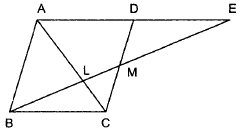
{tex}\Delta A E L \sim \Delta C B L{/tex}
{tex}\Rightarrow \quad \frac { E L } { B L } = \frac { A E } { C B }{/tex}
{tex}\Rightarrow \quad \frac { E L } { B L } = \frac { 2 B C } { B C }{/tex} [Using equations (iii)]
{tex}\Rightarrow \quad \frac { E L } { B L } = 2{/tex}
{tex}\Rightarrow{/tex} EL = 2 BL
Posted by Samarthsunil3 Samarthsunil3 7 years, 3 months ago
- 3 answers
Swati Khatri 7 years, 3 months ago
Latha Latha 7 years, 3 months ago
Posted by Lorial Brail 7 years, 3 months ago
- 1 answers
Posted by Lorial Brail 7 years, 3 months ago
- 3 answers
Gur Maan 7 years, 3 months ago
Posted by Lorial Brail 7 years, 3 months ago
- 2 answers
Anshul Telange 7 years, 3 months ago
Posted by Rohit Kumar 6 years, 6 months ago
- 1 answers
Sia ? 6 years, 6 months ago
Let AB be the mountain of height h kilometres. Let C be a point at a distance of x km. from the base of the mountain such that the angle of elevation of the top at C is 30o. Let D be a point at a distance of 10 km from C such that the angle of elevation at D is of 15o.
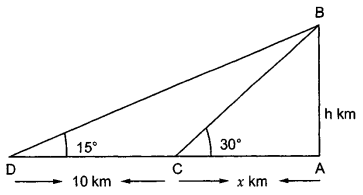
In {tex}\triangle C A B,{/tex} we have
{tex}\tan 30 ^ { \circ } = \frac { A B } { A C }{/tex}
{tex}\Rightarrow \quad \frac { 1 } { \sqrt { 3 } } = \frac { h } { x }{/tex}
{tex}\Rightarrow \quad x = \sqrt { 3 } h{/tex} ...(i)
In {tex}\triangle D A B,{/tex} we have
{tex}\tan 15 ^ { \circ } = \frac { A B } { A D }{/tex}
{tex}\Rightarrow \quad 0.27 = \frac { h } { x + 10 }{/tex}
{tex}\Rightarrow{/tex} (0.27) (x +1) = h ...(ii)
Substituting x = {tex}\sqrt { 3 }{/tex}h obtained from equation (i) in equation (ii), we get
{tex}0.27 ( \sqrt { 3 } h + 10 ) = h{/tex}
{tex}\Rightarrow \quad 0.27 \times 10 = h - 0.27 \times \sqrt { 3 } h{/tex}
{tex}\Rightarrow \quad h ( 1 - 0.27 \times \sqrt { 3 } ) = 2.7{/tex}
{tex}\Rightarrow{/tex} h (1 - 0.46) = 2.7
{tex}\Rightarrow \quad h = \frac { 2.7 } { 0.54 } = 5{/tex}
Hence, the height of the mountain is 5 km.
Posted by Shubh Walia 7 years, 3 months ago
- 2 answers
Posted by Aashiya Gupta 7 years, 3 months ago
- 1 answers
Yash Vardhan Singh Chauhan 7 years, 3 months ago
Posted by Arohi . 7 years, 3 months ago
- 5 answers
Posted by Muskan Aggarwal 7 years, 3 months ago
- 0 answers
Posted by Rupal ???? 7 years, 3 months ago
- 1 answers
Posted by Yash Kumar 6 years, 6 months ago
- 1 answers
Posted by Vaibhav Parmar 6 years, 6 months ago
- 1 answers
Sia ? 6 years, 6 months ago
Given,
{tex}\frac { 1 } { ( a + b + x ) } = \frac { 1 } { a } + \frac { 1 } { b } + \frac { 1 } { x }{/tex}
{tex}\Rightarrow \quad \frac { 1 } { ( a + b + x ) } - \frac { 1 } { x } = \frac { 1 } { a } + \frac { 1 } { b } \Rightarrow \frac { x - ( a + b + x ) } { x ( a + b + x ) } = \frac { b + a } { a b }{/tex}
{tex}\Rightarrow \quad \frac { - ( a + b ) } { x ( a + b + x ) } = \frac { ( a + b ) } { a b }{/tex}
On dividing both sides by (a+b)
{tex}\Rightarrow \quad \frac { - 1 } { x ( a + b + x ) } = \frac { 1 } { a b }{/tex}
Now cross multiply
{tex}\Rightarrow{/tex} x(a + b + x) = -ab
{tex}\Rightarrow{/tex} x2 + ax + bx + ab = 0
{tex}\Rightarrow{/tex} x(x +a) + b(x +a) = 0
{tex}\Rightarrow{/tex} (x + a) (x + b) = 0
{tex}\Rightarrow{/tex} x + a = 0 or x + b = 0
{tex}\Rightarrow{/tex} x = -a or x = -b.
Therefore, -a and -b are the roots of the equation.
Posted by _Harina_07 . 7 years, 3 months ago
- 0 answers
Posted by Harsh Singh 7 years, 3 months ago
- 0 answers
Posted by Nk Nk 7 years, 3 months ago
- 1 answers
Posted by Bittu Kumar 7 years, 3 months ago
- 1 answers
Yogita Ingle 7 years, 3 months ago
In a right-angled triangle, “The sum of squares of the lengths of the two sides is equal to the square of the length of the hypotenuse (or the longest side).”
Posted by Kumar Ujjawal 7 years, 3 months ago
- 0 answers
Posted by Richa Kumari 7 years, 3 months ago
- 1 answers
Gaurav Kumar 7 years, 3 months ago
Posted by Abhishek Yadav 5 years, 8 months ago
- 0 answers
Posted by Saumay Rustagi 7 years, 3 months ago
- 1 answers
Polo .... 7 years, 3 months ago
Posted by Neeraj Kumar 6 years, 6 months ago
- 1 answers
Sia ? 6 years, 6 months ago
Given polynomial is p(x) = 2x3 - x2- 5x - 2
and -1 and 2 are zeroes of polynomial.
{tex}\therefore{/tex} {x - (-1)} (x - 2)= ( x + 1) (x - 2) = x2 - 2x + x - 2 = x2- x - 2 is a factor of p(x)

For other zeroes, 2x + 1 = 0
{tex}\Rightarrow x = \frac { - 1 } { 2 }{/tex}
{tex}\therefore{/tex} Other zero = {tex}\frac { - 1 } { 2 }{/tex}
Posted by Ankit Rajput 7 years, 3 months ago
- 0 answers

myCBSEguide
Trusted by 1 Crore+ Students

Test Generator
Create papers online. It's FREE.

CUET Mock Tests
75,000+ questions to practice only on myCBSEguide app

Sia ? 6 years, 6 months ago
Given: A square ABCD and equilateral triangle BCE and ACF have been described on the side BC and diagonal AC respectively.
To Prove {tex}\operatorname { ar } ( \Delta B C E ) = \frac { 1 } { 2 } \operatorname { ar } ( \Delta A C F ){/tex}.
Proof: Since each of the {tex}\triangle BCE{/tex} and {tex}\triangle ACF{/tex} is an equilateral triangle, so each angle of each one of them is 60°.
So, the triangles are equiangular and hence similar.
{tex}\therefore \quad \triangle B C E \sim \triangle A C F{/tex}
We know that the ratio of the areas of two similar triangles is equal to the ratio of the squares of their corresponding sides.
{tex}\therefore \quad \frac { \operatorname { ar } ( \triangle B C E ) } { \operatorname { ar } ( \triangle A C F ) } = \frac { B C ^ { 2 } } { A C ^ { 2 } } = \frac { B C ^ { 2 } } { 2 ( B C ) ^ { 2 } }{/tex} {tex}[ \because A C = \sqrt { 2 } B C ]{/tex}
{tex}= \frac { 1 } { 2 }{/tex}
Hence, {tex}\operatorname { ar } ( \triangle B C E ) = \frac { 1 } { 2 } \times \operatorname { ar } ( \triangle A C F ){/tex} .
0Thank You