
Ask questions which are clear, concise and easy to understand.
Ask QuestionPosted by Anjali Shukla 7 years, 3 months ago
- 0 answers
Posted by Krishna Priya Vijayan 7 years, 3 months ago
- 1 answers
Posted by Aman Kumar 7 years, 3 months ago
- 1 answers
Posted by Rohit Sahani 7 years, 3 months ago
- 2 answers
Posted by Nidhi Chauhan 7 years, 3 months ago
- 3 answers
Posted by Dheeraj Verma 7 years, 3 months ago
- 2 answers
Rohan Kr. 7 years, 3 months ago
Posted by Rounak Singh 7 years, 3 months ago
- 2 answers
Posted by Nikhil Chaudhary 7 years, 3 months ago
- 2 answers
Shourya Veer 7 years, 3 months ago
Nikhil Chaudhary 7 years, 3 months ago
Posted by Md.Tabrez Khan 7 years, 3 months ago
- 0 answers
Posted by Aleena Iqbal 7 years, 3 months ago
- 1 answers
Posted by Deepanshi ☺☺ 7 years, 3 months ago
- 1 answers
Yogita Ingle 7 years, 3 months ago
Total number is 98
Divisible by 8 are 8,16,24,32,40,48,56,64,72,80,88,96
So 12 numbers are divisible
So probability of divisible numbers = 12/98 = 6/49
Posted by Richa Kumari 6 years, 6 months ago
- 1 answers
Sia ? 6 years, 6 months ago
Given : {tex}\Delta A B C \sim \Delta P Q R{/tex}
To Prove : {tex}\frac { \operatorname { ar } ( \Delta A B C ) } { \operatorname { ar } ( \Delta P Q R ) } = \left( \frac { A B } { P Q } \right) ^ { 2 }= \left( \frac { BC } { QR } \right) ^ { 2 }= \left( \frac { A C } { P R } \right) ^ { 2 }{/tex}
Construction: Draw AD {tex} \bot {/tex}BC and PE {tex} \bot {/tex} QR
Proof :
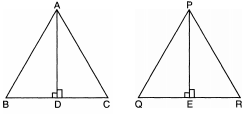
{tex}\Delta A B C \sim \Delta P Q R{/tex}
{tex}\therefore\frac { A B } { P Q } = \frac { B C } { Q R } = \frac { A C } { P R }{/tex} ( Ratio of corresponding sides of similar triangles are equal) ...(i)
{tex}\angle B = \angle Q{/tex} (Corresponding angles of similar triangles)......... (ii)
In {tex}\Delta A D B \text { and } \Delta P E Q{/tex}
{tex}\angle B = \angle Q{/tex} ( From (ii))
{tex}\angle A D B = \angle P E Q{/tex} {tex}\left[\; \operatorname { each } 90 ^ { \circ } \right]{/tex}
{tex}\therefore {/tex} {tex}\Delta A D B \sim \Delta P E Q{/tex} [ By AA criteria]
{tex}\Rightarrow{/tex} {tex}\frac { A D } { P E } = \frac { A B } { P Q }{/tex} (Corresponding sides of similar triangles) ...(iii)
From equation (i) and equation (iii)
{tex}\frac { A B } { P Q } = \frac { B C } { Q R } = \frac { A C } { P R } = \frac { A D } { P E }{/tex} ...(iv)
{tex}\frac { \operatorname { ar } ( \Delta A B C ) } { \operatorname { ar } ( \Delta P Q R ) } = \frac { \frac { 1 } { 2 } \times B C \times A D } { \frac { 1 } { 2 } \times Q R \times P E }{/tex}
{tex}= \left( \frac { B C } { Q R } \right) \times \left( \frac { A D } { P E } \right){/tex}
({tex}\frac{AD}{PE}=\frac{BC}{QR}{/tex})
{tex}= \frac { B C } { Q R } \times \frac { B C } { Q R }{/tex}
{tex}\Rightarrow{/tex} {tex}\frac { a r ( \Delta A B C ) } { a r ( \Delta P Q R ) } = \frac { B C ^ { 2 } } { Q R ^ { 2 } }{/tex} ....(v) [from eq. (iv)]
From equation (iv) and equation (v),
{tex}\therefore\frac { \operatorname { ar } ( \Delta A B C ) } { \operatorname { ar } ( \Delta P Q R ) } = \left( \frac { A B } { P Q } \right) ^ { 2 }= \left( \frac { BC } { QR } \right) ^ { 2 }= \left( \frac { A C } { P R } \right) ^ { 2 }{/tex}
{tex}\therefore{/tex} Ratio of the areas of two similar triangles is equal to the square of the ratio of their corresponding sides.
Posted by Sakshi Rawat Rawat 7 years, 3 months ago
- 0 answers
Posted by Richa Kumari 6 years, 6 months ago
- 1 answers
Sia ? 6 years, 6 months ago
2(3x - y) = 5xy .(i)
2(x + 3y) = 5xy ..(ii)
Divide eqns. (i) and (ii) by xy,
{tex}\frac { 6 } { y } - \frac { 2 } { x } = 5{/tex} ....(iii)
and {tex}\frac { 2 } { y } + \frac { 6 } { x } = 5{/tex} .....(iv)
Let {tex}\frac { 1 } { y } = a \text { and } \frac { 1 } { x } = b{/tex}
then equations (iii) and (iv) become
6a - 2 b = 5 ......(v)
2a -6b = 5 ...(vi)
Multiplying eqn. (v) by 3 and then adding with eqn. (vi),
18a - 6b + 2a - 6b = 15 + 5
20a = 20
{tex}\therefore {/tex} a=1
Substituting this value of a in eqn. (v),
{tex}b = \frac { 1 } { 2 }{/tex}
Now {tex}\frac { 1 } { y } = a = 1{/tex}
or, y=1
and {tex}\frac { 1 } { x } = b = \frac { 1 } { 2 }{/tex}
or, x=2
Hence, x = 2, y = 1
Posted by Richa Kumari 6 years, 6 months ago
- 1 answers
Sia ? 6 years, 6 months ago
Let the time in which man can finish the work in x days and the boy can finish the same work in y days.
Total work done = work done in one day {tex}\times{/tex} number of days
Work done by one man in one day = {tex}\frac { 1 } { x }{/tex}
and work done by one boy in one day ={tex}\frac { 1 } { y }{/tex}
{tex}\frac { 2 } { x } + \frac { 7 } { y } = \frac { 1 } { 4 }{/tex} ....(i)
{tex}\frac { 4 } { x } + \frac { 4 } { y } = \frac { 1 } { 3 }{/tex} ....(ii)
Let {tex}\frac { 1 } { x }{/tex} be a and {tex}\frac { 1 } { y }{/tex} be b , then
{tex}2 a + 7 b = \frac { 1 } { 4 }{/tex} ....(iii)
{tex}4 a + 4 b = \frac { 1 } { 3 }{/tex} ....(iv)
On Multiplying eqn. (iii) by 2 and subtract eqn. (iv)
from it
we get, {tex}b = \frac { 1 } { 60 }{/tex}
Put {tex}b = \frac { 1 } { 60 }{/tex} in equation (iii),
{tex}2 a + \frac { 7 } { 60 } = \frac { 1 } { 4 }{/tex}
{tex}\Rightarrow \quad 2 a = \frac { 1 } { 4 } - \frac { 7 } { 60 }{/tex}
{tex}\Rightarrow \quad a = \frac { 1 } { 15 }{/tex}
So, {tex}\frac { 1 } { 15 } = \frac { 1 } { x }{/tex}
{tex}\therefore {/tex}{tex}x=15{/tex}
Also, {tex}b = \frac { 1 } { 60 }=\frac { 1} { y }{/tex}
Hence, y = 60
Therefore , the man can finish the work alone in 15 days and the boy in 60 days.
Posted by Sherlin Mary 7 years, 3 months ago
- 0 answers
Posted by Rohit Sahani 7 years, 3 months ago
- 1 answers
Posted by Rohit Sahani 7 years, 3 months ago
- 3 answers
Ande Abhishikth 7 years, 3 months ago
Posted by Kanchan Tak 7 years, 3 months ago
- 1 answers
Shivam Soni 7 years, 3 months ago
Posted by Ammu Ammu 7 years, 3 months ago
- 2 answers
Kannu Kranti Yadav 7 years, 3 months ago
Posted by Devesh Kumar 7 years, 3 months ago
- 2 answers
Posted by Mona Sharma ? 6 years, 6 months ago
- 1 answers
Sia ? 6 years, 6 months ago
The point on the y-axis is (-4,3)
{tex}\therefore {/tex}Distance between (-4,3) and (0,3)
d = {tex}\sqrt { ( 0 + 4 ) ^ { 2 } + ( 3 - 3 ) ^ { 2 } }{/tex}
= {tex}\sqrt { 16 + 0 }{/tex}
= 4 units
Posted by Arif Alam 7 years, 3 months ago
- 1 answers
Posted by Navneet Tanwar 7 years, 3 months ago
- 3 answers
Posted by Vishal Mani 6 years, 6 months ago
- 1 answers
Sia ? 6 years, 6 months ago
The distances of P (x, y) from A (5,1) and B (-1,5) are equal, then we have to prove that 3x = 2y.
PA = PB
{tex}\therefore{/tex} PA2 = PB2
By distance formula,
(5 - x)2 + (1 - y)2= (-1 - x)2 + (5 - y)2
{tex}\Rightarrow{/tex}25 - 10x + x2 + 1 - 2y + y2 = 1 + 2x + x2 + 25 - 10y + y2
{tex}\Rightarrow{/tex} -10x - 2y = 2x - 10y
{tex}\Rightarrow{/tex} 8y = 12x
{tex}\Rightarrow{/tex}4(2y)= 4(3x)
{tex}\Rightarrow{/tex}3x = 2y
Hence Proved.
Posted by Yuvraj Bajaj 7 years, 3 months ago
- 2 answers
Posted by Lorial Brail 7 years, 3 months ago
- 2 answers
Anurag Rajpoot 7 years, 3 months ago
Abhishek Patwa 7 years, 3 months ago

myCBSEguide
Trusted by 1 Crore+ Students

Test Generator
Create papers online. It's FREE.

CUET Mock Tests
75,000+ questions to practice only on myCBSEguide app
