
Ask questions which are clear, concise and easy to understand.
Ask QuestionPosted by Bhumi Bhumika 6 years, 6 months ago
- 1 answers
Posted by Dhruv Chatterjee 7 years, 3 months ago
- 1 answers
Ziya Ferzin 7 years, 3 months ago
Posted by Atul Thakur 7 years, 3 months ago
- 1 answers
Posted by Abhay Sharma 6 years, 4 months ago
- 1 answers
Posted by Nitu Khushwah 7 years, 3 months ago
- 6 answers
Posted by Sanskar Chaturvedi 6 years, 6 months ago
- 1 answers
Sia ? 6 years, 6 months ago
Let p(x) ={tex} x^3 + 2x^2 + kx + 3{/tex}
Now, x - 3 = 0
{tex}\Rightarrow{/tex} x = 3
By the remainder theorem, we know that when p(x) is divided by (x - 3), the remainder is p(3).
Now, p(3) = (3)3 + 2(3)2 + k(3) + 3
= 27 + 2(9) + 3k + 3
= 30 + 18 + 3k
= 48 + 3k
But, remainder = 21
{tex}\Rightarrow{/tex} 48 + 3k = 21
{tex}\Rightarrow{/tex} 3k = 21 - 48
{tex}\Rightarrow{/tex} 3k = -27
{tex}\Rightarrow{/tex} k = {tex}\frac{-27}3{/tex}
{tex}\Rightarrow{/tex} k = -9
So, the value of k is -9.
Posted by Nikhil Singh Pratap 7 years, 3 months ago
- 1 answers
Posted by Ziya Ferzin 7 years, 3 months ago
- 1 answers
Fjdigih Gjgkhk 7 years, 3 months ago
Posted by Ziya Ferzin 7 years, 3 months ago
- 3 answers
Ashita Goel 7 years, 3 months ago
Posted by Aman Prajaparti 7 years, 3 months ago
- 0 answers
Posted by Shruti Sharma 7 years, 3 months ago
- 5 answers
Posted by Yashveer Singh Singh 7 years, 3 months ago
- 2 answers
Posted by Abhishek S 6 years, 6 months ago
- 1 answers
Sia ? 6 years, 6 months ago
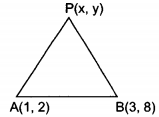
PA = {tex}\sqrt { ( 1 - x ) ^ { 2 } + ( 2 - y ) ^ { 2 } }{/tex}
PB = {tex}\sqrt { ( 3 - x ) ^ { 2 } + ( 8 - y ) ^ { 2 } }{/tex}
{tex}\therefore{/tex} PA = PB
Let coordinates of P are (x, y)
{tex}\Rightarrow{/tex} {tex} \sqrt { ( 1 - x ) ^ { 2 } + ( 2 - y ) ^ { 2 } }{/tex}{tex}= \sqrt { ( 3 - x ) ^ { 2 } + ( 8 - y ) ^ { 2 } }{/tex}
Squaring on both sides,
{tex}\Rightarrow{/tex} {tex}(1 - x)^2 + (2 - y)^2 = (3 - x)^2 + (8 - y)^2{/tex}
{tex}\Rightarrow{/tex} {tex}(1 - x)^2 - (3 - x)^2 = (8 - y)^2 - (2 - y)^2{/tex}
{tex}\Rightarrow{/tex} (1 - x - 3 + x) (1 - x + 3 - x) = (8 - y - 2 + y) (8 - y + 2 - y)
{tex}\Rightarrow{/tex}- 2(4 - 2x) = 6(10 - 2y)
{tex}\Rightarrow{/tex} {tex}- 2 \times 2 ( 2 - x ) = 6 \times 2 ( 5 - y ){/tex}
- 2 + x = 15 - 3y
x = 17 - 3y ...(i)
Area of {tex}\triangle{/tex}PAB = 10 sq units
{tex}\Rightarrow{/tex} {tex} \frac { 1 } { 2 } | x ( 2 - 8 ) + 1 ( 8 - y ) + 3 ( y - 2 ) |{/tex} = 10
{tex}\Rightarrow{/tex} {tex}| - 6 x + 8 - y + 3 y - 6 |{/tex} = 20
{tex}\Rightarrow{/tex} {tex}| - 6 x + 2 y + 2 |{/tex} = 20
{tex}\Rightarrow{/tex} {tex} - 6x + 2y + 2 = 20 {/tex}or {tex}- 6x + 2y + 2 = -20{/tex}
{tex}\Rightarrow{/tex} {tex}- 6(17 - 3y) + 2y + 2 = 20{/tex} or {tex}- 6(17 - 3y) + 2y + 2 = - 20 {/tex}...(ii)
{tex}\Rightarrow{/tex} {tex}- 102 + 18y + 2y + 2 = 20{/tex} or {tex}- 102 + 18y + 2y + 2 = - 20{/tex}
{tex}\Rightarrow{/tex} 20y = 120 or 20y = 80
y = 6 or y = 4
When y = 6, equation (i) becomes x = 17 - 18 = - 1
{tex}\therefore{/tex} Point is (- 1, 6).
When y = 4, equation (i) becomes x = 17 - 12 = 5
{tex}\therefore{/tex} Point is (5, 4).
Posted by Madhav Singh 7 years, 3 months ago
- 0 answers
Posted by Guddu Kumar 7 years, 3 months ago
- 1 answers
Posted by Guddu Kumar 6 years, 6 months ago
- 1 answers
Sia ? 6 years, 6 months ago
Let a be any positive integer and b = 6
∴ by Euclid’s division lemma
a = bq + r, 0≤ r and q be any integer q ≥ 0
∴ a = 6q + r,
where, r = 0, 1, 2, 3, 4, 5
If a is even then then remainder by division of 6 is 0,2 or 4
Hence r=0,2,or 4
or A is of form 6q,6q+2,6q+4
As, a = 6q = 2(3q), or
a = 6q + 2 = 2(3q + 1), or
a = 6q + 4 = 2(3q + 2).
If these 3 cases a is an even integer.
but if the remainder is 1,3 or 5 then r=1,3 or 5
or A is of form 6q+1,,6q+3 or,6q+5
Case 1:a = 6q + 1 = 2(3q) + 1 = 2n + 1,
Case 2: a = 6q + 3 = 6q + 2 + 1,
= 2(3q + 1) + 1 = 2n + 1,
Case 3: a = 6q + 5 = 6q + 4 + 1
= 2(3q + 2) + 1 = 2n + 1
This shows that odd integer is of the form 6q + 1, or 6q + 3, or 6q + 5, where q is some integer.
Posted by Bhrigu Kumar 6 years, 6 months ago
- 1 answers
Sia ? 6 years, 6 months ago
Given:
d = -2, n = 5 and an = 0
We know that , an = a + (n - 1) d
{tex}0 = a + (n - 1) d{/tex}
{tex}[ a_n = 0]{/tex}
{tex}0 = a + ( 5 - 1 ) (-2){/tex}
0 = a + 4 {tex}\times{/tex} - 2
{tex}0 = a - 8{/tex}
0 + 8 = a
a = 8
Hence, the value of a is 8.
Posted by Rahul Sha 7 years, 3 months ago
- 0 answers
Posted by Saanchi Saha 6 years, 4 months ago
- 1 answers
Sia ? 6 years, 4 months ago
According to questions it is given that S and T are points on sides PR and QR of {tex}\triangle PQR{/tex} such that {tex}\angle P = \angle R T S{/tex}
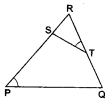
To Prove {tex}\triangle R P Q \sim \triangle R T S{/tex}
Proof In {tex}\triangle RPQ{/tex} and {tex}\triangle RTS{/tex}, we have
{tex}\angle P = \angle R T S{/tex} (given)
{tex}\angle R = \angle R{/tex} (common)
{tex}\therefore \quad \triangle R P Q \sim \triangle R T S{/tex} [by AA-similarity].
Posted by Aditya Gupta 7 years, 3 months ago
- 1 answers
Posted by Avijit Singh 6 years, 4 months ago
- 1 answers
Sia ? 6 years, 4 months ago
Here the given polynomial f(x)=2x2 + 2ax + 5x +10
If x+a is a factor of f(x) then x+a=0 or x = -a
{tex}\Rightarrow{/tex}f(-a) = 0
{tex}\Rightarrow{/tex}2(-a)2 + 2a.(-a) + 5(-a) + 10 =0
{tex}\Rightarrow{/tex}2a2 - 2a2 -5a +10 =0
{tex}\Rightarrow{/tex}-5a = -10
{tex}\Rightarrow{/tex}a=2.
Posted by Aswin Win 6 years, 6 months ago
- 1 answers
Sia ? 6 years, 6 months ago
Let father's age be x years and the sum of the ages of his two children be y years.
Then,
{tex}x = 2y{/tex}
{tex}\Rightarrow{/tex} {tex}x - 2y = 0{/tex} ....(i)
20 years hence,
Father's age = {tex}(x + 20) years{/tex}
Sum of the ages of two children {tex}= y + 20 + 20 = (y + 40) years{/tex}
Then, we have
{tex}x + 20 = y + 40{/tex}
{tex}\Rightarrow{/tex} {tex}x - y = 20 {/tex}....(ii)
Multiplying (ii) by 2, we get
{tex}2x - 2y = 40{/tex} ...(iii)
Subtracting (i) from (iii), we have
x = 40
Thus, the age of father is 40 years.
Posted by Debashish Jana 7 years, 3 months ago
- 2 answers
Rohit Sahani 7 years, 3 months ago
Abhishek Patwa 7 years, 3 months ago
Posted by Aakas H 7 years, 3 months ago
- 0 answers
Posted by Tiger Singh 6 years, 4 months ago
- 1 answers
Posted by Lakshya Prabha 7 years, 3 months ago
- 0 answers
Posted by Gaurav Rawat 6 years, 6 months ago
- 1 answers
Sia ? 6 years, 6 months ago
Let the polynomial is p(x) = 2x4+ 7x3 - 19x2 - 14x + 30
and {tex} \sqrt { 2 } \text { and } - \sqrt { 2 }{/tex} are zeroes of polynomial p(x).
{tex}\therefore ( x - \sqrt { 2 } ) ( x + \sqrt { 2 } ){/tex} = x2 - 2 is a factor of given polynomial.
On dividing given polynomial, we get
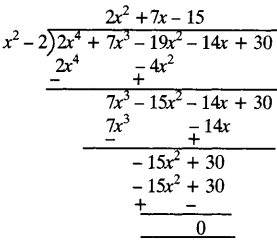
quotient : 2x2 + 7x - 15
So, the other factor is 2x2 + 7x - 15
Now, 2x2 + 7x - 15 = 0
{tex}\Rightarrow{/tex} 2x2 + 10x - 3x - 15 = 0
{tex}\Rightarrow{/tex}2x(x + 5) - 3 (x + 5) = 0
{tex}\Rightarrow{/tex}(x + 5)(2x - 3) = 0
{tex}\therefore \quad x = - 5 , x = \frac { 3 } { 2 }{/tex}
Hence Zeores of given polynomial are {tex}\sqrt { 2 } , - \sqrt { 2 } , - 5 \text { and } \frac { 3 } { 2 }{/tex}.
Posted by Dilkhush Kumar 7 years, 3 months ago
- 1 answers
Dilkhush Kumar 7 years, 3 months ago

myCBSEguide
Trusted by 1 Crore+ Students

Test Generator
Create papers online. It's FREE.

CUET Mock Tests
75,000+ questions to practice only on myCBSEguide app

Sia ? 6 years, 6 months ago
In right {tex}\triangle {/tex}AMB,
tan B = {tex}\frac { 3 } { 4 }{/tex}
{tex}\Rightarrow{/tex} {tex}\frac { A M } { B M } = \frac { 3 } { 4 }{/tex}
{tex}\Rightarrow{/tex} 4AM = 3BM {tex}\Rightarrow{/tex}BM = {tex}\frac { 4 } { 3 }{/tex}AM ...(i)
In right {tex}\triangle{/tex}AMC,
tan C = {tex}\frac { \mathrm { AM } } { \mathrm { MC } }{/tex}
{tex}\Rightarrow \frac { 5 } { 12 } = \frac { \mathrm { AM } } { \mathrm { MC } }{/tex}
{tex}\Rightarrow{/tex} MC = {tex}\frac { 12 } { 5 }{/tex} AM ...(ii)
Now, BM + MC = BC
{tex}\frac { 4 } { 3 }{/tex}AM + {tex}\frac { 12 } { 5 }{/tex}AM = 56
AM {tex}\left( \frac { 4 } { 3 } + \frac { 12 } { 5 } \right){/tex} = 56
AM {tex}\left( \frac { 20 + 36 } { 15 } \right){/tex} = 56
{tex}\Rightarrow{/tex} AM = {tex}\frac { 56 \times 15 } { 56 }{/tex}
= 15 cm
0Thank You