
Ask questions which are clear, concise and easy to understand.
Ask QuestionPosted by Prabhleen Kaur 6 years, 4 months ago
- 1 answers
Posted by Devika Pihu 6 years, 8 months ago
- 1 answers
Posted by ????? ?????? 6 years, 8 months ago
- 1 answers
Posted by Hariom Dalal 6 years, 8 months ago
- 0 answers
Posted by Charu Latha 6 years, 4 months ago
- 1 answers
Sia ? 6 years, 4 months ago
if -2 and -1 are zeros of f(x) = 2x4 + x3 - 14x2 - 19x - 6
x+2 and x+1 are factors of f(x)
So (x + 2)(x + 1) = x2 + x + 2x + 2 = x2 + 3x + 2 is a factor of f(x)
On long division of f(x) by x2 + 3x + 2 we get
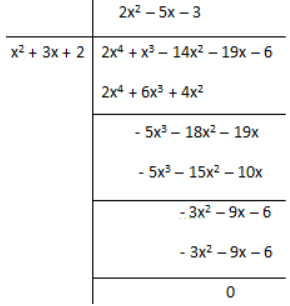
f(x) = 2x4 + x3 - 14x2 - 19x - 6 = (2x2 - 5x - 3)(x2 + 3x + 2)
= (2x + 1)(x - 3)(x + 2)(x + 1)
Therefore, zeroes of the polynomial = {tex}\frac{{ - 1}}{2}{/tex}, 3, -2, -1.
Posted by Mukund Rangwani 6 years, 4 months ago
- 1 answers
Sia ? 6 years, 4 months ago
Since the point (3, a) lies on the line 2x - 3y = 5, we have
2 {tex}\times{/tex} 3 - 3 {tex}\times{/tex} a = 5
{tex}\Rightarrow{/tex} 6 - 3a = 5
{tex}\Rightarrow{/tex} 3a = 1
{tex}\Rightarrow{/tex} {tex}a = \frac { 1 } { 3 }{/tex}
Posted by Rohit Sahani? 6 years, 8 months ago
- 1 answers
Posted by Vinay Pathak 6 years, 8 months ago
- 0 answers
Posted by Pushpak Choudhary 6 years, 4 months ago
- 1 answers
Sia ? 6 years, 4 months ago
Since, any odd positive integer n is of the form 4m + 1 or 4m + 3.
if n = 4m + 1
n2 = (4m + 1)2
= 16m2 + 8m + 1
= 8(2m2 + m) + 1
So n2 = 8q + 1 ........... (i)) (where q = 2m2 + m is a positive integer)
If n = (4m + 3)
n2 = (4m + 3)2
= 16m2 + 24m + 9
= 8(2m2 + 3m + 1) + 1
So n2 = 8q + 1 ...... (ii) (where q = 2m2 + 3m + 1 is a positive integer)
From (i) and (ii) we conclude that the square of an odd positive integer is of the form 8q + 1, for some integer q.
Posted by Drakshayani Patil 6 years, 4 months ago
- 1 answers
Sia ? 6 years, 4 months ago
Given integers are 408 and 1032 where 408 < 1032
By applying Euclid’s division lemma, we get 1032 = 408 {tex}\times{/tex} 2 + 216.
Since the remainder ≠ 0, so apply division lemma again on divisor 408 and remainder 216, we get the relation as
408 = 216 {tex}\times{/tex} 1 + 192.
Since the remainder ≠ 0, so apply division lemma again on divisor 216 and remainder 192
216 = 192 {tex}\times{/tex} 1 + 24.
Since the remainder ≠ 0, so apply division lemma again on divisor 192 and remainder 24
192 = 24 × 8 + 0.
Now the remainder has become 0. Therefore, the H.C.F of 408 and 1032 = 24.
Therefore,
24 = 1032m - 408 {tex}\times{/tex} 5
1032m = 24 + 408 {tex}\times{/tex} 5
1032m = 24 + 2040
1032m = 2064
{tex}m = \frac{{2064}}{{1032}}{/tex}
Therefore, m = 2.
Posted by Naman Pant 6 years, 8 months ago
- 2 answers
Posted by Vishnupriya Venkatraman 6 years, 4 months ago
- 1 answers
Sia ? 6 years, 4 months ago
The prime factors of:
378 = 2 {tex} \times{/tex} 33 {tex}\times{/tex} 7
180 = 23 {tex}\times{/tex} 32 {tex}\times{/tex} 5
420 = 22 {tex}\times{/tex} 3 {tex}\times{/tex} 7{tex}\times{/tex} 5
HCF = 2 {tex}\times{/tex} 3=6
and LCM(378, 180, 420) = 22 {tex}\times{/tex} 33 {tex}\times{/tex} 5 {tex}\times{/tex} 7 = 3780
HCF {tex}\times{/tex} LCM = 6 {tex}\times{/tex} 3780 = 22680
Product of given numbers is = 378 {tex}\times{/tex} 180 {tex}\times{/tex} 420 = 28576800
Hence, HCF {tex}\times{/tex} LCM {tex}\ne{/tex} Product of three numbers.
Posted by Riya Singla 6 years, 8 months ago
- 0 answers
Posted by Adarsh Pathak 6 years, 8 months ago
- 1 answers
Mr Uk.Aala 6 years, 8 months ago
Posted by Abhay Verma 6 years, 8 months ago
- 2 answers
Posted by Ankit Sharma 6 years, 8 months ago
- 1 answers
Posted by Harsh Deep 6 years, 8 months ago
- 1 answers
?D? ??Wish Me At 12Pm...?? 6 years, 8 months ago
Posted by Tanaya Jadhav☺️ 6 years, 8 months ago
- 2 answers
Posted by Hema Kashyab 6 years, 8 months ago
- 1 answers
Rohit Sahani? 6 years, 8 months ago
Posted by Mukesh Kumar Sah 6 years, 8 months ago
- 0 answers
Posted by Adarsh Yadav 6 years, 8 months ago
- 0 answers
Posted by Athish As 6 years, 4 months ago
- 1 answers
Sia ? 6 years, 4 months ago
if -2 and -1 are zeros of f(x) = 2x4 + x3 - 14x2 - 19x - 6
x+2 and x+1 are factors of f(x)
So (x + 2)(x + 1) = x2 + x + 2x + 2 = x2 + 3x + 2 is a factor of f(x)
On long division of f(x) by x2 + 3x + 2 we get
f(x) = 2x4 + x3 - 14x2 - 19x - 6 = (2x2 - 5x - 3)(x2 + 3x + 2)
= (2x + 1)(x - 3)(x + 2)(x + 1)
Therefore, zeroes of the polynomial = {tex}\frac{{ - 1}}{2}{/tex}, 3, -2, -1.
Posted by Sonia Sharma 6 years, 8 months ago
- 0 answers
Posted by Amit Prasad 6 years, 8 months ago
- 0 answers
Posted by Rimmy K 6 years, 8 months ago
- 1 answers
Aryan Pahuja 6 years, 8 months ago
Posted by Muskaan Kumar 6 years, 8 months ago
- 0 answers
Posted by Anushka Bhatt 5 years, 9 months ago
- 0 answers
Posted by Simran Sethi 6 years, 8 months ago
- 1 answers
Sia ? 6 years, 4 months ago
Length of the courtyard = 18 m 72 cm = 1800 cm + 72 cm = 1872 cm (therefore, 1 m = 100 cm)
Breadth of the courtyard = 13 in 20 cm = 1300 cm + 20 cm = 1320 cm
To find the square tile of maximum side we take the HCF of 1872 and 1320
Prime factorization of 1872 = 24 {tex}\times{/tex} 32 {tex}\times{/tex} 13
Prime factorization of 1320 = 23 {tex}\times{/tex} 3 {tex}\times{/tex} 5 {tex}\times{/tex} 11
HCF of 1872 and 1320 = 23 {tex}\times{/tex} 3 = 24
Therefore, Length of side of the square tile = 24 cm
Number of tiles required = Area of the courtyard / Area of each tile = (Length {tex}\times{/tex} Breadth) /Side2
= (1872 cm {tex}\times{/tex} 1320 cm) ÷ (24 cm {tex}\times{/tex} 24 cm) = 4290.
Hence 4290 tiles are required.
Posted by Pritish Medhi 6 years, 8 months ago
- 1 answers
Pritish Medhi 6 years, 8 months ago

myCBSEguide
Trusted by 1 Crore+ Students

Test Generator
Create papers online. It's FREE.

CUET Mock Tests
75,000+ questions to practice only on myCBSEguide app

Sia ? 6 years, 4 months ago
Since, any odd positive integer n is of the form 4m + 1 or 4m + 3.
if n = 4m + 1
n2 = (4m + 1)2
= 16m2 + 8m + 1
= 8(2m2 + m) + 1
So n2 = 8q + 1 ........... (i)) (where q = 2m2 + m is a positive integer)
If n = (4m + 3)
n2 = (4m + 3)2
= 16m2 + 24m + 9
= 8(2m2 + 3m + 1) + 1
So n2 = 8q + 1 ...... (ii) (where q = 2m2 + 3m + 1 is a positive integer)
From (i) and (ii) we conclude that the square of an odd positive integer is of the form 8q + 1, for some integer q.
0Thank You