
Ask questions which are clear, concise and easy to understand.
Ask QuestionPosted by Ramesh Odedra 6 years, 8 months ago
- 0 answers
Posted by Sangram Khokarale 6 years, 4 months ago
- 1 answers
Posted by Preethi Geethakumar 6 years, 8 months ago
- 2 answers
Preethi Geethakumar 6 years, 8 months ago
Posted by Vikash Yadav 6 years, 8 months ago
- 1 answers
Tathagat Chavada 6 years, 8 months ago
Posted by Harsh Singh 6 years, 8 months ago
- 0 answers
Posted by ..Riya.. ?3154? 6 years, 8 months ago
- 2 answers
Preethi Geethakumar 6 years, 8 months ago
Posted by Subha Priya 6 years, 8 months ago
- 1 answers
Posted by Ruhi Bansal 6 years, 8 months ago
- 1 answers
Posted by Umesh Patel Usp Umesh Patel Usp 5 years, 9 months ago
- 1 answers
Shubham Awasthi 6 years, 8 months ago
Posted by Pulkit . 6 years, 8 months ago
- 1 answers
Posted by Hãrshîkä Váshkìyār 6 years, 4 months ago
- 1 answers
Sia ? 6 years, 4 months ago
35 = 5 {tex}\times{/tex} 7
56 = 23 {tex}\times{/tex} 7
91 = 13 {tex}\times{/tex} 7
L.C.M of 35, 56 and 91 = 23 {tex}\times{/tex} 7 {tex}\times{/tex} 5 {tex}\times{/tex} 13 = 3640
The smallest number that when divided by 35, 56, 91 leaves a remainder 7 in each case = 3640 + 7 = 3647.
Hence 3647 is the smallest number that, when divided by 35, 56 and 91 leaves a remainder of 7 in each case.
Posted by Kunal Kene 6 years, 4 months ago
- 2 answers
Sia ? 6 years, 4 months ago
Given numbers are 184, 230, and 276.
Applying Euclid's division lemma to 184 and 230, we get
230 = 184 {tex}\times{/tex} 1 + 46
184 = 46 {tex}\times{/tex} 4 + 0
The remainder at this stage is zero.
So, the divisor at this or the remainder at the previous stage i.e., 46 is the HCF of 184 and 230.
Also,
276 = 46 {tex}\times{/tex} 6 + 0
∴ HCF of 276 and 46 is 46
HCF (184, 230, 276) = 46
Hence, the required HCF of 184, 230 and 276 is 46.
Posted by Garima Chauhan 6 years, 8 months ago
- 1 answers
Yogita Ingle 6 years, 8 months ago
90 = 2 x 3 x 3 x 5 = 2 x 32 x 5
144 = 2 x 2 x 2 x 2 x 3 x 3 = 24 x 32
HCF (90, 144) = 2 x 32 = 18
Posted by Niharika Srivastav 6 years, 8 months ago
- 0 answers
Posted by Prashant Sharma 6 years, 8 months ago
- 0 answers
Posted by Rithvik Shakya 6 years, 8 months ago
- 1 answers
Yogita Ingle 6 years, 8 months ago
Given √2 is irrational number.
Let √2 = a / b wher a,b are integers b ≠ 0
we also suppose that a / b is written in the simplest form
Now √2 = a / b ⇒ 2 = a2 / b2 ⇒ 2b2 = a2
∴ 2b2 is divisible by 2
⇒ a2 is divisible by 2
⇒ a is divisible by 2
∴ let a = 2c
a2 = 4c2 ⇒ 2b2 = 4c2 ⇒ b2 = 2c2
∴ 2c2 is divisible by 2
∴ b2 is divisible by 2
∴ b is divisible by 2
∴a are b are divisible by 2 .
this contradicts our supposition that a/b is written in the simplest form
Hence our supposition is wrong
∴ √2 is irrational number.
Posted by Jayesh Wagh 6 years, 4 months ago
- 1 answers
Sia ? 6 years, 4 months ago
f(x)=6x2-3
To find zeros
6x2-3=0
6x2=3
{tex}x=\pm \frac {1}{\sqrt 2}{/tex}
Henc the zeros f(x) are:
{tex} \alpha = \frac { 1 } { \sqrt { 2 } } \text { and } \beta = - \frac { 1 } { \sqrt { 2 } }{/tex}
Sum of the zeroes = {tex} \alpha + \beta = \frac { 1 } { \sqrt { 2 } } + \left( - \frac { 1 } { \sqrt { 2 } } \right) = 0{/tex} and, {tex} - \frac { \text { Coefficient of } x } { \text { Coefficient of } x ^ { 2 } } = - \frac { 0 } { 6 } = 0{/tex}
{tex}\therefore{/tex} Sum of the zeros {tex} = - \frac { \text { Coefficient of } x } { \text { coefficient of } x ^ { 2 } }{/tex}
Also, Product of the zeroes = {tex} \alpha \beta = \frac { 1 } { \sqrt { 2 } } \times \frac { - 1 } { \sqrt { 2 } } = \frac { - 1 } { 2 } {/tex}, and {tex} \frac { \text { Constant term } } { \text { Coefficient of } x ^ { 2 } }= \frac { - 3 } { 6 } = \frac { - 1 } { 2 }{/tex}
{tex}\therefore{/tex} Product of the zeros {tex}= \frac { \text { Constant term } } { \text { Coefficient of } x ^ { 2 } }{/tex}
Posted by Abhijay Prasad 6 years, 8 months ago
- 0 answers
Posted by Pujan Koladia 6 years, 4 months ago
- 1 answers
Sia ? 6 years, 4 months ago
We have, 2x2 + x + 4 = 0
Dividing both sides by 2, we get
{tex}x^2 +{1 \over 2}x + 2 = 0 {/tex}
{tex}\implies (x)^2 + {1 \over 2}x + {1 \over 16} = -2 + {1 \over 16}{/tex}
{tex}\implies (x)^2 + 2(x) ({1 \over 4})+ ({1 \over4})^2= {- 32 +1 \over 16}{/tex}
{tex}\implies (x + {1 \over4})^2 = -{31 \over 16} <0{/tex}
Which is not possible, as square cannot be negative.
So, there is no real value of x which satisfy the given equation.
Therefore, the given equation has no real roots.
Posted by Sanjana Chimurkar 6 years, 8 months ago
- 0 answers
Posted by Sanjana Chimurkar 6 years, 8 months ago
- 1 answers
Posted by Sanjana Chimurkar 6 years, 4 months ago
- 1 answers
Sia ? 6 years, 4 months ago
- The smallest composite number is 4.
- The smallest prime number is 2.
The LCM of 4 and 2 is 4.
Posted by Sanjana Chimurkar 6 years, 4 months ago
- 1 answers
Posted by Likhita Patnaik 6 years, 8 months ago
- 0 answers
Posted by Agharna S 6 years, 8 months ago
- 0 answers
Posted by Shwasthika Lovely 6 years, 8 months ago
- 0 answers
Posted by Priyank Maheshwari 6 years, 4 months ago
- 1 answers
Sia ? 6 years, 4 months ago
if -2 and -1 are zeros of f(x) = 2x4 + x3 - 14x2 - 19x - 6
x+2 and x+1 are factors of f(x)
So (x + 2)(x + 1) = x2 + x + 2x + 2 = x2 + 3x + 2 is a factor of f(x)
On long division of f(x) by x2 + 3x + 2 we get
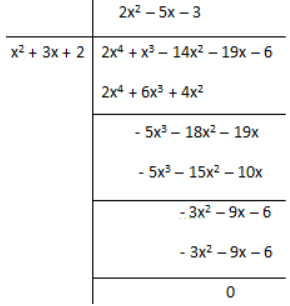
f(x) = 2x4 + x3 - 14x2 - 19x - 6 = (2x2 - 5x - 3)(x2 + 3x + 2)
= (2x + 1)(x - 3)(x + 2)(x + 1)
Therefore, zeroes of the polynomial = {tex}\frac{{ - 1}}{2}{/tex}, 3, -2, -1.

myCBSEguide
Trusted by 1 Crore+ Students

Test Generator
Create papers online. It's FREE.

CUET Mock Tests
75,000+ questions to practice only on myCBSEguide app
