
Ask questions which are clear, concise and easy to understand.
Ask QuestionPosted by Anish Kumar 6 years, 8 months ago
- 0 answers
Posted by Gunjan Raghav 6 years, 8 months ago
- 2 answers
Mahak Agrawal 6 years, 8 months ago
Manavi Yaduvanshi 6 years, 8 months ago
Posted by Anurag Tripathi 6 years, 8 months ago
- 0 answers
Posted by G B 6 years, 8 months ago
- 1 answers
Posted by Diya Sharma 6 years, 4 months ago
- 1 answers
Sia ? 6 years, 4 months ago
Numbers are of two types - prime and composite.
Prime numbers can be divided by 1 and only itself, whereas composite numbers have factors other than 1 and itself.
It can be observed that
7 × 11 × 13 + 13 = 13 × (7 × 11 + 1)
= 13 × (77 + 1)= 13 × 78= 13 ×13 × 6
The given expression has 6 and 13 as its factors.
Therefore, it is a composite number.
7 × 6 × 5 × 4 × 3 × 2 × 1 + 5
= 5 ×(7 × 6 × 4 × 3 × 2 × 1 + 1)
= 5 × (1008 + 1)= 5 ×1009
1009 cannot be factorized further
Therefore, the given expression has 5 and 1009 as its factors.
Hence, it is a composite number.
Posted by Snehal Srijan 6 years, 8 months ago
- 1 answers
Tripti Rawat 6 years, 8 months ago
Root 2 = 1.414
Root 3 = 1.732
Now, we can write n number of rational number between these. That is just greater than 1.414 and less than 1.732 and it should be terminating or not terminating but repeating.
For example
1.415659756, 1.416893, 1.715644, ...
Posted by Prahalad Singh Darjawat 6 years, 8 months ago
- 0 answers
Posted by Pankaj Kumar Behera 6 years, 8 months ago
- 1 answers
Posted by Isha Gupta 6 years, 8 months ago
- 3 answers
Yogita Ingle 6 years, 8 months ago
7×11×13+13 =13(7×11×1+1)
=13×78
=13×3×2×13
Hence, it is a composite number .
We have,
7×6×5×4×3×2×1+5 =5(7×6×4×3×2×1+1)
=5(1008+1)
=5×1009
Hence, it is a composite number .</div>
Prahalad Singh Darjawat 6 years, 8 months ago
Posted by Vishal Kumar Jha 6 years, 4 months ago
- 1 answers
Sia ? 6 years, 4 months ago
Radius (r1) of 1st circle= 19 cm
Radius (r2) or 2nd circle = 9 cm
Let radius of 3rd circle be r
Circumference of 1st circle {tex}= 2\pi {r_1} = 2\pi \left( {19} \right) = 38\pi {/tex}
Circumference of 2nd circle {tex}= 2\pi {r_2} = 2\pi \left( 9 \right) = 18\pi {/tex}
Circumference of 3rd circle {tex} = 2\pi r{/tex}
Given that
Circumference of 3rd circle = circumference of 1st circle + circumference of 2nd circle
{tex}2\pi r = 38\pi + 18\pi = 56\pi {/tex}
{tex}r = \frac{{56\pi }}{{2\pi }} = 28{/tex}
So, radius of circle which has circumference equal to the sum of the circumference of given two circles is 28 cm.
Area of circle {tex} = \pi {r^2} = \left( {\frac{{22}}{7}} \right) \times 28 \times 28 = 2464c{m^2}{/tex}
Posted by #Dead Pool 2 6 years, 8 months ago
- 0 answers
Posted by Tanish Kumar 6 years, 8 months ago
- 0 answers
Posted by Dakshesh Sharma 6 years, 8 months ago
- 6 answers
Priya Rawat 6 years, 8 months ago
Posted by Chandan Kumar Singh 6 years, 8 months ago
- 4 answers
Chandra Bhusan Choudhary 6 years, 8 months ago
Posted by Vijeta Priyam 6 years, 4 months ago
- 1 answers
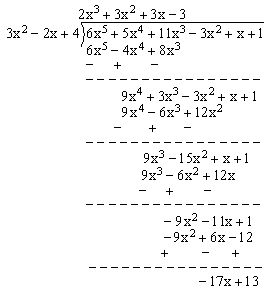
Posted by Prem Kumar 6 years, 8 months ago
- 1 answers
Yogita Ingle 6 years, 8 months ago
3x+2y=4 ........ (i)
2x-3y=7 ....... (ii)
Multiply (i) by 3 and (ii) by 2
9x + 6y = 12......... (iii)
4x - 6y = 14 ......... (iv)
Add (iii) and (iv)
13x = 26
x = 26/13 = 2
Put x = 2 in (i) , we get
3(2) + 2y = 4
6 + 2y = 4
2y = 4 - 6
2y = -2
y = -1
Posted by Akshat Chhabra 6 years, 8 months ago
- 0 answers
Posted by Prem Kumar 6 years, 8 months ago
- 1 answers
Yogita Ingle 6 years, 8 months ago
x=2y-1
x - 2y = -1 ......... (i)
y=5-3x
3x + y = 5 ......... (ii)
multiply (ii) by 2
6x + 2y = 10 ......... (iii)
Adding (i) and (iii)
x - 2y + 6x + 2y = -1 + 10
7x = 9
x = 9/7
Put x = 9/7 in y = 5 -3x
y = 5 - 3(9/7)
y = 5 - 27/7
= (35 - 27)/7
= 8/7
Posted by Dharmendra Kumar 6 years, 8 months ago
- 0 answers
Posted by Abhishek Kumar 6 years, 8 months ago
- 0 answers
Posted by Harsha Solanki 6 years, 7 months ago
- 1 answers
Sia ? 6 years, 7 months ago
It is given that a + b + c = 0
We have function p(x) = ax2 + bx + c
Using remainder theorem by putting x=1 we get
p(1) = a {tex}\times{/tex} 12+ b + c
= a + b +c = 0 (given)
{tex}\therefore{/tex} x = 1 is one zero
Posted by Ujesha Gupta 6 years, 8 months ago
- 1 answers
Posted by Akshat Chhabra 6 years, 8 months ago
- 1 answers
Yogita Ingle 6 years, 8 months ago
px = 3x-2x+6x-5
p2 = 3(2) - 2(2) + 6(2) - 5
= 6 - 4 + 12 - 5
= 2 + 12 - 5
= 14 - 5
= 9
Posted by Mahi Chandrawat 6 years, 7 months ago
- 1 answers
Sia ? 6 years, 7 months ago
We have the equation,
{tex}ax^2+bx-6=0{/tex}
Putting x = {tex}\frac{3}{4}{/tex} , we get
{tex}\therefore{/tex} a({tex}\frac{3}{4}{/tex})2 + b({tex}\frac{3}{4}{/tex}) - 6 = 0
{tex}\Rightarrow{/tex} a{tex}\frac{9}{16}{/tex} +b({tex}\frac{3}{4}{/tex}) - 6 = 0
{tex}\Rightarrow{/tex} 9a + 12b - 96 = 0
{tex}\Rightarrow{/tex} 3a + 4b = 32 ..(i)
Putting x = -2, we get
a(-2)2 + b(-2) - 6 = 0
4a -2b = 6
2a - b = 3 ..... (ii)
Multiplying (ii) by 4 adding the result from (i), we get
11a = 44 {tex}\Rightarrow{/tex} a = 4
Putting a = 4 in (i) , we get
3(4) + 4b = 32
{tex}\Rightarrow{/tex} 4b = 32 - 12
{tex}\Rightarrow{/tex} b = {tex}\frac{20}{4}{/tex} = 5
Therefore, the required value of a = 4 and b = 5.
Posted by Isha Gupta Gupta 6 years, 8 months ago
- 3 answers
Yogita Ingle 6 years, 8 months ago
HCF of 510 and 92.
510 = 92 x 5 + 50
92 = 50 x 1 + 42
50 = 42 x 1 + 8
42 = 8 x 5 + 2
8 = 2 x 4 + 0
∴ HCF of 510 and 92 = 2
Product of two numbers = Product of their LCM and HCF
510 x 92 = 2 x LCM
LCM = (510 x 92) / 2
= 23460
∴ LCM of 510 and 92 = 23460.
Posted by Meeran Arshath 6 years, 8 months ago
- 1 answers
Yogita Ingle 6 years, 8 months ago
X+y=5 ........... (i)
2x-3y=4 ......... (ii)
Multiply (i) by 3
3x + 3y = 15 ........ (iii)
add (ii) and (iii)
2x - 3y + 3x + 3y = 4 + 15
5x = 19
x = 19/5
Put x = 19/5 in (i)
19/5 + y = 5
y = 5 - 19/5
y = (25 -19)/5
y = 6/5

myCBSEguide
Trusted by 1 Crore+ Students

Test Generator
Create papers online. It's FREE.

CUET Mock Tests
75,000+ questions to practice only on myCBSEguide app
