
Ask questions which are clear, concise and easy to understand.
Ask QuestionPosted by Abhay Chaudhary 6 years, 8 months ago
- 1 answers
Posted by Rishabh Kasodhan 6 years, 7 months ago
- 1 answers
Sia ? 6 years, 7 months ago
Numbers are of two types - prime and composite.
Prime numbers can be divided by 1 and only itself, whereas composite numbers have factors other than 1 and itself.
It can be observed that
7 × 11 × 13 + 13 = 13 × (7 × 11 + 1)
= 13 × (77 + 1)= 13 × 78= 13 ×13 × 6
The given expression has 6 and 13 as its factors.
Therefore, it is a composite number.
7 × 6 × 5 × 4 × 3 × 2 × 1 + 5
= 5 ×(7 × 6 × 4 × 3 × 2 × 1 + 1)
= 5 × (1008 + 1)= 5 ×1009
1009 cannot be factorized further
Therefore, the given expression has 5 and 1009 as its factors.
Hence, it is a composite number.
Posted by Rani Mishra ??? 6 years, 8 months ago
- 1 answers
Rishabh Kasodhan 6 years, 8 months ago
Posted by Ravi Shankar Singh 6 years, 8 months ago
- 1 answers
Pravjyot Singh 6 years, 8 months ago
Posted by Prathamesh Musmade 6 years, 8 months ago
- 2 answers
Posted by Puhpalata Srivastava 6 years, 7 months ago
- 1 answers
Sia ? 6 years, 7 months ago
Let digit at ten's place = x and digit at unit's place = y
{tex}\therefore{/tex} number = {tex}10x + y{/tex}
A.T.Q {tex} x + y = 15{/tex}...(i)
Also {tex}10y + x = 10x + y + 9{/tex}
{tex}\Rightarrow{/tex}{tex}9y - 9x = 9{/tex}
{tex}y - x = 1{/tex}...(ii)
Table for {tex} x + y = 15 {/tex}
| 0 | 15 | 7 |
| 15 | 0 | 8 |
Table for {tex}y - x = 1 {/tex}
<th scope="row">x</th> <th scope="row">y</th>| 0 | -1 | 2 |
| 1 | 0 | 3 |
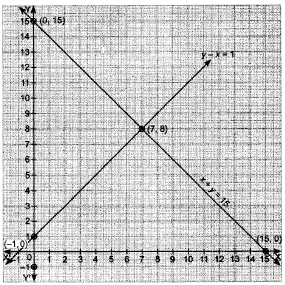
From graph x = 7, y= 8
{tex}\therefore{/tex} Number 10x + y = 10 {tex}\times{/tex}7 + 8 = 78
Posted by Vikas Goel 6 years, 7 months ago
- 1 answers
Sia ? 6 years, 7 months ago
The given equations are
4x + {tex}\frac{6}{y}{/tex} = 15 .......... (i)
6x - {tex}\frac{8}{y}{/tex} = 14 ......... (ii)
Multiply (i) by 3 and (ii) by 2 , we get
12x + {tex}\frac{18}{y}{/tex} = 45 ............(iii)
12x - {tex}\frac{16}{y}{/tex} = 28 ............(iv)
Subtracting (iii) and (iv), we get
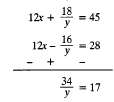
{tex}\Rightarrow{/tex} 2 = y
Put y = 2 in (i) , we get
4x + {tex}\frac{6}{2}{/tex} = 15
{tex}\Rightarrow{/tex}4x = 15 -3
{tex}\Rightarrow{/tex} 4x =12
{tex}\Rightarrow{/tex} x = {tex}\frac{12}{4}{/tex} = 3
Hence x = 3 and y = 2 is the solution of given system of equations.
Posted by Aniket Kashyap 6 years, 7 months ago
- 1 answers
Sia ? 6 years, 7 months ago
Get NCERT solutions here : <a href="https://mycbseguide.com/ncert-solutions.html">https://mycbseguide.com/ncert-solutions.html</a>
Posted by Manoj Sapkota 6 years, 7 months ago
- 1 answers
Sia ? 6 years, 7 months ago
Let n be any positive integer.
By Euclid's division lemma, n = 5q + r, 0{tex}\leqslant{/tex}r < 5
n = 5q,5q + 1,5q + 2 ,5q 4- 3 or 5q + 4, where q{tex}\in \omega{/tex}
Now we find the square of n
If n=5q then (5q)2 = 25q2= 5(5q2) = 5m
If n=5q+1then n2= (5q + 1 )2 = 25q2 + 10q + 1 = 5m + 1
If n=5q+2 then n2 = (5q + 2)2 = 25q2 + 20q + 4 = 5m + 4
If n=5q+4 then n2=(5q + 3)2=25q2+30q+9=5m + 1
Thus square of any positive integer is in the form of 5m,5m+1 or 5m+4, hence cannot be of the form 5m + 2 or 5m + 3.
Posted by Lakshya Pratap Singh 6 years, 8 months ago
- 1 answers
Puspendu Shekhar Panda 6 years, 8 months ago
Posted by Yaman Hussain 6 years, 8 months ago
- 0 answers
Posted by Khushi Singh 6 years, 8 months ago
- 5 answers
Posted by Sanket Gurnule 6 years, 4 months ago
- 1 answers
Sia ? 6 years, 4 months ago
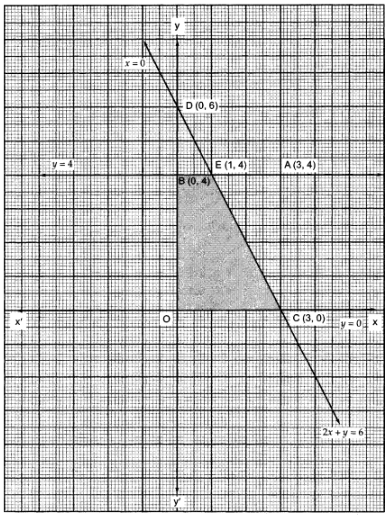
x = 0, y = 0, y = 4 and 2x + y = 6
Graph of the equation y = 4:
{tex}2x + y = 6{/tex}:
We have {tex}2x + y = 6{/tex}
When y = 0, we get x = 3 and x = 0 gives y = 6.
Thus, we obtain the following table giving coordinates of two points on the line represented by the equation {tex}2x + y = 6{/tex}.
| x | 3 | 0 |
| y | 0 | 6 |
The coordinates of its vertices are {tex}O (0,0), C (3,0), E (1,4)\ and\ B (0,4).{/tex}
Area of trapezium {tex}\operatorname { OCEB } = \frac { 1 } { 2 } ( O C + B E ) \times O B = \frac { 1 } { 2 } ( 3 + 1 ) \times 4 = 8 \mathrm { sq } . units{/tex}
Posted by Kunal Thåkkür Editing Market 6 years, 8 months ago
- 1 answers
Sia ? 6 years, 7 months ago
Get NCERT solutions here : <a href="https://mycbseguide.com/ncert-solutions.html">https://mycbseguide.com/ncert-solutions.html</a>
Posted by Sajjan Singh 6 years, 8 months ago
- 1 answers
Sia ? 6 years, 7 months ago
Get NCERT solutions here : https://mycbseguide.com/ncert-solutions.html
Posted by Sushant Rai 6 years, 8 months ago
- 0 answers
Posted by Uday Bhanushali 6 years, 8 months ago
- 3 answers
Prachi Janwani 6 years, 8 months ago
Posted by Beast Rana 6 years, 8 months ago
- 1 answers
Yogita Ingle 6 years, 8 months ago
Given √2 is irrational number.
Let √2 = a / b wher a,b are integers b ≠ 0
we also suppose that a / b is written in the simplest form
Now √2 = a / b ⇒ 2 = a2 / b2 ⇒ 2b2 = a2
∴ 2b2 is divisible by 2
⇒ a2 is divisible by 2
⇒ a is divisible by 2
∴ let a = 2c
a2 = 4c2 ⇒ 2b2 = 4c2 ⇒ b2 = 2c2
∴ 2c2 is divisible by 2
∴ b2 is divisible by 2
∴ b is divisible by 2
∴a are b are divisible by 2 .
this contradicts our supposition that a/b is written in the simplest form
Hence our supposition is wrong
∴ √2 is irrational number.
Posted by Vishal Choudhary 6 years, 8 months ago
- 4 answers
Posted by Rounak Katiyar 6 years, 8 months ago
- 1 answers
Posted by Sachin Yadav 6 years, 8 months ago
- 1 answers
Posted by Vansh Bansal 6 years, 7 months ago
- 1 answers
Sia ? 6 years, 7 months ago
We do not know whether {tex} \frac { a } { b } < \frac { a + 2 b } { a + b } \text { or, } \frac { a } { b } > \frac { a + 2 b } { a + b }{/tex}.
Therefore, to compare these two numbers, let us compute {tex} \frac { a } { b } - \frac { a + 2 b } { a + b }{/tex}
We have,
{tex} \frac { a } { b } - \frac { a + 2 b } { a + b } = \frac { a ( a + b ) - b ( a + 2 b ) } { b ( a + b ) }{/tex} {tex} = \frac { a ^ { 2 } + a b - a b - 2 b ^ { 2 } } { b ( a + b ) } = \frac { a ^ { 2 } - 2 b ^ { 2 } } { b ( a + b ) }{/tex}
{tex} \therefore \quad \frac { a } { b } - \frac { a + 2 b } { a + b } > 0{/tex}
{tex} \Rightarrow \quad \frac { a ^ { 2 } - 2 b ^ { 2 } } { b ( a + b ) } > 0{/tex}
{tex} \Rightarrow{/tex} a2 - 2b2 > 0
{tex} \Rightarrow{/tex} a2> 2b2
{tex} \Rightarrow \quad a > \sqrt { 2 } b{/tex}
and, {tex} \frac { a } { b } - \frac { a + 2 b } { a + b } < 0{/tex}
{tex} \Rightarrow \quad \frac { a ^ { 2 } - 2 b ^ { 2 } } { b ( a + b ) } < 0{/tex}
{tex} \Rightarrow{/tex} a2 - 2b2 < 0
{tex} \Rightarrow{/tex}a2 <2b2
{tex} \Rightarrow \quad a < \sqrt { 2 } b{/tex}
Thus, {tex} \frac { a } { b } > \frac { a + 2 b } { a + b }{/tex}, if {tex}a > \sqrt { 2 b }{/tex} and {tex} \frac { a } { b } < \frac { a + 2 b } { a + b }{/tex}, if {tex} a < \sqrt { 2 } b{/tex}.
So, we have the following cases:
CASE I When {tex} a > \sqrt { 2 } b{/tex}
In this case, we have
{tex} \frac { a } { b } > \frac { a + 2 b } { a + b } \text { i.e., } \frac { a + 2 b } { a + b } < \frac { a } { b }{/tex}
We have to prove that
{tex} \frac { a + 2 b } { a + b } < \sqrt { 2 } < \frac { a } { b }{/tex}
We have,
{tex} a > \sqrt { 2 } b{/tex}
{tex} \Rightarrow{/tex} a2> 2b2 [Adding a2 on both sides]
{tex} \Rightarrow \quad 2 a ^ { 2 } + 2 b ^ { 2 } > \left( a ^ { 2 } + 2 b ^ { 2 } \right) + 2 b ^ { 2 }{/tex} [Adding 2b2 on both sides]
{tex} \Rightarrow \quad 2 \left( a ^ { 2 } + b ^ { 2 } \right) + 4 a b > a ^ { 2 } + 4 b ^ { 2 } + 4 a b{/tex} [Adding 4ab on both sides]
{tex} \Rightarrow \quad 2 \left( a ^ { 2 } + 2 a b + b ^ { 2 } \right) > a ^ { 2 } + 4 a b + 4 b ^ { 2 }{/tex}
{tex} \Rightarrow \quad 2 ( a + b ) ^ { 2 } > ( a + 2 b ) ^ { 2 }{/tex}
{tex} \Rightarrow \quad \sqrt { 2 } ( a + b ) > a + 2 b{/tex}
{tex} \Rightarrow \quad \sqrt { 2 } > \frac { a + 2 b } { a + b }{/tex} ........(i)
Again,
{tex} a > \sqrt { 2 } b {/tex}
{tex}\Rightarrow \frac { a } { b } > \sqrt { 2 }{/tex} .......(ii)
From (i) and (ii), we get
{tex} \frac { a + 2 b } { a + b } < \sqrt { 2 } < \frac { a } { b }{/tex}
CASE II When {tex} a < \sqrt { 2 } b{/tex}
In this case, we have
{tex} \frac { a } { b } < \frac { a + 2 b } { a + b }{/tex}
We have to show that {tex} \frac { a } { b } < \sqrt { 2 } < \frac { a + 2 b } { a + b }{/tex}
We have,
{tex} a < \sqrt { 2 } b{/tex}
{tex} \Rightarrow \quad a ^ { 2 } < 2 b ^ { 2 }{/tex}
{tex} \Rightarrow \quad a ^ { 2 } + a ^ { 2 } < a ^ { 2 } + 2 b ^ { 2 }{/tex} [Adding a2 on both sides]
{tex} \Rightarrow \quad 2 a ^ { 2 } + 2 b ^ { 2 } < a ^ { 2 } + 2 b ^ { 2 }+ 2 b ^ { 2 }{/tex} [Adding 2b2 on both sides]
{tex}\Rightarrow \quad 2 a ^ { 2 } + 2 b ^ { 2 } < a ^ { 2 } + 4 b ^ { 2 }{/tex}
{tex} \Rightarrow \quad 2 a ^ { 2 } + 4 a b + 2 b ^ { 2 } < a ^ { 2 } + 4 a b + 4 b ^ { 2 }{/tex} [Adding 4ab on both sides]
{tex} \Rightarrow \quad 2 ( a + b ) ^ { 2 } < ( a + 2 b ) ^ { 2 }{/tex}
{tex} \Rightarrow \sqrt { 2 } ( a + b ) < a + 2 b{/tex}
{tex} \Rightarrow \quad \sqrt { 2 } < \frac { a + 2 b } { a + b }{/tex} . ...(iii)
{tex} \Rightarrow \quad a < \sqrt { 2 } b \Rightarrow \frac { a } { b } < \sqrt { 2 }{/tex} ....(iv)
From (iii) and (iv), we get
{tex} \frac { a } { b } < \sqrt { 2 } < \frac { a + 2 b } { a + b }{/tex}
Hence, {tex} \sqrt { 2 }{/tex} lies between {tex} \frac { a } { b }{/tex} and {tex} \frac { a + 2 b } { a + b }{/tex}.
Posted by Ayush Panda 6 years, 8 months ago
- 2 answers
Posted by Rishabh Raj 6 years, 8 months ago
- 0 answers
Posted by Ashish Singh 6 years, 8 months ago
- 1 answers
😀 😀 6 years, 8 months ago
Posted by Manjula K 6 years, 8 months ago
- 3 answers
Posted by Manjula K 6 years, 8 months ago
- 1 answers
Yogita Ingle 6 years, 8 months ago
AP , 2 , 7 , 12 , 17 , .........
a = 2 and d = 7 -2 = 5
a5 = a + 4d = 2 + 4(5) = 2 + 20 = 22
a10 = a + 9d = 2 + 9(5) = 2 + 45 = 47

myCBSEguide
Trusted by 1 Crore+ Students

Test Generator
Create papers online. It's FREE.

CUET Mock Tests
75,000+ questions to practice only on myCBSEguide app

Roli Gupta 6 years, 8 months ago
0Thank You