
Ask questions which are clear, concise and easy to understand.
Ask QuestionPosted by Sachin Kumar 6 years, 8 months ago
- 2 answers
Posted by Sachin Kumar 6 years, 7 months ago
- 1 answers
Sia ? 6 years, 7 months ago
Check the syllabus here : <a href="https://mycbseguide.com/cbse-syllabus.html">https://mycbseguide.com/cbse-syllabus.html</a>
Posted by Bunty Chaubey 6 years, 8 months ago
- 1 answers
Gaurav Seth 6 years, 8 months ago
If f(x) is a polynomial of degree n ≥ 1 and ‘a’ is any real number, then
- (x-a) is a factor of f(x) , if f(a)=0
- Its converse “ if (x-a) is a factor of the polynomial f(x), then f(a)=0”
In mathematics, factor theorem is used as a linking factor and zeros of the polynomial. Factor theorem is commonly used for factoring a polynomial and finding the roots of the polynomial equation.
Steps to Use Factor Theorem
Step 1 : If f(-c)=0, ( x+ c) is a factor of the polynomial f(x).
Step 2 : If p(d/c)= 0, (cx-d) is a factor of the polynomial f(x).
Step 3 : If p(-d/c)= 0, (cx+d) is a factor of the polynomial f(x).
Step 4 : If p(c)=0 and p(d) =0, then (x-c) and (x-d) is a factor of the polynomial.
Rather than finding the factors by using polynomial long division method, the best way to find the factors are factor theorem and synthetic division method. The factor theorem is mainly used to remove the known zeros from polynomials leaving all unknown zeros unimpaired, thus by finding the zeros easily to produce the lower degree polynomial.
Example:
Consider the polynomial function f(x)= x2 +2x -15
The values of x for which f(x)=0 are called the roots of the function. By solving the equation, f(x)=0
Then, we get
x2 +2x -15 =0
(x+5)(x-3)=0
(x+5)=0 or (x-3)=0
x = -5 or x = 3
Because (x+5) and (x-3) is a factor of x2 +2x -15, -5 and 3 are the solutions to the equation x2 +2x -15=0, we can also check as follows:
If x = -5 is the solution , then
f(x)= x2 +2x -15
f(-5) = (-5)2 + 2(-5) – 15
f(-5) = 25-10-15
f(-5)=25-25
f(-5)=0
If x=3 is the solution, them
f(x)= x2 +2x -15
f(3)= 32 +2(3) – 15
f(3) = 9 +6 -15
f(3) = 15-15
f(3)= 0
If the remainder is zero, (x-c) is a polynomial of f(x)
Posted by Shubham Singh 6 years, 8 months ago
- 2 answers
Gaurav Seth 6 years, 8 months ago
A polynomial looks like this:
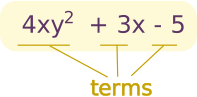 |
| example of a polynomial this one has 3 terms |
Polynomial comes from <i>poly-</i> (meaning "many") and <i>-nomial</i> (in this case meaning "term") ... so it means "many terms"
A polynomial can have:
| constants (like 3, −20, or ½) |
| variables (like <i>x</i> and <i>y</i>) |
| exponents (like the 2 in y2) |
Posted by Anuj Kathait 6 years, 8 months ago
- 1 answers
Bhavya Singh 6 years, 8 months ago
Posted by Om Kore 6 years, 7 months ago
- 1 answers
Sia ? 6 years, 7 months ago
Here {tex}a = 8,\ d = 3 - 8 = -5.{/tex}
So, Sn = {tex}\frac{n}{2}{/tex}[2a + (n - 1)d]
{tex}\Rightarrow{/tex} {tex}S_{n} = \frac n2(16 - 5n + 15) = \frac n2(31 - 5n){/tex}
Posted by Vijay Thakur 6 years, 7 months ago
- 1 answers
Sia ? 6 years, 7 months ago
Let the first term and the common difference of the AP be a and d respectively.
Given that, a17 = a10+7
{tex} \Rightarrow {/tex} a + (17 - 1) d = a + (10 - 1)d + 7 {tex}\because {/tex}an = a +(n - 1)d
{tex} \Rightarrow {/tex} a + 16d = a + 9d + 7
{tex} \Rightarrow {/tex} 16d - 9d = 7
{tex} \Rightarrow {/tex} 7d = 7
{tex} \Rightarrow d = \frac{7}{7} = 1{/tex}
Hence, the common difference is 1.
Posted by Anant Thapa 6 years, 8 months ago
- 2 answers
Honey ??? 6 years, 8 months ago
Posted by Rachana Solanki 6 years, 8 months ago
- 0 answers
Posted by Aryan Raj 6 years, 7 months ago
- 1 answers
Sia ? 6 years, 7 months ago
The zero of the polynomial is defined as any real value of x, for which the value of the polynomial becomes zero.
Posted by Swetha .... 6 years, 8 months ago
- 1 answers
Posted by Bheem Kumar 123456 6 years, 8 months ago
- 0 answers
Posted by Shalu Chaturvedi 6 years, 8 months ago
- 6 answers
Raunak ? Pandey ?? 6 years, 8 months ago
Posted by Priya Kumari 6 years, 8 months ago
- 0 answers
Posted by Rohan Ray Rohan 6 years, 8 months ago
- 2 answers
Posted by Mohit Shivhare 6 years, 7 months ago
- 1 answers
Sia ? 6 years, 7 months ago
{tex}2x + y = 6{/tex}
{tex}\Rightarrow y =-2x + 6{/tex}
| x | {tex}2{/tex} | {tex}4{/tex} |
| y | {tex}2{/tex} | {tex}-2{/tex} |
{tex}6x + 3y = 20{/tex}
{tex}\Rightarrow y = \frac {20-6x} { 3 }{/tex}
| x | {tex}0{/tex} | {tex}\frac{10}{3}{/tex} |
| y | {tex}\frac{20}{3}{/tex} | {tex}0{/tex} |
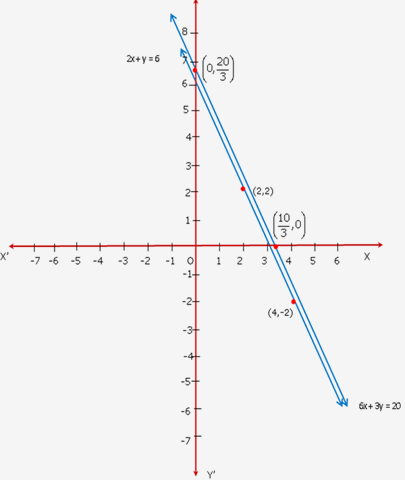
The graph of the system of equations is parallel lines {tex}\therefore{/tex} the system has no solution and hence is inconsistent.
Posted by Shardul Karanjkar 6 years, 8 months ago
- 0 answers
Posted by Akkib Sk Sk 6 years, 8 months ago
- 1 answers
Yogita Ingle 6 years, 8 months ago
(x-2)(x+1)=(x-1)(x+3)
x (x + 1) - 2( x+ 1) = x (x + 3) - 1 ( x + 3)
x2 + x - 2x - 2 = x2 + 3x - 1x - 3
x2 - x - 2 = x2 + 2 x - 3
- x - 2x = -3 + 2
- 3x = -1
x = 1/3
Posted by Vidisha Sachdev 6 years, 8 months ago
- 0 answers
Posted by Aman Toppo 6 years, 8 months ago
- 1 answers
Posted by Mandeep Kharb 6 years, 8 months ago
- 0 answers
Posted by Tulshiram Pawar 6 years, 7 months ago
- 1 answers
Sia ? 6 years, 7 months ago
On dividing x4 - 6x3 - 16x2 - 25x + 10 by x2 - 2x + k
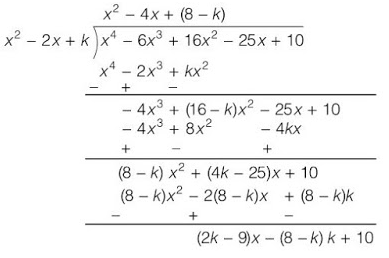
{tex}\therefore{/tex} Remainder = (2k - 9)x - (8 - k)k + 10
But the remainder is given as x+a.
On comparing their coefficients,
2k - 9 = 1
{tex}\Rightarrow{/tex} k = 10
{tex}\Rightarrow{/tex} k = 5 and,
-(8 - k)k + 10 = a
{tex}\Rightarrow{/tex} a = -(8 - 5)5 + 10 = -15 + 10 = -5
Hence, k = 5 and a = -5
Posted by Ch Sharaz Ahmed 6 years, 8 months ago
- 2 answers
Student Student 6 years, 8 months ago
Posted by Parveen Kumar 6 years, 8 months ago
- 2 answers
Posted by Priyanshi Jat 6 years, 8 months ago
- 2 answers
Posted by Parminder Singh 6 years, 8 months ago
- 1 answers

myCBSEguide
Trusted by 1 Crore+ Students

Test Generator
Create papers online. It's FREE.

CUET Mock Tests
75,000+ questions to practice only on myCBSEguide app

Shrikant Kumar 6 years, 8 months ago
0Thank You