
Ask questions which are clear, concise and easy to understand.
Ask QuestionPosted by Aashu Sharma 6 years, 7 months ago
- 1 answers
Posted by Yash Singh 6 years, 8 months ago
- 1 answers
Gaurav Seth 6 years, 8 months ago
Answer:
< q <
Step-by-step explanation:
First we need to analyze the problem in order to build our equations.
If "a" and "b" are two POSITIVE integers, this means that:
Now, our condition is that:
"q" and "r" being unique integers, also called constant numbers.
Our last condition is that "b" is greater than "a", meaning:
--------------------------------------------------------------------------------------
With this information we can conclude that if:
and
then,
Replacing a on the inequation:
On the other side:
In conclusion, "q" is dependent on "r" and "b".
Posted by Pragnil Savjani 6 years, 8 months ago
- 2 answers
Yogita Ingle 6 years, 8 months ago
2x+3=5
2x = 5 - 3
2x = 2
x = 2 ......... (i)
3x+3y=8 ........ (ii)
Put (i) in (ii) , we get
3(2) + 3y = 8
6 + 3y = 8
3y = 8 - 6
3y = 2
y = 2/3
Posted by Priya Yadav 6 years, 8 months ago
- 1 answers
Pavan Saxena 6 years, 8 months ago
Posted by Sanket Arjun 6 years, 8 months ago
- 1 answers
Pavan Saxena 6 years, 8 months ago
Posted by Raunak ? Pandey ?? 6 years, 8 months ago
- 2 answers
अनुराग त्रिपाठी ... 6 years, 8 months ago
Posted by Anant Thapa 6 years, 8 months ago
- 0 answers
Posted by Sarim Ansari 6 years, 7 months ago
- 1 answers
Sia ? 6 years, 7 months ago
- deg p(x) = deg q(x)
{tex}p ( x ) = 2 x ^ { 2 } - 2 x + 14{/tex}
g(x) = 2
q(x) = x2 - x + 7
r(x) = 0
Clearly, p(x) = q(x) {tex} \times {/tex} g(x) + r(x) - deg q(x) = deg r(x)
{tex}p ( x ) = x ^ { 3 } + x ^ { 2 } + x + 1{/tex}
{tex}g ( x ) = x ^ { 2 } - 1{/tex}
q(x) = x + 1
r(x) = 2x + 2
Clearly, {tex}p ( x ) = q ( x ) \times g ( x ) + r ( x ){/tex}
Posted by Anant Thapa 6 years, 7 months ago
- 1 answers
Sia ? 6 years, 7 months ago
According to the question, S5 + S7 = 167
{tex}\Rightarrow \frac{5}{2}[2 a+4 d]+\frac{7}{2}{/tex}[ 2a + 6d] = 167
{tex}\Rightarrow{/tex} 5(a + 2d) + 7(a + 3d) = 167
{tex}\Rightarrow{/tex} 12a + 31d = 167 ......(i)
and S10 = 235
{tex}\Rightarrow \quad \frac{10}{2}{/tex}[2a + 9d] = 235
{tex}\Rightarrow{/tex} 2a + 9d = {tex}\frac{235}{5}{/tex} = 47 ........(ii)
Multiplying eq. (ii) by 6 and then subtracting from (i), we have
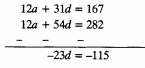
d = {tex}\frac{-115}{-23}{/tex} = 5
From (ii), we get
2a + 9d = 47
{tex}\Rightarrow{/tex} 2a + 9(5) = 47
{tex}\Rightarrow{/tex} 2a = 47 - 45
{tex}\Rightarrow{/tex} 2a = 2 {tex}\Rightarrow{/tex} a = 1
Therefore, A.P is 1, (1 + 5), (1 + 5 + 5), (1 + 5+ 5+ 5)........
i.e, 1, 6, 11, 16......
Posted by Anant Thapa 6 years, 7 months ago
- 1 answers
Sia ? 6 years, 7 months ago
We have,
a4 = 0
{tex}a + 3d = 0{/tex}
{tex}3d = -a{/tex}
or {tex}-3d = a{/tex}..........(i)
Now,
a25 = {tex}a + 24d{/tex}
= {tex}-3d + 24d{/tex} [Putting value of a from eq(i)]
= {tex}21d{/tex}...........(ii)
a11 = {tex}a + 10d{/tex}
= {tex}-3d + 10d{/tex}
= {tex}7d{/tex}.........(iii)
From eq(ii) and (iii), we get
a25 = 21 d
a25 = 3(7d)
a25 = 3a11
Hence Proved
Posted by Anant Thapa 6 years, 8 months ago
- 0 answers
Posted by Aryan Dhritlahare 6 years, 4 months ago
- 1 answers
Sia ? 6 years, 4 months ago
We have, kx(x - 2) + 6 = 0
{tex}\Rightarrow k x^{2}-2 k x+6=0{/tex}........(1)
We know that quadratic equation {tex}ax^2+bx+c=0{/tex},a≠0, has equal roots if its discriminant D is 0.
D = 0
{tex}\Rightarrow{/tex}{tex}b^2-4ac=0{/tex}
{tex}\Rightarrow{/tex}4k2 - 4(k)6 = 0 [from given quad. equ.(1); a=k≠0, b= -2k, c= 6]
{tex}\Rightarrow{/tex}4k2 - 24k = 0
{tex}\Rightarrow{/tex}4k(k - 6) = 0
{tex}\Rightarrow{/tex}k - 6 = 0 [ since, k≠0]
{tex}\Rightarrow{/tex}k = 6
Hence the value of K is 6.
Posted by Anant Thapa 6 years, 4 months ago
- 1 answers
Sia ? 6 years, 4 months ago
The 4th term of an A.P. is three times the first term "a" and the 7th term exceeds twice the third term by 1.
Now we have,
a4 = 3a
{tex}\Rightarrow{/tex} a + (4 - 1)d = 3a
{tex}\Rightarrow{/tex}a + 3d - 3a = 0
{tex}\Rightarrow{/tex}-2a + 3d = 0............(i)
and,a7=2a3+1
{tex}\implies{/tex} a7 - 2a3 = 1
{tex}\Rightarrow{/tex} a+ (7 - 1)d -2[a + (3 - 1)d] = 1
{tex}\Rightarrow{/tex} a + 6d - 2[a + 2d] = 1
{tex}\Rightarrow{/tex} a + 6d - 2a - 4d = 1
{tex}\Rightarrow{/tex} -a + 2d = 1 (multiplying by 2 both sides)
{tex}\Rightarrow{/tex} -2a + 4d = 2..........(ii)
Subtracting equation (i) from (ii),
(-2a + 4d) - (-2a + 3d) = 2 - 0
{tex}\Rightarrow{/tex} -2a + 4d + 2a - 3d = 2
{tex}\Rightarrow{/tex} d = 2
Put the value of d in (i)
-2a + 3{tex}\times{/tex} 2 = 0
{tex}\Rightarrow{/tex} -2a = -6
{tex}\Rightarrow \quad a = \frac { - 6 } { - 2 } = 3{/tex}
Therefore, First term a = 3 and Common difference d = 2
Posted by Anant Thapa 6 years, 8 months ago
- 0 answers
Posted by Anant Thapa 6 years, 8 months ago
- 0 answers
Posted by Anant Thapa 6 years, 4 months ago
- 1 answers
Sia ? 6 years, 4 months ago
Here a11 =38 and a16 =73
Using formula a n =a +(n−1)d, to find nth term of arithmetic progression,
38=a +(11−1) (d) And 73=a +(16−1)(d)
⇒ 38=a +10d And 73=a +15d
These are equations consisting of two variables.
We have, 38=a +10d ⇒ a =38−10d
Let us put value of a in equation (73=a +15d),
73=38−10d +15d ⇒ 35=5d
Therefore, Common difference =d =7
Putting value of d in equation 38=a +10d ,
38=a +70 ⇒ a =−32
Therefore, common difference = d = 7 and First term = a = -32
Using formula a n =a +(n−1)d , to find nth term of arithmetic progression,
a31=-32+(31−1)(7) =−32+210=178
Therefore, 31st term of AP is 178.
Posted by Vishal Thakur 6 years, 8 months ago
- 0 answers
Posted by Pranjal Singh 6 years, 8 months ago
- 0 answers
Posted by Radhey Chauhan 6 years, 8 months ago
- 0 answers
Posted by Krushna Khandare 6 years, 4 months ago
- 1 answers
Sia ? 6 years, 4 months ago
Let x = 2p + 1 and y = 2q + 1
{tex}\therefore \quad x ^ { 2 } + y ^ { 2 } = ( 2 p + 1 ) ^ { 2 } + ( 2 q + 1 ) ^ { 2 }{/tex}
{tex}= 4 p ^ { 2 } + 4 p + 1 + 4 q ^ { 2 } + 4 q + 1{/tex}
{tex}= 4 \left( p ^ { 2 } + q ^ { 2 } + p + q \right) + 2{/tex}
{tex}= 2 \left( 2 p ^ { 2 } + 2 q ^ { 2 } + 2 p + 2 q + 1 \right){/tex}
{tex}= 2 m \quad \text { where } m = \left( 2 p ^ { 2 } + 2 q ^ { 2 } + 2 p + 2 q + 1 \right){/tex}
{tex}\therefore \quad x ^ { 2 } + y ^ { 2 }{/tex} is an even number but not divisible by 4.
Posted by Raveena Rajesh 6 years, 8 months ago
- 1 answers
Posted by Gagan Shankar 6 years, 8 months ago
- 0 answers
Posted by Sristee Kapil 6 years, 8 months ago
- 2 answers
Posted by Srinidhi Palaniandi 6 years, 8 months ago
- 0 answers
Posted by Nurul Islam 6 years, 8 months ago
- 0 answers
Posted by Sambhav Rajput 6 years, 8 months ago
- 1 answers
Posted by Gracy Mehar 6 years, 8 months ago
- 1 answers
Yogita Ingle 6 years, 8 months ago
2x = 5y + 4
2x - 5y = 4..... (i)
3x - 2y + 6 = 0
3x - 2y = -6 ......... (ii)
Multiply (i) by 3 and (ii) by 2
6x - 15y = 12....... (iii)
6x - 4y = - 12 .......(iv)
Subtract (iv) from (iii)
- 11y = 24
y = -24/11
Put y = -24/11 in (ii) we get
3x - 2(-24/11) = -6
3x + 48/11 = -6
3x = - 6 - 48/11
3x = -144/11
x = - 38/11
Posted by Salma Gaur 6 years, 8 months ago
- 0 answers

myCBSEguide
Trusted by 1 Crore+ Students

Test Generator
Create papers online. It's FREE.

CUET Mock Tests
75,000+ questions to practice only on myCBSEguide app

Sia ? 6 years, 7 months ago
x + 2y = 5......(1)
or, 2y = 5 - x
or, {tex}y = \frac { 5 - x } { 2 }{/tex}
When x = 1, we have y = 2
When x =3, we have y = 1
When x = 5, we have y = 0
Thus, we have the following table given points on the line x + 2y = 5
2x -3y = - 4.......(2)
-3y = - 4 - 2x
or -3y = -(4 + 2x)
or, {tex}y = \frac { 2 x + 4 } { 3 }{/tex}
When x = 1, we have y = 2
When x = 4, we have y = 4
When x = -2, we have y = 0
Thus we have the following table giving points on the line 2x - 3y = -4
Graph of the given equations x+ 2y = 5 and 2x - 3y = - 4 is as given below:
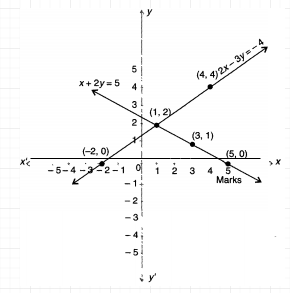
Lines meet x-axis at (5,0) and (- 2 0) respectively.
0Thank You