
Ask questions which are clear, concise and easy to understand.
Ask QuestionPosted by Raunak ??? 6 years, 8 months ago
- 5 answers
Raunak ??? 6 years, 8 months ago
Posted by Ritik Kushwaha 6 years, 8 months ago
- 0 answers
Posted by Harsh Rathore 6 years, 8 months ago
- 1 answers
Posted by Gaurav Pandey 6 years, 8 months ago
- 1 answers
Posted by Aryan Chandra 6 years, 8 months ago
- 0 answers
Posted by Aanchal ????? 6 years, 8 months ago
- 3 answers
Posted by Ramniwash Yadav 6 years, 8 months ago
- 0 answers
Posted by Jashan Khraud 6 years, 8 months ago
- 0 answers
Posted by Brijkishor Singh 6 years, 8 months ago
- 1 answers
Posted by Atharva Amrutkar 6 years, 8 months ago
- 4 answers
Yogita Ingle 6 years, 8 months ago
Step:1 Since 420 > 130 we apply the division lemma to 420 and 130 to get ,
420 = 130 x 3 + 30
Step:2 Since 30 ≠ 0 , we apply the division lemma to 130 and 30 to get
130 = 30 x 4 + 10
Step:3 Since 10 ≠ 0 , we apply the division lemma to 30 and 10 to get
30 = 10 x 3 + 0
The remainder has now become zero, so our procedure stops. Since the divisor at this Step is 10, the HCF of 420 and 130 is 10.
Posted by Shiri Sengar 6 years, 8 months ago
- 1 answers
Posted by Shrianshika Saini 6 years, 8 months ago
- 2 answers
Yogita Ingle 6 years, 8 months ago
An integer can be generated by multiplying the two smallest positive integers and it contains at least one divisor other than one and itself is called a composite number. Each positive <a href="https://byjus.com/maths/integers/">integers</a> is either prime, composite or the unit 1. Composite numbers are the numbers that are neither prime nor unit .
Example : 4( factors are 1, 2 and 4)
Posted by Abhijeet Yadav 6 years, 8 months ago
- 3 answers
Yogita Ingle 6 years, 8 months ago
15 = 3×5
24 = 2×2×2×3
12 = 2×2×3
Lcm = 120
The greatest 4 digit no. Is 9999
Dividing lcm by 9999 we get remainder as 39
9999-39=9960
The answer is 9960
Abhijeet Yadav 6 years, 8 months ago
Posted by Sachin Kumar 6 years, 8 months ago
- 1 answers
Posted by Anjali Mer 6 years, 8 months ago
- 3 answers

Posted by Khamkhanmung Simte 6 years, 8 months ago
- 1 answers
Gaurav Seth 6 years, 8 months ago
We have given that
4th term of an A.P.= a4 = 0
∴ a + (4 – 1)d = 0
∴ a + 3d = 0
∴ a = –3d ….(1)
25th term of an A.P. = a25
= a + (25 – 1)d
= –3d + 24d ….[From the equation (1)]
= 21d
3 times 11th term of an A.P. = 3a11
= 3[a + (11 – 1)d]
= 3[a + 10d]
= 3[–3d + 10d]
= 3 × 7d
= 21d
∴ a25 = 3a11
i.e., the 25th term of the A.P. is three times its 11th term.
Posted by Arpit Singh 6 years, 8 months ago
- 2 answers
Mahesh Mishra 6 years, 8 months ago
Posted by Abhi Rai 6 years, 8 months ago
- 0 answers
Posted by Akhil . 6 years, 7 months ago
- 1 answers
Sia ? 6 years, 7 months ago
Let {tex}\alpha,\beta{/tex} be the zeros of the polynomial {tex}f(x)=x^2-8x+k{/tex}.
Sum of zeroes = {tex} \alpha + \beta = - \left( \frac { - 8 } { 1 } \right) = 8{/tex} and, Product of zeroes = {tex} \alpha \beta = \frac { k } { 1 } = k{/tex}
Now,
{tex} \alpha ^ { 2 } + \beta ^ { 2 } = 40{/tex}
{tex} \Rightarrow \alpha ^ { 2 } + \beta ^ { 2 }+2 \alpha\beta-2 \alpha\beta= 40{/tex}
{tex} \Rightarrow \quad ( \alpha + \beta ) ^ { 2 } - 2 \alpha \beta = 40{/tex}
{tex} \Rightarrow \quad 8 ^ { 2 } - 2 k = 40{/tex}
{tex} \Rightarrow \quad 2 k = 64 - 40 {/tex}
{tex}\Rightarrow 2 k = 24 {/tex}
{tex}\Rightarrow k = 12{/tex}
Posted by Mystery Gal 6 years, 7 months ago
- 1 answers
Sia ? 6 years, 7 months ago
Let a be the first term and d be the common difference of the given AP.
Now a4=a+(4-1)d
{tex}\implies{/tex}a4=a+3d.
And, a17=a+(17-1)d
{tex}\implies{/tex}a17= a+16d.
Then,
T4=a+3d and T17= a+16d
Now, {tex}\frac { T _ { 4 } } { T _ { 17 } } = \frac { 1 } { 5 }{/tex}
{tex}\Rightarrow \frac { a + 3 d } { a + 16 d } = \frac { 1 } { 5 }{/tex}
{tex}\Rightarrow{/tex} 5a+15d=a+16d
{tex}\implies{/tex}5a-a+15d-16d=0
{tex}\Rightarrow{/tex} 4a-d=0
{tex}\Rightarrow{/tex} 4a=d....(i)
Also, S7=182
Where ,S7={tex}\frac {7}2 [{2a+(7-1)d}]{/tex}
{tex}\Rightarrow \frac { 7 } { 2 } [ 2 a + 6 d ] = 182{/tex}
{tex}\Rightarrow \frac { 7 \times 2 } { 2 } [ a + 3 d ] = 182{/tex}
{tex}\Rightarrow{/tex} a+3d=26
{tex}\Rightarrow{/tex} a+3(4a)=26...[from (i)]
{tex}\Rightarrow{/tex} 13a=26
{tex}\Rightarrow{/tex} a=2
{tex}\Rightarrow{/tex} d=4(2)=8
Thus, We have
T1 = 2
T2 = T1 + d = 2 + 8 = 10
T3 = T1 + 2d = 2 + 2(8) = 2 + 16 = 18
T4 = T1 + 3d = 2 + 3(8) = 2 + 24 = 26
Thus, the given AP is 2,10,18,26,...
Posted by Harsh Raj 6 years, 7 months ago
- 1 answers
Sia ? 6 years, 7 months ago
If g(x)=x2 + 2x + k is a factor of f(x) = 2x4 + x3 - 14x2 + 5x + 6
Then remainder is zero when f(x) is divided by g(x)
Let quotient =Q and remainder =R
Let us now divide f(x) by gx)

R = x(7k + 21) + (2k2 + 8k + 6) -------(1)
and Q = 2x2 - 3x - 2(k + 4).------------(2)
{tex}\Rightarrow{/tex}x (7k + 21) + 2 (k2 + 4k + 3) = 0
{tex}\Rightarrow{/tex}7k + 21 = 0 and k2 + 4k + 3 = 0
{tex}\Rightarrow{/tex} 7(k + 3) = 0 and (k + 1) (k + 3) = 0
{tex}\Rightarrow{/tex} k + 3 = 0
{tex}\Rightarrow{/tex}k = -3
Substituting the value of k in the divider x2 + 2x + k, we obtain: x2 + 2x - 3 = (x + 3) (x - 1) as the divisor.
Hence two zeros of g(x) are -3 and 1.------(3)
Putting k=-3 in (2) we get
Q = 2x2 - 3x - 2
= 2x2 - 4x + x - 2
= 2x(x - 2) + 1 (x - 2)
= (x - 2)(2x + 1)
Q=0 if x-2=0 or 2x+1=0
So other two zeros of f(x) are 2 and -{tex}\frac12{/tex}-------(4)
As g(x) is a factor of f(x) so zeros of G(x) are zeros of f(x) also
Hence from (3) and (4) we get
The zeros of f(x) are: -3 ,1,, 2 and {tex}\frac12{/tex}
Posted by Rohan Kaushik 6 years, 8 months ago
- 0 answers
Posted by Yashika Jindal 6 years, 7 months ago
- 1 answers
Sia ? 6 years, 7 months ago
We will find zeroes of p(x) which are not the zeroes of q(x) by using Factor theorem and Euclid’s division algorithm.
By factor theorem if q(x) is a factor of p(x), then r(x) must be zero.
p(x) = x5 – x4 – 4x3 + 3x2 + 3x + b
q(x) = x3 + 2x2 + a
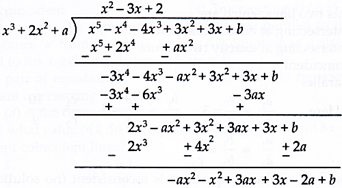
So, by factor theorem remainder must be zero i.e.,
r(x) = 0
Value of r(x) is - ax2 - x2 + 3ax + 3x - 2a + b .
- ax2 - x2 + 3ax + 3x - 2a + b = 0x2 + 0x + 0
⇒ -(a + 1)x2 + (3a + 3)x + (b – 2a) = 0x2 + 0x + 0
Comparing the coefficients of x2, x and constant. on both sides, we get
-(a + 1) = 0 and 3a + 3 = 0 and b – 2a = 0
a + 1 = 0
a = -1
and 3a + 3 = 0
3a = - 3
a = -1
Put a = -1 in b - 2a = 0
Then b – 2(-1) = 0
⇒ b + 2 = 0
⇒ b = -2
For a = -1 and b = -2, zeroes of q(x) will be zeroes of p(x).
For zeroes of p(x), p(x) = 0
⇒ (x3 + 2x2 + a)(x2 – 3x + 2) = 0 [∵ a = -1]
⇒ [x3 + 2x2 – 1][x2 – 2x – 1x + 2] =0
⇒ (x3 + 2x2 – 1)[x(x – 2) – 1(x – 2) = 0
⇒ (x3 + 2x2 – 1) (x – 2) (x – 1) = 0
⇒ (x – 2) = 0 and (x – 1) = 0
⇒ x = 2 and x = 1
Hence, x = 2 and 1 are not the zeroes of q(x).
Posted by Sanju Dhull 6 years, 7 months ago
- 1 answers
Sia ? 6 years, 7 months ago
We need to find the H.C.F. of 506 and 1155 and express it as a linear combination of 506 and 1155.
By applying Euclid’s division lemma
1155 = 506 {tex}\times{/tex} 2 + 143.
506 = 143 {tex}\times{/tex} 3 + 77.
143 = 77 {tex}\times{/tex} 1 + 66.
77 = 66 {tex}\times{/tex} 1 + 11.
66 = 11 {tex}\times{/tex} 6 + 0.
Therefore, H.C.F. = 11.
Now, 11 = 77 - 66 {tex}\times{/tex} 1 = 77 - [143 - 77 {tex}\times{/tex} 1] {tex}\times{/tex} 1 {∵ 143 = 77 {tex}\times{/tex} 1 + 66}
= 77 - 143 {tex}\times{/tex} 1 + 77 {tex}\times{/tex} 1
= 77 {tex}\times{/tex} 2 - 143 {tex}\times{/tex} 1
= [506 - 143 {tex}\times{/tex} 3] {tex}\times{/tex} 2 - 143 {tex}\times{/tex} 1 {∵ 506 = 143 {tex}\times{/tex} 3 + 77 }
= 506 {tex}\times{/tex} 2 - 143 {tex}\times{/tex} 6 - 143 {tex}\times{/tex} 1
= 506 {tex}\times{/tex} 2 - 143 {tex}\times{/tex} 7
= 506 {tex}\times{/tex} 2 - [1155 - 506 {tex}\times{/tex} 2] {tex}\times{/tex} 7 {∵1155 = 506 {tex}\times{/tex} 2 + 143 }
= 506 {tex}\times{/tex} 2 - 1155 {tex}\times{/tex} 7 + 506 {tex}\times{/tex} 14
= 506 {tex}\times{/tex} 16 - 1155 {tex}\times{/tex} 7
Hence obtained.
Posted by Jsbsisb Nsisbsei 6 years, 7 months ago
- 1 answers
Sia ? 6 years, 7 months ago
For no solution,
{tex}\frac { a _ { 1 } } { a _ { 2 } } = \frac { b _ { 1 } } { b _ { 2 } } \neq \frac { c _ { 1 } } { c _ { 2 } }{/tex} {tex}\Rightarrow{/tex} {tex}\frac{k}{5}{/tex} = {tex}\frac{2}{-3}{/tex} {tex}\ne{/tex} {tex}\frac{-1}{2}{/tex}
{tex}\Rightarrow{/tex} k = {tex}\frac{-10}{3}{/tex}
Posted by Sachin Narwariya 6 years, 8 months ago
- 1 answers
Yashika Jindal 6 years, 8 months ago

myCBSEguide
Trusted by 1 Crore+ Students

Test Generator
Create papers online. It's FREE.

CUET Mock Tests
75,000+ questions to practice only on myCBSEguide app

Bestie Sahiba. ??? 6 years, 8 months ago
0Thank You