
Ask questions which are clear, concise and easy to understand.
Ask QuestionPosted by Ash Angel 7 years, 9 months ago
- 5 answers
Posted by Sahnaaz Khan 7 years, 9 months ago
- 7 answers
Posted by Deepak Sharma 7 years, 9 months ago
- 3 answers
Mayank Bhunia 7 years, 9 months ago
Posted by Sourav Barnwal 7 years, 9 months ago
- 3 answers
Mayank Sahu 7 years, 9 months ago
Posted by Sharmishta Sharma 7 years, 9 months ago
- 5 answers
Mohit Chaudhary 7 years, 9 months ago
Posted by Pavan Pandey 6 years, 5 months ago
- 1 answers
Sia ? 6 years, 5 months ago
Let us assume that <m:omath><m:r>√</m:r></m:omath>3 is rational.
That is, we can find integers a and b (<m:omath><m:r>≠0)</m:r></m:omath> such that a and b are co-prime
{tex}\style{font-family:Arial}{\begin{array}{l}\sqrt3=\frac ab\\b\sqrt3=a\\on\;squaring\;both\;sides\;we\;get\\3b^2=a^2\end{array}}{/tex}
Therefore, a2 is divisible by 3,
it follows that a is also divisible by 3.
So, we can write a = 3c for some integer c.
Substituting for a, we get 3b2 = 9c2, that is, b2 = 3c2
This means that b2 is divisible by 3, and so b is also divisible by 3
Therefore, a and b have at least 3 as a common factor.
But this contradicts the fact that a and b are co-prime.
This contradiction has arisen because of our incorrect assumption that <m:omath><m:r>√</m:r></m:omath>3 is rational.
So, we conclude that <m:omath><m:r>√</m:r></m:omath>3 is irrational.
Posted by Sharad Gumber 7 years, 9 months ago
- 4 answers
Posted by Durgesh Singh 7 years, 9 months ago
- 1 answers
Posted by Yasir Hussain 7 years, 9 months ago
- 1 answers
Posted by Cutiee Princess 7 years, 9 months ago
- 0 answers
Posted by Cutiee Princess 6 years, 5 months ago
- 1 answers
Sia ? 6 years, 5 months ago
In {tex}\triangle {/tex}ABC, BD {tex} \bot {/tex} AC
{tex}\therefore {/tex} In right {tex}\triangle {/tex} ADB, BD2 = AB2 - AD2 ...........(i)
In right {tex}\triangle {/tex} BDC, CD2=BC2-BD2 .............(ii)
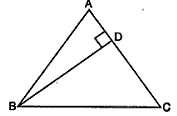
Subtracting (ii) from (i) we get
BD2 - CD2 = AB2 - AD2 - BC2 + BD2
= AC2 - AD2 - BC2 + BD2
= (AD + CD)2 - AD2 - BC2 + BD2 [AB = AC, Given]
=(CD2 + BD2) - BC2 + 2AD.CD [AC = AD + CD]
= BC2 - BC2 + AD.CD [CD2+BD2 = BC2]
=2AD.CD Proved
Posted by Juberiya Zaheer 6 years, 5 months ago
- 1 answers
Sia ? 6 years, 5 months ago
Since both the spheres are made of same metal, their weights are directly proportional to their volumes, or the ratio of their volumes is equal to the ratio of their weights.
Radius of first small sphere, r1 = 3 cm.
Let the radius of second small sphere be r2 cm.
{tex}\therefore \quad \frac { \text { volume of first small sphere } } { \text { volume of second small sphere } } = \frac { 1 } { 7 }{/tex}
{tex}\Rightarrow \frac { \frac { 4 } { 3 } \pi r _ { 1 } ^ { 3 } } { \frac { 4 } { 3 } \pi r _ { 2 } ^ { 3 } } = \frac { 1 } { 7 } \Rightarrow \frac { 3 ^ { 3 } } { r _ { 2 } ^ { 3 } } = \frac { 1 } { 7 } \Rightarrow r _ { 2 } ^ { 3 } = 27 \times 7 = 189.{/tex}
Sum of volumes of two small spheres
{tex}= \frac { 4 } { 3 } \pi \left( r _ { 1 } ^ { 3 } + r _ { 2 } ^ { 3 } \right) = \left[ \frac { 4 } { 3 } \pi \left( 3 ^ { 3 } + 189 \right) \right] \mathrm { cm } ^ { 3 }{/tex}
{tex}= \left( \frac { 4 } { 3 } \pi \times 216 \right) \mathrm { cm } ^ { 3 }{/tex}
Let the radius of the new sphere be R.
Volume of new sphere = sum of volumes of two small spheres
{tex}\Rightarrow \frac { 4 } { 3 } \pi R ^ { 3 } = \frac { 4 } { 3 } \pi \times 216 \Rightarrow R ^ { 3 } = 216{/tex}
{tex}\Rightarrow R = \sqrt [ 3 ] { 216 } = 6 \mathrm { cm }{/tex} {tex}\Rightarrow{/tex} diameter = 2R = 12cm.
Posted by Cutiee Princess 6 years, 5 months ago
- 1 answers
Sia ? 6 years, 5 months ago
Let the number of students be x and the number of rows be y.
Number of students in each row = {tex}x\over y{/tex}
According to the question, when one student is extra in each row, there are 2 rows less i.e., when each row has {tex}\left( \frac { x } { y } + 1 \right){/tex} students, the number of rows is {tex}(y - 2).{/tex}
{tex}\therefore{/tex} Total number of students = No. of rows {tex}\times{/tex}No. of students in each row
{tex}\Rightarrow x = \left( \frac { x } { y } + 1 \right) ( y - 2 ){/tex}
{tex}\Rightarrow x = x - \frac { 2 x } { y } + y - 2 {/tex}
{tex}\Rightarrow - \frac { 2 x } { y } + y - 2 = 0{/tex}....(i)
According to the question, If one student is less in each row, then there are 3 rows more i.e., when each row has {tex}\left( \frac { x } { y } - 1 \right){/tex}students, the number of rows is {tex} (y + 3).{/tex}
{tex}\therefore{/tex} Total number of students = No. of rows {tex}\times{/tex}No. of students in each row
{tex}\Rightarrow x = \left( \frac { x } { y } - 1 \right) ( y + 3 )\\ \Rightarrow x = x + \frac { 3 x } { y } - y - 3 {/tex}
{tex}\Rightarrow \frac { 3 x } { y } - y - 3 = 0{/tex}....(ii)
Putting {tex}\frac { x } { y } = u{/tex} in equation (i) and equation (ii), we get
{tex}\Rightarrow{/tex} -2{tex}u{/tex}+ {tex}y{/tex} {tex}-2=0 {/tex} ...(iii)
{tex}\Rightarrow{/tex} 3{tex}u{/tex} - {tex}y{/tex}{tex}- 3=0{/tex} .....(iv)
Adding (iii) and (iv), we get
{tex}\Rightarrow u - 5 = 0\\ \Rightarrow u = 5{/tex}
Putting u in eq.(iii), we get
{tex}\Rightarrow -10 + y -2 = 0 {/tex}
{tex}\Rightarrow y =12{/tex}
Now, Substituting u value, we get
{tex}\Rightarrow \frac { x } { y } = 5\\ \Rightarrow \frac { x } { 12 } = 5\\ \Rightarrow x = 60{/tex}
Therefore, the number of students in the class is 60.
Posted by Isha Rana 7 years, 9 months ago
- 1 answers
Posted by Gunjan Negi 6 years, 5 months ago
- 1 answers
Sia ? 6 years, 5 months ago
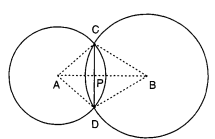
Since tangent at a point to a circle is perpendicular to the radius through the point of contact. Therefore, {tex}\angle A C B{/tex} = 90°
In {tex}\Delta A C B{/tex}, we have
AB2 = AC2 + BC2 [By Pythagoras Theorem]
{tex}\Rightarrow{/tex} AB2 = 32 + 42 = 9 + 16 = 25
AB = 5 cm
Since the line joining the centres of two intersecting circles is perpendicular bisector of their common chord.
{tex}\therefore \quad A P \perp C D{/tex}
and {tex}C P = P D{/tex}
Let AP = x. Then, BP = AB - AP = 5 - x cm (AB = 5cm)
Further, let CP = DP = y cm.
In ∆ APC and ∆ BPC applying Pythagoras theorem, we have
AC2 = A P2 + PC2, BC2 = PB2 + PC2
{tex}\Rightarrow \quad{/tex} 32 = x2 + y2 ......(1)
and, 42 = (5 - x)2 + y2......(2)
Subtracting equation (1) from equation (2) , we get :-
{tex}\Rightarrow{/tex} 42 - 32 = {(5 - x)2 + y2} - {x2 + y2}
{tex}\Rightarrow{/tex} 7 = 25 - 10x
{tex}\Rightarrow{/tex} 10x = 18 {tex}\Rightarrow{/tex} x = 1.8 cm
Now, substituting x = 1.8 in equation (1) , we get :-
32 = (1.8)2 + y2
{tex}\Rightarrow{/tex} y = {tex}\sqrt { 9 - ( 1.8 ) ^ { 2 } } = \sqrt { 5.76 } = 2.4 \mathrm { cm }{/tex}
Hence, common chord CD = 2CP = 2y = 4.8 cm. Ans.
Posted by Ritika Satpathy 7 years, 9 months ago
- 0 answers
Posted by Love Punjabi 7 years, 9 months ago
- 5 answers
Posted by Ayush Sharma 7 years, 9 months ago
- 1 answers
Posted by Rahul Kavital 6 years, 5 months ago
- 1 answers
Sia ? 6 years, 5 months ago
Given,
tan A = n tan B
{tex} \Rightarrow{/tex} tanB = {tex}\frac{1}{n}{/tex}tan A
{tex}\Rightarrow{/tex} cotB = {tex}\frac { n } { \tan A }{/tex}..........(1)
Also given,
sin A = m sin B
{tex}\Rightarrow{/tex} sin B = {tex}\frac{1}{m}{/tex}sin A
{tex}\Rightarrow{/tex} cosec B = {tex}\frac { m } { \sin A }{/tex}.....(2)
We know that, cosec2B - cot2B = 1, hence from (1) & (2) :-
{tex} \quad \frac { m ^ { 2 } } { \sin ^ { 2 } A } - \frac { n ^ { 2 } } { \tan ^ { 2 } A } = 1{/tex}
{tex}\Rightarrow \quad \frac { m ^ { 2 } } { \sin ^ { 2 } A } - \frac { n ^ { 2 } \cos ^ { 2 } A } { \sin ^ { 2 } A } = 1{/tex}
{tex}\Rightarrow \quad \frac { m ^ { 2 } - n ^ { 2 } \cos ^ { 2 } A } { \sin ^ { 2 } A } = 1{/tex}
{tex}\Rightarrow{/tex} m2 - n2cos2A = sin2A
{tex}\Rightarrow{/tex} m2 - n2cos2A = 1 - cos2A
{tex}\Rightarrow{/tex} m2 - 1 = n2cos2A - cos2A
{tex}\Rightarrow{/tex} m2 - 1 = (n2 - 1) cos2A
{tex}\Rightarrow \quad \frac { m ^ { 2 } - 1 } { n ^ { 2 } - 1 } ={/tex} cos2A
Posted by Love Punjabi 7 years, 9 months ago
- 3 answers
Posted by Love Punjabi 7 years, 9 months ago
- 8 answers
Posted by Love Punjabi 7 years, 9 months ago
- 3 answers
Posted by Amarkanta Meitei 7 years, 9 months ago
- 1 answers
Amarkanta Meitei 7 years, 9 months ago
Posted by Nivedita Pandey 6 years, 5 months ago
- 1 answers
Sia ? 6 years, 5 months ago
Let the denominator be y, then numerators = y - 3
So the fraction be {tex}\frac { y - 3 } { y }{/tex}
By the given condition, new fraction = {tex}\frac { y - 3 + 2 } { y + 2 }{/tex}
{tex}= \frac { y- 1 } { y+ 2 }{/tex}
{tex}\frac { y - 3 } { y } + \frac { y - 1 } { y + 2 } = \frac { 29 } { 20 }{/tex}
{tex}\frac {( y - 3 ) ( y + 2 ) + y ( y - 1 ) }{y(y+2)}= \frac{29}{20}{/tex}
{tex}\ 20 [ ( y - 3 ) ( y + 2 ) + y ( y - 1 ) ] = 29 \left( y ^ { 2 } + 2 y \right){/tex}
{tex}\ 20 [ ( y^2-3y+2y-6)+(y^2-y)] = 29 \left( y ^ { 2 } + 2 y \right){/tex}
{tex}20 \left( y ^ { 2 } - y - 6 + y ^ { 2 } - y \right) = 29 y ^ { 2 } + 58 y{/tex}
{tex}20 \left( 2y^2-2y-6 \right) = 29 y ^ { 2 } + 58 y{/tex}
{tex}11 y ^ { 2 } - 98 y - 120 = 0{/tex}
{tex}11 y ^ { 2 } - 110 y + 12 y - 120 = 0{/tex}
{tex}( 11 y + 12 ) ( y - 10 ) = 0 {/tex}
{tex} \therefore y = 10{/tex}
{tex}\therefore {/tex} The fraction is {tex}\frac { 7 } { 10 }{/tex}
Posted by Kshitiz Sharma 7 years, 9 months ago
- 5 answers

myCBSEguide
Trusted by 1 Crore+ Students

Test Generator
Create papers online. It's FREE.

CUET Mock Tests
75,000+ questions to practice only on myCBSEguide app

Risky Girl Sonali Singh 7 years, 9 months ago
0Thank You