
Ask questions which are clear, concise and easy to understand.
Ask QuestionPosted by Riy Sandipan 7 years, 7 months ago
- 1 answers
Posted by Mansi - 7 years, 7 months ago
- 2 answers
Posted by Purnima Kushwaha 6 years, 4 months ago
- 1 answers
Sia ? 6 years, 4 months ago
5x2 - 6x - 2 = 0
Multiplying the above equation by 1/5
{tex} \Rightarrow {x^2} - \frac{6}{5}x - \frac{2}{5} = 0{/tex}
{tex}\Rightarrow x ^ { 2 } - \frac { 6 } { 5 } x + \left( \frac { 3 } { 5 } \right) ^ { 2 } - \left( \frac { 3 } { 5 } \right) ^ { 2 } - \frac { 2 } { 5 } = 0{/tex}
{tex}\Rightarrow \left( x - \frac { 3 } { 5 } \right) ^ { 2 } = \frac { 9 } { 25 } + \frac { 2 } { 5 }{/tex}
{tex}\Rightarrow \left( x - \frac { 3 } { 5 } \right) ^ { 2 } = \frac { 9 + 10 } { 25 }{/tex}
{tex}\Rightarrow \left( x - \frac { 3 } { 5 } \right) ^ { 2 } = \frac { 19 } { 25 }{/tex}
{tex}\Rightarrow x - \frac { 3 } { 5 } = \pm \frac { \sqrt { 19 } } { 5 }{/tex}
{tex}\Rightarrow x = \frac { 3 } { 5 } \pm \frac { \sqrt { 19 } } { 5 }{/tex}
{tex}\Rightarrow x = \frac { 3 + \sqrt { 19 } } { 5 } \text { or } x = \frac { 3 - \sqrt { 19 } } { 5 }{/tex}
Posted by Fahad Mallick 7 years, 7 months ago
- 1 answers
Posted by Sajidha Amrutharaj 5 years, 8 months ago
- 0 answers
Posted by Devang Kumar 6 years, 4 months ago
- 1 answers
Sia ? 6 years, 4 months ago
Zero of a polynomial is a solution to the polynomial equation, P(x) = 0 but Root of a polynomial is that value of x that makes the polynomial equal to 0.
Posted by Afreen Qureshi 6 years, 4 months ago
- 1 answers
Sia ? 6 years, 4 months ago
{tex}x - y - 5 = 0{/tex}
{tex}\Rightarrow y = x - 5{/tex}
| x | 2 | 5 |
| y | -3 | 0 |
{tex}3x + 5y - 15 = 0{/tex}
{tex}\Rightarrow y = \frac { 15 - 3 x } { 5 }{/tex}
| x | 0 | 5 |
| y | 3 | 0 |
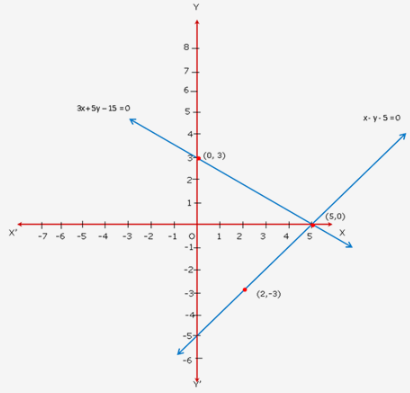
Thus, the two graph lines intersect at {tex}(5, 0){/tex}
{tex}\therefore{/tex} {tex}x = 5\ and\ y = 0{/tex} is the solution of given system of equations
The vertices of the triangle formed by these lines and y - axis are {tex}(5, 0), (0, 3)\ and\ (0, -5){/tex}
So, height of the triangle
= distance from (5, 0) to x-axis
= {tex}5\ units{/tex}
Base = {tex}8\ units{/tex}
Area of the triangle = {tex}\frac { 1 } { 2 } \times \text { base } \times \text{height}{/tex}
{tex}= \frac { 1 } { 2 } \times 8 \times 5{/tex}
= {tex}20\ sq. units{/tex}
Posted by Apurv Popat 7 years, 7 months ago
- 0 answers
Posted by Harsh Anand 7 years, 7 months ago
- 0 answers
Posted by Subhra Banerjee 7 years, 7 months ago
- 1 answers
Posted by Gurmeen Kaur Uppal 7 years, 7 months ago
- 2 answers
Kanak Patidar 7 years, 7 months ago
Gayatri Jagtap 7 years, 7 months ago
Posted by Shriya ?? 7 years, 7 months ago
- 1 answers
Subhra Banerjee 7 years, 7 months ago
Posted by Umang Gupta 7 years, 7 months ago
- 2 answers
Posted by Sameer Sameer 7 years, 7 months ago
- 1 answers
Rachit Dwivedi 7 years, 7 months ago
Posted by Samarth Jain 7 years, 7 months ago
- 6 answers
Aastha Virmani 7 years, 7 months ago
Yukti Saini 7 years, 7 months ago
Yash Pratap Singh 7 years, 7 months ago
Charu Sharma 7 years, 7 months ago
Posted by Kiran Dangwal 7 years, 7 months ago
- 1 answers
Posted by Vikas Rathore 7 years, 7 months ago
- 0 answers
Posted by Bhavya Sethi 6 years, 4 months ago
- 1 answers
Sia ? 6 years, 4 months ago
Suppose, the digit at units and tens place of the given number be x and y respectively.
{tex}\therefore{/tex} the number is {tex}10y + x{/tex}
After interchanging the digits, the number becomes {tex}10x + y{/tex}
Given: The sum of the numbers obtained by interchanging the digits and the original number is 66.
Thus, {tex}(10x + y) + (10y + x) =66{/tex}
{tex}\Rightarrow{/tex} {tex}10x + y + 10y + x = 66{/tex}
{tex}\Rightarrow{/tex} {tex}11x +11y =66{/tex}
{tex}\Rightarrow{/tex} {tex}11(x + y) = 66{/tex}
{tex}\Rightarrow x + y = \frac{{66}}{{11}}{/tex}
{tex}\Rightarrow{/tex} {tex}x + y = 6{/tex} .....(i)
Also given, the two digits of the number are differing by 2.
{tex}\therefore{/tex} we have {tex}x - y = ±2{/tex}....(ii)
So, we have two systems of simultaneous equations,
{tex}x - y = 2, \;x + y = 6{/tex}
{tex}x - y = -2, \;x + y = 6{/tex}
Here x and y are unknowns. We have to solve the above systems of equations for x and y.
- First, we solve the system
{tex}x - y = 2{/tex}
x + y = 6
Adding the two equations,
{tex}\Rightarrow(x - y) + (x + y) = 2 + 6{/tex}
{tex}\Rightarrow{/tex} {tex}x - y + x + y = 8{/tex}
{tex}\Rightarrow{/tex} {tex}2x = 8{/tex}
{tex}\Rightarrow x = \frac{8}{2} {/tex}
{tex}\Rightarrow{/tex} {tex}x = 4{/tex}
Substituting the value of x in the first equation, we have
{tex}4 - y = 2{/tex}
{tex}\Rightarrow{/tex} {tex}y = 4 - 2{/tex}
{tex}\Rightarrow{/tex} {tex}y = 2{/tex}
Hence, the number is 10 {tex}\times{/tex} 2 + 4 = 24 - Now, we solve the system
{tex}x - y= -2{/tex}
{tex}x + y = 6{/tex}
Adding the two equations, we have
{tex}(x - y) + (x + y) = -2 + 6{/tex}
{tex}\Rightarrow{/tex} {tex}x - y + x + y = 4{/tex}
{tex}\Rightarrow{/tex} {tex}2x = 4{/tex}
{tex}\Rightarrow x = \frac{4}{2} {/tex}
{tex}\Rightarrow{/tex} x = 2
Substituting the value of x in the first equation,
{tex}\Rightarrow2 - y = -2{/tex}
{tex}\Rightarrow{/tex} {tex}y = 2 + 2{/tex}
{tex}\Rightarrow{/tex} y = 4
Hence, the number is 10 {tex}\times{/tex} 4 + 2 = 42
Thus, the two numbers are 24 and 42.
Posted by Bhavya Sethi 7 years, 7 months ago
- 1 answers
Posted by Nishi Tiwari 7 years, 7 months ago
- 6 answers
Posted by Gowtham Gowtham 7 years, 7 months ago
- 3 answers
Posted by Sunder Kumar 7 years, 7 months ago
- 1 answers
Posted by Anandhu Krishna 6 years, 4 months ago
- 1 answers
Sia ? 6 years, 4 months ago
We have, abx2 + (b2 -ac) x-bc = 0
{tex}\implies{/tex}abx2 + b2 x - acx - bc = 0
{tex}\implies{/tex}bx ( ax+b) - c (ax + b) = 0
{tex}\implies{/tex}(ax + b) (bx - c) = 0
Either ax+b = 0 or bx - c = 0
{tex}\implies x = -{b \over a},\, {c \over b}{/tex}
Hence, {tex}x = -{b \over a},\, {c \over b}{/tex} are the required solutions.

myCBSEguide
Trusted by 1 Crore+ Students

Test Generator
Create papers online. It's FREE.

CUET Mock Tests
75,000+ questions to practice only on myCBSEguide app

K.Vinay Theja Vinay 7 years, 7 months ago
0Thank You