
Ask questions which are clear, concise and easy to understand.
Ask QuestionPosted by Abhijeet Singh Gaur 7 years, 7 months ago
- 3 answers
Posted by Abhijeet Singh Gaur 7 years, 7 months ago
- 2 answers
..... ...... 7 years, 7 months ago
Posted by Aditya Singh 7 years, 7 months ago
- 1 answers
Posted by Pragya . 6 years, 4 months ago
- 1 answers
Sia ? 6 years, 4 months ago
We have,
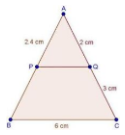
According to the question,we are given that,
{tex}P Q \| B C{/tex}
Therefore, by thales theorem,
We have,
{tex}\frac { A P } { P B } = \frac { A Q } { Q C }{/tex}
{tex}\frac { 2.4 } { P B } = \frac { 2 } { 3 }{/tex}
{tex}\Rightarrow P B = \frac { 3 \times 2.4 } { 2 }{/tex}
{tex}= \frac { 3 \times 24 } { 20 }{/tex}
{tex}= \frac { 3 \times 6 } { 5 }{/tex}
{tex}= \frac { 18 } { 5 }{/tex}
{tex}\Rightarrow{/tex} PB = 3.6 cm
Now, AB = AP + PB
= 2.4 + 3.6
= 6 cm
In {tex}\triangle {/tex}APQ and {tex}\triangle{/tex}ABC
{tex}\angle A = \angle A{/tex} [Common]
{tex}\angle A P Q = \angle A B C{/tex} [{tex}\because{/tex} PQ || BC {tex}\Rightarrow{/tex} Corresponding angles are equal]
{tex}\Rightarrow \triangle A P Q \sim \triangle A B C{/tex} [By AA criteria]
{tex}\Rightarrow \frac { A B } { A P } = \frac { B C } { P Q }{/tex} [Corresponding sides of similar triangles are proportional]
{tex}\Rightarrow \frac { 6 } { 2.4 } = \frac { 6 } { P Q }{/tex}
{tex}\Rightarrow P Q = \frac { 6 \times 2.4 } { 6 }{/tex}
{tex}\Rightarrow{/tex} PQ = 2.4 cm
Hence, AB = 6 cm and PQ = 2.4 cm
Posted by Tarun Yadav 6 years, 4 months ago
- 1 answers
Sia ? 6 years, 4 months ago
On long division of 6x4 + 8x3 + 17x2 + 21x + 7 by 3x2 + 4x + 1 we get

Quotient = 2x2 + 5, remainder = x + 2
Posted by Kunal Zinjade 7 years, 7 months ago
- 0 answers
Posted by Kunal Zinjade 7 years, 7 months ago
- 0 answers
Posted by Senthil Balusamy 7 years, 7 months ago
- 3 answers
Posted by Shriya ?? 7 years, 7 months ago
- 3 answers
Unnati Pragya 7 years, 7 months ago
Posted by Ayush Raj 6 years, 4 months ago
- 1 answers
Sia ? 6 years, 4 months ago
Let the speed of the boat in still water be x km/hr and speed of the stream be y km/hr.
Then,
Speed of the boat while going upstream = (x - y)km/hr
Speed of the boat while going downstream = (x + y) km/hr
Also we know that, time taken to cover ' d ' Km with speed ' s ' Km/hr is {tex} \frac ds{/tex}
Hence,Time taken by the boat to cover 12 km upstream = {tex}\frac{12}{x-y}{/tex}hrs
And,Time taken by the boat to cover 40 km downstream = {tex}\frac{40}{x+y}{/tex}hrs
According to the question, Total time taken = 8 hrs
{tex}\therefore \frac { 12 } { x - y } + \frac { 40 } { x + y } = 8{/tex}.........(1)
Again, time taken by the boat to cover 16 km upstream = {tex}\frac{16}{x-y}{/tex}
And,Time taken by the boat to cover 32 km downstream = {tex}\frac{32}{x+y}{/tex}
According to the question,Total time taken = 8 hrs
{tex}\therefore\frac { 16 } { ( x - y ) } + \frac { 32 } { ( x + y ) } = 8{/tex}.........(2)
Putting {tex}\frac { 1 } { ( x - y ) } = u{/tex} and {tex}\frac { 1 } {( x + y ) } = v{/tex} in equation (1) & equation (2), so that we may get linear equations in the variables u & v as following :-
12u + 40v = 8
{tex}\Rightarrow{/tex} 3u + 10v = 2........(3)
and
16u + 32v = 8
{tex}\Rightarrow{/tex}2u + 4v = 1.........(4)
Multiplying equation (3) by 4 and equation (4) by 10, we get ;
12u + 40v = 8..........(5)
20u + 40v = 10........(6)
Subtracting equation (5) from equation (6), we get
{tex}8u = 2 \Rightarrow u = \frac { 1 } { 4 }{/tex}
Putting u = {tex}\frac 14{/tex} in equation (3), we get
{tex}3 \times \frac { 1 } { 4 } + 10 v = 2 \Rightarrow 10 v = \frac { 5 } { 4 } \Rightarrow v = \frac { 1 } { 8 }{/tex}
{tex}u = \frac { 1 } { 4 } \Rightarrow \frac { 1 } { x - y } = \frac { 1 } { 4 } \Rightarrow x - y = 4{/tex}.....(7)
{tex}v = \frac { 1 } { 8 } \Rightarrow \frac { 1 } { x + y } = \frac { 1 } { 8 } \Rightarrow x + y = 8{/tex}......(8)
On adding (7) and (8), we get
2x = 12
{tex}\Rightarrow{/tex}x = 6
Putting x = 6 in (8), we get
6 + y = 8
{tex}\Rightarrow{/tex}y = 8 - 6 = 2
{tex}\therefore{/tex} x = 6, y = 2
Hence, the speed of the boat in still water = 6 km/hr and speed of the stream = 2 km/hr
Posted by Arjun Arjun 6 years, 4 months ago
- 1 answers
Sia ? 6 years, 4 months ago
We know that, for a square matrix of order n,
|adj (A) |= |A|n-1
Here, the order of A is 3{tex}\times {/tex}3 ,therefore n = 3
Now, |adj (A) | =|A|{tex}^{3-1}{/tex} = |A|2
Given, |adj (A)|= 64,
Therefore,64 =|A|2
{tex}\Rightarrow{/tex} (8)2 =|A|2
{tex}\Rightarrow{/tex} |A|= ± 8 [taking square root]
Posted by Mohd Hussain 7 years, 7 months ago
- 1 answers
Himesh Baraik 7 years, 7 months ago
Posted by Jagseer Singh 7 years, 7 months ago
- 1 answers
Aayush Gautam 7 years, 7 months ago
Posted by Rakshitha Rakshitha 7 years, 7 months ago
- 2 answers
Abhinav Sharma 7 years, 7 months ago
Posted by Aakriti Sah 7 years, 7 months ago
- 2 answers
Posted by Vivek Kumar 5 years, 8 months ago
- 2 answers
Tarun Anand 7 years, 7 months ago
Posted by Archana Rani 7 years, 7 months ago
- 2 answers
Common Debbarma 7 years, 7 months ago
Posted by K J 7 years, 7 months ago
- 1 answers
Posted by Pallavi Jha 6 years, 4 months ago
- 1 answers
Sia ? 6 years, 4 months ago
We have, {tex}4x^2 + 4 \sqrt3 x + 3 = 0{/tex}
{tex}\implies (2x)^2 + 2 (2x) (\sqrt3) + (\sqrt3)^2 = 0{/tex}
{tex}\implies (2x + \sqrt3)^2 = 0{/tex}
{tex}\implies 2x + \sqrt3 = 0,\, 2x + \sqrt3 = 0{/tex}
{tex}\implies x = -{\sqrt3 \over 2},\, -{\sqrt3 \over2}{/tex}
{tex}\therefore x = -{\sqrt3 \over 2},\, -{\sqrt3 \over2}{/tex} are the required roots.
Posted by Lalit Kumar 7 years, 7 months ago
- 1 answers
Mansi - 7 years, 7 months ago
Posted by Kaushal Joshi 7 years, 7 months ago
- 6 answers
Unnati Pragya 7 years, 7 months ago
Posted by Sanjana Sharma 7 years, 7 months ago
- 0 answers
Posted by Siddhi Dube 6 years, 4 months ago
- 1 answers
Posted by Shreya Prasad 7 years, 7 months ago
- 1 answers
Posted by Ritik Kumar Singh 7 years, 7 months ago
- 2 answers
Pallavi Jha 7 years, 7 months ago
Mansi - 7 years, 7 months ago
Posted by Unnati Pragya 6 years, 4 months ago
- 1 answers
Sia ? 6 years, 4 months ago
f(x) = x4 + 4x2 + 6
= (x2)2 + 4x2 + 6
Let x2 =n,
Then, f(x) = n2 + 4n + 6,
Here a=1,b=4,c=6
The discriminant(D) = {tex}\text{b}^2-4\mathrm{ac}=\;(4)^2-4\times1\times6=16-24=-8{/tex}
Since the discriminant is negative so this polynomial has no zeros
Hence, f(x) = x4 + 4x2 + 6 has no zero.
Posted by Sukumar Sukumar 7 years, 7 months ago
- 1 answers
Posted by Agrima Singh 7 years, 7 months ago
- 0 answers

myCBSEguide
Trusted by 1 Crore+ Students

Test Generator
Create papers online. It's FREE.

CUET Mock Tests
75,000+ questions to practice only on myCBSEguide app

Himesh Baraik 7 years, 7 months ago
3Thank You