
Ask questions which are clear, concise and easy to understand.
Ask QuestionPosted by Radha Mishra 4 years, 5 months ago
- 1 answers
Sia ? 4 years, 5 months ago
Make notes using abbreviation and summarize i. Education is not an end, but a means to an end. ... It is not enough just to choose the first system of education one finds, or to continue with one's old system ofeducation without examining it to see whether it in fact, is suitable or not.
Posted by Subhajit Das 4 years, 5 months ago
- 1 answers
Posted by Krishna C Rathva 4 years, 5 months ago
- 1 answers
Sia ? 4 years, 5 months ago
The use of the devising a realistic and bound plan are very much important, to execute a plan successfully. When there are important projects to be done, then there should always be given a stipulated time period, which is used for keeping track of the details.
Posted by Jeevagarni R 4 years, 5 months ago
- 1 answers
Sia ? 4 years, 5 months ago
Communication is the nerve system of an organisation. It is generally observed that managers face several problems due to communication breakdowns or barriers.
The various types of Barriers to effective communication are:
- Semantic Barriers: It is the branch of linguistics dealing with the meaning of words and sentences. These are the barriers concerned with the wrong encoding and decoding of messages. The following are the semantic barriers:
- Badly Expressed Message
- Words or Symbols with Different Meanings
- Faulty Translations
- Unclarified assumptions
- Technical jargons
- Psychological Barriers: Emotional or psychological factors act as barriers to communicators. It is concerned with the state of mind of the sender as well as the receiver. e.g. A worried person cannot communicate properly and an angry receiver cannot understand the meaning of the message. The following are the psychological barriers:
- Premature evaluation
- Lack of attention
- Distrust
- Loss by Transmission and poor retention
- Organizational Barriers: The factors related to organization structure, authority, relationships, rules, and regulations may, sometimes, act as barriers to effective communication. Some of the organizational barriers are:
- Organizational policy and complexity in organisational structure
- Rules and Regulations
- Status
- Organisational facility
- Personal Barriers: The personal factors of both the sender and receiver may exert influence on effective communication. Some of the personal barriers are:
- Fear of challenge to authority
- Lack of confidence of superior on his subordinate
- Unwillingness to communicate
- Lack of proper incentive
Measures for Improving the Effectiveness of Communication are:
- Clarifying the ideas before communication: The entire message should be studied in-depth, analyzed and stated in such a manner that it is clearly conveyed to subordinates.
- Communicate according to the needs of the receiver: A sender should adjust his communication according to the education and intelligence of the receiver.
- Consult others before communicating: Before actually communicating the message, it is better to involve others in developing a plan for communication.
- Be aware of language, tone, and content of the message:
- The content of the message, tone, language used, the manner in which the message is to be communicated, are the important aspects of effective communication.
- The language used should be clear, simple, easily understandable to the receiver and should not offend the sentiments of listeners. The message should be stimulating to evoke a response from the listeners.
Posted by Aditya Sharma 4 years, 5 months ago
- 2 answers
Sahitya Rathore 4 years, 5 months ago
Posted by Sakshi Kumari 4 years, 5 months ago
- 0 answers
Posted by Mayuresh Sonawane 4 years, 5 months ago
- 0 answers
Posted by Prachi Sethy 4 years, 5 months ago
- 5 answers
Aman Thapa Class 9Th A 4 years, 5 months ago
Posted by Kiran Meena 4 years, 5 months ago
- 5 answers
Posted by Anshi Garg 4 years, 5 months ago
- 0 answers
Posted by Anshi Garg 4 years, 5 months ago
- 1 answers
Posted by Anil Jaithalia 4 years, 5 months ago
- 3 answers
Posted by Lomashkumar Sahu 4 years, 5 months ago
- 0 answers
Posted by Nishant Kumar 4 years, 5 months ago
- 0 answers
Posted by Laksh Manorkar 4 years, 5 months ago
- 0 answers
Posted by Aditi Verma 4 years, 5 months ago
- 0 answers
Posted by Isha Gohil 4 years, 5 months ago
- 2 answers
Posted by Saransh Tiwari 4 years, 5 months ago
- 2 answers
Abhay Dubey 4 years, 5 months ago
Saransh Tiwari 4 years, 5 months ago
Posted by Vikrant Singh 4 years, 5 months ago
- 1 answers
Kartik Yadav 4 years, 5 months ago
Posted by Gopika Patadia 4 years, 5 months ago
- 3 answers
Posted by Khushi Dhillon 4 years, 5 months ago
- 1 answers
Sia ? 4 years, 5 months ago
Given: A square ABCD.
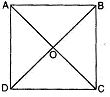
To Prove : (i) AC = BD and (ii) Diagonals bisect each other at right angles.
Proof :
- In {tex}\triangle{/tex}ADB and {tex}\triangle{/tex}BCA, we have
AD = BC ...[As sides of a square are equal]
{tex}\angle{/tex}BAD = {tex}\angle{/tex}ABC ...[All interior angles are of 90o]
AB = BA ...[Common]
{tex}\triangle{/tex}ADB {tex}\cong{/tex} {tex}\triangle{/tex}BCA ...[By SAS rule]
AC = BD ...[c.p.c.t.] - Now in {tex}\triangle{/tex}AOB and {tex}\triangle{/tex}COD, we have
AB = CD ...[Sides of a square]
{tex}\angle{/tex}AOB = {tex}\angle{/tex}COD ...[Vertically opp. angles]
{tex}\angle{/tex}OBA = {tex}\angle{/tex}ODC ...[Alternate interior angles are equal]
{tex}\triangle{/tex}AOB {tex}\cong{/tex} {tex}\triangle{/tex}COD ...[By ASA rule]
OA = OC and OB = OD ...[c.p.c.t.] ...(1)
Now consider {tex}\triangle{/tex}s AOD and COD.
AD = CD ...[Sides of square]
OA = OC ...[As proved above]
OD = OD ...[Common]
{tex}\triangle{/tex}AOD {tex}\cong{/tex} {tex}\triangle{/tex}COD ...[By SSS rule]
{tex}\angle{/tex}AOD = {tex}\angle{/tex}COD ...[c.p.c.t.]
But {tex}\angle{/tex}AOD + {tex}\angle{/tex}COD = 180° ...[linear pair]
or {tex}\angle{/tex}AOD + {tex}\angle{/tex}AOD = 180° ...[As {tex}\angle{/tex}AOD = {tex}\angle{/tex}COD]
or 2{tex}\angle{/tex}AOD = 180° {tex}\therefore{/tex} {tex}\angle{/tex}AOD = 90° ...(2)
From equation (1) and (2) it is clear that diagonals of a square bisect each other at right angles.

myCBSEguide
Trusted by 1 Crore+ Students

Test Generator
Create papers online. It's FREE.

CUET Mock Tests
75,000+ questions to practice only on myCBSEguide app
