
Ask questions which are clear, concise and easy to understand.
Ask QuestionPosted by Devendra Choudhary 4 years, 5 months ago
- 0 answers
Posted by Parineeti Singh 4 years, 5 months ago
- 2 answers
Param Sidhu 4 years, 4 months ago
Posted by Riya Patil 4 years, 5 months ago
- 0 answers
Posted by Hiya Tayal 4 years, 5 months ago
- 1 answers
Posted by Atharva Dum 4 years, 5 months ago
- 5 answers
Rishika Rawat 4 years, 5 months ago
Posted by Kalla Singh 4 years, 5 months ago
- 5 answers
Posted by Aryan Sahare 4 years, 5 months ago
- 1 answers
Posted by Priyanka Kumari 4 years, 5 months ago
- 4 answers
Vishal Singh 4 years, 5 months ago
Dnyan Khambadkar 4 years, 5 months ago
Rishika Rawat 4 years, 5 months ago
Naveen Sharma 4 years, 5 months ago
Posted by Usha Suresh 4 years, 5 months ago
- 3 answers
Vishal Singh 4 years, 5 months ago
Smrity Verma 4 years, 5 months ago
Posted by Arush Shukla 4 years, 5 months ago
- 3 answers
Tejas .... 4 years, 5 months ago
Himanshi Goyal 4 years, 5 months ago
Posted by Disha Arora 4 years, 5 months ago
- 1 answers
Sia ? 4 years, 5 months ago
My Childhood” is an extract taken from the biography of APJ Abdul Kalam - ‘Wings of Fire’. He was a great scientist and also the 14th President of India. He was born in a middle - class Muslim family in 1931 in the island town of Rameswaram, Tamil Nadu. In his childhood he was greatly influenced by his parents, his teachers and his friends. His father, Jainulabdeen, was not highly educated but he was a generous and kind person. He was not rich but provided a secure childhood to Abdul and his siblings. Abdul inherited honesty and self-discipline from his father and faith in goodness and deep kindness from his mother.Kalam earned his first wages by working as a helping hand to his cousin, Samsuddin, who distributed newspapers in Rameswaram.In his childhood he had three close friends- Ramanadha Sastry,Aravindam and Sivaprakashan. Once when he was in fifth standard, a new teacher asked him not to sit in the front row along with the high caste Brahmin boys. Abdul found Ramanadha Sastry weeping as he went to the last row. This made a lasting impression on Abdul.Abdul was also greatly influenced by his science teacher, Sivasubramania Iyer. He learnt the lesson of breaking social barriers from him. Iyer invited him to his home for a meal. His wife refused to serve food to a Muslim boy in her pure kitchen. Iyer served him with his own hands and sat down beside him to eat his meal. He convinced his wife to serve meal with her own hands and thus was successful in changing her conservative attitude.For higher education, Abdul Kalam sought permission from his father to leave Rameswaram and study at the district headquarters in Ramanathapuram. His father said that Abdul had to go a long way in life just like a seagull bird which flies long distances. He calmed down APJ’s reluctant mother by quoting Kahlil Gibran’s poem ‘Your children’. He said that her children could not be dominated by her because they had their own thoughts. They did not belong to her but were a result of life’s desire for itself. He asked her to give them freedom to fulfil their thoughts.
Posted by Vibhansh Tiwari 4 years, 5 months ago
- 1 answers
Posted by Bhairavi Chaubey 4 years, 5 months ago
- 1 answers
Posted by Harsh Rekha 4 years, 5 months ago
- 0 answers
Posted by Jatin Nandal 4 years, 5 months ago
- 2 answers
Posted by Arun Yadav 4 years, 5 months ago
- 1 answers
Sia ? 4 years, 5 months ago
ICT skills are about understanding and applying a range of computer programmes, software and other applications. These include: word processing, spreadsheets, databases, power points and search engines.
Posted by Sanjana Sharma 4 years, 5 months ago
- 4 answers
Sweety Yadav 4 years, 5 months ago
Riya Mishra 4 years, 5 months ago
Posted by Sanjana Sharma 4 years, 5 months ago
- 2 answers
Posted by Vipul Jaisal 4 years, 5 months ago
- 0 answers
Posted by Manya Gupta 4 years, 5 months ago
- 4 answers
Posted by Sukriti Shyam 4 years, 5 months ago
- 1 answers
Sia ? 4 years, 5 months ago
In {tex}\triangle{/tex}ABC,
BP bisects {tex}\angle{/tex}ABC
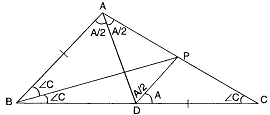
{tex}\therefore{/tex} {tex}\angle{/tex}ABP = {tex}\angle{/tex}PBC = {tex}\frac{1}{2}{/tex}{tex}\angle{/tex}B ={tex}\frac{1}{2}{/tex}(2{tex}\angle{/tex}C) = {tex}\angle{/tex}C . . . . (1)
In PBC,
{tex}\therefore{/tex} {tex}\angle{/tex}PBC = {tex}\angle{/tex}PCB (= ∠C)
{tex}\therefore{/tex} PB = PC . . . [Sides opposite to equal angles] . . .(2)
In {tex}\triangle{/tex}APB and {tex}\triangle{/tex}DPC,
AB = CD . . . [Given]
PB = PC . . .[From (2)]
{tex}\angle{/tex}ABP = {tex}\angle{/tex}DCP (= {tex}\angle{/tex}C)
{tex}\therefore{/tex} {tex}\triangle{/tex}APB = {tex}\triangle{/tex}DPC . . . . [By SAS property]
{tex}\therefore{/tex} {tex}\angle{/tex}BAP = CDP (= {tex}\angle{/tex}A) . . .[c.p.c.t.] . . . (3)
and AP = DP . . . [c.p.c.t.] . . . .(4)
In {tex}\triangle{/tex}APD,
As AP = DC . . . [From (4)]
{tex}\therefore{/tex} {tex}\angle{/tex}PDA = {tex}\angle{/tex}PAD = {tex}\frac{A}{2}{/tex}
{tex}\therefore{/tex} {tex}\angle{/tex}DPA = {tex}\pi-\left(\frac{A}{2}+\frac{A}{2}\right)=\pi-A{/tex} . . . . (5)
From {tex}\angle{/tex}DPC
{tex}\angle{/tex}DPC = {tex}\pi{/tex} – (A + C)
{tex}\therefore{/tex} {tex}\angle{/tex}DPA = {tex}\pi{/tex} – {tex}\angle{/tex}DPC = {tex}\pi{/tex} – [{tex}\pi{/tex} – (A + C)] = A + C . . .(6)
From (5) and (6)
{tex}\pi{/tex} – A = A + C {tex}\therefore{/tex} 2A + C = {tex}\pi{/tex} . . . (7)
Again
A + B + C = {tex}\pi{/tex} . . .[Sum of three angles of a triangle = {tex}\pi{/tex}]
{tex}\therefore{/tex} A + 2C + C = {tex}\pi{/tex} . . .[As B = 2C]
{tex}\therefore{/tex} A + 3C = {tex}\pi{/tex} . . . (8)
Multiplying (7) by 3, we get
6A + 3C = 3{tex}\pi{/tex}
5A = 2{tex}\pi{/tex} . . .[By subtracting (8) from (9)]
{tex}\therefore{/tex} {tex}A=\frac{2 \pi}{5}=\frac{2}{5} \times 180^{\circ}=72^{\circ}{/tex}
{tex}\therefore{/tex} {tex}\angle{/tex}BAC = 72o
Posted by Nidhi Saine 4 years, 5 months ago
- 3 answers
Posted by Abdul Mulla 4 years, 5 months ago
- 1 answers
Yugal Bangare 4 years, 5 months ago
Posted by Navraj Kaur 4 years, 5 months ago
- 1 answers
Sia ? 4 years, 5 months ago
l = 22.5 m, b = 10 cm, h = 7.5 cm.
∴ Total surface area of brick = 2(lb + bh + hl)
= 2(22.5 × 10 + 10 × 7.5 + 7.5 × 22.5)
= 2(225 + 75 + 168.75)
= 2(468.75) = 937.5 cm2 = .09375 m2
The no.of brick that can be painted out ={tex}{9.375}\over.09375{/tex}
= 100 Brick.
Posted by Adarsh Kumar 4 years, 5 months ago
- 3 answers
D K 4 years, 5 months ago
Vishal Singh 4 years, 5 months ago
Sarthak Gupta 4 years, 5 months ago

myCBSEguide
Trusted by 1 Crore+ Students

Test Generator
Create papers online. It's FREE.

CUET Mock Tests
75,000+ questions to practice only on myCBSEguide app
