
Ask questions which are clear, concise and easy to understand.
Ask QuestionPosted by Pirtpal Singh 7 years ago
- 1 answers
Posted by Vrishika Arora 7 years ago
- 1 answers
Posted by Pankaj Singh 7 years ago
- 1 answers
Nitika Neb 7 years ago
Posted by Pankaj Singh 7 years ago
- 1 answers
Vidyanand Gupta 7 years ago
Posted by Ritik Pawar 7 years ago
- 1 answers
Sahana Sankar 7 years ago
Posted by Xyz B 7 years ago
- 1 answers
Gaurav Seth 7 years ago
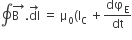
During charging, electric flux between the plates of capacitor keeps on
changing; this results in the production of a displacement current
between the plates.
Expression for the displacement current
Posted by Xyz B 7 years ago
- 1 answers
Gaurav Seth 7 years ago
In a beam of unpolarized light, the vibrations of light vectors are in all directions in a plane perpendicular to the direction
of propagation.
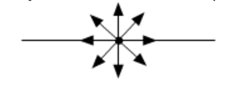
In the linearly polarised light, the vibrations of light take place in a particular direction, perpendicular to the direction of
wave motion.
Polarized light can be distinguished, from unpolarized light, when it is allowed to pass through a Polaroid. Polarized light
does can show the change in its intensity, on passing through a Polaroid; intensity remains same in case of unpolarized
light.
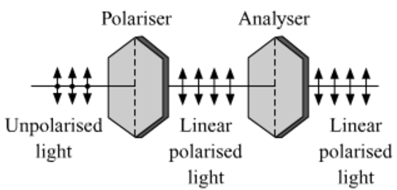
When the unpolarised light wave is incident on a polaroid, then the electric vectors along the direction of its aligned
molecules, get absorbed; the electric vector, oscillating along a direction perpendicular to the aligned molecules, pass
through. This light is called linearly polarized light.
Posted by Aryan Singh 7 years ago
- 1 answers
Posted by Aerik Vishnu 7 years ago
- 1 answers
Yogita Ingle 7 years ago
Coulomb’s law states that Force exerted between two point charges:
- Is inversely proportional to square of the distance between these charges and
- Is directly proportional to product of magnitude of the two charges
- Acts along the line joining the two point charges.
Posted by Mubarakpur Kotwa Chayal 7 years ago
- 1 answers
Yogita Ingle 7 years ago
Magnetic susceptibility in electromagnetism is defined as the measure of how much a material will be magnetized in an applied magnetic field. It is denoted by χ.
The mathematical definition of magnetic susceptibility is the ratio of magnetization to applied magnetizing field intensity. This is a dimensionless quantity.
<nobr></nobr> <nobr>χ=M/H</nobr>
Where,
χ: magnetic susceptibility
M: magnetization
H: field intensity
Posted by Shikhar Kumar Gupta 7 years ago
- 2 answers
Khushi Verma 7 years ago
Gaurav Seth 7 years ago
If refractive index of medium is greater then refractive index of lens then lens gain opposite nature . e.g when lens is initially cancave then after submerge in medium lens show convex nature and voce-versa .
reason :-
we know ,
1/v. - 1/u. = (d - 1){ 1/ R 1 - 1/ R 2}
d is the relative refractive index of system.
if initially (d -1){ 1/R 1 - 1/R 2} is positive
after submerge ,
d=1.5/1.65 <1 so, ( d-1 ) < 0
it means
(d - 1){ 1/R 1 - 1/R 2 } will be negative .
so,
lens will be convex
Posted by Jeevita Jennie 7 years ago
- 0 answers
Posted by Amar Kumar 7 years ago
- 0 answers
Posted by A B 7 years ago
- 2 answers
Posted by Sahana Sankar 7 years ago
- 1 answers
Posted by Richa Singh 7 years ago
- 2 answers
Rohan Sharma 7 years ago
Kishu Raj 7 years ago
Posted by Gagandeep Rathi 7 years ago
- 3 answers
Alok Singh 7 years ago
Alok Singh 7 years ago
Alok Singh 7 years ago
Posted by Gaurav Kumar 7 years ago
- 0 answers
Posted by Rahul Choudhary 5 years, 10 months ago
- 1 answers
Posted by Rahul Choudhary 7 years ago
- 2 answers
Geetanjali Tevathiya 7 years ago
Posted by A B 7 years ago
- 0 answers
Posted by A B 7 years ago
- 2 answers

myCBSEguide
Trusted by 1 Crore+ Students

Test Generator
Create papers online. It's FREE.

CUET Mock Tests
75,000+ questions to practice only on myCBSEguide app

Nitika Neb 7 years ago
1Thank You