
Ask questions which are clear, concise and easy to understand.
Ask QuestionPosted by Shiva N.?? Yadav?? 5 years, 4 months ago
- 1 answers
Posted by Saleh Aadil 5 years, 4 months ago
- 3 answers
Yogita Ingle 5 years, 4 months ago
Geminal refers to the relationship between two atoms or functional groups that are attached to the same atom. Propylidene chloride is the common name of IUPAC compound 1,1−dichloropropane.
Posted by Aditya Chauhan 5 years, 4 months ago
- 1 answers
Posted by Kavia Selvam 5 years, 4 months ago
- 1 answers
Varun Baibhaw 5 years, 4 months ago
Posted by Bhavna Jadam 5 years, 4 months ago
- 1 answers
Posted by Pradeep Sahu 5 years, 4 months ago
- 2 answers
Posted by Misty Yadav 5 years, 4 months ago
- 4 answers
Devil ? 5 years, 4 months ago
Mishti ???? 5 years, 4 months ago
Shiva N.?? Yadav?? 5 years, 4 months ago
Posted by Sanjana Chhetrii 5 years, 4 months ago
- 3 answers
Mr. Badmash 5 years, 4 months ago
Posted by Devil ? 5 years, 4 months ago
- 4 answers
Mishti ???? 5 years, 4 months ago
Posted by Harsh Singh 5 years, 4 months ago
- 2 answers
Posted by Harsh Singh 5 years, 4 months ago
- 3 answers
? Yang ? 5 years, 4 months ago
Yogita Ingle 5 years, 4 months ago
Iron has higher enthalpy of Atomisation than that of copper. The enthalpy of Atomisation depends on the number of unpaired electrons, Greater are the number of unpaired electrons, stronger are the metallic bonds and higher is the enthalpy of Atomisation. Iron has outer electronic configuration of 3d64s2 and 4 unpaired electrons.
Copper has outer electronic configuration of 3d104s1 and 1 unpaired electron. Iron has more number of unpaired electrons than copper. Hence, Iron has higher enthalpy of atomisation than that of copper.
Posted by Aniket Rajput 5 years, 4 months ago
- 1 answers
Khushi Shahi 5 years, 4 months ago
Posted by Aryan Choudhary ?? 5 years, 4 months ago
- 2 answers
Yogita Ingle 5 years, 4 months ago
At high heights the fractional weight of oxygen is not as much as that at the ground level. This stimulates low concentrations of oxygen in the blood and tissues of individuals living at high heights or climbers. Low blood oxygen causes climbers to feel feeble and not able to think plainly, indications of a condition known as anoxia.
Posted by Sumit Malviya 5 years, 4 months ago
- 2 answers
Harsh Singh 5 years, 4 months ago
Harsh Singh 5 years, 4 months ago
Posted by Pankaj Kumar 5 years, 4 months ago
- 1 answers
Posted by Rahul Mahato 5 years, 4 months ago
- 1 answers
Khushi Shahi 5 years, 4 months ago
Posted by Rahul Mahato 5 years, 4 months ago
- 1 answers
Khushi Shahi 5 years, 4 months ago
Posted by Priyanshu Singh 5 years, 4 months ago
- 1 answers
Harsh Singh 5 years, 4 months ago
Posted by Priyanshu Kumar 5 years, 4 months ago
- 2 answers
Posted by Kartika Rajput 5 years, 4 months ago
- 0 answers
Posted by Anshul Bansal 5 years, 4 months ago
- 2 answers
? Yang ? 5 years, 4 months ago
Gaurav Seth 5 years, 4 months ago
Group 12 elements have lowest melting point. This is because, elements of this group have no unpaired electrons and therefore donot form metallic bonds, hence, have least melting point.
Example:
Zn,Cd and Hg with complete outer most d-subshell have lowest melting point and belongs to Group IIB (12th).
Posted by Shreya Mansi 5 years, 4 months ago
- 1 answers
Yogita Ingle 5 years, 4 months ago
The paramagnetic solid is 3). CuO
Actually, paramagnetism is shown by the molecules which have at least 1 ore more than one unpaired electron.
It can not be shown by alkali metal compounds like NaCl and KF etc..
For the information of no. of unpaired electron draw the transition state of the elements.
Like in CuO, the copper exists in d9 has Ti in d0 system. So, it has no unpaired electron and so it is diamagnetic.
Posted by Subham Debnath 5 years, 4 months ago
- 2 answers
Posted by Pankaj Kumar 5 years, 4 months ago
- 2 answers
Yogita Ingle 5 years, 4 months ago
Gauss’s Law
According to Gauss’s law, the total of the electric flux out of a closed surface is equal to the charge enclosed divided by the permittivity. The total electric flux through a closed surface is zero if no charge is enclosed by the surface.
- Gauss’s law is true for any closed surface, no matter what its shape or size.
- The term q on the right side of Gauss’s lawincludes the sum of all charges enclosed by the surface. The charges may be located anywhere inside the surface.
- In the situation when the surface is so chosen that there are some charges inside and some outside, the electric field [whose flux appears on the left side of Eq. (1.31)] is due to all the charges, both inside and outside S. The term q on the right side of Gauss’s law, however, represents only the total charge inside S.
- The surface that we choose for the application of Gauss’s law is called the Gaussian surface. The Gaussian surface can pass through a continuous charge distribution.
- Gauss’s law is useful for the calculation of the electrostatic field for a symmetric system.
Posted by B Anwesha 5 years, 4 months ago
- 1 answers
Gaurav Seth 5 years, 4 months ago
When grease or oil on the cloth comes in contact with soap solution, the stearate ions arrange themselves in such a way that its hydrophobic part is in the oil (or grease) and the hydrophilic parts project outside the grease droplet like bristles.
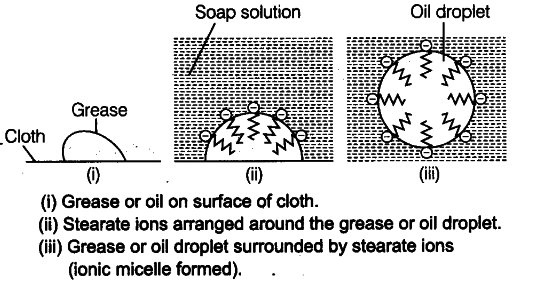
As the hydrophilic part is polar, these polar groups can interact with the water molecules present around the oil droplet which is pulled away from the surface of the cloth into water to form ionic micelle. Thus, soap helps in emulsification and washing away of oils and fats. The negatively charged sheath around the globules prevent them from coming together and forming aggregates. It is then washed away with the excess of water
Posted by Shubham Beriwal 5 years, 4 months ago
- 2 answers
Shweta? Dhama? 5 years, 4 months ago
Yogita Ingle 5 years, 4 months ago
Transition elements are those elements that have partially or incompletely filled d orbital in their ground state or the most stable oxidation state. The partially filled subshells of d-block elements incorporate (n-1) d subshell. All the d-block elements carry a similar number of electrons in their furthest shell.
The transition elements are placed between S and P block elements. They are divided as first transition series (the elements from Sc to Cu), the second transition series (the elements from Y to Ag), and the third transition series (the element La and the elements from Hf to Au).
Posted by Vicky Wani 5 years, 4 months ago
- 1 answers
Gaurav Seth 5 years, 4 months ago
k = (2.303/t)log a/(a - x)
K = specific reaction rate
Let initial conc. (a) = 100g, t = 10min
Posted by Vicky Wani 5 years, 4 months ago
- 1 answers
Yogita Ingle 5 years, 4 months ago
(a) Copper wire at 25˚C because with increase in temperature, resistance increase, metallic conduction decrease with increase in temp .due to vibration of kernels.
(b) 0.1 M acetic acid solution because with dilution degree of dissociation increases and hence number of ions.

myCBSEguide
Trusted by 1 Crore+ Students

Test Generator
Create papers online. It's FREE.

CUET Mock Tests
75,000+ questions to practice only on myCBSEguide app

Sushmita Sah 5 years, 4 months ago
2Thank You