
Ask questions which are clear, concise and easy to understand.
Ask QuestionPosted by Pratik Banerjee 8 years, 5 months ago
- 2 answers
Aman Kumar 8 years, 5 months ago
Cathode (-ve) and Anode (+ve) sign for electrolytic cell.
Posted by Sneha Sharma 8 years, 5 months ago
- 1 answers
Ajay Karthikeya 8 years, 5 months ago
Calculating molar conductivity at infinite dilution for weak electrolytes
Degree of dissociation ¢cm÷¢minfinity(¢=lambda)
Dissociation constant kc=c(alpha)2÷1-(alpha)
Solubility of soluble NaCl
Posted by Karthik Agarwal 8 years, 5 months ago
- 1 answers
Dr. Kamlapati Bhatt 8 years, 5 months ago
Answers to all queries related to CBSE 12th compartment result 2017 are are authentically available at cbse.12thresultsnic.in/compartment-result.html However ,looking to your incusitiveness the following is reproduceed -
- The CBSE 12th Supply Exam Results willl be available on official website in third week of August Month ,( may be 20th of the month ). All candidates are eligible to see their results through @ cbseresullts.nic.i
- How to check CBSE Supply Results 2017
- . log on to official website cbseresults.nic.in
- Click link CBSE XII Compartment Results 2017
- Enter your Re Exam roll no.
- . Click to enter
- Your 12th Compartment Result Mark sheet on Screen
- Download and save
- Take a printout
Central Board of Secondary Education has successfully conducted 12th Supplementary Exam in July .Hence it is supposed that you must have
appeared , and done well . Pl. keep awaiting for results , till Aug .2017. Now , no points in providing you tricks / methodology to score maximum in Chemistry paper..
Feel free to discuss with us regarding your career / courses etc.
Wish you all the best.
Posted by Zehra Khadeeja 8 years, 6 months ago
- 2 answers
Dr. Kamlapati Bhatt 8 years, 5 months ago
A typing error ! Pl. read as ,
.......................................CH3 ** C* H O , instead of H3 ** C* HO
Thanks,
Dr. Kamlapati Bhatt 8 years, 6 months ago
Aldehydes and ketones exhibit the unusual acidity of hydrogen atoms attached to Carbons - alpha ( {tex}\alpha{/tex} ) which is adjacent to that of the carbonyl group. These hydrogens are referred as {tex}\alpha{/tex} - hydrogens , and the carbon atom to which they are bonded is {tex}\alpha{/tex}- carbon. In ethanal there is one {tex}\alpha{/tex} C* & three {tex}\alpha{/tex}. - H atoms ( marked as H** ).
................................H3 ** .C* H O
although weakly acidic , ( Ka = 10-19 to 10-20 ) {tex}\alpha{/tex} - H can react with strong bases to form anion . The unnusual acidity of {tex}\alpha{/tex} - H can be explained by both electron withdrawing ability of the carbonyl ( =CO ) group ,and resonance in anion that is formed . The electron withdrawing ability of =CO group is caused by the groups di[pole nature which results by difference in electronegativities of C and O atoms.
The anion formed by loss of {tex}\alpha{/tex} - hydrogen can be resonance stabilised because of mobility of {tex}\pi{/tex} - electrons that are adjacent to carbonyl group ( =CO ) . This resonance which stabilises the anion ( commonly termed as enolate ion ) creates two resonance structures , an enol & a keto-form . In most cases the keto form is more stable.
The reaction is very well termed as Aldol condensation . In case of ethanal this reaction , in the simplest form , can be represented as -
2CH3 CHO <------dil .NaOH -----------> CH3 - CH (OH) -CH2 - CHO------------- {tex}\Delta{/tex} / ( - H2 O ) -------------> CH2 - CH=CH - CHO. -
Ethanal...................................................3- Hydroxybutanal.....................................................................But -2 - enal(
....................................................................( Aldol ).....................................................................( Aldol condensation product )
Posted by Mamta Bhati 8 years, 6 months ago
- 1 answers
Payal Singh 8 years, 6 months ago
Sea water contains a lot of electrolytes. River contains colloids of sand and clay. When they meet the electrolytes neutralise the charge on colloidal particles and result in the precipitation of sand, clay etc. Thus resulting in a delta formation .
Posted by Mamta Bhati 8 years, 6 months ago
- 1 answers
Payal Singh 8 years, 6 months ago
Adsorption is always exothermic. This statement can be explained in two ways.
(i)Adsorption leads to a decrease in the residual forces on the surface of the adsorbent. This causes a decrease in the surface energy of the adsorbent. Therefore, adsorption is always exothermic.
(ii)ΔH of adsorption is always negative. When a gas is adsorbed on a solid surface, its movement is restricted leading to a decrease in the entropy of the gas i.e., ΔS is negative. Now for a process to be spontaneous, ΔG should be negative.
ΔG= ΔH-TΔS
Since ΔS is negative, ΔH has to be negative to make ΔG negative. Hence, adsorption is always exothermic.
Posted by Sanjay Sharma 8 years, 6 months ago
- 1 answers
Shweta Gulati 8 years, 6 months ago
<pre> Main reason is the very high hydration enthalpy of the fluoride ion. That is because the ion is very small. There is a very strong attraction between the fluoride ions and water molecules. The stronger the attraction, the more heat is evolved when the hydrated ions are formed.</pre>
Posted by Maria Chhakchhuak 8 years, 6 months ago
- 2 answers
Nitin Mhamane 8 years, 4 months ago
Osmosis:A process by which molecules of a solvent tend to pass through a semipermeable membrane from a less concentrated solution into a more concentrated one.
Osmotic Pressure:The pressure that would have to be applied to a pure solvent to prevent it from passing into a given solution by osmosis, often used to express the concentration of the solution.
Dr. Kamlapati Bhatt 8 years, 6 months ago
Osmosis is a phenomenon where in there happens to be a movement of solvent particles ( ie. molecules / ion ) from a solution of lower concentration to that of higher concentration when the two are separated from each other by a semipermeable membrane.
while ,
Osmotic pressure is the pressure built up between the two solution undergoing osmosis . It is caused due to a difference of vapour pressures between both the solutions.
Posted by Amar Kumar Gupta 8 years, 6 months ago
- 2 answers
Nitin Mhamane 8 years, 4 months ago
No.Osmotic pressure is generated due to presence of concentration gradient between the two solutions seperated by a SPM.
Dr. Kamlapati Bhatt 8 years, 6 months ago
No ! a solution of itself has vapour pressure , but not the osmotic pressure . Osmotic pressure comes into consideration only when the phenomenon of osmosis between two solutions with different vapour pressures & separated by a semipermeable membrane comes into play .
Posted by Sangharam Mohite 8 years, 6 months ago
- 1 answers
Payal Singh 8 years, 6 months ago
Steric hindrance is the stopping of a chemical reaction which might be caused by a molecule's structure. An example of steric hindrance is how rotaxanes are created
Posted by Sangharam Mohite 8 years, 6 months ago
- 2 answers
Nitin Mhamane 8 years, 4 months ago
Steric hindrance occurs when the large size of groups within a molecule prevents chemical reactions that are observed in related molecules with smaller groups.
Payal Singh 8 years, 6 months ago
Steric hindrance is the stopping of a chemical reaction which might be caused by a molecule's structure. An example of steric hindrance is how rotaxanes are created
Posted by Saksham Phaugat 8 years, 6 months ago
- 1 answers
Dr. Kamlapati Bhatt 8 years, 5 months ago
When a solid solute is added to the solvent like water , some solute dissolves and its concentration increases in solution . This proces is known as as ' dissolution ' . Some solute particles in solution collide with solid solute particles and get separated out of solution . This process is known as ' crystallisation '. A stage is reached when the ttwo processes occur at the same rate and thus a dynamic equilibrium is reached ,
..............................................Dissolution <-----------> crystallisation
Factors affecting the rate of dissolution :
(i) Effect of temperature -
The rate of dissolution of a solid in a liquid is significantly affected by temperature changes as the above dynamic equilibria must follow LeChatelier's Principle. In general , if the dissolution process is endothermic ( {tex}\Delta H{/tex} sol < 0 ) , the solubility increases with rise in temperature. and if it is exothermic ( {tex}\Delta H{/tex} sol > 0 ) the rate of dissolution decreases . These trends have been experimentally observed governing the concerned rate law too..
(ii) Effect of pressure -
Since both solids as well as liquids are highly incompressible , variations of pressure does not have any significant effect on tthe process or rate of dissolution of a solid in water.
Posted by Mintu Rawat 8 years, 6 months ago
- 1 answers
Payal Singh 8 years, 6 months ago
Graphite is odd in its categorisation and does by no means rigorously follow the conventions of either a covalent solid, or a molecular solid (for example it can conduct electricity). Graphite has properties of both molecular solids (it is soft), and covalent solids (it has a very high melting point. In fact it will break down before it melts.).
For this reason, the categorisation of some materials, such as graphite, can be somewhat complicated, and the idea of graphite being a covalent solid really just comes from its similarity with other covalent solids.
Posted by Mamta Vaish 8 years, 6 months ago
- 2 answers
Nitin Mhamane 8 years, 4 months ago
Dopant: A substance used to produce a desired electrical characteristic in a semiconductor.
Dopant increses the conductivity of semiconductor by creating new donor level near to conduction band or acceptor level near to valence band.
Shweta Gulati 8 years, 6 months ago
Doping is nothing but adding N or P type impurities to a pure semiconductor. So these impurities will contain electrons or holes based on their impurity. When these kind of doping takes place in semiconductors and voltage is applied, these electrons will conduct electricity. In case of holes, electrons due to potential excitation jump from their original positions to these holes and form immobile ions at that point, whereas equal amount of holes are created from where these electrons jumped. Thus conductivity increases due to doping.
Posted by Lovely Kishan 8 years, 6 months ago
- 2 answers
Nitin Mhamane 8 years, 4 months ago
Aromatic compounds are substances that consist of one or more rings that contain alternating single and double bonds in its chemical structure and follows the Huckels (4n+2)Pie electrons rule.
Payal Singh 8 years, 6 months ago
Aromatic compounds, also known as arenes or aromatics, are chemical compounds that contain conjugated planar ring systems with delocalized pi electron clouds instead of discrete alternating single and double bonds. Typical aromatic compounds are benzene and toluene.
Posted by Mamta Yadav 8 years, 6 months ago
- 1 answers
Dr. Kamlapati Bhatt 8 years, 5 months ago
The question refers to electrolyte - concentration cells which consist of identical electrodes but are dipped in solutions of same electrolyte having different concentrations. Electrical energy given out by the cell is due to tendency of the electrolyte to diffuse from a solution of higher concentration to that of lower concentration. Thus two concentrations of the same electrolyte tend to become equal with the expiry of time. An equilibrium is established at this stage. This results into a cell emf which happens to be maximum at the start and then gradually falls to zero.The cell representation of this cell is ,
M | M+ (C1) || M+ (C2) | M ,
where , C1 & C2 are the concentrations of the same electrolyte in the two half cells , and also C2 > C1
A simple example of such a cell is
( Zn|Zn2+ (C1) / Anode || Zn2+ (C2 ) | Zn / Cathode
The emf of such a cell is given by using Nernst equation
E Cell = {tex}\frac{0.0591}{n}{/tex} log ( C1 / C2 )
When C1 becomes equal to C2 E cell = 0
So , for every concentration cell Eo = 0
Thus , the cell will not generate emf when concentrations become equal
Posted by Swarup Rathi 8 years, 6 months ago
- 2 answers
Harmanjit Singh 8 years, 6 months ago
Number of atoms of A per unit cell = contribution from corners + contribution from alternate face centres (these are 2) = 1/8 X 8 + 1/2 X 2 = 2
Number of atoms of B per unit cell = contribution from body centre + contribution from edge centres
= 1 + 1\4 X 12 = 4
> Formula of compound = A2B4
or exactly it is AB2
Since charge on B is -1 therefore Charge on A will be +2
Payal Singh 8 years, 6 months ago
A occupy all the corners and alternate face centres.
Therefore, No. of atoms of A = {tex}(8\times {1\over 8} )+ (3\times {1\over 2}) = 1 + {3\over 2}{/tex}
= {tex}5\over 2{/tex}
Now, B occupy all the body centre and the edge centre.
So, No. of atoms of B : {tex}1+({1\over 4}\times 12) = 1+3=4{/tex}
Therefore, formula of compound will be
{tex}A_{5\over 2} B_4 = A_5B_8{/tex}
Charge on B = -1
Let charge on A = x
Then
5x +8(-1) = 0
=> 5x -8=0
=> 5x = 8
=> x = {tex}8\over 5{/tex}
Posted by Parvez Alam 8 years, 6 months ago
- 1 answers
Payal Singh 8 years, 6 months ago
The volatility of a substance refers to the readiness with which it vaporizes. Generally speaking, substances with a boiling point below 100 °C are considered volatile and all others are called nonvolatile. Ethyl alcohol and pentane are examples of volatile substances;
Posted by Ramautar Mishra 8 years, 6 months ago
- 1 answers
Payal Singh 8 years, 6 months ago
The free electrons trapped in the anion vacancies are called as F-centers. Solids containing F-centres are paramagnetic because the electrons occupying the vacant sites are unpaired.
Posted by Srinivas Chandra 8 years, 7 months ago
- 1 answers
Posted by Srinivas Chandra 8 years, 7 months ago
- 1 answers
Payal Singh 8 years, 7 months ago
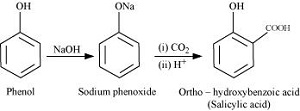
Kolbe's reaction: When phenol is treated with sodium hydroxide, sodium phenoxide is produced. This sodium phenoxide when treated with carbon dioxide, followed by acidification, undergoes electrophilic substitution to give ortho-hydroxybenzoic acid as the main product.
This reaction is known as Kolbe's reaction.
Williamson ether synthesis: Williamson ether synthesis is a laboratory method to prepare symmetrical and unsymmetrical ethers by allowing alkyl halides to react with sodium alkoxides.

This reaction involves SN2 attack of the alkoxide ion on the alkyl halide. Better results are obtained in case of primary alkyl halides.
 If the alkyl halide is secondary or tertiary, then elimination competes over substitution.
Posted by Anayat Usain 8 years, 7 months ago
- 1 answers
Payal Singh 8 years, 7 months ago
Vapour pressure of pure water, po = 360 mm Hg
Lowered vapour pressure, p = 360 –0 .5% of 360
= 360 – 1.8 = 358.2 mm Hg
Now, Weight of water, w1= 200ml x 1g.ml = 200g
Weight of urea w2 = ?
Molecular weight of water, M1 = 18 g/mol Molecular weight of urea, M2 = 60 g/mol
According to Roult’s law:
{tex}{p^o -p \over p} = {n_2\over n_1 + n_2}{/tex}
=> {tex}{360 - 358.2\over 358.2} = { {w_2 \over M_2}\over {{w_1\over M_1 } + {w_2 \over M_2}}}{/tex}
=> {tex}0.005 = { {w_2 \over M_2}\over {{w_1\over M_1 } + {w_2 \over M_2}}}{/tex}
=> {tex}0.005 {\left ({w_1\over M_1 } + {w_2 \over M_2}\right )}= {w_2 \over M_2}{/tex}
=> {tex}0.005 \times {w_1\over M_1 } = {w_2 \over M_2} - 0.005\times {w_2 \over M_2}{/tex}
=> {tex}0.005 \times {w_1\over M_1 } =0.995\times {w_2 \over M_2}{/tex}
=> {tex}{0.005 \over 0.995} \times {w_1\times M_2\over M_1 } = {w_2 }{/tex}
=> {tex}{0.005 \over 0.995} \times {200\over 18 }\times 60 = {w_2 }{/tex}
=> w2 = 3.33g
Hence, 3.33g urea should be added
Posted by Akanksha Tomar 8 years, 7 months ago
- 1 answers
Payal Singh 8 years, 7 months ago
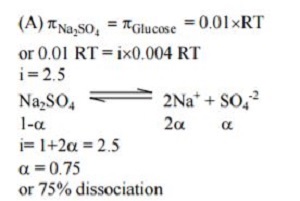
Benzophenone It is a ketone, so it does not undergo Canniyzaro's reaction. Without {tex}\alpha{/tex} -hydrogen, it cannot participate in aldol condensation.
Posted by Deepanshu Banga 8 years, 7 months ago
- 1 answers
Jatin Singh 8 years, 6 months ago
Full cylinder is not filled with nitrogen .
A mixture of gases are mixed
Posted by Pawan Kabdal 8 years, 7 months ago
- 1 answers
Payal Singh 8 years, 7 months ago
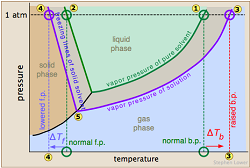
Freezing point depression is the phenomena that describes why adding a solute to a solvent results in the lowering of the freezing point of the solvent. When a substance starts to freeze, the molecules slow down due to the decreases in temperature, and the intermolecular forces start to take over. The molecules will then arrange themselves in a pattern, and thus turn into a solid. For example, as water is cooled to the freezing point, its molecules become slower and hydrogen bonds begin to "stick" more, eventually creating a solid. If salt is added to the water, the Na+ and Cl- ions attract to the water molecules and interfere with the formation of the large network solid known as ice. In order to achieve a solid, the solution must be cooled to an even lower temperature.
The freezing point depression can also be explained in terms of vapor pressure. Adding solute to a solvent will essentially dilute the solvent molecules, and according to Raoult's law, this leads to a decrease in vapor pressure. Considering the fact that the vapor pressure of the solid and liquid forms must be the same at freezing point, because otherwise the system would not be at equilibrium, the lowering of the vapor pressure leads to the lowering of the temperature at which the vapor pressures of the liquid and frozen forms of the solution will be equal.
The freezing point depression can be calculated by the formula:
{tex}\Delta T_f=i\times K_ f\times molality{/tex}
In this equation,
{tex}\Delta T_f{/tex} is the freezing point depression,
Kf is the freezing point depression constant, and i is the van 't Hoff factor.
The freezing point depression constant changes depending on the solvent, and the van 't Hoff factor accounts for the number of particles that a dissolving solute creates in solution.
Posted by Muskan Asthana 8 years, 7 months ago
- 1 answers
Aashka Shah 8 years, 7 months ago
2 tetrahedral voids on each body diagonal in ccp unit
Total 8 tetrahedral voids in 1 ccp unit
Posted by Aashka Shah 8 years, 7 months ago
- 1 answers
Payal Singh 8 years, 7 months ago
Solution:
rc + ra = {tex}\sqrt 3a\over 2{/tex}
=> {tex}r_c + r_a = {\sqrt 3 \times 4.3\over 2}{/tex}= {tex}3.72 A^°{/tex}

myCBSEguide
Trusted by 1 Crore+ Students

Test Generator
Create papers online. It's FREE.

CUET Mock Tests
75,000+ questions to practice only on myCBSEguide app

Nitin Mhamane 8 years, 4 months ago
Cathode is negative and anode is positive inthe electrolytic cell.
0Thank You