
Ask questions which are clear, concise and easy to understand.
Ask QuestionPosted by Nusrat Shaikh 8 years, 4 months ago
- 0 answers
Posted by Nusrat Shaikh 8 years, 4 months ago
- 1 answers
Posted by Nusrat Shaikh 8 years, 4 months ago
- 0 answers
Posted by Manish Rao 8 years, 4 months ago
- 1 answers
Posted by Ant Sunthwal 8 years, 4 months ago
- 0 answers
Posted by Sai Shetkar 8 years, 4 months ago
- 2 answers
Posted by Mahejabi Bano 8 years, 4 months ago
- 1 answers
Payal Singh 8 years, 4 months ago
Azeotrope, in chemistry, a mixture of liquids that has a constant boiling point because the vapour has the same composition as the liquid mixture. The boiling point of an azeotropic mixture may be higher or lower than that of any of its components.
Posted by Ipxita Bordoloi 8 years, 4 months ago
- 1 answers
Payal Singh 8 years, 4 months ago
Conductivity of a solution at any given concentration is the conductance of one unit volume of the solution kept between two platinum electrodes with the unit cross-sectional area at a distance of unit length. Its SI unit is Sm−1
Molar conductivity of a solution at a given concentration, on the other hand is the conductance of volume V of a solution containing 1 mole of the electrolyte, kept between two electrodes with the cross-sectional area of A and distance of unit length. It is denoted as Λm. The SI unit of molar conductivity is Sm2mol-1.
Posted by Shiva Patel 8 years, 4 months ago
- 0 answers
Posted by Lavanya Gupta 8 years, 4 months ago
- 0 answers
Posted by Rajan Kumar 8 years, 4 months ago
- 0 answers
Posted by Ashok Kumar S 8 years, 4 months ago
- 1 answers
Payal Singh 8 years, 4 months ago
Electrolysis of aqueous sodium chloride yields hydrogen at cathode and chlorine at anode, with aqueous sodium hydroxide remaining in solution.
Posted by Ńäųşhað Àlļ 8 years, 5 months ago
- 0 answers
Posted by Chetan Joshi 8 years, 5 months ago
- 3 answers
Sahdev Sharma 8 years, 5 months ago
The acid produced in the reaction acts as a catalyst and makes the reaction faster. Substances that act as catalysts in the same reaction in which they are obtained as products are known as autocatalysts
Payal Singh 8 years, 5 months ago
Ester hydrolysis can be represented as: Ester + Water → Acid + Alcohol
The acid produced in the reaction acts as a catalyst and makes the reaction faster. Substances that act as catalysts in the same reaction in which they are obtained as products are known as autocatalysts.
Posted by Yash Sahu 8 years, 5 months ago
- 2 answers
Dr. Kamlapati Bhatt 8 years, 5 months ago
In case of isotonic electrolytes ,
* the concentrations of both the electrolytes are equimolecular
* their osmotic pressures are equal
* both the electrolytes have same temperature
Therefore , considering the given electrolytes ,
{tex}\pi{/tex}(K2SO4) = {tex}\pi{/tex}(NaOH )
i(K2SO4) C(K2SO4) RT = i(NaOH) C (NaOH)RT
but , C(K2SO4) = C(NaOH)
{tex}\therefore{/tex} i (K2SO4) = i ( NaOH )
Now, we know that i (ie . vant Hoff' 's factor )
= No. of particles in dissociated molecule ( ie. after dissociation ) / No. of particles in undissociated molecule ( ie before dissociation )
ie. = degree of dissociation ({tex}\alpha{/tex})
So, let us calculate degree of dissociation for both the given electrolytes-
K2 SO4-----------------> 2K+ + SO42- ; NaOH -----------> Na+ + OH-
( 1 - {tex}\alpha{/tex} ).........................( 2 {tex}\alpha{/tex} )...........({tex}\alpha{/tex} ) -----------------------(1- {tex}\alpha{/tex} )..................({tex}\alpha{/tex}).............({tex}\alpha{/tex})
Therefore total number of particles ( ie ions / molecules ) after dissociation in both cases are -
( 1 - {tex}\alpha{/tex} + 2{tex}\alpha{/tex} + {tex}\alpha{/tex} ).............................................................................( 1 - {tex}\alpha{/tex} + {tex}\alpha{/tex} + {tex}\alpha{/tex} )
= (1 + 2{tex}\alpha{/tex} )................................. ...............................................................= ( 1 + {tex}\alpha{/tex} )
..........................................substituting the given value for degree of dissociation ({tex}\alpha{/tex}) in case of NaOH as = 1
.......................................................................................................................= 2
Further , i( K2 S O4 ) = [ (1 + 2{tex}\alpha{/tex} ) / 1 ] ........................& i (NaOH ) = ( 2 / 1 )
.......................................= [ ( 1 + 2{tex}\alpha{/tex} (K2 SO4 ) ] .......................................= 2....................................
Equating i(K2SO4) and i ( NaOH) , as inferred above we get -
1 + 2{tex}\alpha{/tex} (K2SO4) = 2
{tex}\therefore{/tex} 2 {tex}\alpha{/tex} (K2SO4) = 1
& {tex}\alpha{/tex} (K2SO4) = 1/ 2
...........................= 0.50
Hence , the degree of dissociation of given 17.4% K2 SO4 is 0.50 and is ,therefore ,50% dissociated when it is isotonic with given 4% NaOH solution .
Posted by Jemini Maheshwari 8 years, 5 months ago
- 2 answers
Dr. Kamlapati Bhatt 8 years, 5 months ago
The reaction of Propene with HBr can adopt any one of the following paths yielding different products.
The anti- Markonikov addition occurs under following conditions,
Thus , the mechanism of anti - Markonikov reaction follows a free radical mechanism as depicted below,
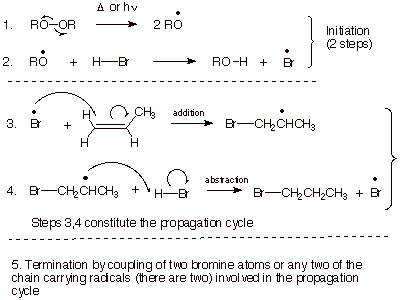
Yash Sahu 8 years, 5 months ago
Mechanism:-- As in the presence of any peroxide ,the negative part of the alkyl halide( here-Br) always gets attached to that carbon atom of alkene which has more no.of H atom therefore,
CH3CH=CH2 + HBr (In peroxide)
----------> CH3CH2CH2Br
Posted by Saurav Yadav 8 years, 5 months ago
- 1 answers
Ashutosh Kumar 8 years, 5 months ago
Adsorption is the adhesion of atoms, ions, or molecules from a gas, liquid, or dissolved solid to a surface. This process creates a film of the adsorbate on the surface of the adsorbent.
Posted by Ekta Sangwan 8 years, 5 months ago
- 1 answers
Dr. Kamlapati Bhatt 8 years, 5 months ago
Following are the points of differences between vitamins and halogen containing drugs ,
|
Vitamins are certain organic compounds required in small amounts in our diet but thier defficiency causes deseases. Most of the vitamins cannot be synthesised in our body but plants can synthesise all of them. Different vitamins belong to various chemical classes and it is difficult to classify them on the basis of their structures. These have been classified as (i) fat soluble vitamins viz. vitamins A,D, Eand K (ii) Water soluble vitamins , viz. B group vitamins and vitamin C They perfom specific biological functions for normal maintenance of optimal growth and health of organism. |
Halogen containing drugs | |
| These are clinically useful. | ||
|
A few examples are : Chlorine containing antibiotic , chloramphenicol is very effective for treatment of typhoid fever,chloroquine is used for treatment of malaria,Halothane is used for as an anaesthetic during surgery.a hormone thyroxine is produced by iodine in our body . |
Posted by Mamta Vaish 8 years, 5 months ago
- 2 answers
Durgesh Bishi 8 years, 5 months ago
No because the threshold energy remains the same irrespective of it's speed. Hence speed do not depends upon the activation energy
Durgesh Bishi 8 years, 5 months ago
No because the threshold energy remains the same irrespective of it's speed.. Hence speed do not depends upon the activation energy
Posted by Mamta Vaish 8 years, 5 months ago
- 2 answers
Durgesh Bishi 8 years, 5 months ago
Rate constant k=AeEa/RT
AS temperature is infinite, K=A.
Dr Pathikrt Banerjee 8 years, 5 months ago
At 338K the value i <font size="+1">2.40 x 10⁻³</font>
Posted by Mamta Vaish 8 years, 5 months ago
- 4 answers
Mohit Sharma 7 years, 11 months ago
There are instances where the activation energy can be negative. There are reactions where the rate of the reaction decreases with increasing temperatures. This happens because the when you increase the temperature, it can sometimes reduce the probability of molecules colliding as the increased momentum carries the molecules away from the potential “collision zone.” So when you fit the rate constant into an Arrhenius expression, it results in a negative activation energy. But these reactions are generally the ones without barriers. So there’s no activation energy per se.
Nitin Mhamane 8 years, 4 months ago
Activation energy is always a positive quantity.It never have a negative energy.
Durgesh Bishi 8 years, 5 months ago
Yes sometime it is negative in case of backward reaction
Nitin Mhamane 8 years, 5 months ago
Reaction never have negative activation energy.Its always a positive quantity.
Posted by Mamta Vaish 8 years, 5 months ago
- 1 answers
Nitin Mhamane 8 years, 5 months ago
There is no effect of altering the concentrations of reactant on zero order reaction,since they are concentration independent.
Posted by Mamta Vaish 8 years, 5 months ago
- 1 answers
Posted by Mamta Vaish 8 years, 5 months ago
- 2 answers
Dr. Kamlapati Bhatt 8 years, 5 months ago
This is because the speed of the molecules in the gaseous mixture at room temperature does not provide enough kinetic energy to activate the reaction during collision between the reactants . A mixture of gases is formed with potential to react or explode violently , if sufficient energy is given. to such a gaseous mixture .Even introduction of an spark to this mixture results in raised temperature among some of the hydrogen and oxygen molecules causing their faster collision . This , then results into an exothermic reaction proceeding violently .
2H2(g) + O2(g) ---------> 2 H2 O (g)
Ashutosh Kumar 8 years, 5 months ago
The activation energy barrier to the reaction is indeed very large. The Arrhenius equation allows the rate constant, k, for a reaction to be determined:
k = Ae^(-Ea/RT)
where A = Arrhenius pre-exponential factor (depends on the system in question)
Ea = activation energy barrier in J/mol
R = 8.314 J/(K·mol)
T = absolute temperature in K
If Ea is sufficient large, k can be so close to zero that the reaction essentially will not occur at the temperature
Posted by Abhishek Raj 8 years, 5 months ago
- 1 answers
Dr. Kamlapati Bhatt 8 years, 5 months ago
It is because practically we fail to determine electrode potential of a half cell consisting of an electrode dipped in its own salt solution. We, can measure only the difference between two half - cell potentials. that gives emf of the cell . If we arbitrarily choose the potential of one of the electrode ( half cell ) then that of the other can be determined with respect to this. Therefore , we need to set up a galvanic cell consisting of two half cells , and measuring out its EMF. This is possible only when we construct a cell with two half cells & calculate its EMF ( in volts ) using the expression
Eo cell = EoR - EoL
Hence , electrode potential of one of the half cells must be known . As per IUPAC norms Hydrogen electrode has been chosen under standard conditions (ie. H2 with 1 bar press . ,[ H+ ] = 1 M & at 298 K ) with its arbitrarily fixed electrode potential as equal to zero.
So , the reduction electrode potentials of all the different electrodes have been determined and reported as electrode potential relative to that of hydrogen electrode .
Posted by Pratik Banerjee 8 years, 5 months ago
- 1 answers
Payal Singh 8 years, 5 months ago
An electrode is an electrical conductor that makes contact with the nonmetallic circuit parts of a circuit, such as an electrolyte, semiconductor or vacuum.
A half cell is one of the two electrodes in a galvanic cell or simple battery. For example, in the Zn-Cu battery, the two half cells make an oxidizing-reducing couple. Placing a piece of reactant in an electrolyte solution makes a half cell.
Posted by Azhar Khan 8 years, 5 months ago
- 1 answers
Dr. Kamlapati Bhatt 8 years, 5 months ago
Face centred cubic (fcc) or Cubic closed pack (ccp) - these are the two names for the same lattice.
We can thhink of this cell as being made by another atom into each face of a simple cubic lattice - hence the " face centred cubic " name .
In such a unit cell there are atoms at all the corners , and at the centre of all the faces of the cube.
Each atom located at the face - centre is shared between two adjacent cells and only half of the atom belongs to a unit cell. Thus ,the number of atoms in this cell are ,
(i) 8 corner atoms x {tex}\frac{1}{8}{/tex} atom per unit cell = 8 x {tex}\frac{1}{8}{/tex} = 1 atom
(ii) 6 atoms at the faces x{tex}\frac{1}{2}{/tex} atom per unit cell = 6 x {tex}\frac{1}{2}{/tex} = 3 atoms
{tex}\therefore{/tex} Total number of atoms per unit cell = 4 atoms
Posted by Jagdish Rathore 8 years, 5 months ago
- 1 answers
Payal Singh 8 years, 5 months ago
N2 is exist as diatomic molecule in which two nitrogen atoms are attached to each other by triple bond this triple bond is due to p(π)-p(π) multiple bonding (sidewise overlapping) and such bonding is not possible in phosphorus due to it's large size but possible in nitrogen due to it's small size.
In case of phosphorus four atoms are associated so it have high molecular mass, large magnitude of venderwall forces so phosphorus is solid and nitrogen is gas.

myCBSEguide
Trusted by 1 Crore+ Students

Test Generator
Create papers online. It's FREE.

CUET Mock Tests
75,000+ questions to practice only on myCBSEguide app
