
Ask questions which are clear, concise and easy to understand.
Ask QuestionPosted by Mudassir Mohiuddin Inamdar 8 years, 7 months ago
- 1 answers
Dr. Kamlapati Bhatt 8 years, 6 months ago
step 1,
Molality (m) = No. of moles / 1000 g of solvent ( water )
...................= 1.25 / 1000 g
.................. = ( 1.25 x40 ) g / 1000 g
.................. = 50 g / 1000 g
{tex}\therefore{/tex} total weight of the solution = 1050 g
step 2 ,
Percent by weight of the solution is given by the expression ,
......................................................................................( Mass of solute ) / [ ( mass of solute ) + ( mass of solvent ) ]
Since , 1050 g of solution contains solute ( NaOH ) = 50.00 g
{tex}\therefore{/tex} 100 g of solution would contain solutte ( ie. NaOH ) = ( 50 / 1050 )
.................................................................................= 0.0476
Thus , the percent by weight of NaOH in the solution is 0.0476 %
Posted by Pavani B 8 years, 7 months ago
- 1 answers
Posted by Aditya Chakraborty 8 years, 8 months ago
- 1 answers
Posted by Ankur Majumdar 8 years, 8 months ago
- 1 answers
Aashka Shah 8 years, 8 months ago
AMORPHOUS SOLIDS :-
- It has irregular shape
- isotropic in nature
- has short range order
- they are pseudo solids or super-cooled liquids
- When cut with a specific sharp edge tool, they cut into two pieces with irregular surfaces
Posted by Hritika Jain 8 years, 8 months ago
- 1 answers
Hritika Jain 8 years, 8 months ago
But the question is this much only and is from vibrant academy
Posted by Aashka Shah 8 years, 8 months ago
- 1 answers
Payal Singh 8 years, 8 months ago
No ur method is not correct. Because electrons removed from outermost shell that is 4s in case of Fe.
Posted by Aashka Shah 8 years, 8 months ago
- 2 answers
Aashka Shah 8 years, 8 months ago
But if we look like Fe2+ as Cr and
Fe3+ as V
in that sense then Fe2+ should be the correct,,,,
is my method correct?????
Payal Singh 8 years, 8 months ago
Electronic Configuration of
Fe = {tex}1s^2 2s^2 2p^6 3s^2 3p^6 3d^6 4s^2{/tex}
Electronic Configuration of
Fe2+ = {tex}1s^2 2s^2 2p^6 3s^2 3p^6 3d^6 {/tex}
Electronic Configuration of
Fe3+ = {tex}1s^2 2s^2 2p^6 3s^2 3p^6 3d^5{/tex}
So Fe3+ has more unpaired electron.
Posted by Aashka Shah 8 years, 8 months ago
- 1 answers
Dr. Kamlapati Bhatt 8 years, 6 months ago
A simple advice , ( of course not a trick )
One shouldn't be in search of short cuts or tricks to understand or develop confidence over descriptive topics like " d - & f-block elements" . The properties or charecteristics of d - & f - block elements are very well understood and explained using a relation between their electronic configurations and application of involved screening effects .Of course, there happens to be exceptions in a few cases only ,which are needed to be kept in mind , eventhough these have their own justifications.
Posted by Pallavi Kapoor 8 years, 8 months ago
- 1 answers
Dr. Kamlapati Bhatt 8 years, 5 months ago
Conversion of a galvanic cell into an electrolytic cell is practically possible by -
(i) connecting the cell to an external source of electricity , and
(ii) providing enough potential difference through this external source , such that , the applied emf exceeds the emf of the galvanic cell itself. [ for example > 1.1 V ,in case of simple Daniel cell ie.( Zn - Cu ) -cell. ]
Explanation :
Thus , In the beginning the external opposing potential is less than 1.1 V. In this case the normal cell reaction occurs in the galvanic cell and the current flows from copper electrode to zinc electrode. But when the opposing potential is increased slowly and gradually it is observed that normal reaction continues to occur till the opposing potential reaches to value of 1.1 V. At this stage the cell reaction stops .& the current continues to flow . Further increase in the opposing potential ( beyond 1.1 V ) again causes the chemical reaction to occur. But now the reaction occurs in opposite direction forcing Zn2+ ions to get reduced and Cu atoms to get oxidised.
Zn2+ (aq) + Cu (s) ----------> Zn (s) + Cu2+ (aq )
Posted by Pallavi Kapoor 8 years, 8 months ago
- 1 answers
Dr. Kamlapati Bhatt 8 years, 5 months ago
A galvanic cell is an electrochemical cell that uses the transfer of electrons in redox reaction to supply an electric current.This cell is driven by spontaneous chemical reaction that produces an electric current through an outside electrical circuit .Galvanic cell reactions supply energy , which is used to perform work. For this reason galvanic cells are used as batteries .
Galvanic cells harness the electrical energy available from the electron transfer in a redox reaction to perform useful electrical work. The key to gathering the electron flow is to separate the oxidation and reduction half reactions., connecting them by a wire , so that the electrons must flow through that wire. The electron flow called a current can be sent through a circuit which could be part of any number of electrical devices such as radios , televisions , watches etc.
A schemetic line diagram of a galvanic cell may be represented in a simple way as-
............. Oxidation half cell --------> Salt bridge <---------Reduction half cell
|____________connecting wire_____________|
The salt bridge : The salt bridge or a porous disk is necessary to maintain the charge neutrality of each half cell by allowing the flow of ions with minimal mixing of the half cell solutions . As electrons are transferred from the oxidation half cell to the reduction half cell , a negative charge builds
in the reduction half cell and a positive charge in the oxidation half cell. The charge building up would serve to oppose the current from anode to cathode - effectively stopping the electron flow - if the cell lacked a path for ions to flow between the two solutions. From the schemetic diagram as illustrated above it can easily be gathered that that the electrode in oxidation half cell is called anode and the electrode in reduction half cell is called the cathode.. A good mnemonic to help remember that is " the Red Cat ate an Ox " meaning that reduction takes place at the cathode and oxidation takes place at the anode .
The anode , as the source of negatively charged electrons is usually marked with a minus ( - ) sign and cathode is marked with a plus ( + ) sign.
Line notation for a Galvanic Cell
Instead of drawing a cell diagram a shorthand way of describing a cell is called line notation. This notation scheme places the constituents of cathode on the right and the anode components on the left. The phases of all reactive species are listed and their concentrations or pressures are given if those species are not at standard states ( ie. 1 atm . for gases and 1M for solutions ). All phase interfaces are noted with a single line ( | ) and multiple species in a single phase are separated by commas. For example a half cell containing 1M solution of CuO and HCl and a Pt electrode for reduction of Cu2+ would be written as :
Pt (s) | Cu2+ ( aq ) , H+ ( aq )
Note that the spectator ions , oxide and chloride have been left out of notation and that banode is written to the far left.
The salt bridge or porous disk is shown in the notation as a double line ( || ) . Therefore a cell that undergoes oxidation of magnesium by Al3+ would have the following cell notation if the anode is magnesium and the cathode is aluminium
Mg (s) | Mg2+ ( aq ) | | Al3+ ( aq ) | Al (s)
Standard Reduction Potentials
One can measure the cell potential Ecell , in volts , of any galvanic cell using a potentiometer. However it is directly impossible to measure the potential of each individual half cell.. Hence , a method has been devised to measure thhe ability of a chemical species to reduce by compiling tables of standard reduction potentials Eo . Arbitrarily assigning a value of exactly zero to potential of of the standard hydrogen electrode allows us tommeasure the Eo of any half reaction. That measurement is made by constructing a galvanic cell between the STandard Hydrogen Electrode (SHE) and the unknown half cell at standard state conditions .For example , if the following cell is constructed , an Eo cell of 0.34 V is observed
Pt (s ) | H2 (g) | H+ ( aq ) | | Cu2+ (aq) | Cu (s)
Because SHE has a potential of exactly zero volts , the reaction Cu2+ + 2e ------------> Cu has a value of 0.34 V for its Eo . Note that ,
Eo cell = Eo SHE + Eo
Fortunately , every important reduction potential has been measured and tabulated . Useful list of reduction potentials are available in most of the introductory chemistry texts , including yours. Using this list the EMF of galvanic cells are calculated.The following expression is helpful to calculate emf of a galvanic cell under Standard conditions ( ie. 1 atm pressire and at 278 K )
Eo cell = Eo R - Eo L where , R & L mean the right and left half cells when the line notation for cell composition is written , repectively.
Posted by Ankur Raj Singh 8 years, 8 months ago
- 1 answers
Payal Singh 8 years, 8 months ago
Amorphous solids don't break at fixed cleavage planes whereas Crystalline solids cleavage along particular direction at fixed cleavage planes.
Posted by Dev Lavania 8 years, 8 months ago
- 1 answers
Payal Singh 8 years, 8 months ago
Kernels are basically the atom without its valence shell .all the inner shells and the nucleus make up the kernel. The valence shell is represented outside the kernel.
Posted by Swastika Chandan 8 years, 8 months ago
- 1 answers
Payal Singh 8 years, 8 months ago
This is example of Wurtz Reaction . Product ll be Bicyclobutane. 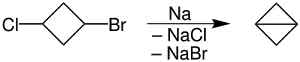
Posted by Pallavi Kapoor 8 years, 8 months ago
- 1 answers
Swastika Chandan 8 years, 8 months ago
The standard enthalpy of formation for an element in its state is zero.
Posted by Mahendra Bagul 8 years, 8 months ago
- 1 answers

Posted by Ashish Jaiswal 8 years, 8 months ago
- 1 answers
Dr. Kamlapati Bhatt 8 years, 6 months ago
The posted question doesn't mention its nature or type . However , supposing that the question is an MCQ type question( , the option (ii) is correct ie.
' energy released during spontaneoous chemical reactions and the use of electrical energy to bring about nonspontaneous chemical transformations '
Posted by Devansh Agarwal 8 years, 8 months ago
- 1 answers
Dr. Kamlapati Bhatt 8 years, 5 months ago
In LiCl structure the chloride ion forms a face centred unit cell( anion - anion contact ). Hence chloride ions contact each other across the diagonal of the face. If we draw a diagonal on the face of a unit cell , we find that -
length of the diameter = radii of 4 chloride ions (ie. one radius from each corner chloride ion and one diameter which equals to two radii of chloride ion , at the center of the face )
Thus , when the length of diameter is represented by d and radius of each chloride ion by r ,
d = 4r
applying Pythagorean theorem we get ,
a2 + a2 = d2
Substituting the given value for a = 5.14 Ao ( or = 0.514 nm ) in the above equation ,
( 0.514 nm )2 + ( 0.514 nm )2 = d2 = (4r) 2 = 16 r2
{tex}\therefore{/tex} solving for r we get ,
r = Sqrt [ { ( 0.514 nm )2 + ( 0.514 nm )2 } ] / {tex}\sqrt16{/tex}
= 0.182 nm
or , = 1.82 Ao for chloride ion
Posted by Abhishek Verma 8 years, 8 months ago
- 1 answers
Payal Singh 8 years, 7 months ago
according to henry's law the vapour pressure of gas is directly proportional to the concentration of gas or we can say the mole fraction of gas in the slution
At higher altitude the vapour pressure of oxygen decreases , which reults in the lowering of concentration of oxygen in our blood and results in anoxia
Posted by Vaalee Patil 8 years, 8 months ago
- 1 answers
Posted by Yash Sharma 8 years, 8 months ago
- 1 answers
Dr. Kamlapati Bhatt 8 years, 5 months ago
Considering an equilibrium established between the number of holes and the number of free electrons in a semiconductor at a particullar temperature.at equilibrium let
, no be the equilibrium free electron concentration in conduction band ,, [ cm-3 ]
po be the equilibrium hole concentration in valency band , [ cm-3 ]
Certainly , then in intrinsic semiconductor :
.............no = po = ni
where, ni represents intrinsic - carrier concentration.
As T increases , then ni increases .
As Eg increases , ni decreases.
We can consider this equilibria .........bond <----------> e- + h+ using an anology to chemical reaction H2O <------------> H+ + OH-
Applying law of mass action ,
..................................................................K = [ e- ] [ h+ ] / [ bond ]...................................................................& K = [ H+ ] [ OH- ] / [ H2 O ]
........................................................................{tex}\approx{/tex} exp [ - Eg / k T ]...................................................................................{tex}\approx{/tex} [ - E / k T ]
where , [ bonds ] is the concentration of unbroken bonds , k is rate constant & E , Eg represents respective activation energies..
again , since [ bonds ] >> no , po
..................{tex}\therefore{/tex} [ bonds ] = constant
In general , relatively few bonds are broken to form an electron hole , therefore, the number of bonds are approximately constant .Hence ,
......................Number of holes are equal to number of free electrons
Posted by Yash Sharma 8 years, 8 months ago
- 1 answers
Shweta Gulati 8 years, 8 months ago
When intrinsic semiconductors like Si and Ge are doped with group-13 elements like B,Al or Ga which contains only three valence electrons, then the place where the fourth valence electron is missing is called electron hole.An electron from a neighbouring atom can come and fill the electron hole,but in doing so it would leave an electron hole at its majority position.
Since, the number of holes are more than the number of electrons,therefore they are called as p-tyoe semiconductors and holes are the majority carriers.
Posted by Rohan Choudhary 8 years, 8 months ago
- 1 answers
Payal Singh 8 years, 8 months ago
Solution : LiBr is Ionic, Brass is metallic,
(NH4)3PO4 is ionic.
Posted by Rohan Choudhary 8 years, 8 months ago
- 1 answers
Posted by Alish Mech 8 years, 9 months ago
- 1 answers
Naveen Sharma 8 years, 9 months ago
Ans. A basic substance is capable of donating a lone pair towards forming a coordinate covalent bond. A secondary amine can donate its lone pair more easily, as the extra inductive effect stabilises the charge on the nitrogen atom.
Posted by Samantha D'Souza 8 years, 9 months ago
- 1 answers
Naveen Sharma 8 years, 9 months ago
Ans. S8+ 48HNO3 {tex}\to {/tex}8H2SO4 + 48NO2 + 16H2O
Posted by Bhavna Rawal 8 years, 9 months ago
- 1 answers
Naveen Sharma 8 years, 9 months ago
Ans.
- Molecular compounds are pure substances formed when atoms are linked together by sharing of electrons while ionic compounds are formed due to the transfer of electrons.
- Molecular compounds are made due to covalent bonding while ionic compounds are made due to ionic bonding.
- Molecular compounds are formed between two non-metals while ionic compounds are formed between metals and non-metals.
- Molecular compounds are poor electrical conductors while ionic compounds are good conductors.
- Molecular compounds can be in any physical state ‘“ solid, liquid, or gas. Ionic compounds are always solid and crystalline in appearance.
Posted by Bhavna Rathore 8 years, 9 months ago
- 1 answers
Naveen Sharma 8 years, 9 months ago
Ans. Because it is a stable cross linked polymer which attain a particular shape by heat and pressure. Chemical bonds formed are very strong. This is the reason why thermosetting plastics melt only the first time and become firm after that.
Posted by Bhavna Rawal 8 years, 9 months ago
- 1 answers
Naveen Sharma 8 years, 9 months ago
Ans. This happens because the energy difference between 5f, 6d and 7s subshell of the actinides is very small and hence electrons can be accommodated in any of them.

myCBSEguide
Trusted by 1 Crore+ Students

Test Generator
Create papers online. It's FREE.

CUET Mock Tests
75,000+ questions to practice only on myCBSEguide app

Payal Singh 8 years, 7 months ago
Solution:
{tex}AuCl_3 + NaCl \to Na[AuCl_4]{/tex}
Silver chloride dissolves in methyl amine solution because it forms soluble complex.
{tex}2CH_3NH_2 + AgCl \to {/tex}
{tex}[CH_3 -H_2N \to Ag \leftarrow NH_2-CH_3]Cl{/tex}
1Thank You