
Ask questions which are clear, concise and easy to understand.
Ask QuestionPosted by Naina Thakur 5 years, 4 months ago
- 1 answers
Posted by Ifham Azeez 5 years, 4 months ago
- 2 answers
Ifham Azeez 5 years, 4 months ago
Gaurav Seth 5 years, 4 months ago
- Gandhiji was convinced that it was the duty of women to look after the home, be good mothers and good wives. And for a long time, the Congress was reluctant to allow women to hold any position of authority within the organization. It was keen only on their symbolic presence.
- Women participated in protest marches, manufactured salt, and picketed foreign cloth and liquor shops. Many went to jail.
- In urban areas, these women were from high-caste families whereas in rural areas, they came from rich peasant households. Moved by Gandhiji’s call, they began to see service to the nation as a sacred duty of women. Yet, this increased public role did not necessarily mean any radical change in the way the position of women was visualized.
Posted by Preetam Pandey 5 years, 4 months ago
- 1 answers
Shivam Rai 5 years, 4 months ago
Posted by Aziz Fatima 5 years, 4 months ago
- 2 answers
Gaurav Seth 5 years, 4 months ago
Poverty has become a common phenomenon in India. Both the rural and the urban areas have a large number of people living below the poverty line. Following are the ways in which poverty becomes a challenge to democracy:
(i) The poor are not able to take an active part in public affairs because most of their time is spent in arranging basic necessities of life.
(ii) Poor people often lose faith in the democratic institutions as their situation remains the same year after year.
(iii) Poor people often misuse their right to vote. They are easily manipulated to sell their vote for money by influential and rich candidates.
Yogita Ingle 5 years, 4 months ago
Poverty is a major challenge to Society. It is what the poor are when not poor that sustains Democracy, and weakens it the more they slide back.
Every person who cannot contribute to the society, (due to class, education or even the simple necessities of a regular bath, or sufficient food) is a loss of that potential contribution to that society.
Any person who was concerned that the society prosper, and certainly any person with empathy for others would want to do what was possible to reduce poverty, and at least lessen the worst effects.
Those cases where they have done so do indeed prosper more than those who do not.
More important however is what happens to those people when they can rise above poverty and become middle class.
The first gift is time, the poor have to spend hours where having minimal funds need minutes, travelling, communicating, even washing dishes, are huge chunks of wasted time that benefits nobody.
But with the magic of that efficiency what can be done with that extra time is what can make or break a democracy. Because ithe is then that a person can become aware of reality around then and work to improve it.
It is actually that large middle class that generates the wealth and has the political muscle of both number and money to stabilize that society. It is more the middle class that make democracy possible than the reverse.
In addition it is the abuse of honor and power that create great power and wealth in a few individuals. Rarely it is simple luck that gets them there, more often it lies or unfair advantage that is, or should be, criminal.
That concentration of power corrupts, and eventually destroyes the society's ability to act efficiently. It is only societies that have curtailed such criminality that truly prosper. And only a strong, Democratic Middle Class canext do that.
Posted by Saksham Srivastava 5 years, 4 months ago
- 1 answers
Yogita Ingle 5 years, 4 months ago
Through income is one of the most important components of development but there are other important goals which people look at for development.
- People also seek things like equal treatment, freedom, security and respect.
- Women need a safe and secure environment to take up a variety of jobs or to run business and entrepreneurs.
- People seek a pollution free environment.
- Students seek better education and equal opportunities to learn.
Posted by Aziz Fatima 5 years, 4 months ago
- 1 answers
Gaurav Seth 5 years, 4 months ago
(i) Of course, the gains of economic growth should be equally distributed among the citizens so as to make an economically even society. Also this would be as per one of the basis causes of democracy i.e., economic justice.
(ii) It is possible only when this group is given proper representation and chances to participate in decision making.
• They should get united to fight for the cause. Only then, they will be able to get their share. At the same time, they will have to take initiatives to strengthen their internal democracy and exploit their own available natural resources.
Posted by Armaan Singh 5 years, 4 months ago
- 1 answers
Yogita Ingle 5 years, 4 months ago
The word Laterite is derived from the Latin word ‘later’ which means ‘brick’.Laterite is a soil and rock type rich in iron and aluminium and is commonly considered to have formed in hot and wet tropical areas. Nearly all laterites are of rusty-red colouration, because of high iron oxide content. They develop by intensive and long-lasting weathering of the underlying parent rock.
Posted by Subham Gite 5 years, 4 months ago
- 2 answers
Posted by Subham Gite 5 years, 4 months ago
- 1 answers
Gaurav Seth 5 years, 4 months ago
Belgium
- They adopted a policy of power sharing.
- They gave equal powers to all communities.. minor or major doesn’t matter
- It solved the problem.
SriLanka
- They adopted a policy of Majoritarioism.
- They gave preferences to the majority Sinhala group alone, disregarding the minority
- It only increased the problem
Posted by Harsh Janghu 5 years, 4 months ago
- 1 answers
Yogita Ingle 5 years, 4 months ago
Liberalism definition is - the quality or state of being liberal. How to use liberalism in a sentence. In the economic sphere, liberalism stood for the freedom of markets and the abolition of state- imposed restrictions on the movement of goods and capital. During the nineteenth century this was a strong demand of the emerging middle classes.
Posted by Harsh Janghu 3 years, 5 months ago
- 1 answers
Yogita Ingle 5 years, 4 months ago
Liberal Nationalism stood for many things- individual freedom, equality before the law, representative government & constitution as well as the inviolability of private property.
Liberal Nationalists in the economic sphere:
1. Liberalism stood for freedom of markets. They wanted to remove all restrictions of state on the movement of goods and capital.
2. Napoleon's regime had created different currencies, weights, measures and customs duties for each state. Liberalists wanted a unified economic territory.
3. A customs union from Prussia that was joined by many German states removed all tariffs and reduced the currencies from thirty to two.
4. The economic nationalism and unification further contributed to the nationalist sentiments.
Posted by Kushal Keshari 5 years, 4 months ago
- 2 answers
Yogita Ingle 5 years, 4 months ago
The utopian in the social science indicates a vision which is more ideal than the paractical scenario. There are many examples of utopian vidions one thinks about the society.
Imagining of a society without any problem is desired by all the people and you can call it as utpia. The equality on economics and rights in the society is the main focus in the utopian vision.
Harsh Janghu 5 years, 4 months ago
Posted by Shivam Sharma 5 years, 4 months ago
- 2 answers
Yogita Ingle 5 years, 4 months ago
Communalism can take several forms in politics – in everyday beliefs, formation of parties based on communities, campaigning or asking for votes, formation of government, etc.
(i) Communalism in daily beliefs : The most common expression of communalism is in everyday life. These routinely involve religious prejudices, stereotypes of religious communities and the beliefs in the superiority of one religion over the other religions. This is so common that we often fail to notice it, even when we believe in it.
(ii) Formation of political parties on the basis of communities : All the communities of the world have a quest for political dominance of one’s own religious community. For those belonging to the majority community, this takes the form of majoritarian dominance. For those belonging to the minority community, it can take the form of a desire to form a separate political unit.
(iii) Political mobilisation on communal lines : It is another frequent form of communalism. Parties based on a particular community make use of sacred symbols, religious leaders, emotional appeal and create fear in order to bring the followers of one religion together in the political arena. In electoral politics, this often involves a special appeal to the interests or emotions of voters of one religion in preference to others.
(iv) Communal riots: Sometimes, communalism takes the most ugly form of communal violence, riots and massacre. India has suffered some of the worst communal riots at the time of partition. The post independence period has also seen large- scale communal violence.
Gaurav Seth 5 years, 4 months ago
Communalism implies a strong sense of belonging to a particular religious community to the exclusion of others. The concept of communalism holds that religious distinction is the most fundamental and overriding distinction that separates a particular community from others. Communalism as evident from the rise of politics based on religious identity has been an important factor in the Indian political system.
The relationship between communalism and Indian politics was institutionalized in 1909 by the Minto - Morley Reforms and subsequently through the Montagu – Chermsford Reforms of 1919 which led to separate electorates. Though the system was abolished in 1947 the germs of communalism remained in independent India as well.
The introduction of universal adult franchise in independent India was one of the historic events of the nation. This gave the people of this country an opportunity to elect their representatives, a right which was denied to them for long. However, political parties soon began to look for ‘easy ways’ of mobilizing votes. Besides using caste they also used religion to woo voters. Interestingly, the law of the land does not debar the formation of political parties on the basis of caste or religion. Even the Supreme Court in a judgment delivered on 17th July, 1995, ruled that political parties which identify with a particular caste, community, religion or language can seek votes to promote their cause without harming or creating hatred for other caste, community, religion or language. Unfortunately, many political parties today cross their limits and this has created a number of communal violence in recent years.
Moreover, communal issues are often brought up during the time of elections; this is mostly done to divert attention from real issues of basic development. A section of politicians have been manipulating communal issues for their selfish ends. This section of individuals and groups are more prone to use divisive ideologies like communalism to ensure their political power. Communalization of politics has today become a threat to secular character of the nation.
Posted by Aman Aryan 5 years, 4 months ago
- 2 answers
Posted by Aman Aryan 5 years, 4 months ago
- 1 answers
ಹರ್ಷನಂದ ಹರ್ಷನಂದ 5 years, 4 months ago
Posted by Muskaan Sharma 5 years, 4 months ago
- 1 answers
Yogita Ingle 5 years, 4 months ago
The Non-Cooperation movement started with middle-class participation in the cities. Thousands of students left government-controlled schools and colleges, headmasters and teachers resigned, and lawyers gave up their legal practices.
Posted by Aman Aryan 5 years, 4 months ago
- 1 answers
Yogita Ingle 5 years, 4 months ago
- Democracy produces an accountable government: Democracy produces an accountable governments, as the people have the right in choosing their representatives through the electoral process. These elected representatives form the government and participate in the decision-making process on behalf of the people. If these elected representatives do not work properly, people have a chance to not elect them in the next election.
- Democracy Produces Responsive Government: Democratic governments are elected by the people and are responsible towards the people and Parliament. These governments promote the formation of public opinion and take care of the needs and expectations of the people.
- Democracy Produces Legitimate Government: A democratic government is people’s own government. People wish to be ruled by representatives elected by them. They also believe that democracy is suitable for their country. Democracy’s ability to generate its own support is itself an outcome that cannot be ignored.
Posted by Aman Aryan 5 years, 4 months ago
- 1 answers
Yogita Ingle 5 years, 4 months ago
Democracy is indeed based on the idea of deliberation and negotiation. This is because the democracy talks about the peaceful solution problems or drawing a important decisions. So in order to take the good decision some times the delay can be occur before reaching a conclusive decision.This is mainly because the procedure have to be followed in the democracy. if the negotiation and deliberation are lacking that may result in the conflicts resulting in the destabilize conditions . But the proper procedure is need to be followed for a better conclusion .
Posted by Aman Aryan 5 years, 4 months ago
- 1 answers
Gaurav Seth 5 years, 4 months ago
Democracy is preferred over dictatorship because it:
- Promotes equality among citizens
- Enhances the dignity of the individual
- Improves the quality of decision-making
- Provides a method to resolve conflicts
- Allows room for correction
Democracy is followed differently across the world on the basis of their social situations, economic achievements and cultures.
Outcomes out of every democracy:
- As a political outcome of democracy, we expect an accountable, responsive and legitimate government.
- As an economic outcome, we expect that democracies produce economic growth and development, and reduce poverty and inequality.
- As a social outcome, we expect democracy to accommodate the social diversity in a society, and provide dignity and freedom to all citizens.
Democracy is just a form of government; it can only create suitable conditions for us. As citizens, we have to take advantage of those conditions and achieve our goals.
Posted by Aman Aryan 5 years, 4 months ago
- 2 answers
Shivam Sharma 5 years, 4 months ago
Yogita Ingle 5 years, 4 months ago
Democracy better than any other form of government because:
- A democratic government is a better government because it is a more accountable form of government.
- Democracy improves the quality of Decision Making
- Democracy provides a method to deal with differences and conflicts
- Democracy allows people to correct their own mistakes
- It is an accountable and legitimate form of the government
- It promotes equality among citizens
- It enhances the dignity of the citizens
Posted by Aman Aryan 5 years, 4 months ago
- 1 answers
Yogita Ingle 5 years, 4 months ago
- In a democratic government, the working of the government machinery is transparent. It means a citizen can enquire if any decision was taken based on prescribed norms and procedures. Thus, a democratic government follows procedures and is accountable to the people.
- The government is legitimate if it is elected by the citizens of the country in free and fair elections.
- A government is said to be responsive government when it responds to the demands of the public and considers it very much part of the government. For example, after a prolonged period of mass protest and negotiation, the UPA government had to finally agree to people’s demand and introduce the Lokpal Bill in the Parliament. Even though, there still remains certain glitches in its implementation, the very fact that the government was forced to act on people’s demand is testimony to its responsive credentials.
Posted by Rishika Singh 5 years, 4 months ago
- 3 answers
Shivam Sharma 5 years, 4 months ago
King?Adithya H. M.. 5 years, 4 months ago
Yogita Ingle 5 years, 4 months ago
Though India is an important producer of iron and steel in the world, we are not able to perform to our full potential largely due to:
- High cost: Limited availability of coking coal as the amount of coking coal is limited, its cost in India is high therefore the industry faces difficulty in buying it.
- Low productivity of labour.
- Irregular supply of energy: There is an irregular supply of electricity in India, so that work becomes more difficult.
- Poor infrastructure: The technological development in India is less as compared to other countries.
Posted by Bhavneet Kaur 5 years, 4 months ago
- 1 answers
Gaurav Seth 5 years, 4 months ago
(i) The power that is shared among different organs of government equally is known as horizontal power sharing.
(ii) Horizontal power sharing places all the organs of the government, i.e., legislature, executive and judiciary at the same level.
(iii) Under this kind of power sharing no organ can exercise unlimited powers.
(iv) This system is also known as system of checks and balances.
(v) For example, in India, though the ministers and government officials exercise power, but they are responsible to the parliament or state legislatures. Similarly, although the judges are appointed by the executive, but they can check the functioning of executive of laws made by the legislatures.
Posted by Bhavneet Kaur 5 years, 4 months ago
- 1 answers
Gaurav Seth 5 years, 4 months ago
Power sharing is true spirit of democracy because
(i) It helps to reduce the possibility of conflict between social groups.
(ii) It is a good way to ensure the stability of the political order.
(iii) Here, people have a right to be consulted on how they are to be governed. Thus, a legitimate government, is one where citizens, through participation, acquire a stake in the system.
Posted by Bhavneet Kaur 5 years, 4 months ago
- 2 answers
Bhavneet Kaur 5 years, 3 months ago
Gaurav Seth 5 years, 4 months ago
(i) All states in the Indian Union do not have identical powers. For example, Jammu and Kashmir enjoys a special status and has its own constitution.
(ii) Many provisions of the Indian Constitution do not apply here.
(iii) Indians who are not the permanent residents of Jammu and Kashmir cannot buy land or house there.
(iv) Smaller units called Union Territories do not have the powers of a state. The Central Government has special powers in running these areas.
Posted by Vishal Raj 5 years, 4 months ago
- 1 answers
Gaurav Seth 5 years, 4 months ago
a. The French Revolution challenged absolute monarchy and established France as a Republic, the revolution also popularized the ideas of liberty , equality and fraternity. This became an example for other states in Europe.
b. The revolutionaries used various symbols like flag, ideas of fatherland to instill a sense of collective identity among the people.
c. The French revolution was the first expression of the feeling of nationalism in Europe. The revolutionaries further declared their mission to liberate Europe from despotism.
d. It was through the role of French army, by the activities and campaigns carried out by Jacobin clubs that idea of nation, of collective identity became poulraised.
e. Napolean who had conquered large part of Europe brought about administrative changes, uniform civil code, abolished feudal system. All this helped in creating a sense of unification.
f. He sought to modernize army set to conquer neighbouring European countries. He established control over the European Continent through a series of military victories and exported Napoleonic code to many European countries like Italy, Switzerland, Germany.
g. Napoleon also introduced weights and measures, introduced common currency.
h. All this facilitated economic and political unification in Europe
Posted by Yuvraj Kalra 5 years, 4 months ago
- 2 answers
Gaurav Seth 5 years, 4 months ago
SELF Help Group are small groups of 15-20 members of rural people in particular women belonging to one neighbouhood who meet and saves regularly. The members of the group can take small loan to meet their needs on low interest rate.
Role:
- Most of the decisions regarding the savings and loan activities are taken by the group members.
- The group decides as regards the loans to be granted- the purpose, amount, interest to be
charged, repayment schedule etc. - Group is responsible for the repayment of the loan.
- Any case of non-repayment of loan, by any one member is followed up seriously by other members in the group.
- The SHG help borrowers overcome the problem of collateral.
- They provide timely loans for a variety of purposes and at a reasonable interest rate.
Yogita Ingle 5 years, 4 months ago
- Self-Help Groups (SHGs) are informal associations of people who choose to come together to find ways to improve their living conditions.
- It can be defined as self governed, peer controlled information group of people with similar socio-economic background and having a desire to collectively perform common purpose.
- Villages face numerous problems related to poverty, illiteracy, lack of skills, lack of formal credit etc. These problems cannot be tackled at an individual level and need collective efforts.
- Thus SHG can become a vehicle of change for the poor and marginalized. SHG rely on the notion of “Self Help” to encourage self-employment and poverty alleviation.
Functions
- It looks to build the functional capacity of the poor and the marginalized in the field of employment and income generating activities.
- It resolves conflicts through collective leadership and mutual discussion.
- It provides collateral free loan with terms decided by the group at the market driven rates.
- Such groups work as a collective guarantee system for members who propose to borrow from organised sources. The poor collect their savings and save it in banks. In return they receive easy access to loans with a small rate of interest to start their micro unit enterprise.
- Consequently, Self-Help Groups have emerged as the most effective mechanism for delivery of microfinance services to the poor.
Posted by Akhya Sahay 5 years, 4 months ago
- 1 answers
Yogita Ingle 5 years, 4 months ago
Friedrich Wilhelm IV was the king of Prussia, when the deputies offered the crowd he rejected it and joined other monarchs to oppose the elected assembly.
Posted by Tanish Shivhare 5 years, 4 months ago
- 3 answers
Gaurav Seth 5 years, 4 months ago
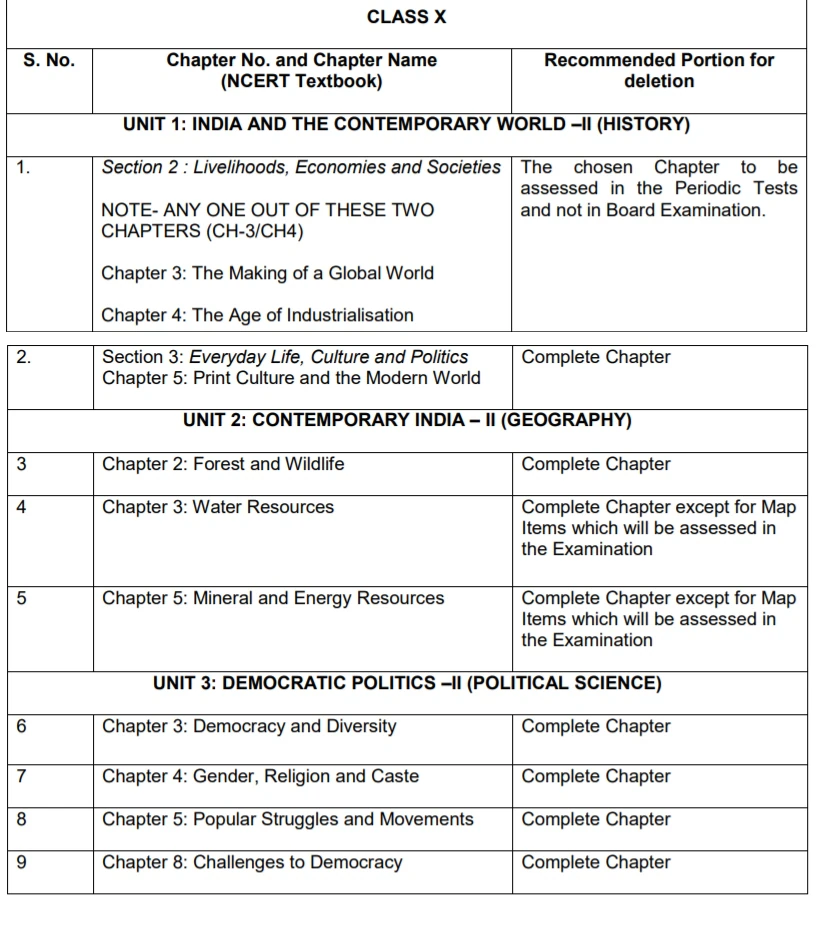
HRD Minister Ramesh Nishank announced a major CBSE syllabus reduction for the new academic year 2020-21 on July 7 which was soon followed by an official notification by CBSE on the same.
Considering the loss of classroom teaching time due to the Covid-19 pandemic and lockdown, CBSE reduced the syllabus of classes 9 to 12 with the help of suggestions from NCERT.
The CBSE syllabus has been rationalized keeping intact the learning outcomes so that the core concepts of students can be retained.
CBSE stated in its notification that the deleted portions of the CBSE syllabus should not be considered for internal assessments or for the year-end board exams.
Deleted syllabus of CBSE Class 10 Social Science
Posted by Shaziya Shaikh 5 years, 4 months ago
- 1 answers
Yogita Ingle 5 years, 4 months ago
location of sugar mills close to the fields:
- The raw material used, (i.e.,) sugarcane is bulky and perishable.
- It cannot be transported to long distances because its sucrose content dries up fast, so it should be processed within 24 hours of its harvest.

myCBSEguide
Trusted by 1 Crore+ Students

Test Generator
Create papers online. It's FREE.

CUET Mock Tests
75,000+ questions to practice only on myCBSEguide app

Gaurav Seth 5 years, 4 months ago
A n s w e r ;
The different types of objects used as money before the introduction of coins are as follows:
1. Grains
2. Cattle
3. Shoes
4. Utensil
5. Food items
6. Clothes
0Thank You