
Ask questions which are clear, concise and easy to understand.
Ask QuestionPosted by Manan Vijay 5 years, 4 months ago
- 0 answers
Posted by Boybe Cool 5 years, 4 months ago
- 1 answers
Yogita Ingle 5 years, 4 months ago
Ultrafiltration - The process of the filtration of blood in the glomerulus under great pressure during which the liquid part of the blood i.e. plasma along with urea, glucose, amino acids and other substances enter the renal tubule.
Posted by Usha Rani Jena 5 years, 4 months ago
- 1 answers
Yogita Ingle 5 years, 4 months ago
- The name Methane determines that the hydrocarbon is having only one carbon atom in its compound.
- If a hydrocarbon has only one carbon atom it is impossible to form double or triple bonds in that hydrocarbon.
- To form double bondage or triple bondage in the hydrocarbon there must be 2 carbon atoms in that hydrocarbon of least.
- But we can have only one carbon in the hydrocarbons.
- So there will be no Methene or Methyne existing on nature even if we alter or manipulate the compounds.
Posted by Lavanya Selvam 5 years, 4 months ago
- 3 answers
Rudra Singh 5 years, 4 months ago
Simpy Kumari 5 years, 4 months ago
Anirudh Jaat From Haryana 5 years, 4 months ago
Posted by Kamlesh Dhurwey 5 years, 4 months ago
- 1 answers
Ayush Kashyap 5 years, 4 months ago
Posted by Adarsh Vikram 5 years, 4 months ago
- 3 answers
Rachit Kumar 5 years, 4 months ago
Ipsita Seal 5 years, 4 months ago
Posted by Manjot Kaur 5 years, 4 months ago
- 3 answers
Posted by Boybe Cool 5 years, 4 months ago
- 2 answers
Jaat Shab 5 years, 4 months ago
Gaurav Seth 5 years, 4 months ago
The hilum is basically a bundle of ‘tubes’ entering and exiting the kidney. The structures in this bundle include the renal artery that supplies the kidney with blood, the renal vein which drains blood from the kidney back to the inferior vena cava and then the heart, the ureter which conveys urine produced in the kidneys down to the bladder
Posted by Boybe Cool 5 years, 4 months ago
- 2 answers
Gaurav Seth 5 years, 4 months ago
ANSWER
A nephron is the basic filtration unit of the kidney. It is a cluster of thin-walled blood capillaries. There are different parts of the nephron in which the formation of urine take place which is the main function of the kidney.
- Bowman's capsule and the glomerulus are together called as the glomerular apparatus.
- There are afferent and efferent arterioles which bring and carry the blood way.
- The blood is filtered by the glomerulus and enters the Bowman's capsule where the podocytes help in the filtration and the glomerular filtrate is formed.
- When the glomerular filtrate comes to the proximal tubule then the essential nutrients are reabsorbed.
- There are two limbs of the loop of Henle, ascending and descending limb.
- The countercurrent exchange mechanism occurs which help in the regulation of the water and ions in the blood.
- When the glomerular filtrate is in the proximal tubule creatinine, uric acid are secreted in it.
- When the filtrate goes to the distal convoluted tubule urea, potassium ion and some hydrogen ions are secreted in it.
- The urine which is formed is transported by the collecting tubules to the renal pelvis.
- The urine is transported out by the ureters to the urinary bladder to store and excrete the urine from urethra.
Posted by Boybe Cool 5 years, 4 months ago
- 3 answers
Posted by Boybe Cool 5 years, 4 months ago
- 1 answers
Posted by Boybe Cool 5 years, 4 months ago
- 2 answers
Posted by Boybe Cool 5 years, 4 months ago
- 2 answers
Posted by Solo . 5 years, 4 months ago
- 4 answers
Jaat Shab 5 years, 4 months ago
Mohit Patel 5 years, 4 months ago
Gaurav Seth 5 years, 4 months ago
1 ohm is equal to
<article id="post-1174049">1 Ohm is defined as the resistance of a conductor with a potential difference of 1 volt applied to the ends through which 1-ampere current flows.
Ohms is the SI unit of electrical resistance
</article>Posted by Safa Khan 5 years, 4 months ago
- 2 answers
Posted by Niharika Raj 5 years, 4 months ago
- 1 answers
Posted by Khiubangliu Riamei 5 years, 4 months ago
- 1 answers
Posted by Dikshant Swami 5 years, 4 months ago
- 3 answers
Nila N 5 years, 4 months ago
Tanushree Khatod 5 years, 4 months ago
Shagun Tyagi 5 years, 4 months ago
Posted by Priyanshu Ingle 5 years, 4 months ago
- 3 answers
Tanushree Khatod 5 years, 4 months ago
Gaurav Seth 5 years, 4 months ago
voltage-drop is same across both
In parallel connection, all the elements are connected between same two points hence the voltage drop across any number of resistors or other elements connected in parallel is same.
Posted by Anil Tharkar 5 years, 4 months ago
- 1 answers
Yogita Ingle 5 years, 4 months ago
Vegetative propagation is potentially something very unique to plants. The very same attribute is also used for the commercial value and by ardent gardeners who know their plants well. Seeds are not always essential for plants to grow. Vegetative propagation such as grafting and budding, etc. help in growing new plants from vegetative parts of the older plants. It is an asexual method of reproduction. In vegetative reproduction, morphologically and the genetically identical offspring is produced.
Advantages Of Vegetative Propagation
- Vegetative reproduction has several benefits, primarily because the developed offspring represent copies of their parent plants. If a plant has positive features, the genetic information can be passed on to its offspring.
- Commercial growers may profit by cloning such plants in order to ensure their crops remain compatible financially.
- Vegetational propagation often helps plants in the development of *** organs such as flowers and eventual seeds and fruit to avoid costly and complicated processes. In other terms, as farmers grow the ideal characteristics in apples, they use grafting and birth to ensure that the new variety and its productive production are compatible at the trade level. This does not always occur though, as can be seen in many different plants since many plants are a chimera and the cuttings will represent the characteristics of only one or some of the cellular parent lines. Plants can also skip the intermediate process of seedling and enter the mature stage more rapidly.
- It increases the chances of a plant reaching maturity effectively in nature and saves growers a great deal of time and money on a commercial basis as it permits a quicker overturn.
- Vegetative reproduction offers scientific opportunities in several biological fields and is realistic in the context of afforestation. The most frequent use of forest geneticists and tree breeders in vegetative propagation has been to move genes from selected trees to a convenient location, typically a gene bank, a clone bench, a cloning orchard or seed garden where genes can be recombined with pedigrees.
Posted by Anil Tharkar 5 years, 4 months ago
- 1 answers
Yogita Ingle 5 years, 4 months ago
- Budding is the asexual mode of reproduction. In budding, a genetically identical new organism grows attached to the body of parent <i>Hydra </i>and separates later on.
- In the process of budding, a bud develops as an outgrowth due to repeated cell division at one specific site. This bud grows randomly and there is no specific order or direction they follow.

Posted by Anil Tharkar 5 years, 4 months ago
- 1 answers
Maitra Tiwari 5 years, 4 months ago
Posted by Anil Tharkar 5 years, 4 months ago
- 2 answers
Yogita Ingle 5 years, 4 months ago
The heart receives deoxygenated blood from different parts of the body, and it pumps this blood to the lungs. The oxygenated blood from the lungs returns to the heart, which is pumped again into different parts of the body by the heart. Thus, the blood passes twice through the heart making one complete round through the body. This is called double circulation.
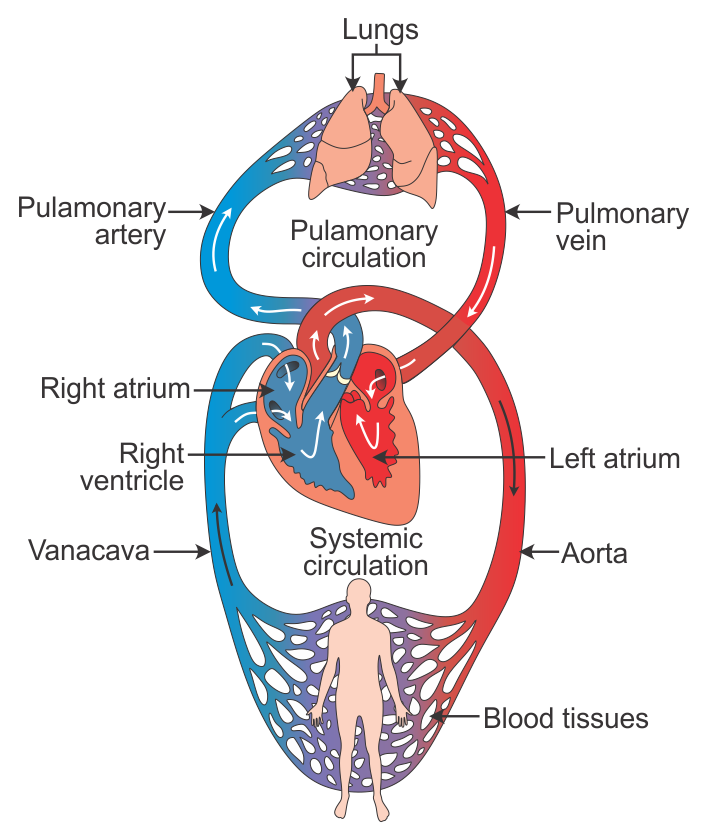
Pulmonary and systemic circulation
The pulmonary circulation pertains to lungs. The blood flows from the right ventricle to the lungs. Pulmonary veins collect oxygenated blood from the lungs and carry it back to the heart (left auricle).
The systemic circulation pertains to the major circulation of the body. The aorta receives the blood from the left ventricle and sends it to the various parts of the body. Veins collect the deoxygenated blood from the body parts and pour it back into the right auricle.
Akshita ???? 5 years, 4 months ago
Posted by Ankita Pal 5 years, 4 months ago
- 1 answers
Yogita Ingle 5 years, 4 months ago
Structure of forelimb in a frog, lizard, bird and horse is similar with similar bones which are modified to suit the function they perform. From this it can be safely assumed that they may have evolved from a common ancestor.
Posted by Barsha Mondal 5 years, 4 months ago
- 1 answers
Yogita Ingle 5 years, 4 months ago
The placenta is an organ that links the budding fetus to the uterine wall to facilitate the uptake of nutrients, gas exchange and waste elimination, with the help of the mother's blood supply. The umbilical cord connects the fetus to the placenta.
The placenta is a spongy mass of flesh that absorbs oxygen and nutrients from the blood stream of the mother, which are then transferred to the baby via the umbilical cord. The umbilical cord is responsible for carrying the oxygen and nutrients to the fetus.
The placenta is discarded after the baby's delivery, while a portion of the umbilical stump still remains on the baby, but soon withers away as well.
Posted by Disha Agarwal 5 years, 4 months ago
- 5 answers
Manyatha R 5 years, 4 months ago
Posted by Kunal Yadav 5 years, 4 months ago
- 4 answers
Tanushree Khatod 5 years, 4 months ago
Sabari Krishna 5 years, 4 months ago
Yogita Ingle 5 years, 4 months ago
The magnitude of electric current is measured in coulombs per second. The SI unit of electric current is Ampere and is denoted by the letter A. Ampere is defined as one coulomb of charge moving past a point in one second. If there are 6.241 x 10¹⁸ electrons flowing through our frame in one second then the electrical current flowing through it is ‘One Ampere.’
The unit Ampere is widely used within electrical and electronic technology along with the multipliers like milliamp (0.001A), microamp (0.000001A), and so forth.
Posted by Sneha Thakur 5 years, 4 months ago
- 1 answers
Gaurav Seth 5 years, 4 months ago
i. Take small quantity of quick lime (CaO) in a beaker.
ii. Slowly add water to thequick lime (CaO) taken in the beaker.
iii. Touch the beaker with fingers and make a note of the change in temperature.
Observations:
i. Quick lime reacts vigorously with water producing hissing sound.
ii. Beaker becomes hot.
Inferences:
Quick lime (calcium oxide) reacts with water vigorously to form calcium hydroxide and releases large amount of heat.
It is an example of a combination reaction as well as an exothermic reaction.
Posted by Dikshant Mashane 5 years, 4 months ago
- 2 answers
Gaurav Seth 5 years, 4 months ago
HRD Minister Ramesh Nishank announced a major CBSE syllabus reduction for the new academic year 2020-21 on July 7 which was soon followed by an official notification by CBSE on the same.
Considering the loss of classroom teaching time due to the Covid-19 pandemic and lockdown, CBSE reduced the syllabus of classes 9 to 12 with the help of suggestions from NCERT.
Deleted syllabus of CBSE Class 10 Science

Posted by Vaishnavi Katyal 5 years, 4 months ago
- 1 answers
Yogita Ingle 5 years, 4 months ago
Any visible movement such as walking, breathing, or growing is generally used to decide whether something is alive or not. However, a living organism can also have movements, which are not visible to the naked eye. Therefore, the presence of life processes is a fundamental criterion that can be used to decide whether something is alive or not.
Evidence which can ensure something is alive or not
- Shape and Dimension
- Reproduction
- Growth
- Cellular structure
- Metabolism
- Movements
- Self-regulations
- Variation
- Co- ordination
- Definite life cycle
- Death
Example – Movements are fast in most animals but motions in plants are generally slow.

myCBSEguide
Trusted by 1 Crore+ Students

Test Generator
Create papers online. It's FREE.

CUET Mock Tests
75,000+ questions to practice only on myCBSEguide app
