
Ask questions which are clear, concise and easy to understand.
Ask QuestionPosted by Lovely Kumari 5 years, 2 months ago
- 1 answers
Posted by Lovely Kumari 5 years, 2 months ago
- 1 answers
Gaurav Seth 5 years, 2 months ago
Flow of energy in an ecosystem is as follows.
- The green plants in a terrestrial ecosystem capture about 1% of the energy of sunlight that falls on their leaves and convert it into food energy.
- When green plants are eaten by primary consumers, a great deal of energy is lost as heat to the environment, some amount goes into digestion and in doing work and the rest goes towards growth and reproduction.
- An average of 10% of the food eaten is turned into its own body and made available for the next level of consumers.
- Therefore, 10% can be taken as the average value for the amount of organic matter that is present at each step and reaches the next level of consumers.
- Since so little energy is available for the next level of consumers, food chains generally consist of only three or four steps.
- The loss of energy at each step is so great that very little usable energy remains after four trophic levels.
- There are generally a greater number of individuals at the lower trophic levels of an ecosystem, the greatest number is of the producers.
- The length and complexity of food chains vary greatly.
- Each organism is generally eaten by two or more other kinds of organisms which in turn are eaten by several other organisms.
- So instead of a straight line food chain, the relationship can be shown as a series of branching lines called a food web.
Flow of energy is unidirectional because the energy that is captured by the autotrophs does not revert back to the solar input and the energy which passes to the herbivores does not come back to autotrophs.
As it moves progressively through the various trophic levels it is no longer available to the previous level.
Secondly, the energy available at each trophic level gets diminished progressively due to loss of energy at each level.
Posted by Lovely Kumari 5 years, 2 months ago
- 1 answers
Gaurav Seth 5 years, 2 months ago
a ns w e r
In human beings, male produce two types of sperm cells, one is having X- chromosome, while other type is having a Y -chromosome. Females produce ova, all of them having X chromosome.
Posted by Lovely Kumari 5 years, 2 months ago
- 2 answers
Gaurav Seth 5 years, 2 months ago
The process of breakdown of glucose in a cell are as follows:
The first step in the breakdown of glucose both in presence of O2 and in absence of O2 is same. In this step, glucose is broken down into pyruvate. Second step which involves further breakdown of private into simple compounds can take place in two different ways:
(a) In presence of O2: In the presence of O2, private is converted into CO2 and water. Energy released during aerobic respiration is much greater than that released during an anaerobic respiration.
(b)In absence of O2: In the absence of O2 in yeast, pyruvate is converted into ethanol and CO2 and the process is called fermentation. In absence of O2, in our muscle cells, pyruvate is converted into lactic acid. The build up of lactic acid in muscle cells causes cramps.
Yogita Ingle 5 years, 2 months ago
(i) In the presence of oxygen- When breakdown of glucose is carried out in the presence of oxygen in a cell, it is called as aerobic respiration. Glucose is converted into a 3 carbon molecule called pyruvate which further breaks down in the presence of oxygen to form carbon dioxide and water. Energy is released in this process.
(ii)In the presence of oxygen- When breakdown of glucose is carried out in the Absence of oxygen in a cell, it is called as anaerobic respiration.Glucose is converted into a 3 carbon molecule called pyruvate which further breaks down in the absence of oxygen to give lactic acid and ethyl alcohol. This process is called fermentation.
Posted by Ayisha ★ 5 years, 2 months ago
- 1 answers
Gaurav Seth 5 years, 2 months ago
Sieve tubes are elements of phloem. They are slender, tube-like structures composed of elongated thin-walled cells, placed end to end. The main function of sieve tubes is to transport sugars and nutrients up and down the plant
Posted by Sonukishore Kamat 5 years, 2 months ago
- 1 answers
Gaurav Seth 5 years, 2 months ago
Refractive index
Speed of light in vacuum= 3.00×10⁸ m/s.
The amount of change in speed of light in a medium depend upon the property of medium(refractive index)
Refractive index is a measure of how much speed of light changes when it enter the medium from air.
Absolute refractive index is the ratio of speed of light in vacuum or air to speed of light in the medium.
c
n=——
ν
Relative refractive index
Speed of light in medium 1
n21 = ————————————–
Speed of light in medium 2
Refractive index of medium 2 wrt medium 1 is known as refractive index of medium 2.
Speed of light in medium 2
n12= ————————————–
Speed of light in medium 1
Refractive index of medium 1 wrt medium 2 is known as refractive index of medium 1.
1)When light goes from rarer medium to denser medium.
Sin i n1
——- = —— >1
Sin r n2
Sin i >Sin r
∠i=∠r
Reflected ray bend toward normal.
2)When light goes from denser medium to rarer medium.
Sin i n2
——- = ——- <1
sin r n1
Sin i < Sin r
∠i < ∠r
Reflected ray bend away from the normal.
Refractive index depend on nature of material of medium,density of medium,colour or wavelength of light.
Posted by Anugrah Joseph 5 years, 2 months ago
- 2 answers
Yogita Ingle 5 years, 2 months ago
Pure acids in the liquid state are exceedingly poor conductors of electricity. The fact that aqueous solutions of acids conduct electricity is definite evidence of the existence of ions in these solutions. Acids undergo dissociation in aqueous solution to form H+ ions.
When electricity is passed through an aqueous solution of an acid, the H+ ions reach the cathode and each H+ ion picks up one electron from the cathode to form H2 gas. Because of this reaction, an aqueous solution of acid conducts electricity.
HCl(aq) → H+(aq) + Cl–(aq)
Raj Yadav 5 years, 2 months ago
Posted by Navya Joshi 5 years, 2 months ago
- 0 answers
Posted by Kanhaiya Singh Rajput 5 years, 2 months ago
- 3 answers
Disha Bansal 5 years, 2 months ago
Kunal Thakur 5 years, 2 months ago
Om Chauhan 5 years, 2 months ago
Posted by Sonukishore Kamat 5 years, 2 months ago
- 0 answers
Posted by Shivansh Shukla 5 years, 2 months ago
- 1 answers
Posted by Shyam Chaudhaey 5 years, 2 months ago
- 1 answers
Gaurav Seth 5 years, 2 months ago
The nervous system or the neural system is a complex network of neurons specialized to carry messages. The complexity of the nervous system increases as we move towards higher animals.
For instance, cnidarians such as jellyfish have relatively simple nerve nets spread throughout their body. Crabs have a more complicated nervous system in the form of 2 nerve centers called dorsal ganglion and ventral ganglion.
Posted by Aashish Jii. 5 years, 2 months ago
- 2 answers
Yogita Ingle 5 years, 2 months ago
The sunlight that reaches the earth’s atmosphere is scattered in all directions by the gases and dust particles present in the atmosphere.
The blue colour is scattered more and hence the sky appears blue. The reason for more scattering of blue colour is that the wavelength of the blue light is shorter than the other light. So blue light is scattered in all directions by the tiny molecules of air in Earth’s atmosphere. This the reason for the blue appearance of the sky.
Posted by Vinay Gupta 5 years, 2 months ago
- 2 answers
Yogita Ingle 5 years, 2 months ago
| Real Image | Virtual Image |
| Real images are inverted | Virtual images are erect |
| Convex lenses form a real image | Concave lenses form a virtual image |
| Real images are formed on the screen | Virtual images appear to be on the lens or the mirror itself |
| Real images are formed by a concave mirror | Plane, convex mirror and concave lens form a virtual image |
| Real images are formed due to the actual intersection of light rays | Virtual images are formed due to the imaginary intersection of light rays |
Vinay Gupta 5 years, 2 months ago
Posted by Vinay Gupta 5 years, 2 months ago
- 2 answers
Gaurav Seth 5 years, 2 months ago
Who coined the term genetics?
Answer:
The genetic term was coined in 1905 by the English biologist William Bateson. He also described the study of heredity.
Posted by Vinay Gupta 5 years, 2 months ago
- 4 answers
Gaurav Seth 5 years, 2 months ago
More energy is produced in aerobic respiration
The oxidative breakdown of respiratory substrates with the help of atmospheric oxygen is known as aerobic respiration. It involves the complete breakdown of substrates into carbon dioxide and water releasing energy. The energy released per mole of glucose is 686 Kcal or 2870 kJ. Oxidation of respiratory substrates in the absence of atmospheric oxygen is termed as anaerobic respiration. It involves an incomplete breakdown of respiratory substrates in which the end products such as ethanol or lactic acid are produced and carbon dioxide is released. The amount of energy released in this case is 247 kJ.
Posted by Vinay Gupta 5 years, 2 months ago
- 1 answers
Gaurav Seth 5 years, 2 months ago
A plane mirror is a mirror with a flat (planar) reflective surface. For light rays striking a plane mirror, the angle of reflection equals the angle of incidence. ... Plane mirrors are the only type of mirror for which a real object always produces an image that is virtual, erect and of the same size as the object.
Posted by Shruti Malik 5 years, 2 months ago
- 1 answers
Yogita Ingle 5 years, 2 months ago
A real image is formed when light rays actually meet or intersect at a point after reflection or refraction.
Posted by Mannu Kumar 5 years, 2 months ago
- 1 answers
Yogita Ingle 5 years, 2 months ago
Geotropism: The movement of plant parts in response to gravity is known as geotropism. The stimulus is gravity.
Posted by Mannu Kumar 5 years, 2 months ago
- 1 answers
Yogita Ingle 5 years, 2 months ago
The shape of guard cells changes due to amount of water in them. The guard cell swell when water flows into them, causing the stomatal pore to open. Similarly, the pore closes if the guard cells shrink, due to the loss of water in then.
Posted by Mehak Garg 5 years, 2 months ago
- 3 answers
Mehak Garg 5 years, 2 months ago
Taher Chakkiwala 5 years, 2 months ago
Yogita Ingle 5 years, 2 months ago
A person's lungs are not the same size. The right lung is a little wider than the left lung, but it is also shorter. According to York University, the right lung is shorter because it has to make room for the liver, which is right beneath it. The left lung is narrower because it must make room for the heart.
Posted by Nikita Saraswat 5 years, 2 months ago
- 3 answers
Taher Chakkiwala 5 years, 2 months ago
ಹರ್ಷನಂದ ಹರ್ಷನಂದ 5 years, 2 months ago
Gaurav Seth 5 years, 2 months ago
BSE Class 10 Science (086) - Deleted portion (Theory):
|
Unit I: Chemical Substances - Nature and Behaviour |
|
|
Chapter |
Topics |
|
Metals and Non-metals |
Basic metallurgical processes; Corrosion and its prevention. |
|
Carbon Compounds |
Nomenclature of carbon compounds containing functional groups (halogens, alcohol, ketones, aldehydes, alkanes and alkynes), difference between saturated hydro carbons and unsaturated hydrocarbons. Chemical properties of carbon compounds (combustion, oxidation, addition and substitution reaction). Ethanol and Ethanoic acid (only properties and uses), soaps and detergents. |
|
Unit II: World of Living |
|
|
Chapter |
Topics |
|
Control and co-ordination in animals and plants (Whole Chapter Removed) |
Tropic movements in plants; Introduction of plant hormones; Control and co-ordination in animals: Nervous system; Voluntary, involuntary and reflex action; Chemical co-ordination: animal hormones |
|
Heredity and Evolution |
Basic concepts of evolution |
|
Unit III: Natural Phenomena |
|
|
Chapter |
Topics |
|
The Human Eye and the Colourful World |
Functioning of a lens in human eye, defects of vision and their corrections, applications of spherical mirrors and lenses |
|
Unit IV: Effects of Current |
|
|
Chapter |
Topics |
|
Magnetic Effects of Current : |
Electric Generator, Direct current. Alternating current: frequency of AC, Advantage of AC over DC. Domestic electric circuits |
|
Unit V: Natural Resources |
|
|
Chapter |
Topics |
|
Sources of Energy (Whole Chapter Deleted) |
Different forms of energy, conventional and non-conventional sources of energy: Fossil fuels, solar energy; biogas; wind, water and tidal energy; Nuclear energy. Renewable versus non-renewable sources of Energy. |
|
Management of Natural Resources (This chapter is to be prepared only for Internal Assessment. It will not be assessed in the Annual Board Examination) |
Conservation and judicious use of natural resources. Forest and wild life; Coal and Petroleum conservation. Examples of people’s participation for conservation of natural resources. Big dams: advantages and limitations; alternatives, if any. Water harvesting. Sustainability of natural resources. |
Posted by Guddy Yadav 5 years, 2 months ago
- 1 answers
Gaurav Seth 5 years, 2 months ago
Answer:
Frequent pregnancies by women are avoided due to the following reasons:
- It has adverse effect on the health of women.
- It increases the rate of the population of our country.
Major contraceptive methods are categorized as barrier methods, surgical and chemical methods.
Barrier methods are the physical devices that prevent contraception by inhibiting the entry of sperms in the female genital tract. Example: condoms, diaphragms, cervical caps, etc.
Surgical methods include vasectomy (blocks vas deferens to prevent sperms from coming out) and tubectomy (blocks fallopian tubes to prevent the entry of eggs in it) in males and females respectively.
Chemical methods of contraception include any hormonal preparation that serves to alter the hormonal balance of the body to prevent egg maturation or fertilization. For example, oral and vaginal pills.
Other methods include intrauterine devices (inserted by a physician into the uterus to prevent implantation), medical termination of pregnancy, coitus interruptus, etc.
Posted by P. Jaswanth 5 years, 2 months ago
- 4 answers
Yogita Ingle 5 years, 2 months ago
The electrical resistance of insulators is .1m * a) high (b) low (c) zero (d) infinitely high
Ans Infinitely high
Posted by Saba Yasmeen Kamdod 5 years, 2 months ago
- 2 answers
Tarang Chaudhary 5 years, 2 months ago
Yogita Ingle 5 years, 2 months ago
Convex mirror as it provides a virtual, erect and DIMINISHED image . So because of the WIDE view it is used as rear view mirror in vehicles.
Posted by Sonukishore Kamat 5 years, 2 months ago
- 2 answers
Yogita Ingle 5 years, 2 months ago
Strength of magnetic field is directly proportional to current. Strength of magnetic field is inversely proportional to radius of circular wire.
Kunal Thakur 5 years, 2 months ago
Posted by Sonukishore Kamat 5 years, 2 months ago
- 3 answers
Saba Yasmeen Kamdod 5 years, 2 months ago
Uzma Choudhary 5 years, 2 months ago
Gaurav Seth 5 years, 2 months ago
The ratio between the speed of light in medium to speed in a vacuum is the refractive index. When light travels in medium other than the vacuum, the atoms of that medium continually absorb and re-emit the particles of light, slowing down the speed light.
The formula of the refractive index is as follows:
n=c / v
Where,
n is the refractive index
c is the velocity of light in a vacuum ( 3 × 10⁸ m/s)
v is the velocity of light in a substance
Posted by Sonukishore Kamat 5 years, 2 months ago
- 1 answers
Gaurav Seth 5 years, 2 months ago
Electric motor: A motor is a device which converts electrical energy into mechanical energy.
Principle of motor : A motor works on the principle that when a rectangular coil is placed in a magnetic field and current is passed through it. A force acts on the coil which rotates it continuously.
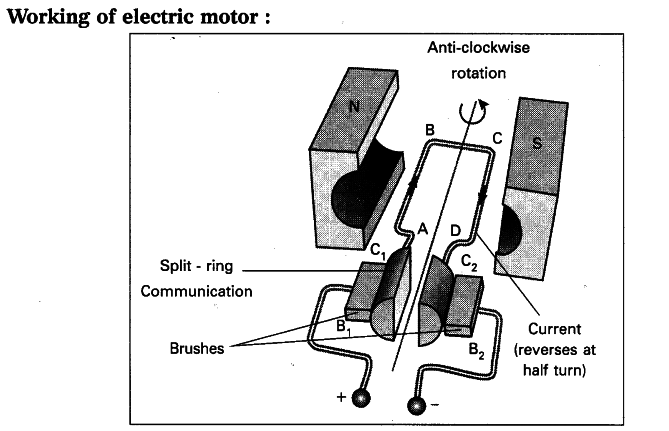
- When electric current is passed into the rectangular coil, this current produces a magnetic field around the coil.
- The magnetic field of horse shoe-type magnet then interacts with the magnetic field of the coil and causes the coil to rotate continuously.
- If ABCD is in horizontal position current from battery enters the coil through brush B _{ 1 }, and commutator half ring C:. The current flows in the direction ABCD
and leaves via ring and brush B _{ 2 } - The direction of current is from A to B, the direction of current is from C to D. The force on side AB of the coil is in the downward direction. Whereas the force on the side CD of the coil is in the upward direction. ABCD rotate in anti-clockwise direction.
- While rotating when the coil reaches vertical position then the brushes B _{ 1 } and B _{ 2 } will touch the gap between the commutator rings and current to the coil is cut off. But the coil does not stop rotating because it has already gained momentum.
- The coil CD comes on the left side and AB comes to the right side. Again they come in contact with brush B _{ 1 } Current direction is reversed.
- The reversing of current in the coil is repeated after every half rotation due to which the coil continue to rotate as long as current from the batter is passed through it. The rotating shaft of electric motor can drive a large number of machines which are connected to it.

myCBSEguide
Trusted by 1 Crore+ Students

Test Generator
Create papers online. It's FREE.

CUET Mock Tests
75,000+ questions to practice only on myCBSEguide app

Gaurav Seth 5 years, 2 months ago
Accessory reproductive organs are those structures which help in the transfer and meeting of the two kinds of *** cells.
Accessory glands in male reproductive system are:
1. Seminal vesicles
2. Prostate gland
3. Cowper's gland
Seminal vesicles secrete an alkaline medium for the transportation of sperms. The mixture of the fluid and sperms is known as semen. Prostate glands pour its alkaline secretion into the semen to neutralize acid in female ******. Secretion of Cowper’s gland acts as a lubricant.
1Thank You