
Ask questions which are clear, concise and easy to understand.
Ask QuestionPosted by Sonukishore Kamat 5 years, 2 months ago
- 0 answers
Posted by Mankrishan Chadda ?? 5 years, 2 months ago
- 5 answers
Yogita Ingle 5 years, 2 months ago
The carbon dioxide gas enters the leaves of the plants through the stomata present on their surface.
Posted by Sujata Sahani 5 years, 2 months ago
- 1 answers
Posted by Ayush Randhawa 5 years, 2 months ago
- 5 answers
Rishu Raj 5 years, 2 months ago
Gaurav Seth 5 years, 2 months ago
Cellulose
The digestive system of Humans has many enzymes, and acids to break down and digest all kinds of different foods (carbohydrates. proteins and fats), but do not have the enzymes needed to break down cellulose. Cows, Goats, Sheep and other animals that graze on many organic foods(For example, grass) do have the enzymes needed to break down cellulose. Hence The part of food that is not digested in the body is Cellulose because the cellulose-digesting enzyme is absent.
Posted by Drashti Ambiya 5 years, 2 months ago
- 1 answers
Yogita Ingle 5 years, 2 months ago
Kreb's cycle is an important step in aerobic respiration which takes place in mitochondria in presence of molecular oxygen. Here pyruvic acid is further degraded into CO2 and H2O, releasing energy. The organic acids formed in this cycle have 3 carboxylic groups, hence this cycle is also called tricarboxylic acid cycle.
Posted by Shruti Malik 5 years, 2 months ago
- 3 answers
Maniya Jain 5 years, 2 months ago
Drashti Ambiya 5 years, 2 months ago
Yogita Ingle 5 years, 2 months ago
- The space or region around a magnet within which its influence can be felt by another magnet is called magnetic field.
- Magnetic field lines are imaginary lines around the magnet. The magnitude of a field is indicated by its line's density. Near to South and North Pole of a magnet, the magnetic field is stronger and will get weaker when it moves away from the poles.
Posted by Priya Dg 5 years, 2 months ago
- 1 answers
Gaurav Seth 5 years, 2 months ago
An acid is any hydrogen-containing substance that is capable of donating a proton (hydrogen ion) to another substance. A base is a molecule or ion able to accept a hydrogen ion from an acid.
Acidic substances are usually identified by their sour taste. An acid is basically a molecule which can donate an H+ ion and can remain energetically favourable after a loss of H+. Acids are known to turn blue litmus red.
Properties of Acids
- Acids are corrosive in nature.
- They are good conductors of electricity.
- Their pH values are always less than 7.
- When reacted with metals, these substances produce hydrogen gas.
- Acids are sour-tasting substances.
- Examples: Sulfuric acid [H2SO4], Hydrochloric acid [HCl], Acetic acid [CH3COOH].
Posted by Rajnish Mehta 5 years, 2 months ago
- 1 answers
Gaurav Seth 5 years, 2 months ago
the process is galvanisation where iron is protected from getting rust
here A peice of iron is coated with liquid zinc
to get prevention from rusting
here X is liquid zinc and process is known as Galvanisation
Posted by Abhinav Pandey 5 years, 2 months ago
- 1 answers
Gaurav Seth 5 years, 2 months ago
An electromagnet is a type of magnet in which the magnetic field is produced by an electric current. Electromagnets usually consist of wire wound into a coil. A current through the wire creates a magnetic field which is concentrated in the hole, denoting the centre of the coil.
Posted by Azeem Shahid 5 years, 2 months ago
- 0 answers
Posted by Jaiveer Singh Chouhan 5 years, 2 months ago
- 1 answers
Yogita Ingle 5 years, 2 months ago
A food chain refers to the order of events in an ecosystem, where one living organism eats another organism, and later that organism is consumed by another larger organism. The flow of nutrients and energy from one organism to another at different trophic levels forms a food chain.
The food chain also explains the feeding pattern or relationship between living organisms. Trophic level refers to the sequential stages in a food chain, starting with producers at the bottom, followed by primary, secondary and tertiary consumers. Every level in a food chain is known as a trophic level.
Posted by Saurabh Pandey 5 years, 2 months ago
- 1 answers
Gaurav Seth 5 years, 2 months ago
After fertilisation has taken place in flower, a zygote is formed which divides several times to form an embryo within the ovule. The ovule develops a tough protective coat around itself and is gradually converted into a seed. The ovary grows rapidly and ripens to form a fruit. Meanwhile, the petals, sepals, stamens, style and stigma gets shriveled and fall off.
Posted by Kamlesh Kumar 5 years, 2 months ago
- 1 answers
Posted by Kamlesh Kumar 5 years, 2 months ago
- 3 answers
Posted by Dreamgirl357 Aisha 5 years, 2 months ago
- 1 answers
Gaurav Seth 5 years, 2 months ago
Biotic (or biological) environment: It includes :
- Plants.
- Animals (including human beings).
- Decomposers (bacteria and.fungi).
Other important constituents of the biotic environment includes Kites and vultures as they feed on dead organisms and act as scavengers (cleansing agents) of the environment.
Posted by Arjav Jain 5 years, 2 months ago
- 3 answers
Uzma Choudhary 5 years, 2 months ago
Yogita Ingle 5 years, 2 months ago
The process by which the harmful and toxic substances enter the food chain and get concentrated in the body of living organisms at each successive level in food chain is called biological magnification.
Gaurav Seth 5 years, 2 months ago
Biomagnification refers to the accumulation of toxic substances in the food chain. The toxic chemicals that are released into the environment are absorbed by the lower organisms such as plants, earthworms, etc. These chemicals are then transferred to different trophic levels when lower organisms are eaten by other organisms.
Posted by Shresth Gupta 5 years, 2 months ago
- 1 answers
Yogita Ingle 5 years, 2 months ago
| Mirror | Lens |
| This works on the principle of reflection | This works on the principle of refraction |
| These are manufactured using materials other than glass or clear plastic | These are manufactured using materials made up of glass or clear plastic |
| An ideal mirror reflects 100% of light | An ideal lens refracts 100% of light |
| The uses of mirror can be seen in houses, automobiles, solar appliances, etc | The uses of lenses can be seen in astronomy and scientific industries, medical and research purposes, etc. |
| There are two types: concave and convex | There are of six types of lenses |
| Plane mirrors do not have a focal point | It has two focal points for each kind of lens |
Posted by Shresth Gupta 5 years, 2 months ago
- 1 answers
Yogita Ingle 5 years, 2 months ago
| Real Image | Virtual Image |
| Real images are inverted | Virtual images are erect |
| Convex lenses form a real image | Concave lenses form a virtual image |
| Real images are formed on the screen | Virtual images appear to be on the lens or the mirror itself |
| Real images are formed by a concave mirror | Plane, convex mirror and concave lens form a virtual image |
| Real images are formed due to the actual intersection of light rays | Virtual images are formed due to the imaginary intersection of light rays |
Posted by Shresth Gupta 5 years, 2 months ago
- 2 answers
Virender Kumar 5 years, 2 months ago
Yogita Ingle 5 years, 2 months ago
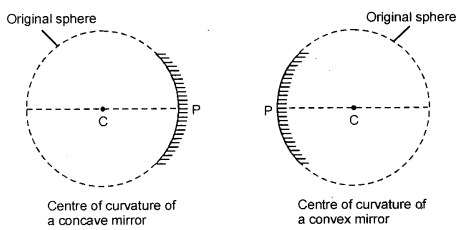
- Radius of curvature: Radius of curvature of a spherical mirror is the radius of the hollow sphere of glass of which the mirror is a part.
- Pole: The middle point of the reflecting surface of a spherical mirror is called pole.
The letter P represents pole, MP = M’P. - Principal focus: The mid-point of CP is called focus (F). It is the point on the principal axis of a spherical mirror where all incident rays parallel to the principal axis meet or appear to diverge after reflection.
Posted by Sonukishore Kamat 5 years, 2 months ago
- 1 answers
Yogita Ingle 5 years, 2 months ago
Emergent ray is the light ray that comes out after being reflected by a mirror or after being refracted through a lens.
Posted by Shreyansh Gupta 5 years, 2 months ago
- 0 answers
Posted by Lipi Nag 5 years, 2 months ago
- 2 answers
Yogita Ingle 5 years, 2 months ago
A thermal decomposition reaction can be defined as a decomposition reaction which is activated by thermal energy. In other words, a thermal decomposition reaction requires energy to be supplied to the reactants in the form of heat. Such reactions are generally endothermic since energy is required to break the chemical bonds and separate the constituent elements. A common example of a thermal decomposition reaction is provided below.
CaCO3 → CaO + CO2
When heated, calcium carbonate decomposes into calcium oxide and carbon dioxide. This process is employed in the manufacturing of quick lime, which is an important substance in many industries.
Soumya Senthilkumar 5 years, 2 months ago
Posted by Arpit Bhatti 5 years, 2 months ago
- 2 answers
Gaurav Seth 5 years, 2 months ago
Washing soda can be obtained by heating baking soda. On heating, baking soda gives carbonate, carbon dioxide and water. Consequently, the recrystallisation of sodium carbonate gives washing soda. The chemical equations involved in the process are:
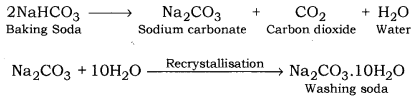
Washing soda is used in glass, soap and paper industries.
Posted by Mohit Mohit 5 years, 2 months ago
- 0 answers
Posted by Aakriti Rustagi 5 years, 2 months ago
- 1 answers
Unknown User 5 years, 2 months ago
Posted by Shephali Shephali 5 years, 2 months ago
- 1 answers
Gaurav Seth 5 years, 2 months ago
A n s w e r :
The equation for Potassium bromide+Barium iodide = Potassium iodide+Barium bromide is given below:
2KBr (aq) + BaI2 (aq) → 2KI (aq) + BaBr2 (s): Double displacement reaction
Posted by Moh Faizan 5 years, 2 months ago
- 1 answers
Gaurav Seth 5 years, 2 months ago
Globalisation is a process in which people of the world are linked together to each other through internet and other advanced means of communication. It means the integration of the economy of the country with the world economy. It aims to encourage foreign trade, private and institutional foreign investment. It creates various policies that try to turn the world in to one.
Posted by Ishika Kumari 5 years, 2 months ago
- 5 answers
Ritish Routa 5 years, 2 months ago
Yogita Ingle 5 years, 2 months ago
he products formed are ferric oxide, sulphur dioxide and sulphur trioxide. During this change, decomposition reaction occurs.
Satyam Kr 5 years, 2 months ago
Posted by Krishna Nidhi 5 years, 2 months ago
- 4 answers
Virender Kumar 5 years, 2 months ago
Tanisha Bharti 5 years, 2 months ago
Shivi Dubey 5 years, 2 months ago
Yogita Ingle 5 years, 2 months ago
Oxides of metals which have both acidic as well as basic behaviour are known as amphoteric oxides. Such metallic oxides react with acids as well as base to produce salt and water. Examples of Amphoteric oxides are aluminium oxide and zinc oxide.

myCBSEguide
Trusted by 1 Crore+ Students

Test Generator
Create papers online. It's FREE.

CUET Mock Tests
75,000+ questions to practice only on myCBSEguide app
