
Ask questions which are clear, concise and easy to understand.
Ask QuestionPosted by Akash Joshi 7 years, 3 months ago
- 1 answers
Posted by Sumit Kumar 7 years, 3 months ago
- 3 answers
Diwakar Kumar 7 years, 3 months ago
Swati Bhattacharya 7 years, 3 months ago
Posted by Shivanand Mantanavar 7 years, 3 months ago
- 1 answers
Rajveer Rathod 7 years, 3 months ago
Posted by K B 7 years, 3 months ago
- 1 answers
Posted by Apeksha Majhotra 7 years, 3 months ago
- 2 answers
Posted by Zahira Malik 7 years, 3 months ago
- 2 answers
Devanshi Grover 7 years, 3 months ago
Posted by Yogesh Kuntal 7 years, 3 months ago
- 0 answers
Posted by Shivam Prakash 7 years, 3 months ago
- 1 answers
Happy Singh 7 years, 3 months ago
Posted by Himanshu Pal Pal 7 years, 3 months ago
- 0 answers
Posted by Manoj Kumar 6 years, 4 months ago
- 1 answers
Sia ? 6 years, 4 months ago
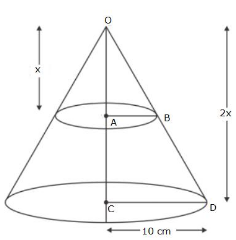
Let height of cone = 2x cm
Radius of cone = 10 cm
In {tex}\triangle{/tex}OAB and {tex}\triangle{/tex}OCD
{tex}\angle{/tex}AOB = {tex}\angle{/tex}COD [ common ]
{tex}\angle{/tex}OAB = {tex}\angle{/tex}OCD [ each 90o ]
Then, {tex}\triangle{/tex}OAB {tex}\sim{/tex} {tex}\triangle{/tex}OCD [ by AA simiarity ]
{tex}\therefore{/tex} {tex}\frac { O A } { O C } = \frac { A B } { C D }{/tex} [ corresponding sides of similar triangle are proportional]
{tex}\Rightarrow \quad \frac { X } { 2 X } = \frac { r } { 10 }{/tex}
{tex}\Rightarrow{/tex} r = 5 cm
{tex}\therefore{/tex} {tex}\frac { \text { Volume of small cone } } { \text { Volume of frustum } } = \frac { \frac { 1 } { 3 } \pi ( 5 ) ^ { 2 } \times x } { \frac { 1 } { 3 } \pi ( x ) \left[ 10 ^ { 2 } + 10 \times 5 + 5 ^ { 2 } \right] }{/tex}
{tex}= \frac { 25 x } { x \times 175 }{/tex}
={tex}\frac{1}{7}{/tex}
Posted by Ashwin Hammar 5 years, 8 months ago
- 1 answers
Posted by Tisha Bordia 7 years, 3 months ago
- 1 answers
Posted by Ritik Rathod 7 years, 3 months ago
- 2 answers
Siri.M.V Siri 7 years, 3 months ago
Posted by Sakshi Mohan 7 years, 3 months ago
- 6 answers
Disha Rathore 7 years, 3 months ago
Harsh Tripathi 7 years, 3 months ago
Posted by Anshika Agrawal 6 years, 4 months ago
- 1 answers
Sia ? 6 years, 4 months ago
Let us suppose that 'a' be the first term and 'd' be the common difference of the A.P.
Now according to question it is given that
S9 = 162.
Using formula for sum to n terms of A.P, we have
{tex}\Rightarrow \frac{9}{2}\left[ {2a + (9 - 1)d} \right] = 162{/tex}
{tex} \Rightarrow \frac{9}{2}\left[ {2a + 8d} \right] = 162{/tex}
{tex}\Rightarrow{/tex} 9a + 36d = 162 ........................(i)
Let a6 and a13 be the 6th and 13th term of the A.P. respectively.
Therefore, using general form of nth term, we have,a6 = a + 5d and a13 = a + 12d
Since, {tex}\frac{{{a_6}}}{{{a_{13}}}} = \frac{1}{2}{/tex}
{tex} \Rightarrow \frac{{a + 5d}}{{a + 12d}} = \frac{1}{2}{/tex}
{tex}\Rightarrow{/tex} 2a + 10d = a + 12d
{tex}\Rightarrow{/tex} a = 2d
Now,substituting the value of a = 2d in equation (i), we get,
9(2d) + 36d = 162
{tex}\Rightarrow{/tex} 18d + 36d = 162
{tex}\Rightarrow{/tex} 54d = 162
{tex}\Rightarrow{/tex} d = 3
{tex}\Rightarrow{/tex} a = 2d = 2 {tex}\times{/tex} 3 = 6 = First term
Therefore, 15th term=a+14d=6+14(3)=48
Posted by Khushi Gupta 7 years, 3 months ago
- 7 answers
Posted by Shruti Hatte 7 years, 3 months ago
- 1 answers
Mayank Chhabra 7 years, 3 months ago
Posted by Abhishek Kumar 7 years, 3 months ago
- 1 answers
Posted by Manav Arora 7 years, 3 months ago
- 0 answers
Posted by Knv . 7 years, 3 months ago
- 1 answers
Posted by Anshi Sharma 6 years, 4 months ago
- 1 answers
Sia ? 6 years, 4 months ago
Let {tex} \alpha{/tex} and {tex} \frac { 1 } { \alpha }{/tex} be the zeros of (a2 + 9)x2 + 13x + 6a.
Then, we have
{tex} \alpha \times \frac { 1 } { \alpha } = \frac { 6 a } { a ^ { 2 } + 9 }{/tex}
⇒ 1 = {tex} \frac { 6 a } { a ^ { 2 } + 9 }{/tex}
⇒ a2 + 9 = 6a
⇒ a2 - 6a + 9 = 0
⇒ a2 - 3a - 3a + 9 = 0
⇒ a(a - 3) - 3(a - 3) = 0
⇒ (a - 3) (a - 3) = 0
⇒ (a - 3)2 = 0
⇒ a - 3 = 0
⇒ a = 3
So, the value of a in given polynomial is 3.
Posted by Harshal Mirge 7 years, 3 months ago
- 1 answers
Satish Kumar 7 years, 3 months ago
Posted by Jatin Singh 7 years, 3 months ago
- 1 answers
Soham Deshpande 7 years, 3 months ago
Posted by Monika Mishra 7 years, 3 months ago
- 2 answers
Posted by Mandvi Chaturvedi 7 years, 3 months ago
- 0 answers

myCBSEguide
Trusted by 1 Crore+ Students

Test Generator
Create papers online. It's FREE.

CUET Mock Tests
75,000+ questions to practice only on myCBSEguide app

Akshat Makhaik 7 years, 3 months ago
1Thank You