
Ask questions which are clear, concise and easy to understand.
Ask QuestionPosted by Piyush Gwala 7 years, 3 months ago
- 0 answers
Posted by स यादव 7 years, 3 months ago
- 0 answers
Posted by Mohit Sehwag 7 years, 3 months ago
- 0 answers
Posted by Kirankumar Jambenal 7 years, 3 months ago
- 1 answers
Posted by Poorvi Gupta 6 years, 6 months ago
- 1 answers
Sia ? 6 years, 6 months ago
We have, ax2 + 7x + b = 0
Since x = {tex}{2 \over 3}{/tex}, -3 are the solutions of the given equation
Substitute x = {tex}{2 \over 3}{/tex} in the given equation, we get
{tex}a({2 \over 3})^2 + 7({2 \over 3})+b =0{/tex}
{tex}\implies {4a \over 9} + {14 \over 3} + b =0{/tex}
Multiplying the equation by 9, we get
4a + 9b + 42 = 0 ......(i)
Now, substitute x = - 3 in the given equation, we get
a(-3)2 + 7 (-3) + b = 0
9a +b - 21 = 0 ........(ii)
Multiplying the equation by 9, we get
81a +9b - 189 = 0 ........(ii)
subtracting(ii) from (i), we get
-77a = -231 or a = 3
Substitue a =3 in (i), we get
4(3) + 9b +42 = 0
{tex}\implies{/tex}9b + 54 = 0 or b = -6
So, a = 3 and b = -6
Posted by Vinay Yadav 7 years, 3 months ago
- 1 answers
Posted by Harshi ?? 6 years, 6 months ago
- 1 answers
Sia ? 6 years, 6 months ago
given , observations x, x + 2, x + 4, x + 6 and x + 8.
given , mean = 11.
Mean of given observations = {tex}\frac{\text{Sum of given observations}}{\text{Total number of observations}}{/tex}
{tex}\therefore 11 = \frac { x + ( x + 2 ) + ( x + 4 ) + ( x + 6 ) + ( x + 8 ) } { 5 }{/tex}
{tex}\Rightarrow 55 = 5x + 20{/tex}
{tex}\Rightarrow 5x = 55 - 20{/tex}
{tex}\Rightarrow 5x = 35{/tex}
{tex}\Rightarrow x = 7{/tex}
Posted by Saniha Thomas 7 years, 3 months ago
- 0 answers
Posted by Kelin Gogoi 7 years, 3 months ago
- 0 answers
Posted by Shalet Menezes 7 years, 3 months ago
- 1 answers
Sia ? 6 years, 6 months ago
L.H.S={tex}\frac { \tan \theta + \sec \theta - 1 } { \tan \theta - \sec \theta + 1 }{/tex}
{tex}= \frac { ( \tan \theta + \sec \theta ) - \left( \sec ^ { 2 } \theta - \tan ^ { 2 } \theta \right) } { \tan \theta - \sec \theta + 1 }{/tex} {tex}[\because sec^2\theta-tan^2\theta=1]{/tex}
{tex}= \frac { ( \tan \theta + \sec \theta ) - ( \sec \theta - \tan \theta ) ( \sec \theta + \tan \theta ) } { \tan \theta - \sec \theta + 1 }{/tex}
{tex}= \frac { ( \tan \theta + \sec \theta ) [ 1 - \sec \theta + \tan \theta ] } { \tan \theta - \sec \theta + 1 }{/tex}
= {tex}tan\theta+sec\theta{/tex}
= R.H.S.
Hence Proved.
Posted by Nisha Yadav 6 years, 6 months ago
- 1 answers
Sia ? 6 years, 6 months ago
The largest positive integer that will divide 398, 436 and 542 leaving reminders 7, 11 and 15 respectively is the HCF of the numbers (398 – 7), (436 – 11) and (542 – 15) i.e. 391, 425 and 527.
HCF of 391,425 and 527:
HCF of 425 and 391:
425 = 391 × 1 + 34
391 = 34 × 11 + 17
34 = 17 ×2 + 0
HCF of 425 and 391 = 17
527 = 17 × 31
Similarly, HCF of 17 and 527 = 17
So, HCF of (391,425 ,527) = 17
∴ Required number is 17.
Posted by B K Samanvitha 7 years, 3 months ago
- 1 answers
Satish Kumar 7 years, 3 months ago
Posted by Narayana Nani 7 years, 3 months ago
- 1 answers
Nandini Sain 7 years, 3 months ago
Posted by Yukta Mandavi 7 years, 3 months ago
- 2 answers
Chandru R 7 years, 3 months ago
Posted by Prashant Pandey 6 years, 6 months ago
- 1 answers
Sia ? 6 years, 6 months ago
Given, cos{tex}\theta{/tex} = 0.6 {tex}= \frac { 6 } { 10 } = \frac { 3 } { 5 }{/tex}
Let us draw a triangle ABC in which {tex}\angle{/tex}B = 90°.
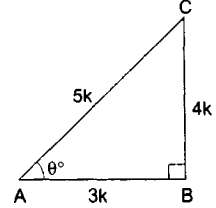
Let {tex}\angle{/tex}A = {tex}\theta{/tex}°.
Then, {tex}\cos \theta = \frac { A B } { A C } = \frac { 3 } { 5 }{/tex}
Let AB = 3k and AC = 5k, where k is positive.
By Pythagoras' theorem, we have
AC2 = AB2 + BC2
{tex}\Rightarrow{/tex}BC2 = AC2 - AB2
= (5k)2 - (3k)2 = 25k2 - 9k2 = 16k2
{tex}\Rightarrow \quad B C = \sqrt { 16 k ^ { 2 } } = 4 k{/tex}
{tex}\sin \theta = \frac { A B } { A C } = \frac { 4 k } { 5 k } = \frac { 4 } { 5 }{/tex}
{tex}\cos \theta = \frac { 3 } { 5 }{/tex}
{tex}\tan \theta = \frac { \sin \theta } { \cos \theta } = \left( \frac { 4 } { 5 } \times \frac { 5 } { 3 } \right) = \frac { 4 } { 3 }{/tex}
{tex}\Rightarrow ( 5 \sin \theta - 3 \tan \theta ) = \left( 5 \times \frac { 4 } { 5 } - 3 \times \frac { 4 } { 3 } \right) = 0{/tex}
Hence, (5sin{tex}\theta{/tex} - 3 tan{tex}\theta{/tex}) = 0.
Posted by Atul Kumar 7 years, 3 months ago
- 0 answers
Posted by Mayank Badal 7 years, 3 months ago
- 0 answers
Posted by H H 7 years, 3 months ago
- 1 answers
Sia ? 6 years, 6 months ago
Check NCERT solutions here : <a href="https://mycbseguide.com/ncert-solutions.html">https://mycbseguide.com/ncert-solutions.html</a>
Posted by Srushti Kunkolienkar 7 years, 3 months ago
- 1 answers
Chinmay Deshmukh 7 years, 3 months ago
Posted by Ashish Sharma 7 years, 3 months ago
- 7 answers
Siri.M.V Siri 7 years, 3 months ago
Inchara V Inchara V 7 years, 3 months ago
Zahira Malik 7 years, 3 months ago
Posted by Dipesh Mishra 7 years, 3 months ago
- 3 answers
Posted by Sahil Panchal 6 years, 6 months ago
- 1 answers
Sia ? 6 years, 6 months ago
In equilateral {tex}\triangle{/tex}ABC. 4BD = BC
Construction: Draw AE {tex}\perp{/tex} BC. {tex}\therefore{/tex} BE = {tex}\frac{1}{2}{/tex}BC.
In right {tex}\triangle{/tex}AED, AD2 = DE2 + AE2 {tex}\Rightarrow{/tex} AE2 = AD2 - DE2 ..(i)
In right {tex}\triangle{/tex}AEB, AB2 = AE2 + BE2 {tex}\Rightarrow{/tex} AB2 = AD2 - DE2 + BE2 [using (i)]

{tex}\Rightarrow{/tex} AB2 + DE2 - BE2 = AD2
{tex}\Rightarrow{/tex} AB2 + (BE - BD)2 - BE2 = AD2
{tex}\Rightarrow{/tex} AB2 + BE2 + BD2 - 2BE.BD - BE2 = AD2
{tex}\Rightarrow{/tex} AB2 + ({tex}\frac{1}{2}{/tex}BC)2 - {tex}2 \times \frac{1}{2}{/tex}BC{tex}\times \frac{1}{4}{/tex}BC = AD2
{tex}\Rightarrow{/tex} AB2 + {tex}\frac{1}{16}{/tex}BC2 - {tex}\frac{1}{4}{/tex}BC2 = AD2
{tex}\Rightarrow{/tex} BC2 - {tex}\frac{3}{16}{/tex}BC2 = AD2 [{tex}\because{/tex} AB = BC]
{tex}\Rightarrow{/tex} {tex}\frac { 13 \mathrm { BC } ^ { 2 } } { 16 }{/tex} = AD2
{tex}\Rightarrow{/tex} 13BC2 = 16AD2
Posted by Saurabh Bisht 6 years, 6 months ago
- 1 answers
Sia ? 6 years, 6 months ago
In {tex}\triangle{/tex}ABM
AB + BM > AM....[Sum of the lengths of any two sides of a triangle is greater than the length of the third side].....(1)
In {tex}\triangle{/tex}ACM
CA + CM > AM....[Sum of the lenghts of any two sides of a triangle is greater than the length of the third side].....(2)
Sum (1) and (2)
(AB + BM) + (CA + CM) > AM + AM
{tex}\therefore{/tex} AB + (BM + CM) + CA > 2AM
{tex}\therefore{/tex} AB + BC + CA > 2AM
Posted by Yash Pal Singh 6 years, 6 months ago
- 1 answers
Sia ? 6 years, 6 months ago
Given, tan A + cot A = 2
We need to square both sides,
(tan A + cot A)2 = (2)2
{tex}\Rightarrow{/tex}tan2A + cot2A + 2 tan A. cotA = 4 {tex}[(a+b)^2=a^2+b^2+2ab]{/tex}
{tex}\Rightarrow{/tex}tan2A + cot2A + 2 tan A{tex}\times \frac { 1 } { \tan A }{/tex}= 4
{tex}\Rightarrow{/tex}tan2A + cot2A + 2 = 4
{tex}\Rightarrow{/tex}tan2A + cot2A = 4 - 2 = 2
Therefore the value of tan2 A + cot2 A = 2
Posted by Chetan Kaushik 7 years, 3 months ago
- 3 answers

myCBSEguide
Trusted by 1 Crore+ Students

Test Generator
Create papers online. It's FREE.

CUET Mock Tests
75,000+ questions to practice only on myCBSEguide app
