
Ask questions which are clear, concise and easy to understand.
Ask QuestionPosted by Anjali Singh 7 years, 3 months ago
- 4 answers
Shravani Burhade 7 years, 3 months ago
Posted by Raghav Garg 7 years, 3 months ago
- 2 answers
Posted by Karan Raj 6 years, 4 months ago
- 1 answers
Sia ? 6 years, 4 months ago
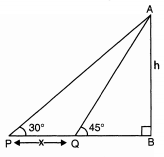
Let AB be the tower of height h
{tex}\angle A Q B = 45 ^ { \circ }{/tex}
Now, in {tex}\triangle {/tex}ABQ,
{tex}\tan 45 ^ { \circ } = \frac { A B } { B Q }{/tex}
{tex}\Rightarrow \quad 1 = \frac { h } { B Q }{/tex}
{tex}\Rightarrow {/tex} BQ = h
In {tex}\triangle A P B{/tex}
{tex}\tan 30 ^ { \circ } = \frac { A B } { P B }{/tex}
{tex}\Rightarrow \quad \frac { 1 } { \sqrt { 3 } } = \frac { h } { x + h }{/tex}
{tex}\Rightarrow \quad x + b = h \sqrt { 3 }{/tex}
i.e.,{tex} \quad x = h ( \sqrt { 3 } - 1 ){/tex}
So speed of car
{tex}V=\frac{distance}{time}=\frac{x}{12}=\frac{h(√3-1)}{12}{/tex}
Hence time taken by car to reach upto the tower
{tex}t=\frac{BQ}{V}=\frac{h}{\frac{h}{12}(√3-1)}{/tex}
{tex}=\frac{12}{√3-1}=\frac{12(√3+1)}{(√3+1)(√3-1)}{/tex}
= 6(√3 + 1) = 6 {tex}\times{/tex} (1.73 + 1)
= 6 {tex}\times{/tex} 2.73 = 16.38 minutes
{tex}{/tex}
Posted by Abhilasha Chotia 6 years, 4 months ago
- 1 answers
Sia ? 6 years, 4 months ago
We have L.H.S=. {tex}\cos \left( {\frac{\pi }{4} - x} \right)\cos \left( {\frac{\pi }{4} - y} \right)\sin \left( {\frac{\pi }{4} - x} \right){/tex}{tex}\sin \left( {\frac{x}{4} - y} \right){/tex}
{tex} = \cos \left[ {\frac{\pi }{4} - x + \frac{\pi }{4} - y} \right]{/tex}[ {tex}\because {/tex}cos (A+ B) = cos A cos B - sin A sin B]
{tex} = \cos \left[ {\frac{\pi }{2} - (x + y)} \right]{/tex}= sin (x + y) = R.H.S
Posted by B. Manish 6 years, 4 months ago
- 1 answers
Sia ? 6 years, 4 months ago
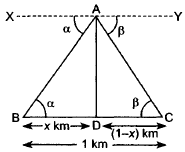
Let us suppose that aeroplane is at A
Suppose B and C are two consecutive kilometre stones such that
{tex}\angle \mathbf { X } \mathbf { A } \mathbf { B } = \alpha{/tex} and {tex}\angle \mathrm { YAC } = \beta{/tex}
{tex}\therefore \angle A B D = \alpha{/tex} and {tex}\angle A C D = \beta{/tex}
Let us suppose that BD = x km.
AD is height of aeroplane.
In {tex}\triangle{/tex}ADB, {tex}\frac { A D } { B D } = \tan \alpha{/tex}
{tex}\Rightarrow \quad \frac { \mathrm { AD } } { x } = \tan \alpha {/tex}
{tex}\Rightarrow x = \frac { \mathrm { AD } } { \tan \alpha }{/tex}
In {tex}\triangle{/tex}ADC, {tex}\frac { \mathrm { AD } } { \mathrm { DC } } = \tan \beta{/tex}
{tex}\Rightarrow \quad \frac { \mathrm { AD } } { 1 - x } = \tan \beta{/tex}
{tex}\Rightarrow \frac { \mathrm { AD } } { 1 - \frac { \mathrm { AD } } { \tan \alpha } } = \tan \beta{/tex}
{tex}\Rightarrow \frac { \operatorname { AD } \tan \alpha } { \tan \alpha - \mathrm { AD } } = \tan \beta{/tex}
{tex}\Rightarrow A D \tan \alpha = \tan \alpha . \tan \beta - A D \tan \beta{/tex}
{tex}\Rightarrow A D \tan \alpha + A D \tan \beta = \tan \alpha . \tan \beta{/tex}
{tex}\Rightarrow \mathbf { A D } = \frac { \tan \alpha \cdot \tan \beta } { \tan \alpha + \tan \beta }{/tex}
Hence proved.
Posted by Diwakar Kumar 7 years, 3 months ago
- 1 answers
Posted by Harsh Kumar 7 years, 3 months ago
- 0 answers
Posted by Shivam Singh 7 years, 3 months ago
- 1 answers
Posted by Shrey Ghelani 7 years, 3 months ago
- 0 answers
Posted by Sanjana Saini 7 years, 3 months ago
- 3 answers
Posted by Jeet Saini 7 years, 3 months ago
- 3 answers
Vidhi Bisen 7 years, 3 months ago
Posted by Dharahini Ramesh 6 years, 4 months ago
- 1 answers
Sia ? 6 years, 4 months ago
Let n = 4q + 1 (an odd integer)
{tex}\therefore \quad n ^ { 2 } - 1 = ( 4 q + 1 ) ^ { 2 } - 1{/tex}
{tex}= 16 q ^ { 2 } + 1 + 8 q - 1 \quad \text { Using Identity } ( a + b ) ^ { 2 } = a ^ { 2 } + 2 a b + b ^ { 2 }{/tex}
{tex}= 16{q^2} + 8q{/tex}
{tex}= 8 \left( 2 q ^ { 2 } + q \right){/tex}
= 8m, which is divisible by 8.
Posted by Hari Mukesh 6 years, 4 months ago
- 1 answers
Sia ? 6 years, 4 months ago
The consecutive numbers on the houses of a row are 1, 2, 3, ..., 49
Clearly this list of number forming an AP.
Here, a = 1
d = 2 - 1 = 1
Sx-1 = S49 - Sx
{tex} \Rightarrow \frac{{x - 1}}{2}[2a + (x - 1 - 1)d] - \frac{x}{2}[2a + (x - 1)d]{/tex}
{tex}\because {S_n} = \frac{n}{2}[2a + (n - 1)d]{/tex}
{tex} \Rightarrow \frac{{x - 1}}{2}[2(1) + (x - 2)(1)]{/tex} {tex} = \frac{{49}}{2}[2(1) + (48)(1)] - \frac{x}{2}[2(1) + (x - 1)(1)]{/tex}
{tex} \Rightarrow \frac{{x - 1}}{2}[x] = 1225 - \frac{{x(x + 1)}}{2}{/tex}
{tex} \Rightarrow \frac{{(x - 1)(x)}}{2} + \frac{{x(x + 1)}}{2} = 1225{/tex}
{tex} \Rightarrow \frac{x}{2}(x - 1 + x + 1) = 1225{/tex}
{tex} \Rightarrow {x^2} = 1225{/tex}
{tex} \Rightarrow x = \sqrt {1225} {/tex}
{tex} \Rightarrow x = 35{/tex}
Hence, the required value of x is 35.
Posted by Sneha Sharma 7 years, 3 months ago
- 2 answers
Posted by Sanjana P Jain 7 years, 3 months ago
- 2 answers
Kajal Kumari 7 years, 3 months ago
let the terms of a.p.= a-d, a,a+d,
now, according to question
a-d+a+a+d=24
3a =24
a=24/3= 8
again according to question
(a-d)(a)(a+d)= 240
(a2 - d2)(a)= 240
now putting the value of a
(8^2 -d^2)×8 =240
64-d^2=240/8= 30
64-30 = d^2
d = root34
so the terms = 8-root34, 8, 8+ root34
Posted by Sameer Gautam 7 years, 3 months ago
- 0 answers
Posted by Priyanshu Panda 6 years, 4 months ago
- 1 answers
Sia ? 6 years, 4 months ago
Suppose that {tex} \sqrt { p } + \sqrt { q }{/tex} is a rational number equal to {tex} \frac { a } { b }{/tex}, where a and b are integers having no common factor.
Now, {tex} \sqrt { p } + \sqrt { q } = \frac { a } { b }{/tex}
{tex} \Rightarrow \sqrt { p } = \frac { a } { b } - \sqrt { q }{/tex} (squaring both side)
{tex} \Rightarrow \quad ( \sqrt { p } ) ^ { 2 } = \left( \frac { a } { b } - \sqrt { q } \right) ^ { 2 }{/tex}
{tex} \Rightarrow \quad p = \frac { a ^ { 2 } } { b ^ { 2 } } - 2 \left( \frac { a } { b } \right) \sqrt { q } + q{/tex}
{tex} \Rightarrow \quad 2 \left( \frac { a } { b } \right) \sqrt { q } = \frac { a ^ { 2 } } { b ^ { 2 } } + q - p{/tex}
{tex} \Rightarrow \quad 2 \frac { a } { b } \sqrt { q } = \frac { a ^ { 2 } + b ^ { 2 } ( q - p ) } { b ^ { 2 } }{/tex}
{tex} \Rightarrow \quad \sqrt { q } = \frac { a ^ { 2 } + b ^ { 2 } ( q - p ) } { 2 a b }{/tex}
{tex} \Rightarrow \sqrt { q }{/tex} is a rational number. (because sum of two rational numbers is always rational)
This is a contradiction as {tex} \sqrt { q }{/tex} is an irrational number.
Hence, {tex} \sqrt { p } + \sqrt { q }{/tex} is an irrational number.
Posted by Urvashi Khanna 7 years, 3 months ago
- 1 answers
Posted by Supriya Tiwari 7 years, 3 months ago
- 3 answers
Mayank Chhabra 7 years, 3 months ago
Posted by Anuj Kumar 7 years, 3 months ago
- 1 answers
Posted by Devanshu Kalma 7 years, 3 months ago
- 1 answers
Prayas Nashier 7 years, 3 months ago
Posted by Zoya Nafees 7 years, 3 months ago
- 1 answers
Posted by Harsh Pawar 5 years, 8 months ago
- 1 answers
Posted by Umang Shriwastav 7 years, 3 months ago
- 0 answers
Posted by Anureet Kaur Saroaye 6 years, 4 months ago
- 1 answers
Sia ? 6 years, 4 months ago
Given that, -4 is a zero of the polynomial f(x) = x2 - x - (2k + 2), so, we have
f(-4) = 0
{tex}\Rightarrow{/tex} (-4)2 - (-4) - 2k - 2 = 0
{tex}\Rightarrow{/tex} 16 + 4 - 2k - 2 = 0
{tex}\Rightarrow{/tex} 18 - 2k = 0
{tex}\Rightarrow{/tex} 2k = 18
{tex}\Rightarrow{/tex} k = 9.
Posted by Jay Sharma 7 years, 3 months ago
- 0 answers
Posted by Deepak Kadian 7 years, 3 months ago
- 1 answers
Rishi Raj 7 years, 3 months ago
Posted by Piyush Gwala 7 years, 3 months ago
- 1 answers
Rishi Raj 7 years, 3 months ago

myCBSEguide
Trusted by 1 Crore+ Students

Test Generator
Create papers online. It's FREE.

CUET Mock Tests
75,000+ questions to practice only on myCBSEguide app

Sarthak Gupta 7 years, 3 months ago
0Thank You