
Ask questions which are clear, concise and easy to understand.
Ask QuestionPosted by Sagar Singh 7 years, 3 months ago
- 2 answers
Posted by Thanvika Yadav Thotla 7 years, 3 months ago
- 0 answers
Posted by Jay Jd 7 years, 3 months ago
- 1 answers
Posted by Agam Jain 6 years, 4 months ago
- 1 answers
Sia ? 6 years, 4 months ago
Let time taken by tap of smaller diameter to fill the tank = x hours
Let time taken by tap of larger diameter to fill the tank = (x - 10) hours
It means that tap of smaller diameter fills {tex}{\frac{1}{x}^{th}}{/tex}part of tank in 1 hour. ................ (1)
And, tap of larger diameter fills{tex}{\frac{1}{{x - 10}}^{th}}{/tex}part of tank in 1 hour. ................ (2)
When two taps are used together, they fill tank in 75/8 hours.
In 1 hour, they fill {tex}{\frac{8}{{75}}^{th}}{/tex} part of tank {tex}\left( \frac { 1 } { \frac { 75 } { 8 } } = \frac { 8 } { 75 } \right){/tex}.................. (3)
From (1), (2) and (3),
{tex}\frac{1}{x} + \frac{1}{{x - 10}} = {\frac{8}{{75}}_ \Rightarrow }\;\frac{{x - 10 + x}}{{x(x - 10)}} = \frac{8}{{75}}{/tex}
⇒ 75(2x−10)=8(x2−10x)
⇒ 150x - 750=8x 2−80x
⇒ 8x 2−80x−150x +750=0
⇒ 4x 2−115x +375=0 (Dividing whole equation by 2)
Comparing equation 4x 2−115x +375=0 with general equation ax 2 +bx +c =0,
We get a =4, b =−115 and c =375
Applying quadratic formula {tex}x = \frac { - b \pm \sqrt { b ^ { 2 } - 4 ac } } { 2 a }{/tex}
{tex}x = {\frac{{115 \pm \sqrt {{{( - 115)}^2} - 4(4)(375)} }}{{2 \times 4}}_ \Rightarrow }\quad x = \frac{{115 \pm \sqrt {13225 - 6000} }}{8}{/tex}
⇒ {tex}x = \frac { 15 \pm \sqrt { 725 } } { 8 }{/tex}
⇒ {tex}x = \frac { 115 \pm 85 } { 8 }{/tex}
⇒{tex}x = \frac { 115 + 85 } { 8 } , \frac { 115 - 85 } { 8 }{/tex}
⇒ x =25, 3.75
Time taken by larger tap = x - 10=3.75 - 10=− 6.25hours
Time cannot be in negative. Therefore, we ignore this value.
Time taken by larger tap = x - 10=25 - 10=15 hours
Therefore, time taken by larger tap is 15 hours and time is taken by smaller tap is 25 hours.
Posted by A A 7 years, 3 months ago
- 1 answers
Posted by Harshul Jain 7 years, 3 months ago
- 0 answers
Posted by Aniket Star 7 years, 3 months ago
- 0 answers
Posted by Deepak Sethy 7 years, 3 months ago
- 1 answers
Mehak . 7 years, 3 months ago
Posted by Suraj Sahu 7 years, 3 months ago
- 0 answers
Posted by Vinay Patidar 7 years, 3 months ago
- 0 answers
Posted by Avinash Kumar Avinash Kumar 6 years, 4 months ago
- 1 answers
Sia ? 6 years, 4 months ago
Check syllabus here : https://mycbseguide.com/cbse-syllabus.html
Posted by Mridul Dwivedi 7 years, 3 months ago
- 0 answers
Posted by Shruti Agrawal 7 years, 3 months ago
- 1 answers
Posted by Ravi Raushan Singh Rajput 5 years, 8 months ago
- 0 answers
Posted by Eric Toppo 7 years, 3 months ago
- 1 answers
Posted by Mohd Shoheb 7 years, 3 months ago
- 0 answers
Posted by Gaurav Yadav 7 years, 3 months ago
- 0 answers
Posted by Prajjawal Verma 7 years, 3 months ago
- 1 answers
Posted by Abhishek Kumar 7 years, 3 months ago
- 1 answers
Posted by Yuvaraj U 6 years, 4 months ago
- 1 answers
Sia ? 6 years, 4 months ago
Since, sum of the angles between radii and between intersection point of tangent is 180°. Angle at the point of intersection of tangents
{tex}= 180 ^ { \circ } - 130 ^ { \circ } = 50 ^ { \circ }{/tex}
Posted by Ch Kavya 7 years, 3 months ago
- 1 answers
Posted by Joban Gill 7 years, 3 months ago
- 3 answers
Posted by Prince Kumar 5 years, 8 months ago
- 1 answers
Sia ? 6 years, 4 months ago
Let the first term be a and the common difference be d.
we know, {tex}a_n= a+(n-1)d{/tex}
{tex}a_p=a+(p-1)d{/tex}
{tex}a_{p+2q}=a+(p+2q-1)d{/tex}
{tex}\therefore a_p+a_{p+2q}=a + (p - 1)d + a + (p + 2 q -1)d{/tex}
{tex}= a + pd - d + a + pd + 2qd - d{/tex}
{tex}= 2a + 2pd + 2qd - 2d{/tex}
{tex}= 2[a + (p + q - 1) d]{/tex} ............(i)
{tex}2a_{p+q}=2[a + (p + q - 1 ) d ]{/tex} ..........(ii)
From (i) and (ii), we get
ap + ap + 2q = 2ap+q
Posted by Varsha Yadav 7 years, 3 months ago
- 0 answers
Posted by Arshdeep Kaur 6 years, 4 months ago
- 1 answers
Sia ? 6 years, 4 months ago
|PQ| = |PR
{tex}\begin{aligned} \sqrt { [ x - ( a + b ) ] ^ { 2 } + [ y - ( b - a ) ] ^ { 2 } } = \sqrt { [ x - ( a - b ) ] ^ { 2 } + [ y - ( b + a ) ] ^ { 2 } } \end{aligned}{/tex}
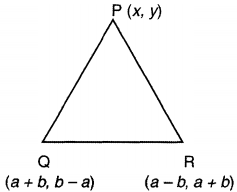
Squaring, we get
[x - (a + b)]2 + [y - (b - a)]2 = [x - (a - b)]2 + [y - (a + b)]2
or, [x - (a + b)]2 - [x - a + b]2 = (y - a - b)2 - (y - b + a)2
or, (x - a - b + x - a + b) ( x - a - b - x + a - b)
= (y - a - b + y - b + a)(y - a - b - y + b - a)
or, (2x - 2a) (- 2b) = (2y - 2b) (- 2a)
or, (x - a)b = (y - b)a
or, bx = ay.
Hence Proved.
Posted by Jaya Vanawat 7 years, 3 months ago
- 1 answers

myCBSEguide
Trusted by 1 Crore+ Students

Test Generator
Create papers online. It's FREE.

CUET Mock Tests
75,000+ questions to practice only on myCBSEguide app

Nisha Sangwan 7 years, 3 months ago
0Thank You