
Ask questions which are clear, concise and easy to understand.
Ask QuestionPosted by Vp Singh Jodha 6 years, 4 months ago
- 1 answers
Posted by Anushka Agrawal 7 years, 3 months ago
- 3 answers
Anushka Agrawal 5 years, 8 months ago
Posted by Ankit Singh 5 years, 8 months ago
- 0 answers
Posted by Nikhil Dixit 7 years, 3 months ago
- 1 answers
Posted by Raja Dubey 7 years, 3 months ago
- 2 answers
Posted by Mohit Joshi 7 years, 3 months ago
- 1 answers
Posted by Shraddha Hiremath 7 years, 3 months ago
- 1 answers
Posted by Ajay Nayal 7 years, 3 months ago
- 0 answers
Posted by Rahul Jaiswal 7 years, 3 months ago
- 2 answers
Posted by Eeya Modi 6 years, 4 months ago
- 1 answers
Sia ? 6 years, 4 months ago
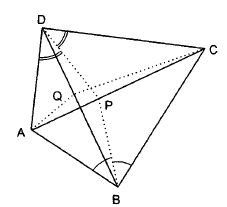
According to question it is given that ABCD is a quadrilateral in which the bisectors of {tex}\angle{/tex}ABC and {tex}\angle{/tex}ADC meet on the diagonal AC at P.
TO PROVE: Bisectors of {tex}\angle{/tex}BAD and {tex}\angle{/tex}BCD meet on the diagonal BD
CONSTRUCTION: Join BP and DP. Let us suppose that the bisector of {tex}\angle{/tex}BAD meet BD at Q. Now, Join AQ and CQ.
PROOF: In order to prove that the bisectors of {tex}\angle{/tex}BAD and {tex}\angle{/tex}BCD meet on the diagonal BD, we have to prove that CQ is a bisector of∠BCD for which we will prove that Q divides BD in the ratio BC: DC.
In {tex}\Delta{/tex}ABC, BP is the bisector of {tex}\angle{/tex}ABC.( According to question)
{tex}\therefore \quad \frac { A B } { B C } = \frac { A P } { P C }{/tex} .......................(i)
In {tex}\Delta{/tex}ACD, DP is the bisector of {tex}\angle{/tex}ADC.(as per fig)
{tex}\therefore \quad \frac { A D } { D C } = \frac { A P } { P C }{/tex} .....................(ii)
Therefore, from (i) and (ii), we get
{tex}\frac { A B } { B C } = \frac { A D } { D C }{/tex}
{tex}\Rightarrow \quad \frac { A B } { A D } = \frac { B C } { D C }{/tex}.................... ...(iii)
Again, In {tex}\Delta{/tex} ABD, AQ is the bisector of {tex}\angle{/tex}BAD. [By construction]
{tex}\therefore \quad \frac { A B } { A D } = \frac { B Q } { D Q }{/tex} .............(iv)
From (iii) and (iv), we get
{tex}\frac { B C } { D C } = \frac { B Q } { D Q }.{/tex}
Hence, in {tex}\Delta{/tex}CBD, Q divides BD in the ratio of CB: CD.
Thus, CQ is the bisector of {tex}\angle{/tex}BCD.
Therefore, the bisectors of {tex}\angle{/tex}BAD and {tex}\angle{/tex}BCD meet on the diagonal BD.( Hence proved)
Posted by Royal Boy Alok 7 years, 3 months ago
- 1 answers
Posted by Abhishek Soni 7 years, 3 months ago
- 2 answers
Posted by Md Ehsan Alam 7 years, 3 months ago
- 1 answers
Harsh Pratap Singh ,V 7 years, 3 months ago
Posted by Anmol Prasad 7 years, 3 months ago
- 0 answers
Posted by Kanika Chauhan 7 years, 3 months ago
- 1 answers
Posted by Ajay Tomar 7 years, 3 months ago
- 0 answers
Posted by Sanjana Mandarapu 6 years, 4 months ago
- 1 answers
Sia ? 6 years, 4 months ago
We have to find the points on X-axis which are at a distance of {tex}2\sqrt5{/tex} from the point(7,-4). Also,we will how many such points are there.
Let, the point on X-axis be (x,0).
Now, by using distance formula,
{tex}\sqrt{(x_{2\;}-\;x_1)^2+\;(y_2-\;y_2)^2} {/tex}
{tex}\sqrt{(x-7)^2+(0+4)^2}= 2\sqrt5{/tex}
Squaring both sides,
{tex}\Rightarrow (x-7)^2+4^2=(2\sqrt5)^2{/tex}
{tex}\Rightarrow x^2 - 14x + 49 + 16 = 20{/tex}
{tex}\Rightarrow x^2-14x+45=0{/tex}
{tex}\Rightarrow {/tex} (x - 9) (x - 5) = 0
{tex}\Rightarrow x=9 \;or\;x=5{/tex}
Hence, two points exists (9,0) and (5,0)
Posted by Kiran Kiru 7 years, 3 months ago
- 1 answers
Posted by Aryan Gupta 6 years, 4 months ago
- 1 answers
Sia ? 6 years, 4 months ago
Let the ten's place digit be y and unit's place be x.
Therefore, number is 10y + x.
According to given condition,
10y + x = 4(x + y) and 10y + x = 2xy
{tex}\Rightarrow{/tex} x = 2y and 10y + x = 2xy
Putting x = 2y in 10y + x = 2xy
10y + 2y = 2.2y.y
12y = 4y2
4y2 - 12y = 0 {tex}\Rightarrow{/tex} 4y(y - 3) = 0
{tex}\Rightarrow{/tex} y - 3 = 0 or y = 3
Hence, the ten's place digit is 3 and units digit is 6 (2y = x)
Hence the required number is 36.
Posted by Salman Noor 5 years, 8 months ago
- 0 answers
Posted by Ramprakash Karishma 6 years, 4 months ago
- 1 answers
Sia ? 6 years, 4 months ago
First find the HCF of 65 and 117 by Using Euclid's division algorithm,
117 = 65{tex}\times{/tex} 1 + 52
65 = 52{tex}\times{/tex} 1 + 13
52 = 13{tex}\times{/tex} 4 + 0
So, HCF of 117 and 65 = 13
HCF = {tex}65m + 117n{/tex}
For, {tex}m= 2{/tex} and {tex}n = -1{/tex},
HCF = 65{tex}\times{/tex} 2 + 117{tex}\times{/tex} (-1)
= 130 - 117
= 13
Hence, the integral values of m and n are 2 and -1 respectively and the HCF of 117 and 65 is 13.
Posted by Jaibir Singh 7 years, 3 months ago
- 1 answers
बेबि बीच 7 years, 3 months ago
Posted by Sankar Naveen 7 years, 3 months ago
- 3 answers
Lakshay Bhargav 7 years, 3 months ago
Ritu Sena 7 years, 3 months ago
Posted by Rajat Bisht 7 years, 3 months ago
- 0 answers
Posted by Sachin Sagar 7 years, 3 months ago
- 1 answers
Taiyab Hussain. 7 years, 3 months ago
Posted by Satish Kumar 7 years, 3 months ago
- 0 answers
Posted by Ruchika Yadav 7 years, 3 months ago
- 0 answers
Posted by Amit Pandey 7 years, 3 months ago
- 0 answers
Posted by Sjae 2115 7 years, 3 months ago
- 1 answers

myCBSEguide
Trusted by 1 Crore+ Students

Test Generator
Create papers online. It's FREE.

CUET Mock Tests
75,000+ questions to practice only on myCBSEguide app

Sia ? 6 years, 4 months ago
Let the speed of boat is x km/h in still water and stream y km/h
According to question,
{tex}\frac{{30}}{{x - y}} + \frac{{44}}{{x + y}} = 10{/tex}
and {tex}\frac{{40}}{{x - y}} + \frac{{55}}{{x + y}} = 13{/tex}
Let {tex}\frac{1}{{x - y}} = u{/tex} and {tex}\frac{1}{{x + y}} = v{/tex}
30u + 44v = 10 ...(i)
40u + 55v = 13 ....(ii)
on solving eq. (i) and (ii) we get,
{tex}u = \frac{1}{5} \Rightarrow x - y = 5{/tex} ....(iii)
{tex}v = \frac{1}{{11}} \Rightarrow x + y = 11{/tex} ....(iv)
On solving eq. (iii) and (iv) we get,
x = 8km/h
y = 3km/h
0Thank You